What Happens to Your Pet’s Brain When You’re Depressed
Science is finding something uncomfortable: your mental health is your animal’s mental health.
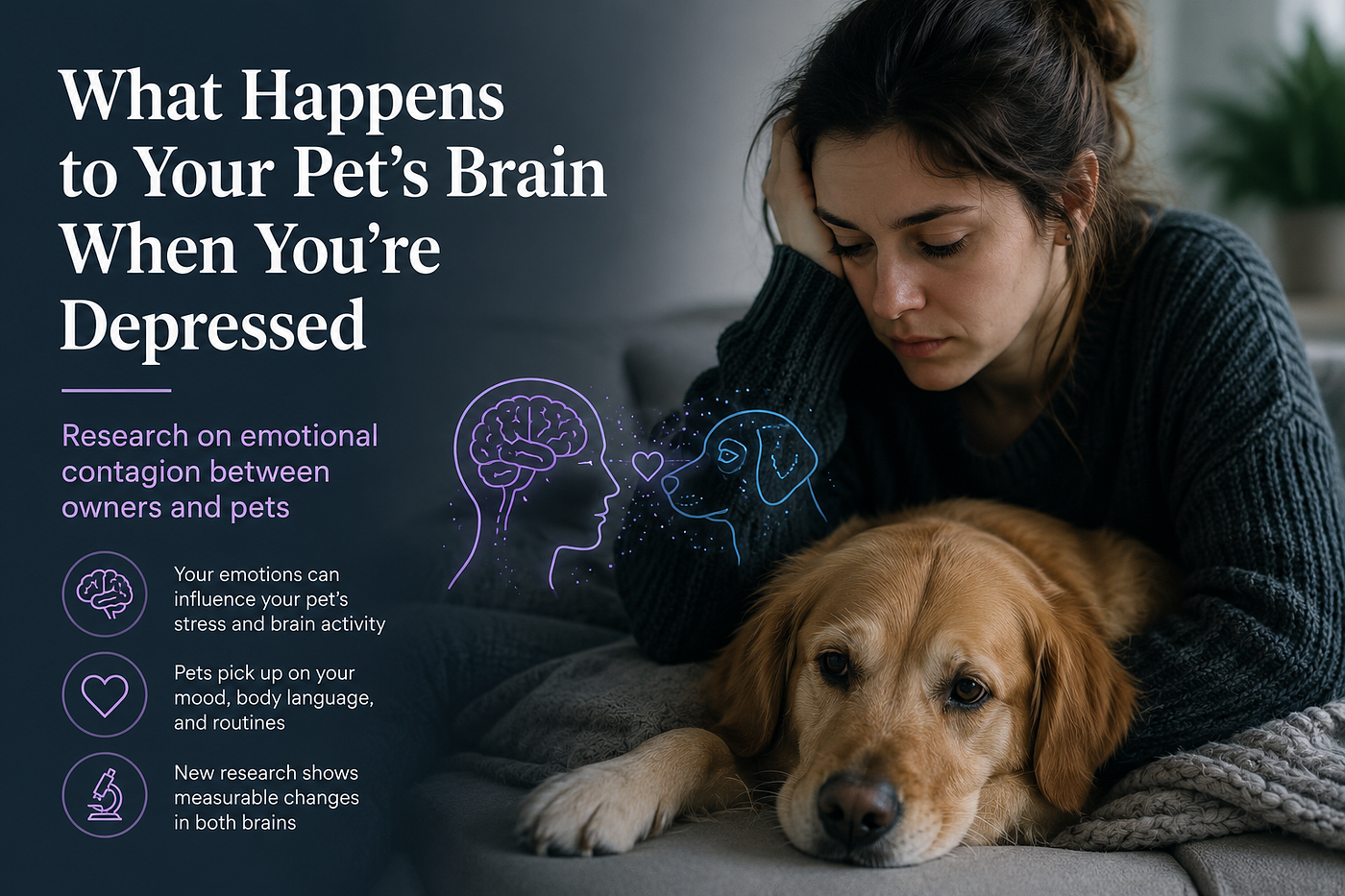
What Happens to Your Pet’s Brain When You’re Depressed
Science is finding something uncomfortable: your mental health is your animal’s mental health.
By Dr. Jivitesh Singh, B.V.Sc & A.H.
There is a dog I think about sometimes.
His name was Bruno. Seven years old, a quiet Labrador with a history of being perfectly healthy — good weight, clean bloodwork, no significant medical findings. His owner brought him in because he had stopped eating properly. He was sleeping more than usual. He had lost interest in his walks, in his toys, in the things that used to make his tail move.
I ran the tests. Everything came back normal.
And then, almost as an afterthought, I asked about the household. How was everything at home?
The owner was quiet for a moment. Then she told me she had been struggling with depression for the past eight months. Barely leaving the house. Not sleeping well. Going through the motions.
Bruno, it turned out, had been doing exactly the same thing.
I did not have a medical explanation to offer her that day. But the science, it turns out, has been quietly building one for years.
The Animal That Reads You
To understand what happens to your pet’s brain when you are depressed, you first need to understand something remarkable about the animals we have chosen to live with.
Dogs, in particular, are extraordinary readers of human emotion. This is not a folk belief or sentimental thinking — it is one of the most replicated findings in comparative psychology. Dogs can distinguish happy faces from angry ones. They respond differently to a human voice expressing fear versus joy. They follow the direction of a human gaze with an accuracy that even our closest primate relatives cannot match.
A 2016 study published in Biology Letters found that dogs could combine visual and auditory emotional cues — matching an image of a happy or angry face to the corresponding tone of voice — in a way that suggests genuine cross-modal emotional recognition. In plain language: your dog is not just reacting to what you do. It is reading who you are in that moment.
Cats, often assumed to be indifferent, are catching up in the research. A 2020 study from the University of Ljubljana found that cats adjust their behaviour based on their owner’s emotional state, showing more affiliative behaviour — rubbing, purring, proximity-seeking — when their owner displayed positive affect, and more stress-related behaviours when the owner was anxious or distressed.
These animals are not passive companions. They are active, continuous readers of your emotional landscape.
Which means that when your emotional landscape goes dark, they notice. Immediately, and in detail.
Emotional Contagion: The Mechanism
The technical term for what happens next is emotional contagion — the phenomenon by which one individual’s emotional state is transferred to and mirrored by another. In humans, we understand this well. We cry at funerals we feel only distantly connected to. We feel inexplicably heavy after spending time with someone who is depressed. Emotions are, in a very literal neurobiological sense, contagious.
The same mechanism operates across species.
Research published in PLOS ONE in 2019 measured cortisol levels — the primary stress hormone — in both dogs and their owners over several months. The findings were striking: the long-term cortisol patterns of dogs and their owners were significantly synchronised. Dogs living with chronically stressed owners had chronically elevated cortisol themselves. The synchronisation was stronger in dogs with a close owner bond, and notably, the direction of influence appeared to run primarily from owner to dog, not the other way around.
Your stress becomes their stress. Not metaphorically. Biochemically.
The proposed mechanism involves several overlapping pathways. The most immediate is sensory: dogs can smell cortisol in human sweat. A 2021 study in PLOS ONE confirmed that dogs could detect, with high accuracy, the breath and sweat samples of humans experiencing acute psychological stress — distinguished from their relaxed baseline. Your nervous system announces itself to your dog before you have said a single word.
Beyond smell, there is body language, vocal tone, movement patterns, and daily routine — all of which shift profoundly when a person is depressed, and all of which a cohabiting animal is exquisitely calibrated to detect.
What It Does to Their Brain
So the animal detects the depression. What actually happens inside their nervous system in response?
The short answer is: a great deal, and none of it good over the long term.
The HPA axis goes into overdrive. The hypothalamic-pituitary-adrenal axis — the body’s central stress response system — operates in dogs and cats in a manner functionally similar to humans. Chronic activation, driven by persistent low-level stress in the environment, leads to sustained elevation of cortisol. Over time, this suppresses immune function, disrupts sleep architecture, impairs memory consolidation, and — in a finding that should give every pet owner pause — appears to accelerate cellular aging.
Neuroplasticity suffers. In both humans and animals, chronic stress reduces the production of brain-derived neurotrophic factor (BDNF) — a protein essentially responsible for growing and maintaining neural connections. Reduced BDNF is one of the most consistent neurobiological findings in clinical depression. It is also what researchers observe in chronically stressed animals. The brain, under sustained emotional pressure, begins to shrink its own infrastructure.
The reward system dampens. The dopaminergic pathways that underpin motivation, pleasure-seeking, and play behaviour are sensitive to chronic stress. Animals living in persistently stressful environments show measurably reduced interest in play, food, exploration, and social interaction — behaviours that map almost exactly onto the clinical picture of anhedonia in human depression.
Bruno, the Labrador I mentioned at the beginning, was not performing his owner’s depression. He was experiencing his own version of it, driven by the same neurochemical cascades, triggered by her proximity and the daily emotional environment she — through no fault of her own — had created.
The Feedback Loop Nobody Warns You About
Here is where this becomes genuinely complicated, and where I think the research has the most to say to those of us who work in both veterinary medicine and mental health advocacy.
The human-animal bond is not a one-way street.
One of the most robust findings in psychoneuroimmunology is that interaction with companion animals — stroking, playing, simply being near them — triggers the release of oxytocin, reduces cortisol, lowers blood pressure, and activates the parasympathetic nervous system. Animals are, in the most literal physiological sense, therapeutic.
But a depressed owner tends to interact less with their pet. They pet them less. They play less. They walk less. They are present in the house but emotionally absent — a phenomenon researchers sometimes call psychological unavailability. And the animal, deprived of the interaction that normally regulates their own stress system, begins to deteriorate.
The cruelty of this loop is in its symmetry. The person who most needs the therapeutic benefit of their animal is the one least capable of accessing it — and in the process, they inadvertently transmit their suffering to the creature most devoted to their wellbeing.
Both of them suffer. Both of them do so quietly. And because neither can explain what is happening, neither typically gets help.
What This Looks Like in the Clinic
I want to be practical for a moment, because this research has direct implications for how we recognise distress in animals.
A pet whose owner is experiencing depression may present with:
- Reduced appetite or altered eating patterns — mirroring the owner’s own disrupted relationship with food
- Increased sleep and lethargy — not explainable by illness or aging
- Withdrawal from play and social interaction — even with people or animals they previously enjoyed
- Increased anxiety behaviours — restlessness, excessive vocalisation, destructive behaviour, separation anxiety
- Altered grooming — excessive grooming in cats (psychogenic alopecia) or neglected coat condition in dogs
- Gastrointestinal symptoms — stress-induced colitis, vomiting, and diarrhoea are well-documented in anxious animals
The challenge, of course, is that all of these can also have straightforward medical causes. A good clinician rules those out first. But when the workup is clean and the history reveals a household under sustained emotional strain, the connection deserves to be taken seriously.
I have started, carefully and with sensitivity, asking about the emotional environment at home as a routine part of my consultations for behavioural and appetite complaints. More often than I initially expected, it matters.
What You Can Actually Do
If you are reading this and recognising something — in your pet, or in yourself — here is what the evidence actually supports.
Acknowledge the loop. Simply knowing that your emotional state has a measurable physiological effect on your animal can be, paradoxically, motivating. Some people who have struggled to take action for their own wellbeing find it easier when they understand that their pet is affected too. This is not guilt — it is information.
Protect the routine. Depression systematically dismantles routine, and routine is one of the most powerful stabilising forces for an animal’s nervous system. Consistent feeding times, regular short walks, and predictable daily structure can partially buffer a pet against the effects of an owner’s emotional volatility — even when those walks are short and those routines are minimal.
Reintroduce physical contact deliberately. Even when it feels effortful, stroking your animal for ten minutes has a measurable bilateral effect — it reduces cortisol in both of you. You are not just comforting them. You are treating yourself.
Tell your vet the full picture. If your pet is showing behavioural or appetite changes and you are also going through a difficult period, say so. It is relevant clinical information. A vet who knows the household context is a vet who can give better, more targeted advice.
Seek help for yourself — partly for them. I say this with care and without judgment: the most effective intervention for a depressed pet owner is treatment of the owner’s depression. Therapy, medication, social support, lifestyle change — whatever the right combination is for you. Your recovery is their recovery.
The Science of Shared Suffering
There is something both beautiful and sobering in this research.
Beautiful, because it confirms what people who love animals have always instinctively known: the bond is real, and it runs deep. Your pet is not simply responding to cues. They are genuinely connected to you — neurochemically, physiologically, emotionally — in ways that science is only beginning to fully map.
Sobering, because it means the relationship carries weight in both directions. We speak often about what animals do for us — the comfort they provide, the unconditional love, the therapeutic presence. We speak less often about our responsibility in return: to bring as much emotional health as we can into the space we share with them.
Bruno eventually recovered. So did his owner — slowly, with support, over the better part of a year. When I saw them both at his annual check-up twelve months later, he walked into my clinic with his tail moving.
She was smiling.
I did not need a blood test to tell me both of them were doing better.
— Dr. Jivitesh Singh, B.V.Sc & A.H.
If you are struggling with depression or your mental health, please reach out to a qualified professional. In India, the iCall helpline — 9152987821 offers free psychological support.
메타데이터
- post_id
- a11f96de1714
- slug
- what-happens-to-your-pets-brain-when-you-re-depressed-a11f96de1714
- url
- https://medium.com/@jiviteshsingh0102/what-happens-to-your-pets-brain-when-you-re-depressed-a11f96de1714
- canonical_url
- https://medium.com/@jiviteshsingh0102/what-happens-to-your-pets-brain-when-you-re-depressed-a11f96de1714
- author_url
- https://medium.com/@jiviteshsingh0102
- status
- ok
- fetched_at
- 2026-06-14 11:28:49