Jim Brown, , Built Like a Verdict: The 5.2 Yards Per Carry Standard
The raw power never aged, the efficiency never dipped, and Cleveland’s legend still sets a number the position cannot touch.
Jim Brown, , Built Like a Verdict: The 5.2 Yards Per Carry Standard
The raw power never aged, the efficiency never dipped, and Cleveland’s legend still sets a number the position cannot touch.
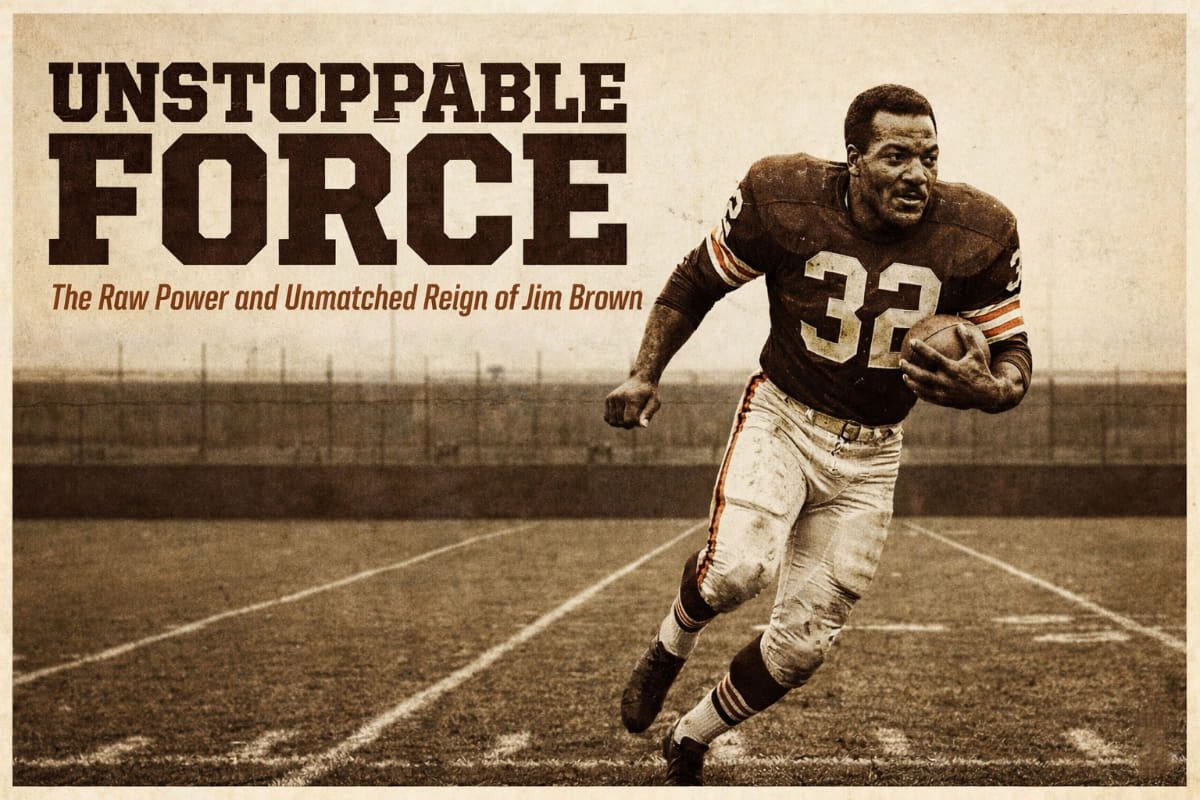
Jim Brown did not just run the football; he issued a summons. Cold air hung over Cleveland Municipal Stadium and the place smelled like wet wool, cigar smoke, and metal bleachers. The handoff hit his belly and the crowd leaned forward, already counting. A linebacker met him in the hole and slid down his frame like rain off a hood. Another defender grabbed cloth and wrist and anything he could reach. Brown kept the pile moving anyway, chin tucked, legs chewing up inches that felt illegal. Coaches watched their play sheets lose meaning. Fans watched a simple run turn into a public lesson.
That lesson still lands today. Per **Pro Football Reference, Brown finished at 5.2 yards per carry on 2,359 rushing attempts, and the stat survives every era shift because it refuses to drop. adds the sting: no retired running back with at least 2,000 rushing attempts** finished with a higher career average. The number reads clean, but it cuts cruel, because it says every other workhorse eventually traded efficiency for survival. Brown did not. So we do not debate dominance. We debate the mechanism. How did Jim Brown make violence look inevitable, and why does the league still chase an answer it never found?
Cleveland learned his sound before it learned his numbers
Noise arrived first. Pads cracked, helmets popped, and the crowd reacted to contact the way people react to thunder that hits too close. Brown ran with his shoulders square and his eyes quiet, like he already knew where the hole would open. One step of patience pulled a linebacker out of position. Another step turned the angle into a mistake. The cut came late, and the tackler arrived early, which is how Brown kept winning the same argument.
Power did the rest. A stiff arm landed like a lead pipe, snapping heads back as he turned the corner and refused the sideline. Gene Hickerson and the Browns line gave him lanes, but Brown supplied the cruelty. Paul Brown and later Blanton Collier did not treat him like a decoy. Cleveland built Sunday plans around the idea that one player could make the fourth quarter feel inevitable.
The craft inside the collision
Myth makes Brown sound simple. Tape makes him look deliberate. Syracuse explains part of it. The **Pro Football Hall of Fame** notes Brown earned All America honors in football and lacrosse and lettered in basketball, and that mix shows up in the way he moved. Lacrosse gave him angles. Basketball gave him balance in traffic. Football gave him permission to finish plays with spite.
Footwork drove the whole machine. Brown pressed a crease until the last possible beat, then snapped into daylight with a cut that felt unfair for a man built like that. Tacklers reached for his hips and found nothing stable. Linebackers aimed for his chest and met a shoulder that would not turn. Safeties tried to go low and got dragged for extra yards, their cleats carving lines in the grass.
Efficiency stayed glued to volume, which is the part modern fans miss. **Pro Football Reference lists Brown at 5.2 yards per carry** across a workload that would make a current general manager flinch. That pairing rarely survives time. Most great backs flash, then fade once the carries stack up and the joints start bargaining. Brown kept his bargain one sided.
The number that still embarrasses the position
Modern football loves the pass. Salary caps reward quarterbacks and edge rushers. Running backs get treated like short term batteries. That logic often sounds cold, yet it comes from bruises, not spreadsheets. Front offices see the position as a fast burn. Legs wear out. Yards per carry falls. Contracts turn toxic.
Jim Brown breaks that story. **Pro Football Reference shows the raw material: 2,359 carries, 12,312 rushing yards, and a per game rushing average of 104.3 yards**. Brown did it in 12 and 14 game seasons, with fewer medical tools, and with defenders who treated the middle of the field like a crime scene. The 5.2 average survives because it refuses to behave like a normal career arc. It never drops into the tired part of the graph.
That is why the number still feels personal. A stat line does not usually offend anyone. Brown’s does.
Ten scenes that explain the Jim Brown unstoppable force
A great career needs more than totals. Moments give the legend its texture. The list below leans on three lenses that keep showing up in credible reporting: production that holds up under time, defining plays that made defenses panic, and cultural weight that followed Brown off the field. Each scene carries a data point you can trace to the **Pro Football Hall of Fame, [Pro Football Reference](https://www.pro-football-reference.com/players/B/BrowJi00.htm), [Cleveland Browns history](https://www.clevelandbrowns.com/news/58-years-ago-today-jim-brown-rushes-for-nfl-record-237-yards-16362366), and an [AP News records roundup](https://apnews.com/article/sports-jim-brown-d4076095fc8492fbe3867ed8804ef62a)** published May 19, 2023, because the truth behind Jim Brown always sounds too wild until you see the numbers printed.
10. The rookie who stole the trophy case
Gravity followed. Defenses started crowding the line on early downs, and Brown still kept slipping through first contact. His rookie year created a new kind of fan confidence in Cleveland, the sense that one player could turn a bad Sunday into a story worth telling on Monday.
9. The 237 yard hostile takeover
One afternoon erased doubt. **Encyclopaedia Britannica notes Brown set an NFL record by rushing for 237 yards** in a single game on November 24, 1957, a number that stood for years. The performance did not feel like a statistical fluke. That day felt like Brown announcing that the league belonged to him for as long as he wanted it.
Violence wrote the headline. Tacklers hit him, bounced, then chased him again. Cleveland learned to expect explosions instead of hope. The rest of the NFL learned to fear the schedule when the Browns showed up.
8. The 1958 record that cracked the league
Authority came with it. Brown won MVP again, and the season forced coaches to rethink what a run game could carry. Fans did not talk about balance in Cleveland. People talked about inevitability.
7. The year his workload turned into a warning label
Toll showed up in opponents, not in him. Defensive fronts wore down. Late tackles turned into arm grabs. Fourth quarters became a grind where Brown made tired men look smaller than they were.
6. Syracuse angles, Cleveland bruises
Lacrosse explains the cut. The **Pro Football Hall of Fame** notes Brown earned All America honors in football and lacrosse at Syracuse, and that detail matters because his running style carried that sport’s geometry. Brown did not just find holes. He created angles that did not exist, then used his body to seal the edge.
Balance turned into weaponry. A defender would meet him at the line, and Brown would step through contact while keeping his feet under him. The crowd reacted to that kind of balance with a different sound, a sharp laugh that came out when something looked unfair.
5. The 1963 season that still looks like a typo
Peak seasons usually come with excuses. Brown did not need one. The **AP News records roundup lists him as the first player to reach 2,000 yards from scrimmage, posting 2,131 scrimmage yards in 1963. [Pro Football Reference](https://www.pro-football-reference.com/players/B/BrowJi00.htm) shows the core of it: 1,863 rushing yards on 6.4 yards per carry**.
4. The title game played in cold wind and bad intentions
The Colts walked into Cleveland favored. Johnny Unitas and Don Shula brought a reputation that usually survived road games. Wind clawed through the stadium and the cold sharpened every collision, a detail former Browns players have recalled in championship recollections and interviews. Baltimore’s defense carried its own aura, too, the kind that made points feel expensive.
3. The 5.2 that followed him out of the stadium
Workload usually pulls a runner down. Brown kept his feet on the ceiling. The stat works as a trap for every era, because it refuses to care about scheme talk or rule changes. It just sits there and says this: a man can carry the ball like a hammer and still run like a blade.
2. The table in Cleveland that athletes still borrow
Football did not contain him. **AP News reporting** on the Cleveland Summit noted Brown helped bring leading Black athletes together in 1967 to support Muhammad Ali after Ali’s refusal of the Vietnam draft. A press table lined with microphones turned into a kind of second stage, and Brown sat at the center of it with the same calm he carried in the backfield.
Influence grew from that moment. Athletes today talk about using their platform like it is normal. Brown helped make that posture possible, and he did it while still carrying the physical authority of the NFL’s most feared runner. Public leadership made him a symbol. Symbols draw worship, but they also draw scrutiny.
1. The exit that preserved the myth
Legends usually fade on film. Brown froze his prime instead. **Andscape** reporting on his retirement described a July 14, 1966 press conference held on the set of The Dirty Dozen, with Brown in military fatigues and a tank nearby. That report also described the pressure point: Browns owner Art Modell threatened fines for missed camp while movie production dragged on.
Brown chose the door. He retired at 30. The league lost the slow decline that usually makes fans comfortable with goodbye. Cleveland lost the weekly certainty. Football gained a permanent ghost.
The part of the story that refuses a clean ending
A symbol invites a simpler story than real life allows. Jim Brown gave the sport an impossible standard on the field, then stepped into a public life that carried real weight and real contradiction. The Cleveland Summit sits on the record as leadership. His film work sits there as reinvention. His dominance sits there as fact.
Another part of the record sits there, too, and it does not belong to football. **Los Angeles Times reporting** in 1999 described domestic violence allegations involving Brown’s wife Monique, including prosecutors’ claims of violence and threats. Subsequent court coverage reported legal consequences tied to the case, including jail time connected to probation issues after Brown rejected a judge’s offer involving counseling requirements. Those details demand plain language, not euphemism, because harm does not soften when a legend holds the spotlight.
No highlight can cancel that gravity. No rushing total can turn it into background noise. Fans can admire the player who forced defenses to swarm and still confront what credible reporting placed in the public record. Both truths sit in the same name.
Modern debates about running backs often sound transactional. Talk turns to contract value, injury probability, and shelf life. Jim Brown makes that conversation feel small, because he drags it back to the oldest question football asks: what happens when one man refuses to stop moving forward?
Another runner will break records. A new highlight will go viral. Some future back might even flirt with Brown’s efficiency for a season or two. Yet the deeper test stays the same, and it still sits inside that 5.2: can anyone carry the burden of being a workhorse and still run like the first hit never happened?
[embed]
READ ALSO: Lawrence Taylor: The Ghost in the Pocket
FAQs
Q1. What makes Jim Brown’s 5.2 yards per carry so rare? A1. He held it across 2,359 carries, and StatMuse notes no retired back with 2,000+ attempts finished higher.
Q2. What was his most famous peak season? A2. In 1963, AP News lists 2,131 scrimmage yards, and Pro Football Reference credits 1,863 rushing yards.
Q3. Why does his retirement still matter? A3. Andscape reported he retired at 30 while filming The Dirty Dozen, leaving the sport before any visible decline phase.
Originally published at https://sportsorca.com on February 26, 2026.
메타데이터
- post_id
- a136374ddfd9
- slug
- jim-brown-built-like-a-verdict-the-5-2-yards-per-carry-standard-a136374ddfd9
- url
- https://medium.com/@Byronscore/jim-brown-built-like-a-verdict-the-5-2-yards-per-carry-standard-a136374ddfd9
- canonical_url
- https://medium.com/@Byronscore/jim-brown-built-like-a-verdict-the-5-2-yards-per-carry-standard-a136374ddfd9
- author_url
- https://medium.com/@Byronscore
- status
- ok
- fetched_at
- 2026-07-27 13:21:04