Navigating AI-Ready Data Governance: How OvalEdge Turns Governed Data Into the Foundation for…
Most enterprise AI doesn’t fail at the model. It fails at the data underneath it. Here’s how OvalEdge is closing that gap — through agentic…
Navigating AI-Ready Data Governance: How OvalEdge Turns Governed Data Into the Foundation for Trusted AI
Most enterprise AI doesn’t fail at the model. It fails at the data underneath it. Here’s how OvalEdge is closing that gap — through agentic governance, askEdgi, the Recipe Marketplace, and an emerging MCP layer.
Every enterprise has the same AI ambition right now: ship copilots, stand up agents, let business users ask questions in plain language and get answers back. The pilots look magical. Then they hit production, and the magic curdles into a familiar problem — the answers can’t be trusted, nobody can trace where a number came from, and the legal team starts asking who can see what.
The instinct is to blame the model. It’s almost never the model.
The AI trust gap
The uncomfortable truth is that enterprises are scaling AI far faster than they’re fixing the data beneath it. The numbers tell the story plainly.
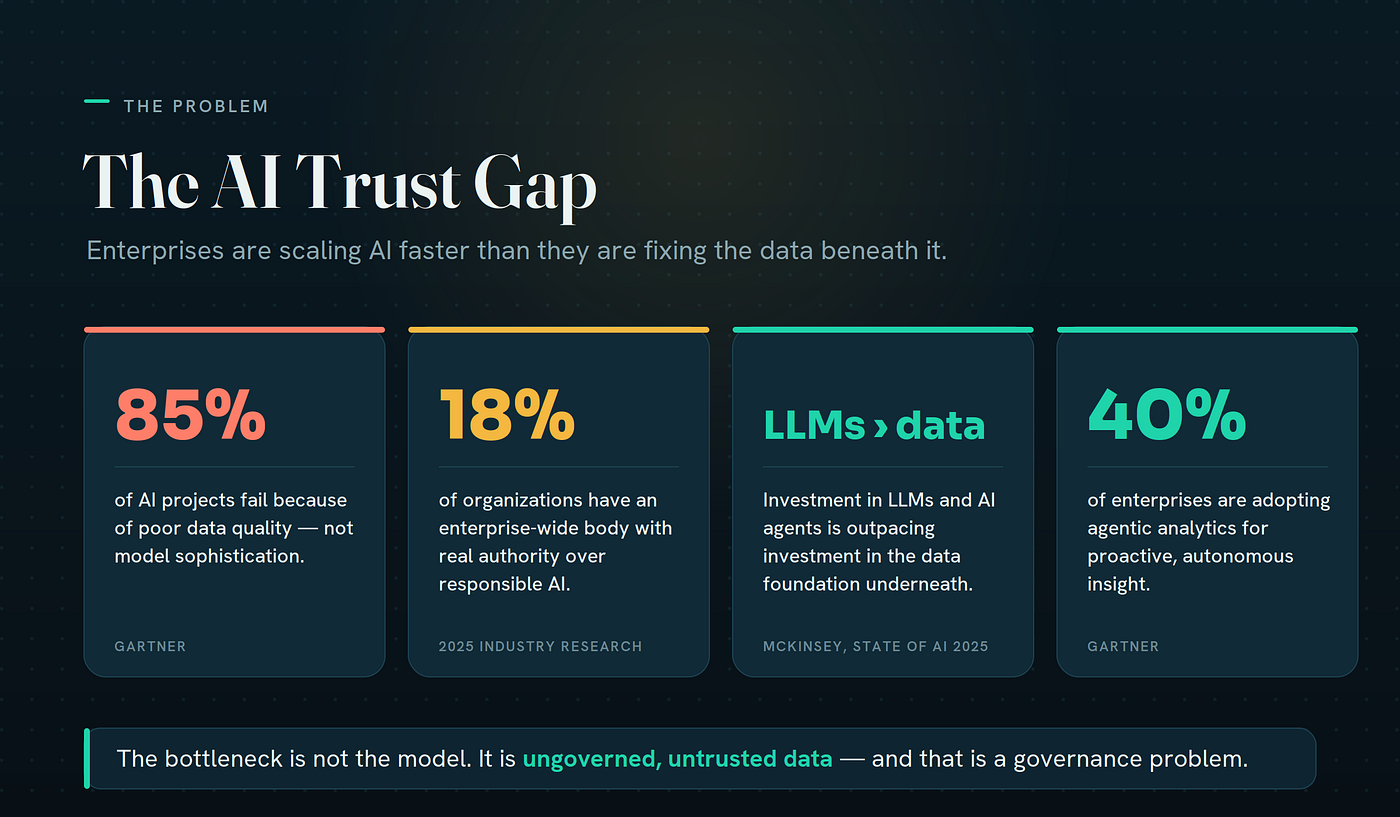
Gartner estimates that the large majority of AI projects fail because of poor data quality, not insufficient model sophistication. McKinsey’s most recent State of AI research describes organizations pouring investment into large language models and agents while leaving the data infrastructure beneath them comparatively untouched. And only a small fraction of organizations have an enterprise-wide body with real authority over responsible AI — even as roughly four in ten enterprises adopt agentic analytics for proactive, autonomous decision-making.
Put those facts together and the conclusion writes itself. The bottleneck is not the model. It is ungoverned, untrusted data — and that is a governance problem, not a modeling problem.
What “AI-ready data governance” actually means
For two decades, data governance was treated as a compliance tax: a project you ran after the data was built, to satisfy an audit. That model breaks the moment an autonomous agent starts reading your catalog at 2 a.m. and acting on what it finds.
AI-ready data governance flips the order. Governance becomes the thing that makes the data consumable by machines in the first place. An AI-ready foundation has to do several things at once: enrich metadata actively rather than passively cataloging it, attach semantic context so an agent knows what “revenue” means in your business, track end-to-end lineage so any output can be traced to its source, enforce policy and access controls at the moment of consumption, and expose all of that programmatically so AI systems can query trusted context at inference time.
In other words: governance stops being a layer you add on top and becomes the operating system the AI runs on.
OvalEdge’s answer: govern by default, in weeks not years
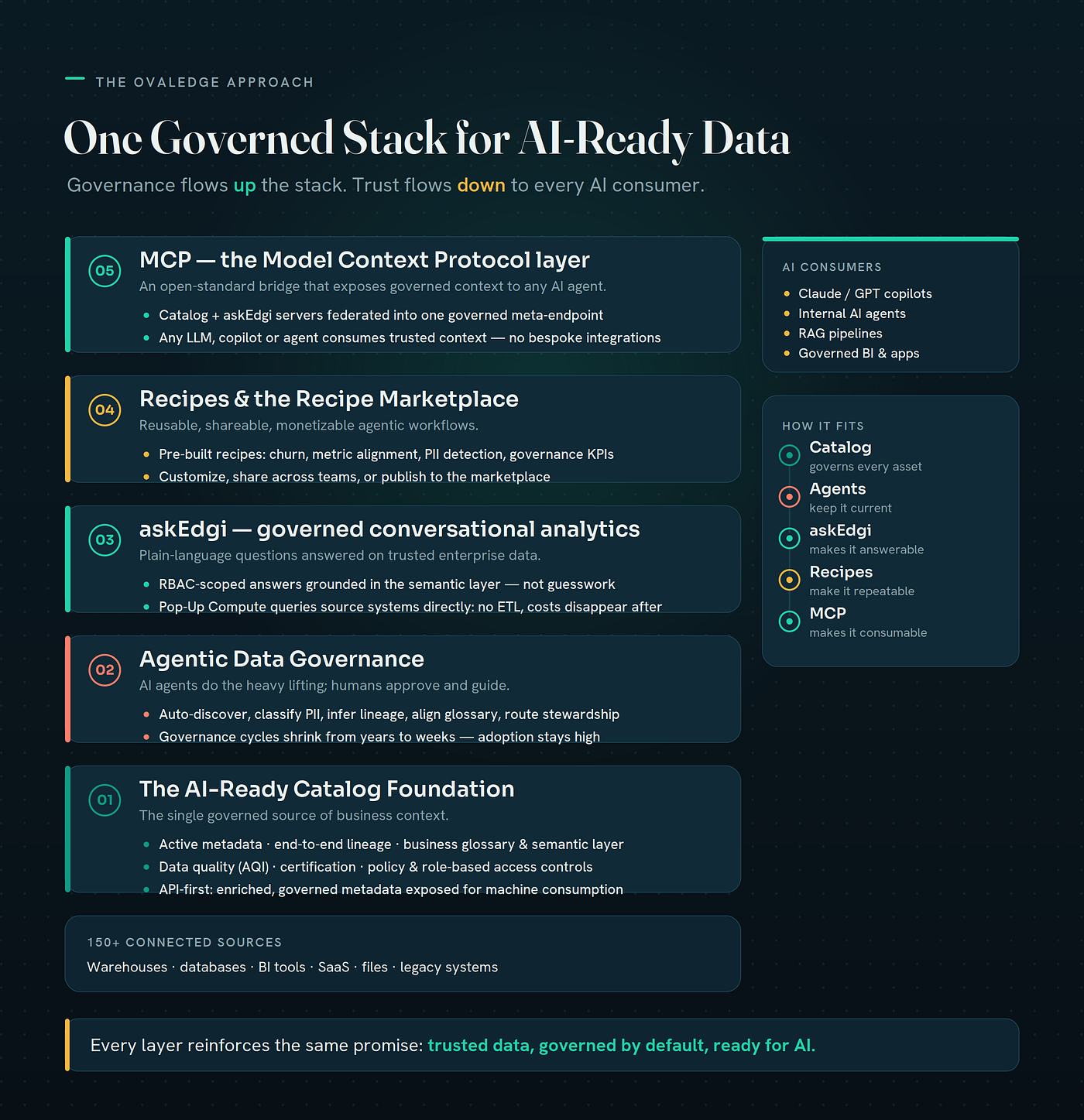
This is the thesis behind OvalEdge’s positioning as an agentic data intelligence platform — and it’s worth understanding as a single connected stack rather than a list of features. Governance flows up the stack; trust flows down to every AI consumer.
The foundation: an AI-ready catalog
Everything starts with the catalog, but not the passive, search-and-find catalog of the last decade. OvalEdge connects to 150-plus modern and legacy sources and builds a single governed source of business context on top of them: active metadata, automated end-to-end lineage, a business glossary and semantic layer, data-quality scoring, certification, and policy-based access controls. Crucially, it’s API-first — enriched, governed metadata is exposed for machine consumption, which is what makes the layers above it possible.
Agentic Data Governance
Here’s where OvalEdge’s bet gets sharp. Traditional governance is manual and fragmented, so adoption stays low and programs drag on for years. OvalEdge’s approach makes governance AI-driven by default, with humans in control: agents discover assets, classify sensitive data, infer lineage, align glossary definitions, and route stewardship tasks — while people validate, approve, and guide.
The practical payoff is the closed correction loop. A huge share of data-quality failures aren’t undetected; they’re flagged, logged, and then left to rot in a backlog while the initiative ships anyway. OvalEdge’s agentic governance detects an issue, identifies the likely root cause, assigns it to the right owner, and tracks resolution end-to-end — without manual coordination at every step. That’s how governance cycles compress from years to weeks while adoption stays high.
askEdgi: governed conversational analytics
askEdgi is the layer most people see first. It lets business users ask questions in plain language and get answers grounded in the semantic layer — not the confident-sounding guesswork that generic chatbots produce. Because askEdgi sits on the governed catalog rather than beside it, every answer respects role-based access (users only see what they’re allowed to), resolves business terms against governed definitions, and can be traced back to a trusted source.
One detail worth flagging for a technical audience: askEdgi’s “Pop-Up Compute” queries source systems directly and spins down afterward, pulling only the data needed to answer a question. That sidesteps a lot of brittle ETL and keeps cost in check — compute appears, answers, and disappears.
Recipes and the Recipe Marketplace
This is the piece that turns conversation into a repeatable, scalable asset. A recipe is a reusable, end-to-end agentic workflow for a recurring business problem — churn prediction, metric alignment across teams, PII detection, or governance KPIs like glossary adoption and lineage completeness. Build the analysis once, and it becomes a repeatable solution rather than a one-off query.
The Recipe Marketplace extends that idea into an ecosystem: recipes can be customized, shared across teams, and even monetized. Every execution stays bounded by RBAC and admin policy, so reuse never becomes a governance leak. It’s a genuinely interesting model — packaged, governed intelligence that travels.
MCP: the open bridge to every agent
The final layer is the most forward-looking, and the most strategically important. The Model Context Protocol — the open standard Anthropic introduced in late 2024 and now stewarded as an open-source spec — solves the “N×M” integration problem: instead of building a bespoke connector for every combination of AI tool and data source, you expose your context once, through a standard protocol, and any compliant client can consume it.
For a governed catalog, this is the natural endgame of being API-first. OvalEdge’s enriched, policy-aware metadata is exactly the kind of context an agent needs to reason accurately — and an MCP layer is how that context reaches Claude, GPT-based copilots, internal agents, and RAG pipelines without one-off integrations. The architecture that points the way here is server federation: an existing catalog MCP server and a new askEdgi MCP server, combined behind a single governed meta-endpoint, each independently deployable but unified at the point of consumption. That’s how a governed estate becomes consumable by the entire AI ecosystem — safely, and on an open standard rather than a proprietary one.
Autonomy meets accountability
Step back and the four products express one principle: AI can move fast precisely because governance is built in, not bolted on.
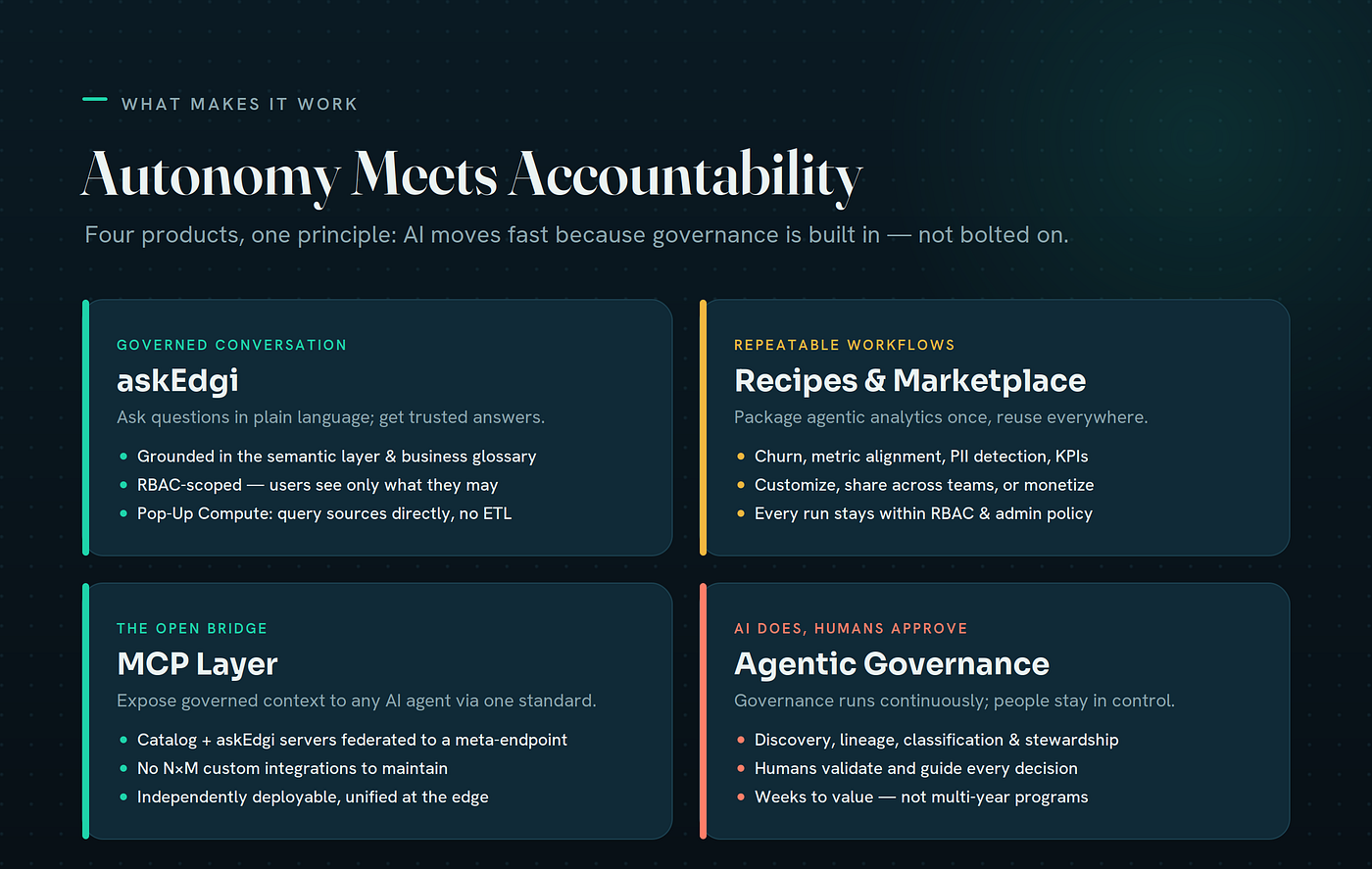
askEdgi gives autonomy to business users without surrendering control. Recipes make that autonomy repeatable and shareable. The MCP layer extends it to every agent in the organization. And agentic governance is the continuous machinery underneath that keeps the whole thing trustworthy while humans stay in the loop on the decisions that matter.
This is the part competitors find hard to copy. Bolting a chatbot onto a dashboard is easy. Grounding every autonomous action in governed, classified, lineage-backed, access-controlled data — and doing it through an open protocol — is an architecture, not a feature.
Why this matters now
The market is splitting into two groups. One is buying AI tools and hoping the data sorts itself out. The other is treating governed, AI-ready data as the actual product — the durable asset that every future model, agent, and copilot will draw from. The first group will keep producing impressive demos and disappointing deployments. The second will operationalize trust as fast as it operationalizes data, and that’s the group that wins the next few years.
OvalEdge’s wager is that governance, done agentically and exposed through open standards, is the shortest path from “we have AI ambitions” to “we have AI in production we can defend in an audit.” On the evidence of where the failures actually happen, it’s a wager worth making.
The models will keep getting better on their own. The real question every data leader should be asking is simpler: when our agents reach for data, will they find something they can trust?
The diagrams above were built to illustrate how OvalEdge’s catalog foundation, agentic governance, askEdgi, the Recipe Marketplace, and the MCP layer fit into a single governed stack.
메타데이터
- post_id
- a137a6c9b521
- slug
- navigating-ai-ready-data-governance-how-ovaledge-turns-governed-data-into-the-foundation-for-a137a6c9b521
- url
- https://medium.com/signal-structure/navigating-ai-ready-data-governance-how-ovaledge-turns-governed-data-into-the-foundation-for-a137a6c9b521
- canonical_url
- https://medium.com/signal-structure/navigating-ai-ready-data-governance-how-ovaledge-turns-governed-data-into-the-foundation-for-a137a6c9b521
- author_url
- https://medium.com/@dnanatihor
- status
- ok
- fetched_at
- 2026-06-11 05:11:55