ESTCube-LuNa E-sail experiments
ESTCube Lunar Nanospacecraft electric solar wind sail experiment designs
ESTCube-LuNa: ESTCube Lunar Nanospacecraft electric solar wind sail experiment designs
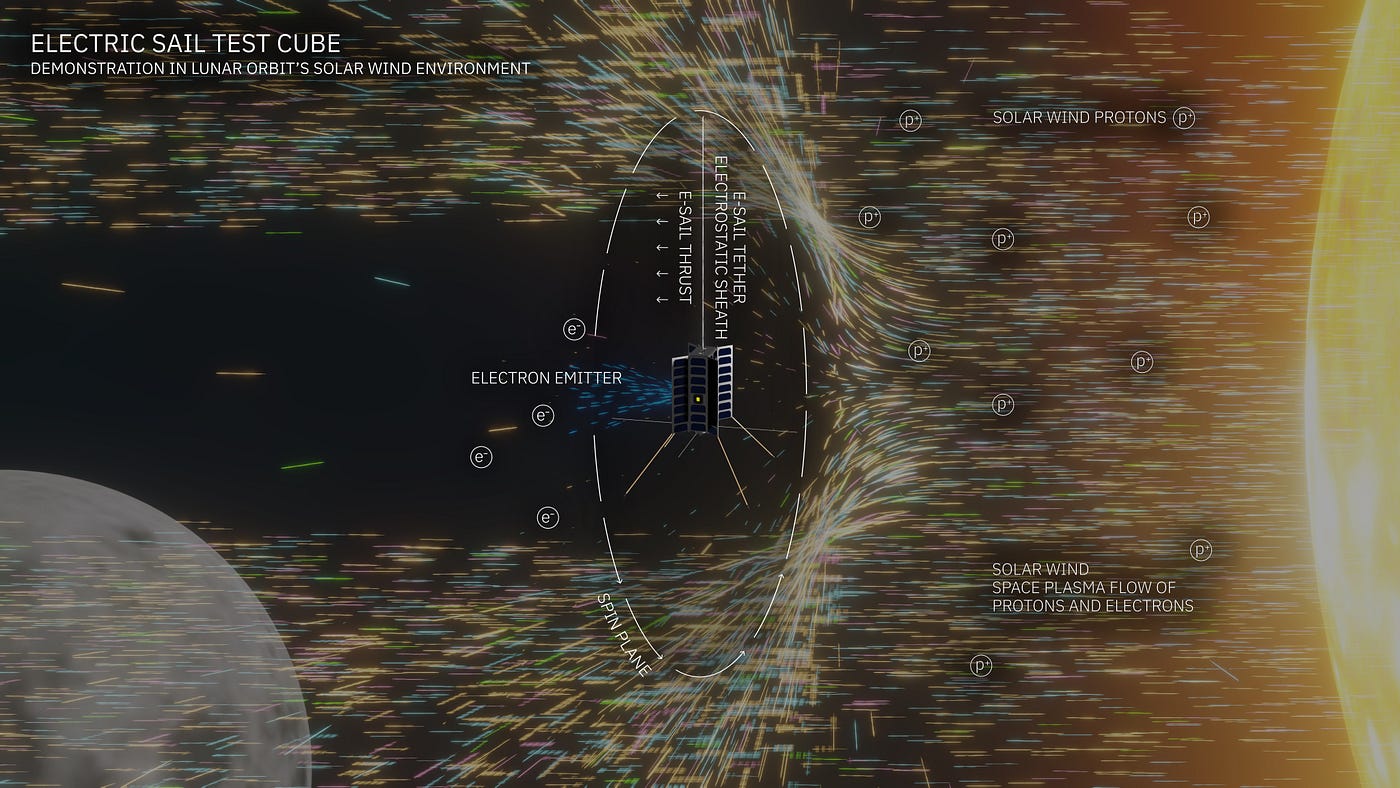
The Electric Sail Test Cube — Lunar Nanospacecraft, or ESTCube-LuNa, mission concept is designed to demonstrate the electric solar wind sail, or E-sail, in its authentic environment. The Moon’s orbit provides access to the solar wind for some two thirds of the time in pristine solar wind conditions; this is where the E-sail experiments can be performed. The figure depicts the E-sail thrust experiment; the sail’s spin plane is facing the solar wind, which is optimal for creating orbital displacement. This blog post also introduces the E-sail torque experiment for spin-rate modification. Credit: Space Travel Blog / ESTCube / UT Tartu Observatory / Palos, Jansone, Maskava, first appeared in Palos et al. 2023.
Dear Readers,
We are continuing the ESTCube-LuNa series! Since publishing it for the first time in May 2023, the ESTCube-LuNa mission concept has gone through several major changes. In this blog post, we will focus on the details of how to actually bring about new propulsion technology: what are the steps (or changes in orbital altitude) we need to take for the E-sail to be demonstrated? The ESTCube-LuNa baseline concept is designed to characterise the fundamental aspects of the E-sail: can we create a force that is measurable with on-board sensors and ground systems? We propose to do this by introducing changes in the orbital altitude, which in turn changes the orbital period, as well by introducing changes in the spin rate.
The illustration at the top of the page shows ESTCube-LuNa with the E-sail spin plane roughly perpendicular to the incoming solar wind (if this sentence confuses you, please see our earlier blog post about the E-sail and its working principles). For simplicity, we have designed the E-sail spin plane to remain fixed in space because turning it would require the development of a so-called “remote unit” with attitude thrusters placed at the E-sail tether’s tip, such as conceptualised for Multi-Asteroid Touring. Instead, we have reused the approach from the ESTCube-2 mission, where a little “endmass” helps in pulling out the E-sail tether. While simpler and suitable for demonstrating the E-sail fundamentals, the endmass cannot be used for spin plane turning, hence limiting ESTCube-LuNa’s abilities to perform proper trajectory manoeuvres (we have nevertheless simulated a lunar escape trajectory, in collaboration with the University of Pisa, and it will certainly be described in the Space Travel Blog at a later date).
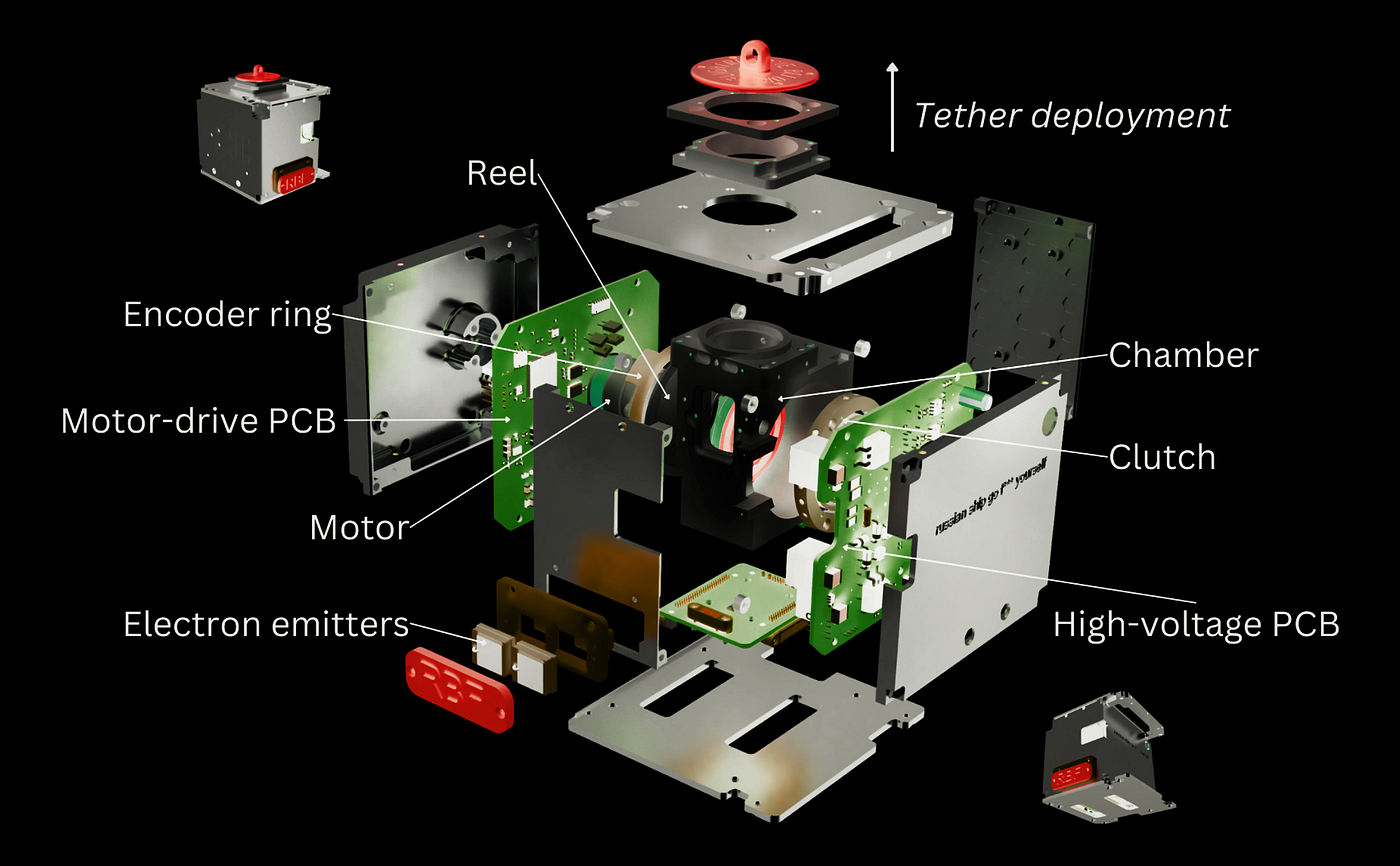
The ESTCube-2 tether deployment system with the red button on the top representing the endmass. The ESTCube-LuNa baseline concept assumes the same working principles, and much of the system design can be reused. Credit: FMI / Iakubivskyi and Maskava, first appeared in Dalbins et al. 2023.
E-sail thrust experiment
With the fixed spin plane, we can patiently wait for the spin plane to be aligned with the incoming solar wind: either perpendicular or parallel to the flow. Every half a year, the spin plane would be perpendicular to the solar wind, which would give the ESTCube Lunar Nanospacecraft a chance to exert a maximum E-sail thrust. Our mission concept is designed to introduce a change in one of the orbital parameters (or elements) – the orbital altitude – which is directly linked with the orbital period. By charging the E-sail when going against the solar wind, the altitude will be reduced along with the orbital period – something we plan to characterise using radio frequency ranging and precise orbit determination, in collaboration with the Ventspils International Radio Astronomy Centre. With General Mission Analysis Tool (GMAT) simulations, we have estimated that ESTCube-LuNa could achieve a 100-second change in the orbital period by running the experiment for three days – a short enough period to consider the fixed spin plane to be roughly perpendicular to the solar wind.
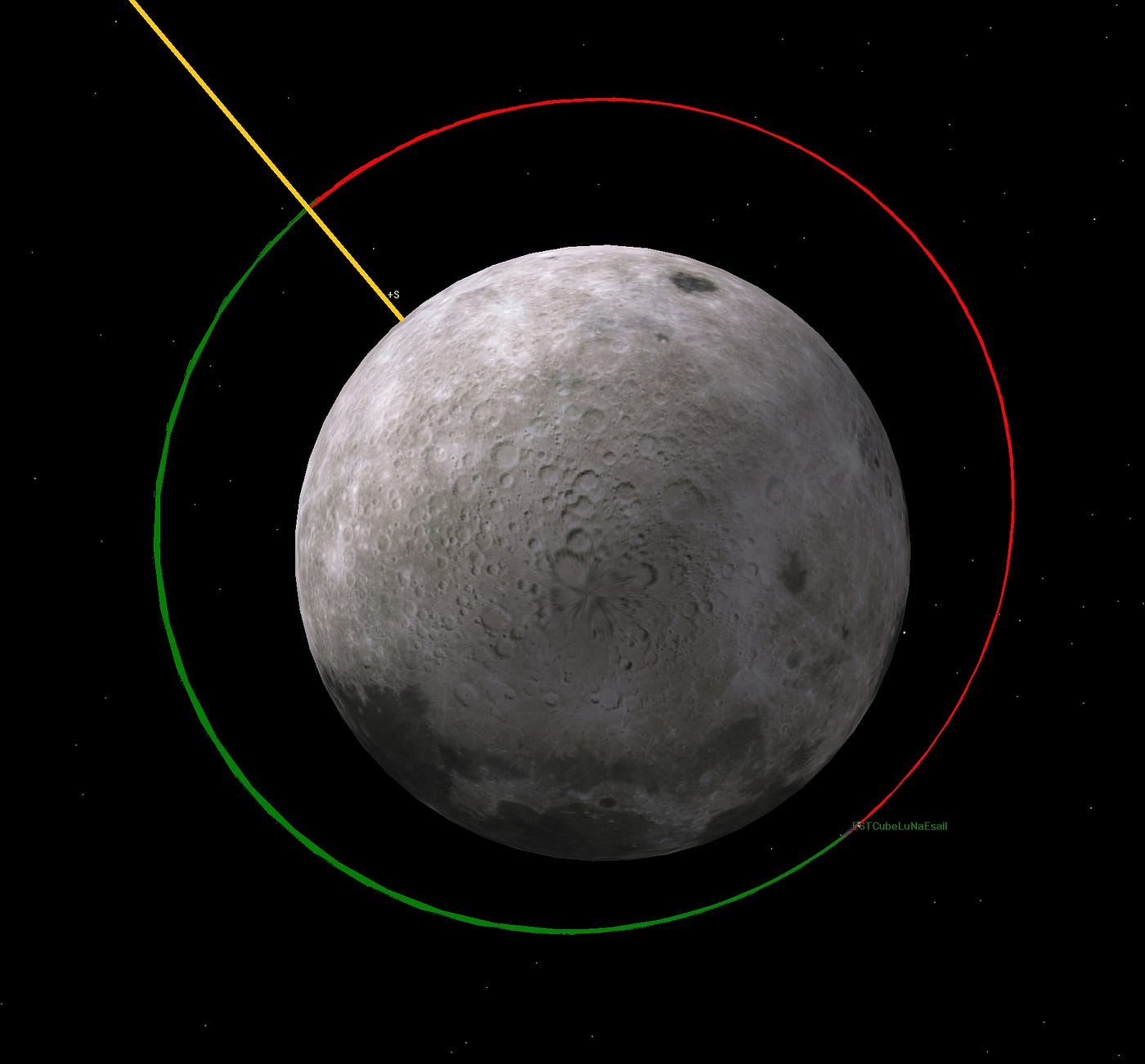
An ESTCube-LuNa thrust simulation in GMAT in which the yellow line represents the solar direction (i.e. where the solar wind comes from), the green part of the trajectory shows when ESTCube-LuNa is pushed by the solar wind (increased orbital altitude and period), and the red part shows when ESTCube-LuNa is going against the wind (reduced orbital altitude and period). Credit: Slavinskis et al. 2024.
E-sail torque experiment
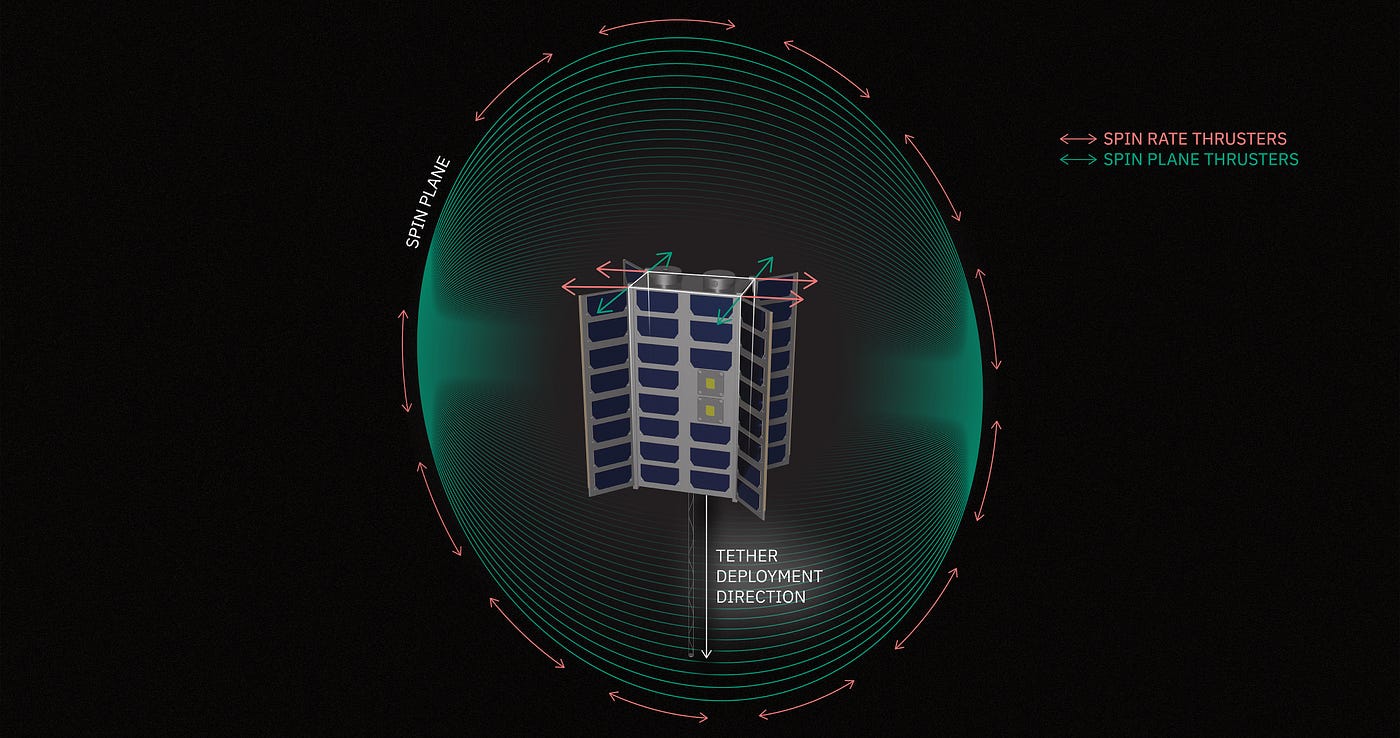
Three months after a perpendicular case, the ESTCube-LuNa E-sail tether spin plane will be parallel to the solar wind (the occurrence will repeat itself six months later). The parallel case is optimal for introducing the E-sail torque. As shown in the following illustration, we can charge the tether either when it is rotating in the same direction as the solar wind (top sector) or in the opposite direction (bottom sector). When the tether charging is synced while rotating in the same direction with the wind, the spin rate is increased; when rotation is in the opposite direction, the spin rate is reduced. The estimated change in spin rate is one degree per second while running the experiment for 4200 seconds: something we expect to measure with on-board attitude sensors.
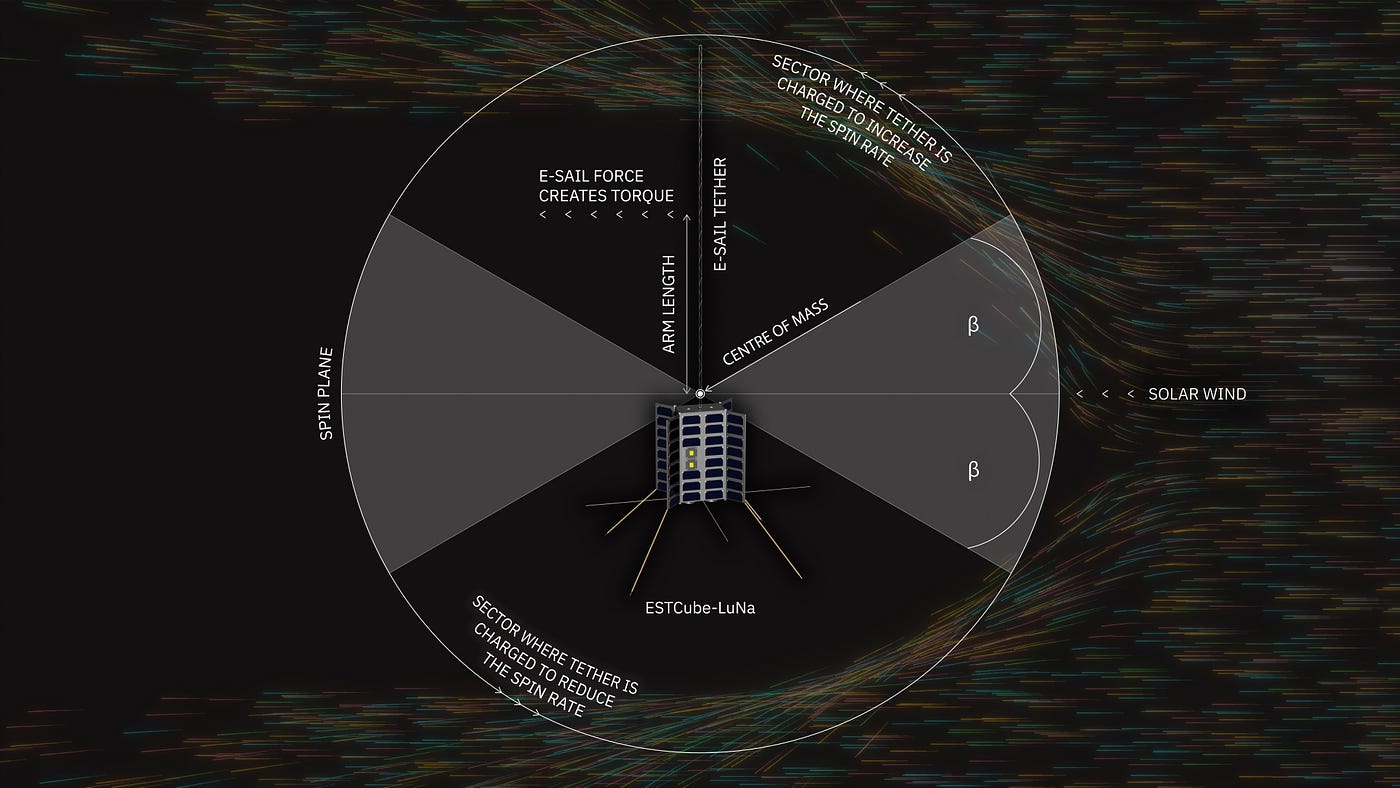
The ESTCube-LuNa spin-rate modification experiment performed with the E-sail spin plane aligned with the incoming solar wind. Depending on the E-sail charge sector, the spin rate can be increased (top sector) or reduced (bottom sector). Credit: Space Travel Blog / ESTCube / UT Tartu Observatory / Palos, Jansone, Maskava, first appeared in Slavinskis et al. 2024.
We have designed the ESTCube-LuNa E-sail experiments in the scope of the scientific article Slavinskis et al. 2024 “Electric Sail Test Cube — Lunar Nanospacecraft, ESTCube-LuNa: Solar-Wind Propulsion Demonstration Mission Concept”, published in the Aerospace Special Issue “Advances in CubeSat Sails and Tethers”. The article provides full analysis of the results introduced in this blog post, as well as draws the future vision for analysing the challenging ESTCube-LuNa concept. In the analysis, we have assumed a tether length of 2 km charged at 20 kV; we have yet to design such a system and find funding to build it.
During spring 2024, we will continue writing about the ESTCube-LuNa concept by covering the following topics in the Space Travel Blog: attitude control and tether deployment, communications, navigation and operations, the on-board system design, as well as the option to perform lunar escape, requiring novel future development of a remote unit.
The ESTCube-LuNa mission is being actively designed. Let us know if you are interested in joining the quest to demonstrate the E-sail in its authentic solar wind environment (we supervise BSc, MSc and PhD theses)!
Cheers, E-Sailor Andris
Author: Andris Slavinskis Editor: Pekka Janhunen Proofreading: Robert B. Davis Design: Anna Maskava, Mario F. Palos and Rute Marta Jansone
Attribution (text): Space Travel Blog / ESTCube / UT Tartu Observatory Attribution (images): see captions
[embed]The ESTCube-LuNa mission concept video.
메타데이터
- post_id
- a153c8a3a1cf
- slug
- estcube-luna-esail-experiments-a153c8a3a1cf
- url
- https://space-travel.blog/estcube-luna-esail-experiments-a153c8a3a1cf
- canonical_url
- https://space-travel.blog/estcube-luna-esail-experiments-a153c8a3a1cf
- author_url
- https://medium.com/@andris.slavinskis
- status
- ok
- fetched_at
- 2026-08-06 19:14:50