Reversing the effects of dementia: how Gene Sequencing and CRISPR could be the future
By: Hugo Winfield Shimada-Keeney
Reversing the effects of dementia: how Gene Sequencing and CRISPR could be the future
By: Hugo Winfield Shimada-Keeney
Imagine a world where people could live to a ripe old age without feeling the side effects of aging? Approximately 12.3% of Japanese citizens over the age of 65 suffer from a condition known as dementia, which is an umbrella term used to describe a decline in cognitive ability such as memories, reasoning and behavior. That’s over 4.6 Million out of Japan’s 123 million people who suffer from this condition (Alzheimer’s & Dementia Help | Japan | Alzheimer’s Association, 2019), and with Japan’s population aging year by year, the number is exponentially growing. This article will briefly outline the effects of Dementia, or Ninchi-Sho, as well as outline how the upcoming technologies of Gene sequencing and CRISPR could be used to combat this ever-growing problem.
As I said, Dementia is an umbrella term used to describe the decline in cognitive ability. However, it goes much deeper than that, by slowly damaging the brain and a person’s ability to remember, make reasoned decisions and even complete simple tasks, like turning off the lights at night. Alzheimer’s disease, the most common cause of dementia, is caused by the buildup of amyloid plaques and proteins, which destroy neurons, causing bain shrinkages. Alzheimer’s has been linked to genetic risk factors, such as the APOE gene, showing that dementia is not only detrimental in terms of social factors but is also detrimental biologically. This is where technologies like Gene Sequencing come into play, as they help identify risks before the condition becomes too severe.
CRISPR (or short for: Clustered Regularly Inter Spaced Palindromic Repeats) is a gene editing emerging technology that can target specific genes in a DNA . CRISPR can edit parts of the genome by using a guide RNA and a Cas9 enzyme to locate and cut a specific DNA sequence. In the context of dementia, one possible target is the APOE gene, especially the APOE4 variant, which is strongly linked to a higher risk of Alzheimer’s disease. However, APOE4 does not directly “cause” dementia in every person. Instead, it increases risk, meaning CRISPR could one day be used to reduce genetic vulnerability rather than act as a guaranteed cure. This makes CRISPR powerful, but also risky, as changing genes connected to the brain would need to be carefully tested to avoid unexpected side effects.
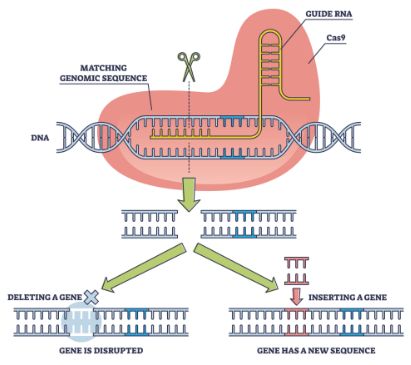
This is where gene sequencing and CRISPR could work together. Gene sequencing can identify people with higher genetic risk while CRISPR could be used as a solution of reducing the risks before they begin.
Dementia is always thought of as simple memory loss, but in my eyes, this description does not cut it, so to speak. Because of the APOE4 gene causing neural inflammation and blockage, dementia goes much deeper. People with dementia suffer from a whole host of different symptoms such as; reasoning, communication, emotional control as well as struggles with daily tasks. This makes the conditions extremely hard, not only for the patient, but also for their family and caregivers. As you age, proteins such as the Amyloid and Tau build up inside your brain. This causes a plaque that can block neural pathways, causing memory loss. The APOE4 gene is essentially terrible at clearing these proteins, even in some cases promoting the growth and build up of these genes. Because these processes are slow, it is really hard to know when and if you have dementia, especially if you are not showing symptoms yet. You might have it, but because of the slow symptoms, you wouldn’t know until too late. That’s why you would need something that could read DNA and find out genetic risk before these proteins can build up.
Gene sequencing is a technology that allows scientists to read DNA and, it is apparent that there are amazing implications for use in the dementia field. For one, it can let doctors and scientists identify genetic risk factors. For example, it can be used to identify if a person has the trait of having APOE4 genes, which, as I have stated numerous times, are directly linked to Alzheimer’s.
While the sequencing of genes can reveal who is genetically vulnerable to developing dementia, CRISPR could potentially take this one step further by editing those genes. Unlike sequencing genes to reveal the genetic code of an individual, CRISPR is a gene-editing tool that allows scientists to target and alter the genetic code of an individual. Scientists have discovered that the APOE gene, specifically the APOE4 variant, is linked to an increased risk of developing Alzheimer’s. Using CRISPR, scientists could one day alter the genes of individuals to reduce the harmful implications of genes such as the APOE4 variant has on developing dementia. Though currently it is not known whether CRISPR would work as a direct cure for dementia as dementia is both a genetic and non genetic condition. Further research should be made in order to determine whether the process is safe or harmful to patients.
However, using CRISPR to treat dementia would come with serious scientific and ethical challenges. Editing genes connected to the brain could have unexpected side effects, and the technology would need years of testing before it could be safely used in humans. There is also the question of who would be able to access this treatment, as advanced genetic technology could be extremely expensive. Because of this, CRISPR should be seen as a promising future possibility rather than a guaranteed cure.
In conclusion, dementia is one of the foremost challenges faced by aging populations such as Japan. While current treatments and “solutions” focus on limiting the symptoms, technologies like gene sequencing and CRISPR could create new approaches by tackling the root problem by identifying the risk early and editing the genes connected to the risk. These technologies are still being developed and MUST be tested carefully to make sure that they are safe, ethical, and accessible. Although there are still some challenges regarding ethics, CRISPR shines a light into the darkness of early intervention in the dementia field, and into a future where aging does not automatically mean losing memory or independence.
메타데이터
- post_id
- a15ff9ef0bbe
- slug
- reversing-the-effects-of-dementia-how-gene-sequencing-and-crispr-could-be-the-future-a15ff9ef0bbe
- url
- https://medium.com/@hshimadakeeney/reversing-the-effects-of-dementia-how-gene-sequencing-and-crispr-could-be-the-future-a15ff9ef0bbe
- canonical_url
- https://medium.com/@hshimadakeeney/reversing-the-effects-of-dementia-how-gene-sequencing-and-crispr-could-be-the-future-a15ff9ef0bbe
- author_url
- https://medium.com/@hshimadakeeney
- status
- ok
- fetched_at
- 2026-06-09 15:37:30