Why the Bill of Lading Can Make or Break Your Supply Chain
Imagine you buy a house. You don’t walk around carrying the physical building in your pocket; instead, you carry a piece of paper called a…
Why the Bill of Lading Can Make or Break Your Supply Chain
Imagine you buy a house. You don’t walk around carrying the physical building in your pocket; instead, you carry a piece of paper called a deed that legally proves you own it.
In global shipping, the Bill of Lading (B/L) is that deed. It is widely considered the most powerful piece of paper in international trade. If the commercial invoice is simply the “price tag” showing how much you paid, the Bill of Lading is the actual ownership title to the container crossing the ocean. In the eyes of the law, whoever holds the Bill of Lading holds the cargo.
Whether you are a seasoned exporter or a startup founder looking to import your first container, mastering the Bill of Lading is non-negotiable. If the commercial invoice is the “price tag,” the Bill of Lading is the “deed” to the property.
Obviously, the Bill of Lading is unique because a single piece of paper does three completely different, heavy-duty legal jobs at the exact same time:
Evidence of the Contract (The Shipping Agreement)
- It is the official proof that you and the shipping company (the carrier) have a binding deal. It outlines the rules, terms, and conditions for moving your cargo safely from Point A to Point B.
Receipt for Goods (The Delivery Slip)
- When the shipping line loads your boxes onto the vessel, the captain or port authority signs the B/L. This signature is their official admission saying: “Yes, we received these exact items, in the exact quantity and condition described on this paper.”
Document of Title (The Deed of Ownership)
- This is where the B/L gets its true power. The paper is the cargo. If you want to sell the goods while they are still floating in the middle of the ocean, you don’t physically hand over the boxes. You simply sign and transfer the Bill of Lading over to the new buyer, and they instantly become the legal owner.
You cannot unlock a container at the destination port without presenting the Bill of Lading. Because it acts as the contract, the receipt, and the actual ownership title all at once, losing this document or mishandling it can completely freeze millions of dollars in inventory.
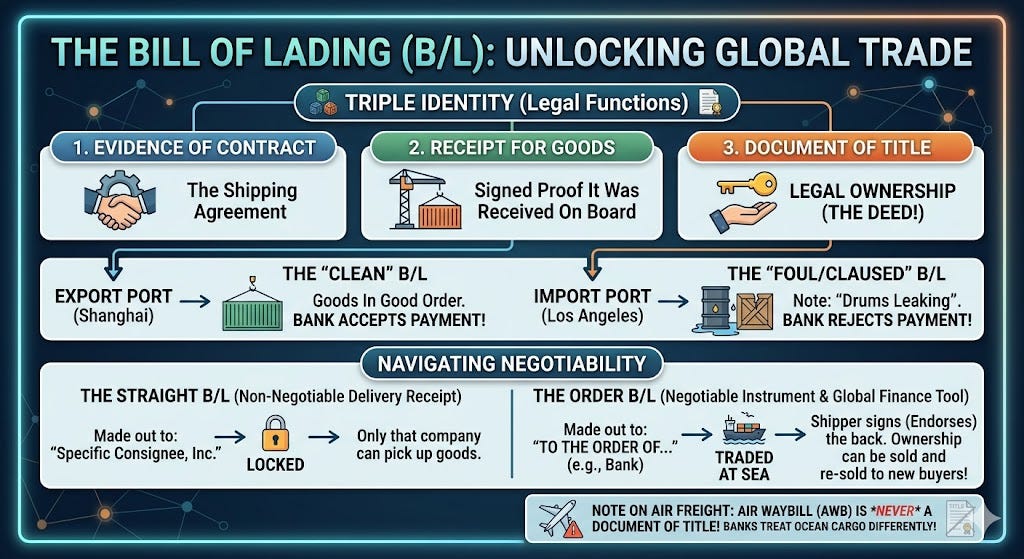
Info-graphic that visually synthesizes all the core concepts of Bill of Lading
The Difference between a “Straight” and an “Order” Bill of Lading
In international shipping, how a Bill of Lading is filled out determines how easily the ownership of the cargo can be transferred. This is called negotiability.
Think of it like the difference between a personalized, non-transferable concert ticket and a cash check. Here is the difference:
The Straight Bill of Lading (The “Locked” Delivery Receipt)
This document is made out directly to a specific person or company (called the consignee).
- How it works: Only that exact named company can legally show up at the port and pick up the boxes.
- The Rules: It is completely non-negotiable. It cannot be sold, traded, or passed along to anyone else mid-voyage. It acts simply as a strict delivery receipt.
The Order Bill of Lading (The “Traded-at-Sea” Passport)
This document is made out “to the order of” a specific company or bank, rather than a final buyer.
- How it works: This creates a negotiable instrument — meaning it can be bought and sold. The person holding it can sign (endorse) the back of the paper, just like signing over a check.
- The Rules: This allows ownership of the cargo to be transferred over and over again to new buyers while the ship is still floating in the middle of the ocean. It is the core tool used in global trade finance.
It is vital to remember that an Air Waybill (AWB) is not a document of title. It is never negotiable. This is why banks treat ocean shipments and air shipments with very different levels of security.
The Golden Rule of Air Freight: Air Waybills are Different
A major trap for new traders is assuming that an Air Waybill (AWB), the paperwork used when you fly goods on an airplane, works exactly like an ocean Bill of Lading. It does not.
- An Air Waybill is never a document of title. It is simply a receipt showing the airline accepted your boxes.
- It can never be negotiable. You cannot sell or trade goods mid-flight using an Air Waybill.
- Because anyone named on the Air Waybill can pick up the cargo at the airport without handing over original paperwork, banks view air freight as much higher risk and handle it with completely different, stricter security rules than ocean cargo.
If you are selling goods on credit or through a bank, you should use an Order B/L so you can hold onto ownership until you get paid. If you have already been paid in full and want a simple, direct delivery, a Straight B/L is the way to go.
Guide to Bill of Lading Documentation
When a trade involves a bank Letter of Credit (LC), the bank’s compliance team acts like a strict editor. They will examine every single character, comma, and number on your Bill of Lading. Even a tiny, accidental typo, like writing “100 cartns” instead of “100 cartons”, can cause the bank to declare a discrepancy. This small mistake can freeze your company’s payment at the bank counter for weeks.
To protect your cash flow and ensure a smooth, problem-free transaction, you must understand the critical difference between a “Clean” and a “Foul” document. Here is the difference:
The “Clean” Bill of Lading (The Green Light)
When the shipping line accepts your cargo at the port, they inspect the outside of the boxes or containers. If everything looks perfectly fine, safe, and secure, they issue a standard, unedited Bill of Lading.
This is called a “Clean” Bill of Lading.
This is exactly what you need. It serves as proof to the buyer and the bank that your goods left port in pristine condition.
The “Foul” or “Claused” Bill of Lading (The Red Flag)
If the port workers or ship captain notice any visible damage while loading your cargo, they are legally obligated to write a special note (called a “clause”) directly onto the paperwork.
- Examples of Clauses: They might type notes like “3 crates broken,” “rust visible on steel,” or “drums leaking.”
Once a damage note is stamped onto the paper, it instantly becomes a “Foul” or “Claused” Bill of Lading.
This is a disaster for an exporter. The moment a bank sees a “Foul” B/L, they will immediately refuse to release your money because you failed to deliver the goods in perfect condition.
Hence, your logistics team must inspect all packaging before it leaves your warehouse. If a crate is slightly cracked on your loading dock, fix it immediately. Letting a damaged box reach the port means getting stuck with a “Foul” Bill of Lading, which gives the bank a perfect legal reason to lock up your funds.
The Accuracy of Destination
When a giant container ship pulls into a port, it is carrying thousands of massive metal boxes stacked high like Legos. If your cargo gets off the ship at the wrong stop because of a paperwork error, fixing it is a logistical nightmare.
Accuracy in the “Port of Discharge” (the port where the ship drops off your container) and the “Final Destination” (where the goods ultimately need to go) fields on your Bill of Lading is absolutely critical.
Most people picture their cargo traveling completely alone, but in reality, your goods are usually packed inside a container alongside hundreds of other items. Once that ship leaves port, its route is set. If your paperwork lists the wrong port, your container will be unloaded there, buried under mountain-high stacks of other cargo, and practically frozen in place.
The Consequences of a Single Typo
If a port mistake is made on the Bill of Lading, you face three massive problems:
- Moving a misdelivered container isn’t as simple as putting it on another boat. You will be hit with massive customs fines, extra port storage fees (demurrage), and the extreme cost of hiring a new shipping line to pick up your stranded cargo and route it back to the correct country.
- Finding a single misplaced container at a massive global port (like Rotterdam or Singapore) is like finding a needle in a haystack. It can take weeks or months just to locate your boxes, causing your supply chain to grind to a halt.
- Once a container is physically unloaded (discharged) at the wrong port, it is practically impossible to move it quickly. You cannot just ask the captain to turn the ship around.
Double-check every single letter of the port names before your freight forwarder submits the final paperwork. A mistake here doesn’t just delay your delivery — it locks your cargo in a foreign port and hits your business with devastating, unbudgeted expenses.
The Legal Framework of the Bill of Lading
International ocean shipping is not a legal wild west. It is governed by historical treaties that dictate exactly how much responsibility a shipping company has if your goods are damaged. Furthermore, if you are shipping massive bulk commodities, the rules change entirely.
The legal framework of a Bill of Lading is governed by international conventions — most notably the Hague-Visby Rules or the Hamburg Rules. These global rulebooks define the carrier’s liability, their responsibilities, and how much money they have to pay you if they ruin your cargo.
The “Charter Party” Exception (Renting the Whole Ship)
Normally, when you ship a container, you are just renting a tiny bit of space on a massive vessel. But what if you are a massive commodity trader renting the entire ship (e.g., a tanker full of oil or a bulk carrier full of grain)?
When you hire the whole ship, you sign a massive contract called a Charter Party Agreement.
In this scenario, the Charter Party is your actual legal contract. The Bill of Lading loses its “triple identity” power and acts merely as a receipt for the cargo.
You must ensure your Bill of Lading includes a specific note referencing back to the original Charter Party contract. If you don’t link them together, you create a legal dead zone and lose your insurance and liability protection.
Technical Checklist for Bill of Lading
To satisfy a modern negotiating bank, especially when dealing with electronic documentation and digital compliance, your Bill of Lading must pass a strict four-point checklist:
- Show the Carrier’s Name: The document cannot be vague. It must clearly state the official name of the shipping line and be physically or digitally signed by the carrier or their authorized agent.
- Be Dated Correctly: The “On Board” date stamped on the document must be earlier than the absolute “Latest Shipment Date” deadline written into your Letter of Credit. If you miss this deadline by even one day, the bank will refuse to pay you.
- Match the “Marks and Numbers”: The unique tracking numbers stamped on your shipping container and the high-security metal seal numbers must perfectly match your Packing List and Invoice. A single mixed-up digit will freeze your funds.
- Indicate Freight Status: It must explicitly state who is paying for the boat ride. It must be stamped either “Freight Prepaid” (the seller paid it) or “Freight Collect” (the buyer pays upon arrival).
In essence, whether you are shipping one small crate or chartering a 50,000-ton vessel, the Bill of Lading must conform to international conventions and match your banking paperwork flawlessly. If any piece of this technical puzzle is missing, your entire international transaction will grind to a costly halt.
Note: The e-B/L
As we move through 2026, the traditional “set of three originals” on paper is being replaced by the Electronic Bill of Lading (e-B/L). Using blockchain technology, an e-B/L eliminates the risk of physical loss and drastically reduces the time it takes for documents to travel from the seller to the buyer. What used to take five days by DHL now takes five seconds via a secure digital ledger.
Conclusion
When you trade internationally, you cannot physically hold a 40-foot ocean container in your hand. The Bill of Lading (B/L) serves as the concrete, legal stand-in for that massive shipment.
- For the Seller: It is your ultimate “proof of performance.” It acts as a receipt from the shipping line showing that you fulfilled your end of the sales contract by loading the goods onto the vessel.
- For the Buyer: It is the official “golden key.” Without holding this exact document (or its digital equivalent), the port authorities will not allow the buyer to unlock the container and claim their new inventory.
To survive in the fast-paced global marketplace, you cannot treat shipping paperwork as an afterthought. Treating the Bill of Lading with technical respect means ensuring three things happen flawlessly:
- Ensuring It Is “Clean”: Making sure the port captain doesn’t stamp any notes about visible damage onto the paper, which would cause the bank to reject it.
- Ensuring It Is Accurate: Double-checking that container numbers, seal numbers, dates, and port names match your commercial invoices and bank documents 100%.
- Ensuring It Is Properly Endorsed: If it is a negotiable instrument, signing the back correctly so the ownership transfers to the right party without legal hiccups.
Think of the Bill of Lading as the financial anchor of your entire international operation. When you treat it with perfectionist-level precision, you ensure that your goods move seamlessly, your buyers stay happy, and your hard-earned profits are fully protected from costly administrative delays.
메타데이터
- post_id
- a170db3e0533
- slug
- why-the-bill-of-lading-can-make-or-break-your-supply-chain-a170db3e0533
- url
- https://medium.com/startup-insider-edge/why-the-bill-of-lading-can-make-or-break-your-supply-chain-a170db3e0533
- canonical_url
- https://medium.com/startup-insider-edge/why-the-bill-of-lading-can-make-or-break-your-supply-chain-a170db3e0533
- author_url
- https://medium.com/@fecoexporting
- status
- ok
- fetched_at
- 2026-06-24 11:06:28