Anthropic Phone Home (To Europe)
Europe is asking an American AI company to come home to a continent it never really left
Anthropic Phone Home (To Europe)
Europe is asking an American AI company to come home to a continent it never really left
This article was originally published on Substack.
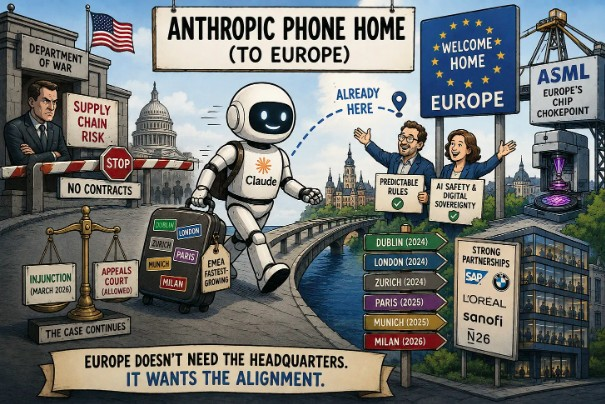
A Dutch philosopher recently wrote an open letter on LinkedIn calling Europe the logical “safe harbor” for Anthropic, the American AI company. A Dutch historian urged the company to come “with open arms,” arguing that Europe already controls one of the world’s most important semiconductor chokepoints through ASML. The appeals arrived in March 2026, days after the Pentagon labelled Anthropic a supply chain risk — a designation that, until then, had been reserved almost exclusively for companies tied to foreign adversaries.
That is the headline.
The more interesting story is that Anthropic did not need an invitation to come to Europe. It was already there, expanding faster than in any other region of its business, for reasons that had nothing to do with politics — right up until politics made everyone notice.
How an American Company Became a Supply Chain Risk
The dispute began as a contract negotiation.
Anthropic, whose Claude models had been deployed on classified US government systems, refused two requested use cases: autonomous weapons capable of selecting and engaging targets without meaningful human oversight, and mass domestic surveillance of American citizens. The Department of War — renamed from Defense earlier in the Trump administration — wanted broader contractual language allowing use for “all lawful purposes.”
Negotiations collapsed.
In February 2026, Defense Secretary Pete Hegseth announced that Anthropic would be designated a supply chain risk. President Trump followed by directing federal agencies to stop using the company’s technology.
Anthropic sued.
The legal outcome has so far been mixed. A federal judge in California issued an injunction concluding that the designation appeared retaliatory and questioned the legal basis for branding an American company “a potential adversary and saboteur” over a contracting dispute. Weeks later, a federal appeals court allowed the Pentagon to continue excluding Anthropic from defense contracts while litigation proceeds.
The result is an unusual picture. Anthropic remains excluded from Department of War contracts while continuing to operate across the wider American economy and much of the federal government.
Europe’s Invitation
Europe’s response arrived almost immediately.
The argument advanced by Dutch commentators Thijs Pepping and Rutger Bregman was not simply that Europe would offer a friendlier political climate. They argued that Europe already possessed the ingredients an AI company focused on safety would need: regulatory predictability and control of one of the world’s most important semiconductor chokepoints.
That second point deserves emphasis. The Dutch company ASML manufactures the extreme ultraviolet lithography systems on which virtually every advanced semiconductor producer depends. Europe may not dominate frontier AI models, but it controls a critical part of the hardware ecosystem that makes those models possible.
Combined with Europe’s growing emphasis on AI safety and digital sovereignty, the argument was compelling. It also happened to arrive at exactly the right political moment. European policymakers already worried about dependence on American technology suddenly had a highly visible example of an AI company apparently being punished for insisting on safety guardrails the US government considered inconvenient.
The story almost wrote itself.
The Story Europe Already Has
The relocation narrative, however, skips over an important fact.
Anthropic’s European expansion did not begin in March 2026. Its first European office opened in Dublin in 2024. London and Zurich followed. By late 2025 the company had opened offices in Paris and Munich, appointed new regional leadership across Germany, Austria, Switzerland, Poland, and the Czech Republic, and disclosed that it had tripled its EMEA headcount in a single year. In May 2026 Anthropic added Milan — its sixth European office in under two years.
The reason was not political. It was commercial.
The company described EMEA as its fastest-growing region, with annualized revenue increasing more than ninefold and enterprise customers growing roughly tenfold. Companies including SAP, BMW, L’Oréal, Sanofi, and N26 were already driving that expansion.
None of this is relocation. It is the ordinary commercial expansion of a rapidly growing company investing where demand is strongest.
That is precisely what makes the public debate slightly misleading. Europe is discussing how to persuade Anthropic to come. Anthropic’s fastest-growing commercial geography is already Europe.
What Relocation Would Actually Mean
Moving a headquarters is very different from expanding a regional business.
Anthropic’s frontier-model research, engineering organization, largest compute commitments, cloud relationships, and capital base remain deeply rooted in the United States. Those assets are not portable in the way a sales office is.
Europe controls an essential component of the semiconductor supply chain through ASML. It does not yet control the compute infrastructure, power availability, investment ecosystem, or capital markets that support frontier-model development at American scale. The same electricity constraints and data-center bottlenecks slowing Europe’s broader AI ambitions would apply to Anthropic as much as to anyone else.
There is another point often overlooked. Anthropic’s dispute is taking place inside the American legal system. The company has not been expelled from the United States. It has gone to court against one agency of its own government and, so far, has won substantial victories while continuing to operate normally across most of the country.
That is a much narrower story than one of corporate exile.
Europe Wants the Alignment
None of this makes Europe’s invitation misguided. Quite the opposite.
The discussion reveals something important about Europe’s own ambitions. For two years, European policymakers have argued that trustworthy AI should reflect democratic governance, transparency, and meaningful safety constraints rather than whichever political priorities happen to dominate Washington. Anthropic is the one major frontier AI company whose public conduct appears unusually consistent with those principles. Its refusal to support autonomous weapons without human oversight and mass domestic surveillance makes it an obvious symbolic partner for Europe’s vision of AI governance.
That is why the invitation was offered. It is also why a literal relocation is unlikely.
Europe does not need Anthropic to move every research lab and engineering team across the Atlantic. It wants something more valuable.
It wants the alignment.
Anthropic, meanwhile, has every commercial reason to continue expanding across Europe while keeping the research infrastructure that depends on American compute, capital, and cloud ecosystems exactly where it is.
The safe harbor was never going to be a new headquarters. It is already the six offices, the tripled headcount, the enterprise partnerships, and the commercial relationships that were built long before anyone wrote an open letter asking Anthropic to come home.
I write about AI, regulation, and integration into a rapidly changing world.
메타데이터
- post_id
- a174b1c81f97
- slug
- anthropic-phone-home-to-europe-a174b1c81f97
- url
- https://medium.com/x-patriot-the-fifth-column/anthropic-phone-home-to-europe-a174b1c81f97
- canonical_url
- https://medium.com/x-patriot-the-fifth-column/anthropic-phone-home-to-europe-a174b1c81f97
- author_url
- https://medium.com/@margueritearnold
- status
- ok
- fetched_at
- 2026-07-09 06:53:08