I Am Not a Ghoster, but I Can’t Say Goodbye
The quiet logic behind slipping away without a word.
I Am Not a Ghoster, but I Can’t Say Goodbye
The quiet logic behind slipping away without a word.

Vanished in the dark — suddenly gone and disappeared from view. Photo by Rene Böhmer on Unsplash
When leaving feels safer than saying goodbye
I leave quietly. Heimlich still und leise (quietly, secretly, without a fuss). I slip out when no one’s looking. No big hugs, no wave, and no round of “It was lovely; let’s do this again.” I am simply gone.
Others do not like it. They say, “You were suddenly gone.”
But this is exactly what happened to me before I was born, in the womb, and maybe this is why I do it like that.
It costs me something to do it the other way.
To stand there, in full view, and say, “I am leaving now.” To let the moment stretch. To hold someone’s gaze while we both acknowledge the ending. I do it when I have to. But I never find it easy.
Here is the part that gets me: When I watch a film and there’s a farewell scene – the whole family on the porch, waving until the car disappears down the road, someone’s eyes going watery – I feel this pull. A longing. Something in me says, “Yes, that. That’s what it should look like. Goodbye parties, gifts, speeches. That’s how it’s done.”
But not for me. For me, it’s slipping out quietly and feeling strangely lighter and heavier at the same time.
I used to think this was just introversion. Or awkwardness. Or some minor social glitch I never bothered fixing.
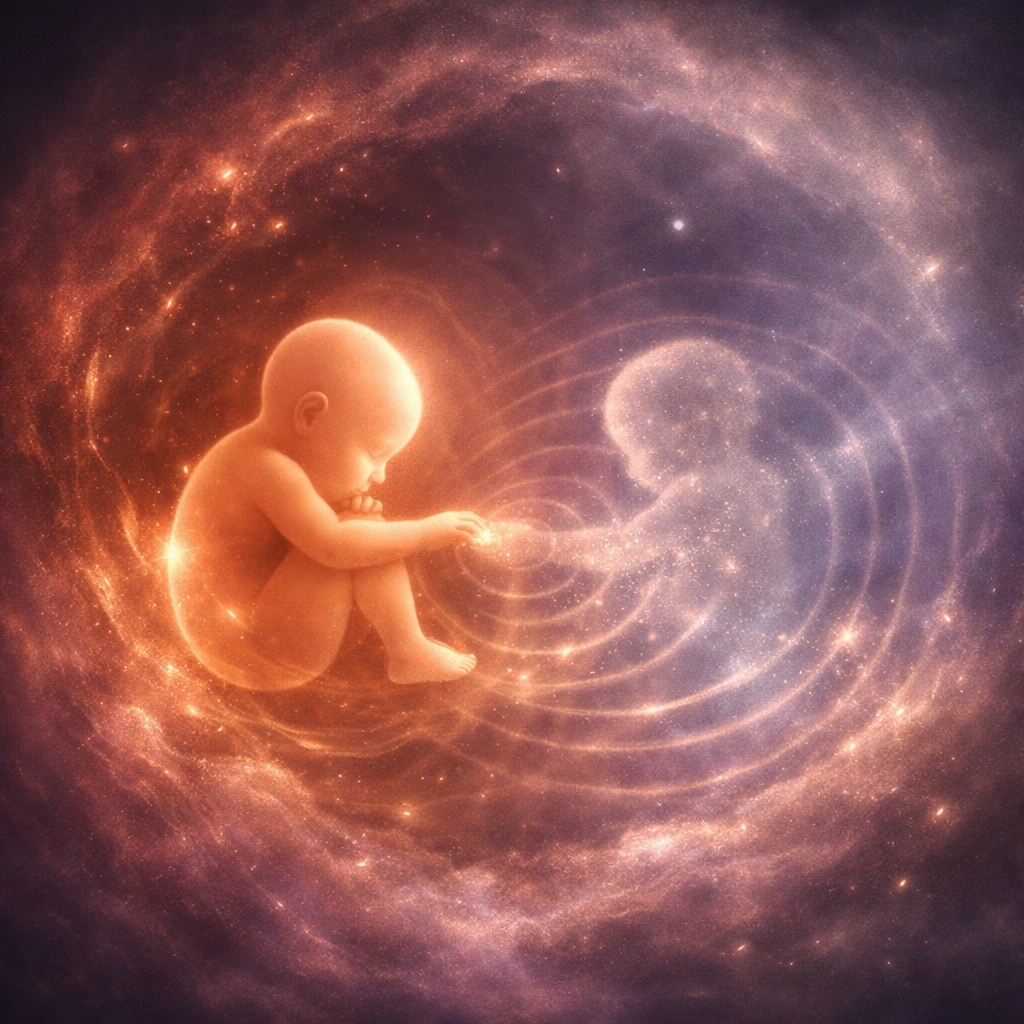
Then I learnt I started life as a twin.
Here is something that does not make the headlines: roughly one in ten of us begins in the womb with company.
A twin. A womb-mate. Someone else, from the very start.
And then, usually between week six and week twelve, that second heartbeat stops. The other embryo gets cold, right next to me, only separated by a thin veil. Then it vanishes; it gets absorbed back into the body. No birth, no name, no funeral. The pregnancy continues, now with one. Most mothers never even know it happened. But the memories and some strange behaviour patterns remain, or feelings of longing or of being left behind and being abandoned do.
The surviving twin, who is now just a singleton, is born alone. Grows up alone. Has no memory of the other. No conscious knowledge that anyone was ever there.
But the body remembers what the mind cannot.
Researcher Althea Hayton spent eight years studying womb twin survivors through a large online questionnaire project. What she found, across hundreds of stories, was a consistent pattern: womb-twin survivors, as they are called, carry grief they cannot explain; feel incomplete in ways they cannot name; and, this is the part relevant to this article, find goodbyes extraordinarily difficult.
Not a little uncomfortable. Horribly difficult is the phrase used in the clinical literature. Goodbyes land as small catastrophes. Separation triggers what looks like anxiety but feels older and deeper than anxiety. Like a body alarm that goes off in response to endings.
Because endings, for the womb twin survivor’s nervous system, carry a different weight.
The first ending was the loss of the twin. And there was no goodbye for that one.
(I almost cry as I write that.)
Here is how it works bodily, not emotionally.
When two beings share a womb, they share more than space. They share the blood supply, the nutrients, the warmth, the rhythm, the sound, the movement, the entire biochemical environment. The nervous system of each is literally calibrated to the presence of the other. Not metaphorically. Physically. The body learns: we are two. We are together. This is normal.
Then one is gone.
The survivor’s body does not receive a clean signal that the loss happened. There is no rupture, no dramatic event, no clear before-and-after. The other simply does not react anymore — no more touching and no more play. He grows cold and then vanishes. The nervous system, still calibrated for two, keeps waiting.
This is the origin story of the goodbye problem. Every later separation — even a small one, even a pleasant one — lands on that original imprint. The body has learned that when someone goes, they do not come back.
Not “They might not come back.” They don’t. The first one didn’t.
So the nervous system responds to ‘goodbye’ the way it learnt to, with alarm. With freeze. With that familiar pull to slip out quietly before the ending can happen to you.
Leaving on your own terms is not the same as being left.
The pattern even expanded to my first marriage. I was always worried and concerned I was not good enough, and I could be left behind, so instead of waiting for this, I ended the relationship. I had to, because it seemed so threatening.
In hindsight and with distance, it looks crazy. Meanwhile, I have learnt to manage that fear better, but it is still there. I am currently visiting a friend. We planned that I would stay several months over the summer, but the moment I stepped into her house, there was the feeling. What if she kicks me out and I cannot stay? I suppress that feeling every day, and it costs me energy; it is as if I had to tell my inner child as an adult, “Calm down. Maybe it will not happen, and if it does, we will find a way. We will sort it out.”
Sounds ridiculous? It doesn’t feel that way.
Maybe if this resonates, you had a simpler experience, or you know people who do not say goodbye and just sneak out. Maybe that’s the reason why. Maybe it’s not a sign of being disrespectful and rude but a sign of a very early trauma imprint.
So, why do I slip out before anybody notices? I do not want the attention. I find it hard to handle.
There is an uncontrollable impulse to leave before anyone notices. Vanish cleanly. No fuss, no ceremony, no extended moment of mutual acknowledgement.
The Irish call this the ‘Irish exit’ — slipping out of a party without saying goodnight to anyone. It sounds anti-social. But it is a survival mechanism, and it is actually a very efficient nervous system solution. If you never arrive at the goodbye moment, the goodbye moment can’t hurt you.
This strategy is not a character flaw. It is the body’s way of managing an experience it learned very early is potentially unbearable.
But there is the other side, the one I described at the opening. The longing for the goodbye ritual you cannot do yourself. Watching the farewell scene in the film and feeling the yearning. Wanting the waving family on the porch. Understanding, intellectually, that this is how humans mark endings with warmth and care. But not being able to get there from here.
In studies of womb-twin survivors, one finding repeats — early loss leaves a signature that shapes every ending. Goodbyes feel heavier because the body has lived one before, long before memory began.
This is not a metaphor. It is a description of how the nervous system encodes experience.
The infant who lost a twin in the uterus does not grow up remembering it. But the body encodes the pattern. I was with someone. They left. I could not stop it. And there was no goodbye.
That encoding shapes the nervous system’s response to every subsequent ending. Not dramatically. Not always consciously. But reliably. The moment of goodbye — the visible, public, held-gaze kind — brings up something the nervous system recognises as that old thing and responds accordingly.
For some, freeze. For some, flee. For some, the Irish exit. For some, staying too long and then leaving badly, trailing apologies.
And for almost everyone, the quiet, persistent sense that goodbyes are harder than they should be.
Here is the strangest part. The healing path that Althea Hayton described in her research includes a farewell ritual for the lost twin. A conscious, deliberate goodbye to someone who was never consciously known. A ceremony of acknowledgement. You were here. You mattered. I carry you with me. And I release you.
It sounds esoteric. But it is, in fact, deeply practical.
Because the body is waiting for the goodbye it never got. The nervous system is still calibrated for a presence that left without a signal. The farewell ritual is not a spiritual performance — it is the completion of an unfinished loop. The nervous system, finally, gets the goodbye it needed.
Many womb-twin survivors report that after this ritual, goodbyes in daily life become easier. Not effortless. Not suddenly the thing they enjoy. But more bearable. The weight shifts.
The first goodbye, finally given, changes all the ones that follow.
You have probably seen this in yourself or in someone close to you now that you are reading this.
The person who always leaves without saying goodbye. The person who turns goodbyes into productions — making them last an hour because they cannot let the moment close. The person who watches farewell scenes in films with an ache they cannot explain.
The person who stays in relationships long past the point of wisdom because the alternative is an ending and endings are too much.
The person who ghosts — not out of cruelty, but out of a nervous system that has learnt if I don’t acknowledge the ending, the ending cannot happen.
These are not personality types. They are body strategies. They are ways of living with an imprint that was made before language, before memory, before any conscious story could be built around it.
Knowing that does not fix it instantly. But knowing it changes the quality of the experience. The goodbye that felt like a character flaw becomes something different, a trace of the first relationship you ever had.
I still leave quietly. Mostly.
But sometimes — not always, but sometimes — I stay for the goodbye. I hold someone’s gaze while we both acknowledge the ending. I let it be what it is.
It costs me something. But less than it used to.
And now I know why.
Louisa Light writes about womb twin survivors, consciousness, and the body’s quiet logic. This is part of the Lost Twin Tales series. If this landed somewhere real, hit follow.
Did you find this article interesting? Consider reposting …
메타데이터
- post_id
- a17fbc5d729f
- slug
- i-am-not-a-ghoster-but-i-cant-say-goodbye-a17fbc5d729f
- url
- https://medium.com/publishous/i-am-not-a-ghoster-but-i-cant-say-goodbye-a17fbc5d729f
- canonical_url
- https://medium.com/publishous/i-am-not-a-ghoster-but-i-cant-say-goodbye-a17fbc5d729f
- author_url
- https://medium.com/@louisa-light
- status
- ok
- fetched_at
- 2026-07-13 06:45:54