The best way to speed up audits: AI assistants
In the last few years, AI has become part of everyday business operations. It’s no longer just a buzzword or a feature in new tech; it’s…
The best way to speed up audits: AI assistants
In the last few years, AI has become part of everyday business operations. It’s no longer just a buzzword or a feature in new tech; it’s something teams are actively using to improve how work gets done.
Businesses, in particular, have started adopting more AI solutions to enhance their operations. A McKinsey study found that 88% of surveyed businesses report regular AI use now in at least one business function, compared to 78% a year ago.
However, many of these organizations are still in their pilot phases with AI. This means they’re still only experimenting with AI tools and have not yet fully integrated them into their daily workflows. Research from Exploding Topics supports this, showing most organizations today are more focused on exploring with AI, rather than embedding it into core processes.
But they shouldn’t stop at exploration — they should learn to deploy AI properly and integrate it into their daily tasks. When AI is properly and efficiently integrated into businesses, it can deliver great and measurable gains, especially with one of their most time-consuming tasks: auditing.

Why auditing takes so long
Before understanding how AI improves audit times, it’s important to understand why audits take so long in the first place. Even with digital tools, many audit processes still rely heavily on human input at every stage. While it works, doing so creates bottlenecks, inconsistencies, and unnecessary administrative work.
Traditional audits often involve:
- Manual data entry and management
- Paper-based or static digital forms
- Time-consuming evidence collection
- Repetitive documentation and follow-ups
- Lengthy report writing
In the end, auditors and frontline workers frequently spend more time documenting the audit than performing the actual inspection.
That’s not just inefficient, it’s costly.
And that’s exactly why this is where you should introduce AI solutions.
How AI can reduce audit times
When used well, AI supports teams at every stage of the audit process. Here are some ways AI has been noted to benefit and improve audit times:
- Automating repetitive tasks
- Providing real-time recommendations
- Generating summaries and reports
- Identifying risks and patterns
- Predicting potential issues
- Assisting with corrective action planning
The result? Faster, smarter, and more actionable audits.
Take note: the right AI solution or assistive feature for your organization won’t replace leaders and auditors; rather, it aims to support them. By reducing audit time, AI can greatly enhance existing processes by speeding up turnaround times, reducing repetitive workflows, and helping piece together fragmented operations.
A Verdantix study, “Future Of AI-Enabled EHS Software Solutions,” echoes this, specifically citing how the Environment, Health, and Safety (EHS) industry has seen positive changes in their auditing procedures and completion times once AI was properly adopted. AI is also used to gain insights and interpret data into more palatable forms, making it easier for leaders to identify areas for improvement. From core operations to niche services, AI is seen helping improve the time it takes to do any work, anytime and anywhere.
Key AI features that reduce the number of audits
Keeping up with audits is important — but constantly pulling teams off the floor to complete them isn’t sustainable. That’s where AI-powered features come in to reduce audit time in the following ways:
1. Instant audit form and checklist creation
Creating audit templates can be time-consuming, especially when teams have to reuse outdated forms, manually research standards to include in checklists, and customize different fields for various departments or users.
AI tools can help users create the right templates they need with simple prompts and by suggesting edits based on their wants and needs. An AI assistive feature can also provide edits you can implement on your forms based on past data.
2. Data and evidence management
During an audit, speed matters, and incomplete documentation often leads to delays later. AI assistants improve data collection by prompting auditors for missing information in real time, then recommending follow-up questions when risks are identified. AI tools can also help with searching for documents across different folders, clouds, and storage spaces. Together, these lead to reduced incomplete inspections and time-consuming revisions.
3. Real-time risk scoring and prioritization
Risk assessment is often subjective and time-intensive. When conducting it, auditors must assign severity levels, calculate risk scores, evaluate risk likelihood, and compare results and plans with company standards — all of which can last hours to days, sometimes even longer.
AI reduces this workload by:
- Automating and calculating risk scores
- Prioritizing findings based on its readings
- Comparing results ot historical data
- Identifying risks and creating solutions for them
- Prompting follow-ups based on a set schedule
4. Instant report generation
One of the biggest time drains in auditing is writing the final report. Traditionally, this involves compiling notes, organizing evidence, writing summaries, and creating overviews. AI accelerates the reporting process by automatically generating summaries of key points and highlighting important risks and actions — all already formatted to your standards.
Finish audits sooner without sacrificing quality. For many teams, this is where the biggest time savings happen.
5. Data simplification and analysis tools
Reviewing past documents to identify trends can take days if done manually, which is where AI comes in. A great use for AI assistant tools is to analyze existing data, audits, and reports.
AI can analyze thousands of audit records in seconds to:
- Identify recurring non-conformances
- Detect patterns across locations
- Highlight seasonal risks
- Predict future compliance issues
This eliminates the need for manual spreadsheet analysis and accelerates strategic decision-making.
SafetyCulture’s AI Assist: coming soon
It can take time to find the right AI tool for your business, which is why many are often stuck in the testing phase more than the deployment one. Many solutions sit outside existing systems, which slows adoption and reduces interest.
Thus, the most effective AI tools are built directly into your operations platform. That’s where SafetyCulture’s upcoming AI Assist comes in.
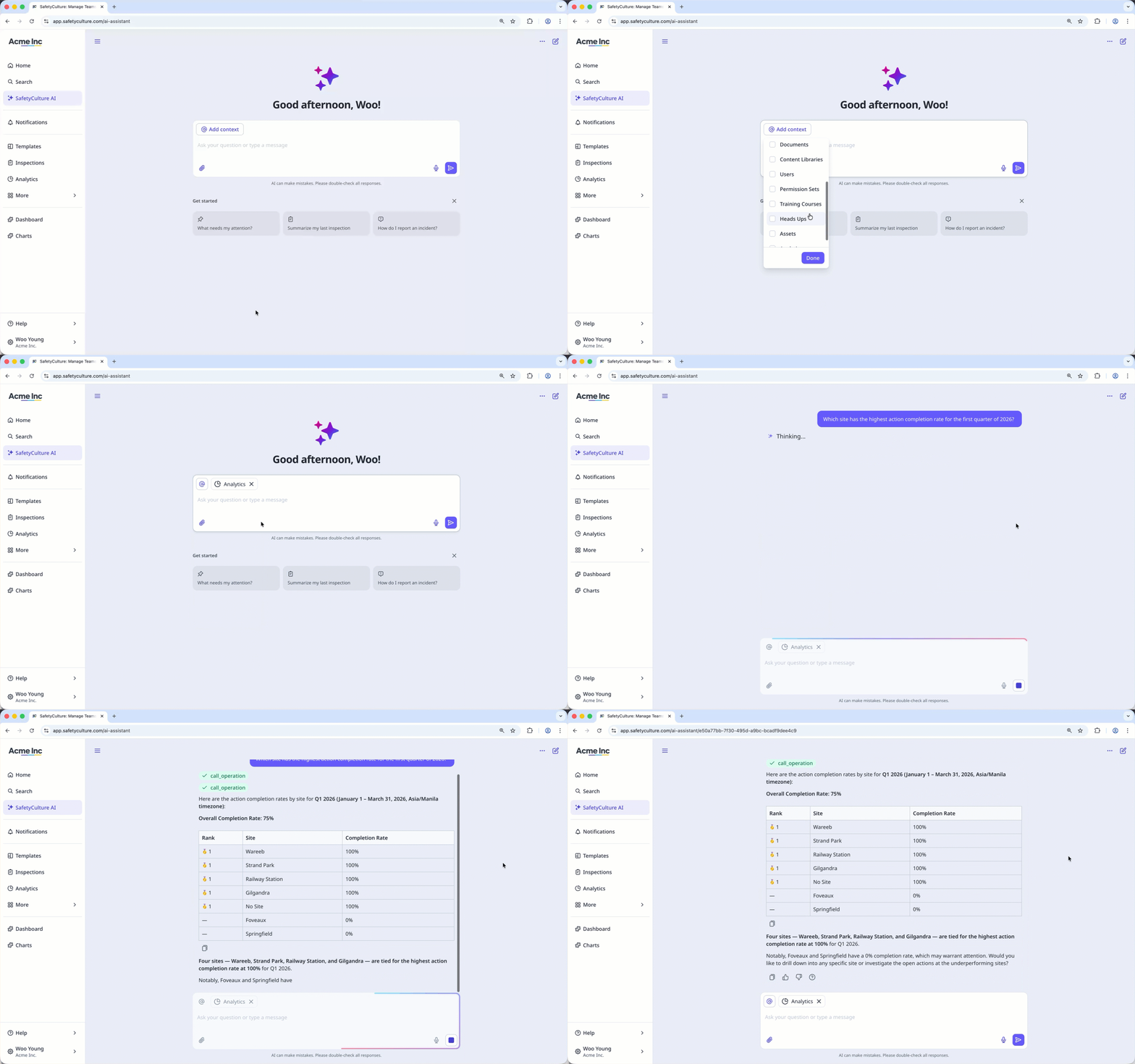
Disclaimer: This is currently in Early Access and is not yet available to all users.
The AI Assistant is designed to be users’ co-pilot in their everyday lives. It helps bring together the tools and information you need in one place, saving users time on searching, downloading, and clicking around features — speeding up any auditing taking place. It provides users a way to find answers, surface the right context, and take action directly in the platform.
FAQs about AI and auditing
How can AI enable continuous auditing and real-time monitoring?
AI tools and assistants enable continuous auditing by automating real-time data analysis across full transaction populations, shifting from periodic snapshots to ongoing oversight. AI can also be used to supplement monitoring tools and their readings. This allows auditors to detect anomalies, risks, and compliance issues as they occur, rather than retrospectively.
What skills and training do internal auditors need to use AI effectively and ethically?
Before using AI tools, internal auditors need technical proficiency, critical thinking, and ethical awareness to deploy AI responsibly in audits. Their training should focus on hands-on application across the audit lifecycle, emphasizing risk mitigation and compliance.
How does AI enhance audit planning and risk assessment?
AI enhances audit planning by analyzing vast datasets to pinpoint high-risk areas and generate tailored audit plans, while improving risk assessment through predictive analytics and anomaly detection. This shifts auditors from manual sampling to data-driven prioritization, enabling proactive strategies over reactive ones.
How does AI adoption affect auditor independence and professional judgment?
AI tools and assistants can support auditor independence by reducing human biases through objective data analysis while preserving professional judgment as the essential oversight layer. Having AI helps mitigate independence threats from familiarity or self-interest by automating routine tasks, allowing auditors to focus on skeptical evaluation of AI outputs.
메타데이터
- post_id
- a18c8d8addc7
- slug
- the-best-way-to-speed-up-audits-ai-assistants-a18c8d8addc7
- url
- https://medium.com/@safetyculture.com/the-best-way-to-speed-up-audits-ai-assistants-a18c8d8addc7
- canonical_url
- https://medium.com/@safetyculture.com/the-best-way-to-speed-up-audits-ai-assistants-a18c8d8addc7
- author_url
- https://medium.com/@safetyculture.com
- status
- ok
- fetched_at
- 2026-07-30 12:48:49