The Heroines of Japan — What Literature Tells Us of Women
This brief article is by no means intended to be used as an absolute guide — I would reacommend to treat it more as a friendly chat with a…
The Heroines of Japan — What Literature Tells Us of Women
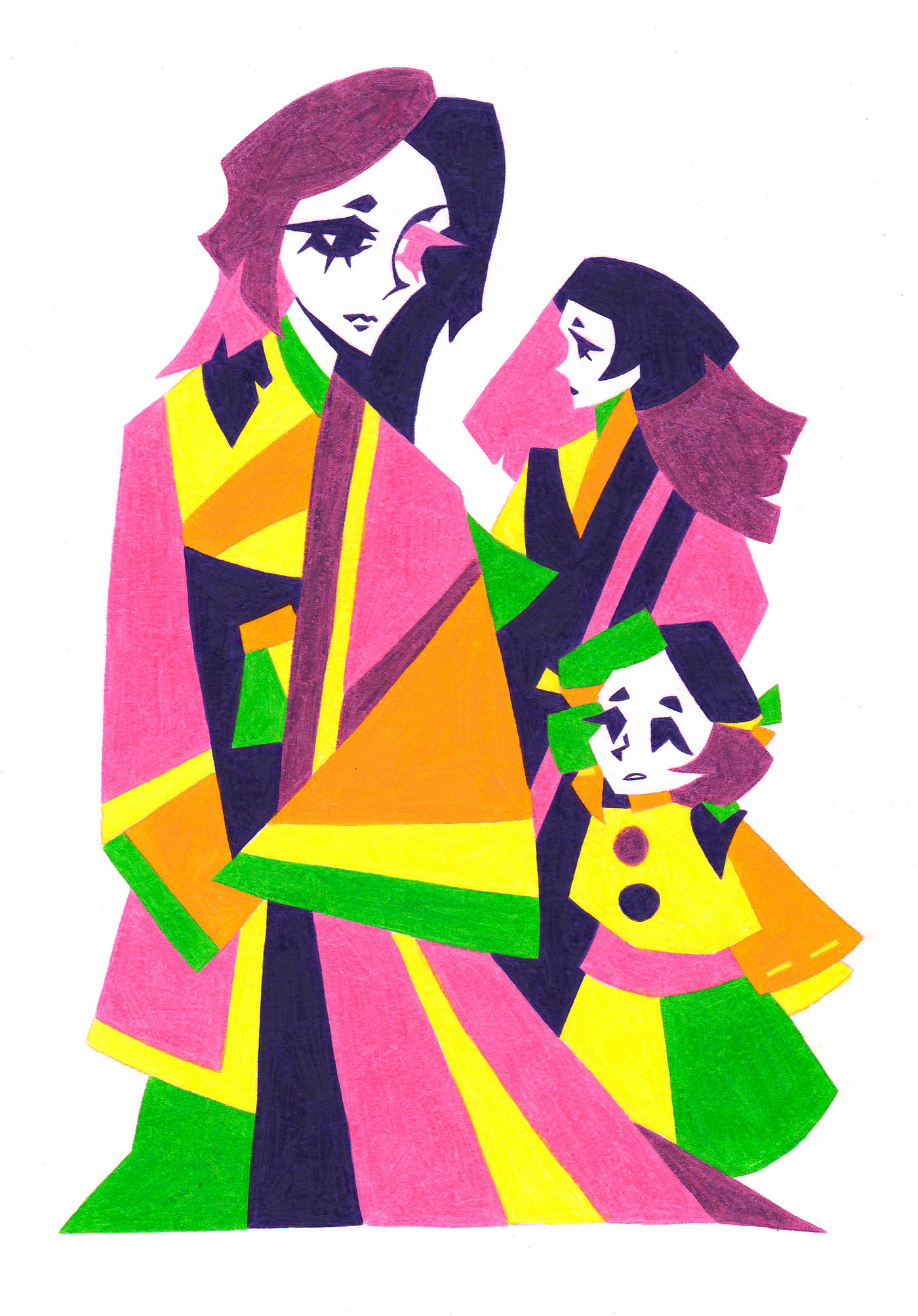
My illustration of the first key figures in the life of young Genji — Kiritsubo and Fujitsubo, “The Tale of Genji”
This brief article is by no means intended to be used as an absolute guide — I would reacommend to treat it more as a friendly chat with a passionate person who happens to read a lot, lot of amazing books. The focus of this text is amazing classical literature of Japan and how a view of women changed throughout the centuries. It is an introduction to a curious mind — a stepping stone in learning about history of literate tradition in this incredible country.
I always advice newer readers to trust their own judgement and not to reject a book because someone has told you to do so. That being said, I think it can be useful to share my thoughts on some of the biggest classics from Japan from my perspective — as a foreign, female reader of the 21st century. While I do not have a special degree in literature, I have years of studying art history and literature that have been proven useful in forming my opinions. I hope this experience will be of use for you!
The Cradle of Global Literature — The Mothers of the Medium
If you have ever found yourself interested in the history of fiction, you surely know that its roots are found in medieval Japan. Murasaki Shikibu, a noblewoman who got her pseudonym from her most beloved character, is considered to be the first author of a book, ever. But if you read “The Tale of Genji” today, perhaps you might not believe it was written by a female author while going through the story. What leads me to this judgement? Well, just like most of medieval traditions, the way of life back then may shock you at first. Though much more secure compared to the rest of the world — just the fact that women were way more protected by their own families as they did not have to move in with the husband and would usually stay in their residence with parents and siblings — the ladies still had to suffer greatly from the deeds of men. For that reason alone, it can be quite triggering to read certain scenes in “The Tale of Genji” — and believe me, there are a lot of them. Sexual assault is often romanticised in the novel, and I would often find myself disgusted by the main character whom most of the cast continues to praise for his beauty, manners and taste. Yet, there are times of clarity when you can feel the author’s contempt — one of such storylines is the stealing of a young girl whom Genji wants to raise as his future perfect wife, his “training” starting at the age that was considered childish even back then. The tone of the narration, perhaps, is one of a poetic acceptance of the tragic will a woman has to withstand throughout life. The work is a great source of knowledge for anyone interested in the etiquette and dynamics of the court-life, its strictly regulated love language — to the point of creating a special schedule for the lovers to meet by and the critical choice of paper one would confess on. Intriguing for an unprepared foreign reader, the Heian world of aristocracy feels like a theater play we cannot fully grasp but find ourselves incapable of looking away from.
If “The Tale…” was the first novel ever written, the not less important genre that actually started it all was also popularized by women in Japan of the same period — the diary tradition. These works, I must say, were the reason I fell in love with asian literature in the first place. For the sake of the article’s length, I will only discuss the two that have impacted me the most: “The Confessions of Lady Nijo” and “The Pillow Book”, both drastically different in their mood and atmosphere. A tragic extension of what “The Tale…” has only hinted, “The Confessions…” is a way more realistic example of a miserable life even a lady from a wealthy family would experience. While privileged, the writer cannot bring herself to see life as a gift in her autobiographical work: from the early childhood she learns of assault and how any must put up with violence; just like in certain parts of “The Tale…”, she weeps about her fate but carries on, believing being born a woman is a punishment from the previous life, according to the Buddhist traditions. The entire diary is absent from any joy, and any time Nijo feels she catches a breath — another tragedy strikes. And most saddening of all, each time she accepts her faith blaming no one but herself and only wishes to bring her soul to enlightenment to stop with neverending torture of being a woman. Quite a diffrent approach to religion compared to a priest who tried to enter her chambers many times against her and the Buddhist will.
In contrast to this somber work is Sei Shonagon’s witty, cocky even, “The Pillow Book”. Posed as a diary that was never intended for print, most researchers assume that it was written to be seen from the very start. Not being the most beautiful, Shonagon still attracted many, both admirers and haters, thanks to her sense of humour and intelligence. In the 11th century Japan, like in the most of the world, women’s education was limited, but it was of great importnafe for any aristocrat serving the royalty to know the renowned collection of poetry by heart and practice female simplified alphabet — the familiarity with cultural references applied with perfect calligraphy were some of the “sexiest” ways to present themselves, considering the ladies were only allowed to show a small piece of their long sleeves from behind the bamboo curtains. “The Pillow Book” is an excellent recollection of small sketches Shonagon shares, presumably edited but mostly true to the life of the court. Compared to the previous work, this diary is mostly a light and amusing read.
Men Take Literature Away
While Heian still had great influence of the local shinto which positioned the goddess of the Sun Amaterasu as the divine predecessor of the sacred Emperor, the later centuries would center the misogynistic philosophy of Confucian subordination exported from China — bringing an end to the tradition of female writers until the very Meiji era, or the Western intervention in the 19th century. When the absolute reign of the aristocrats was over, the military-centred government took off, removing women from the cultural scene at large. The role of a woman was now very limited: a daughter, a wife, a mother. As soon as men have become writers themselves, the literature started being considered of intellectual significance; however, in my opinion, oftentimes it was to the detriment of the quality of character portrayal. While I greatly enjoyed many anonymous (or, better to say, collectively voiced) epics such as “Heike Monogatori” or “The Tale of Yoshitsune”, most of the authored stories did not rank as high on my list as the early female writers we just discussed. Perhaps, it was because of its lack of moralist ingredient that most of the diaries shared? Still, such fiction works as “The Tale of Genji”, for me, managed to bring more dimension to the characters of both genders than many male successors ever wished to achieve.
The Return of Heroines
Finally, the discussion around gender was brought to masses as the equality movement was about to start in the 20th century. Here, from what I have gathered, some of my opinions may differ from the Japanese critics, and I am in no way in any authority to say my view is correct. Nevertheless, I think it is healthy to share views, and I would be more than happy to change my perspective on the authors I am talking about below.
The modernization brought very drastic changes to the mentality and structure of Japan, unquestioned during the long years of isolation. A lot of debate was caused by such a sudden mind-shattering explosion of new knowledge: science, philosopy and art, it all was new and alien to most. Views on women’s rights were ought to develop, and fast. Here comes a scandalous archetype, previously reserved mainly for prostitutes: an independent modern woman who knows how to use her charm, often compared to a villain destroying a good man’s life. When I was researching Kikuchi Kan’s “Madame Pearl”, I was surprised to find that the novel was considered feminist back then. Though the main heroine indeed feels strong and successful, a stylish, confident femme fatale who leads somewhat of a literary club and can easily make any men fall for her with her charisma, the language the author uses is a bit confusing. While a reader today may appreciate the fact that the men of the story are flawed, the text often feels like they are being victimized. The true meaning, as I see it, is how a patriarchal society can make a woman miserable, unsafe and discriminated against — however, the tone may lead to the idea that her shy, naive and reserved counterpart is a better example to follow and that the independent lead is overusing the power she has over men. Kikuchi Kan might not have intended the reader to have that impression, but, perhaps due to the context I grew up in, this work does not feel overly pro-feminist to me.
However, I always give an author a second chance, but a rare occasion I do not want to do it would be Yasunari Kawabata. I have read two books by this writer and both left a very unpleasant feeling towards his way of creating female characters. His “Thousand Cranes” was especially atrocious — while the back cover says the work is a great critique of the shallowness of the tea ceremony, I could not care less about this topic in the moment — so much it was about blaming the women for all and any of the protagonist’s anxieties and misdoings. Do not get me wrong — I am all for heroines not being perfect and making mistakes — but in this novel the young man seems to never take accountability for his and father’s problematic actions consisting of never-ending cheating. The next novel, “The Snow Country” was no better — not as infuriating yet absolutely as disrespectful, it felt like women are portrayed merely as men’s extensions. I think it was the worst experience reading Japanese fiction for me.
On a more positive note, Junichiro Tanizaki must be one of the best examples of male writers bringing the heroines to life on paper. His “Makioka Sisters” is a must-read for anyone who wants to start Japanese literature, its story full of emotion and personality: the sisters, all uniquely themselves, are an excellent portrayal of different types of women in pre-war Japan; in contrast to many other authors, Tanizaki does not villainize the characters for making mistakes, and the reader is free to form their own opinions on each of them. A family, all four of the girls are different, and I may even speculate that some of them could bear such archetypes as future anime’s staples like “kuudere” (emotionless on the outside but deeply loving once you know her).
Natsume Soseki and Takeo Arishima are other male writers who manage to properly introduce female characters. The latter’s “A Certain Woman” has a variety of personalities that feel real. Introducing several emotionally deep heroines, he makes them fight, pretend and doubt themselves in the context of a society that values strict rules and hierarchy.
Of course, it would be a huge misopportunity not to explore the female writers of the new wave of Meiji, but I admit that my knowledge in this area is limited but will hopefully be expanded as soon as I get foreign translations in my hands. Still, I have managed to find a few short stories by some of the 20th century prodigies, those being Ichiyo Higuchi and Yoko Kusaka. Both writers explore the life under the crashing patriarchy of the early Meiji era, focusing on the impoverished and rightless women from different discriminated backgrounds. The tone of their stories, in my opinion, reflects the inability to change the society they live in, yet not agreeing to the status quo. That is why, perhaps, the authors’ lives have ended so suddenly and early, on the verge of the conservative society collapsing yet not quite still there.
The last, and probably the most famous worldwide, novelist I will mention today is controversial Haruki Murakami. Being a big supporter of young female voices in literature, he himself is often criticized for the repetitive sexualization of his female cast from book to book. As I have read more than half of his novels, I can surely agree with this claim while also confirming there are a number of strong-willed and independent secondary heroines in his stories. My problem with his work is not exactly his bad writing of women, but more of the repetitiveness of tropes he never stops to overuse, be it related to gender or not.
To Be Continued!..
I hope that article was of any help to you, and I will surely continue to update it as I dive deeper into Japanese literature. My interest mostly lies within older classics as I continue to explore the 11th-20th centuries at the moment, pretty much missing out on the contemporary scene. But, be it a mere excuse, I feel like the newer novels coming out these years have already gained a massive following without any of my contribution needed. I hope more people pay attention to the incredible classical heritage of Japanese literature that I myself discovered by accident just recently. And I am sure there is great potential for Japanese literature to become as popular as the Western classics, so let’s read on together!
메타데이터
- post_id
- a19969ea75b7
- slug
- the-heroines-of-japan-what-literature-tells-us-of-women-a19969ea75b7
- url
- https://medium.com/hooked-on-books/the-heroines-of-japan-what-literature-tells-us-of-women-a19969ea75b7
- canonical_url
- https://medium.com/hooked-on-books/the-heroines-of-japan-what-literature-tells-us-of-women-a19969ea75b7
- author_url
- https://medium.com/@veronika.purplesfinx
- status
- ok
- fetched_at
- 2026-06-20 20:29:01