From Tools to Processes: Modernizing the SDLC for AI‑Driven Development
The Software Development Life Cycle (SDLC) has been the foundational framework for building software in predictable, repeatable stages for…
From Tools to Processes: Modernizing the SDLC for AI‑Driven Development
The Software Development Life Cycle (SDLC) has been the foundational framework for building software in predictable, repeatable stages for decades. Classical SDLC models — Waterfall, Iterative, Spiral, and Agile — are designed around human‑driven planning, coding, testing, deployment, and maintenance. However, the rapid adoption of Artificial Intelligence (AI) and Machine Learning (ML) is fundamentally reshaping how software is conceived, built, and maintained.
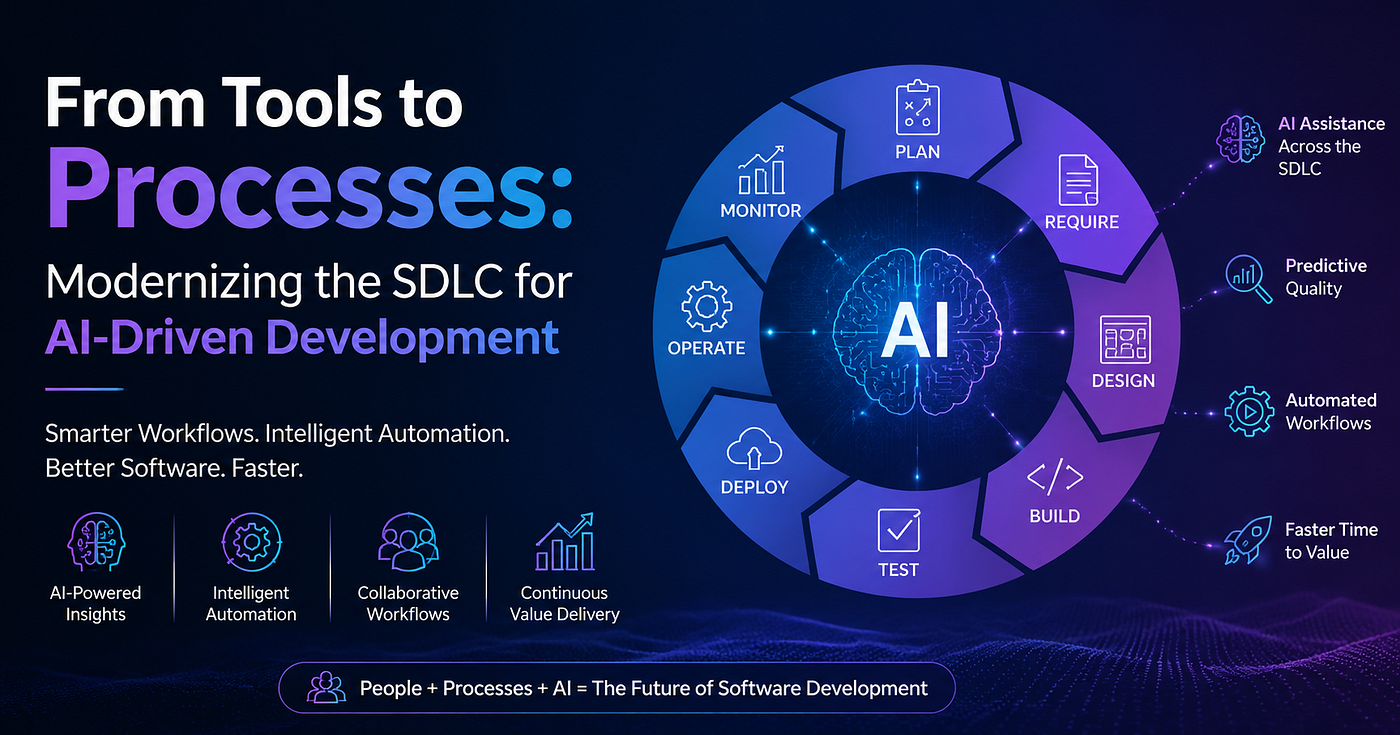
In the United States, where AI adoption is among the highest globally, companies across sectors — from healthcare and finance to manufacturing and logistics — are integrating AI components into modern applications. This evolution requires more than new tools; it demands a rethink of workflows, skill sets, decision processes, and delivery models.
In this article, we explore how the SDLC must evolve to support **AI‑centric development service practices**. We will explain the limitations of legacy SDLC models, outline the core differences between traditional and AI‑enabled development, present an AI‑ready SDLC framework, and highlight practical strategies for U.S. development teams to adopt modern workflows that increase velocity, quality, and business value.
Why Traditional SDLC Falls Short for AI?
Traditional SDLC models were designed for deterministic systems — software that behaves predictably based on clearly defined requirements. The core assumption is that requirements can be gathered up front, implementation can be structured in successive phases, and testing can verify that implementation against expectations.
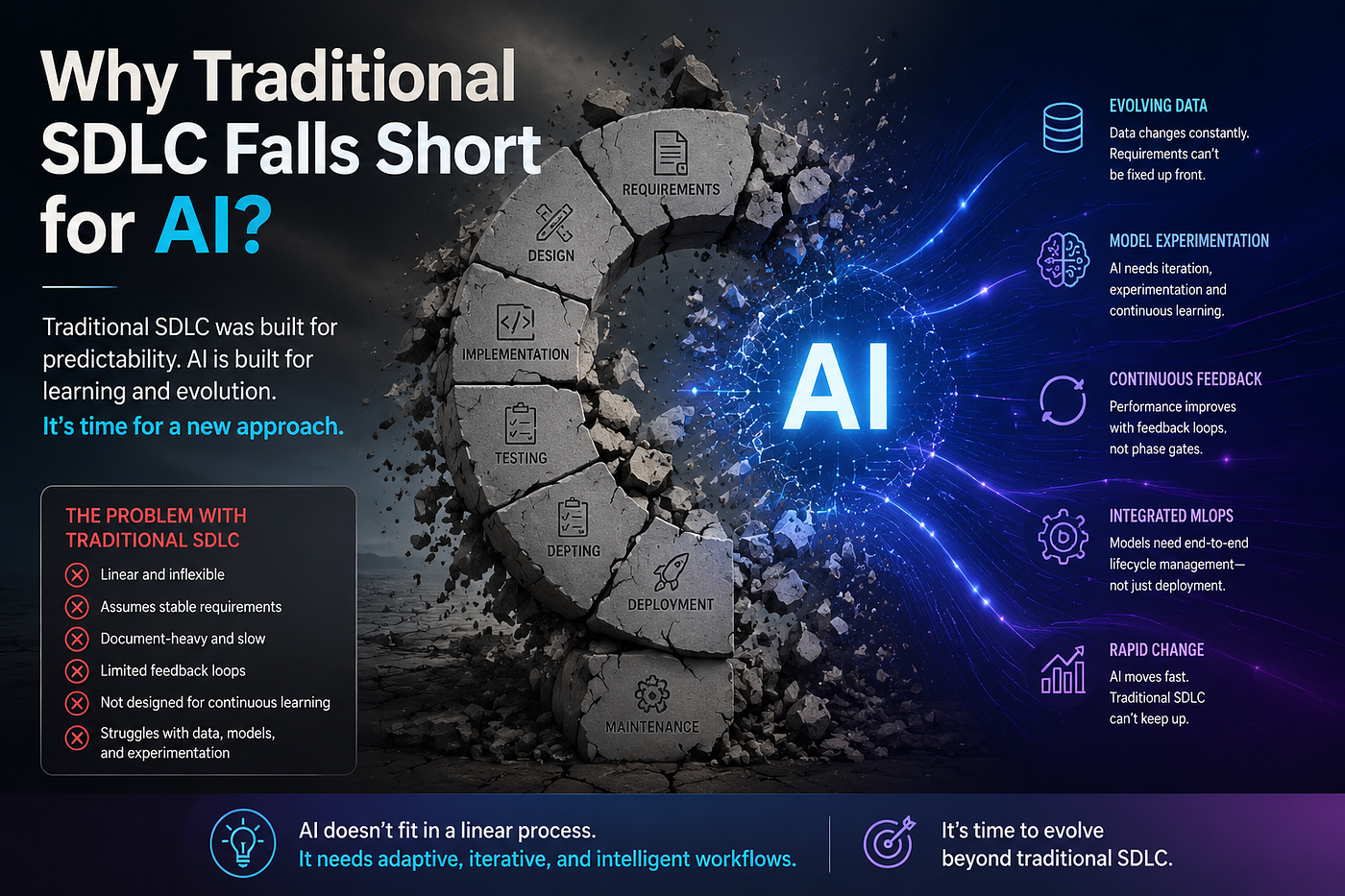
However, AI software development shares several characteristics that challenge these assumptions:
- Data‑centric development: Unlike rule‑based software, AI systems learn from data. Models improve, degrade, or change behavior based on the quality, completeness, and drift in data.
- Probabilistic behavior: AI outputs are inherently probabilistic, not binary or deterministic. This affects testing, validation, and repeatability.
- Evolving requirements: Data and model performance often redefine requirements mid‑development as insights reshape expectations.
- Integration complexity: AI components must interact with existing systems, APIs, data platforms, and monitoring tools.
- Model governance: Ethical compliance, bias mitigation, and transparent explainability are now key regulatory and operational concerns.
Key Limitations of Traditional SDLC in AI Projects

This table highlights how traditional SDLC models fail to account for data pipelines, model validation, ethics, and continuous learning loops — all essential in the AI age.
Core Differences: Traditional vs. AI‑Centric SDLC
To design better workflows, it’s critical to understand the structural differences between building conventional software and AI‑enabled systems.
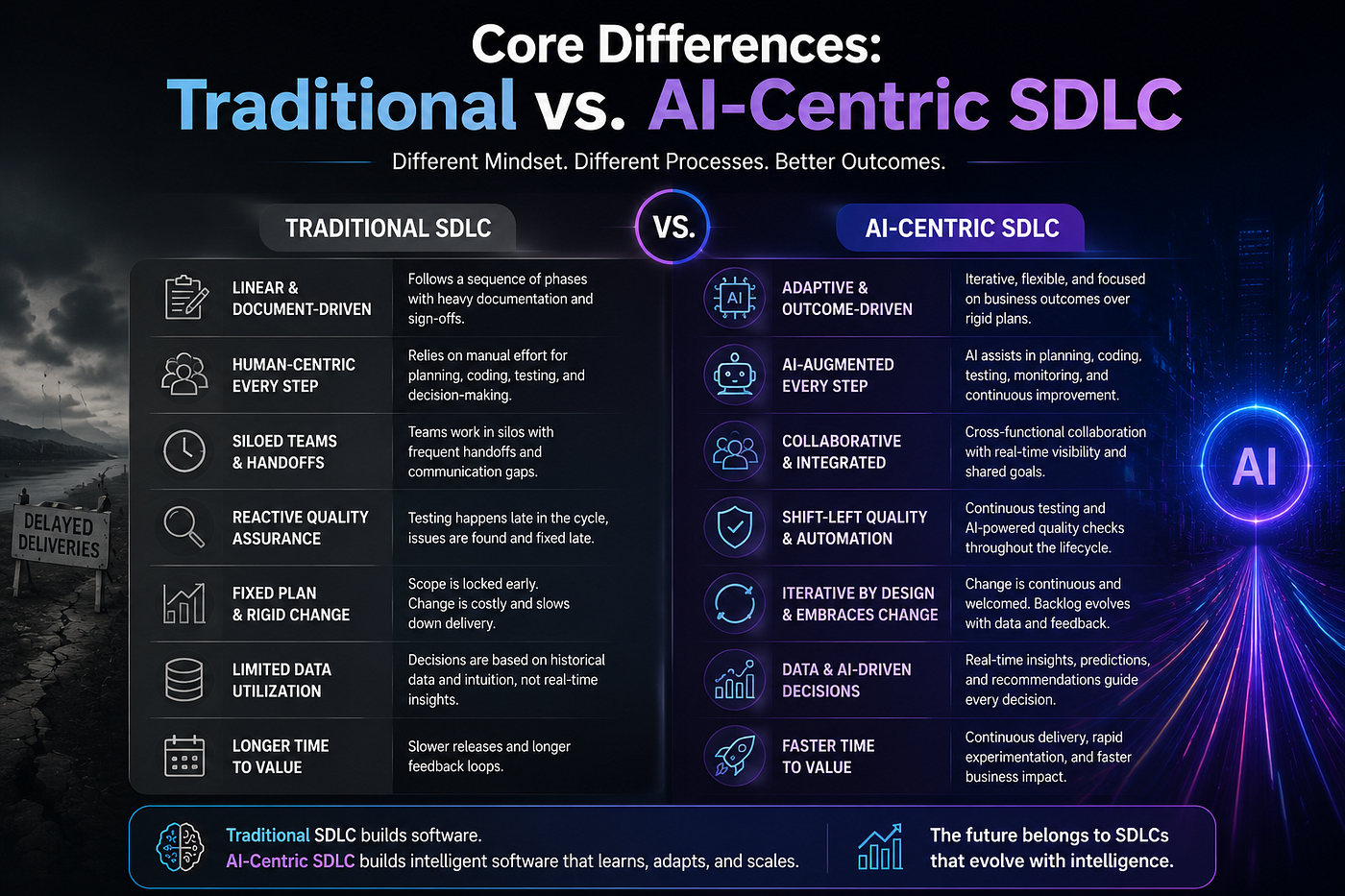
Requirements and Analysis

Design and Architecture
- Traditional: Focuses on system architecture, APIs, modules.
- AI‑Centric: Must design for data ingestion, feature extraction, model training, evaluation, and inference scaling.
Development and Implementation
Traditional software development is relatively modular and predictable. AI affords less predictability:
- Code and configuration define behavior in traditional systems.
- In AI, data shapes behavior, meaning workflows must emphasize data quality, preprocessing, labeling, and iteration.
Testing and Validation
Traditional testing focuses on unit, integration, and acceptance tests. AI systems require:
- Performance metrics (accuracy, precision, recall, F1‑score)
- Bias and fairness assessments
- Data drift detection
- Explainability and compliance checks
Deployment and Monitoring
- Traditional SDLC treats deployment as a milestone.
- AI workflows require continuous model monitoring, feedback loops, retraining, and versioning of both code and models.
Rethinking Workflows for AI
An AI‑ready SDLC must rethink standard workflows from end to end. The goal of this section is to outline a holistic AI workflow that integrates data science, software engineering, DevOps, and governance into a unified lifecycle.
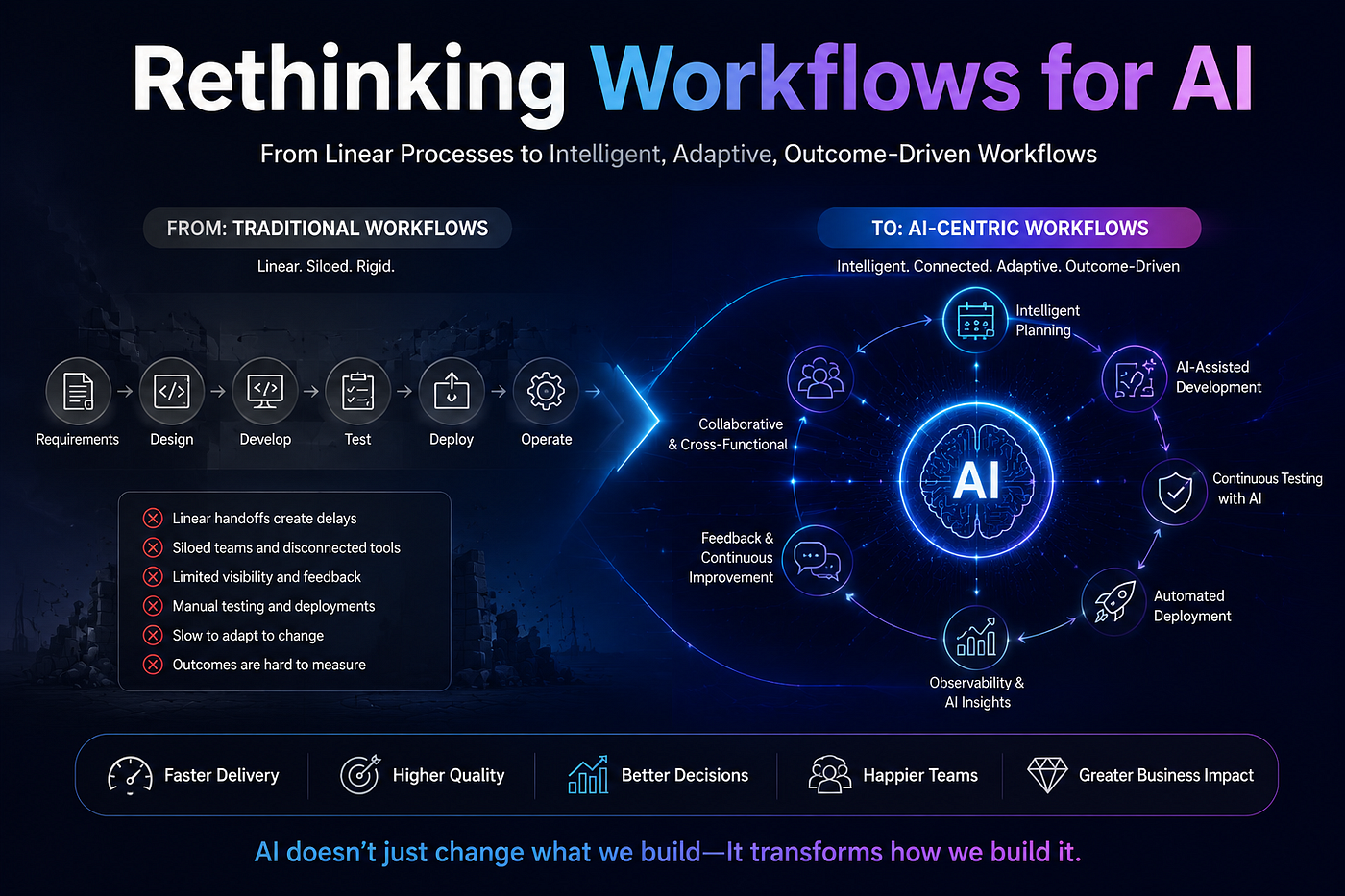
1. Problem Framing & Data Discovery
Before engineering begins:
- Engage stakeholders to define business KPIs
- Identify key datasets and perform preliminary exploration
- Evaluate feasibility: can the problem be addressed with predictive or generative AI?
- Establish boundaries for ethical and regulatory requirements (e.g., data privacy in the U.S. such as HIPAA, GDPR alignment for multinational products)
Outputs:
- Problem definition document
- Data inventory with access and compliance notes
- Preliminary success criteria and metrics
2. Data Engineering & Quality Assurance
Data transformation is central to AI workflows:
- Ingest raw data from multiple systems
- Clean, normalize, label, and version datasets
- Build repeatable pipelines (ETL/ELT) using orchestration tools
Best practices:
- Use data catalogs and metadata standards
- Automate quality checks (missing values, consistency)
- Track lineage for audit and compliance
3. Model Development & Evaluation
This phase is iterative and exploratory:
- Experiment with multiple model architectures
- Use cross‑validation and held‑out test sets
- Track metrics such as accuracy, precision, recall, ROC‑AUC
- Evaluate fairness, explainability, and bias
Best practices:
- Use experiment tracking tools (MLflow, Weights & Biases)
- Collaborate across teams: data scientists + engineers + product owners
4. Integration & Continuous Delivery
AI systems combine code, models, and data flows:
- Use CI/CD pipelines for code and model artifacts
- Containerize models using Docker and deploy on scalable runtimes (Kubernetes, serverless)
- Integrate inference endpoints into application logic
5. Monitoring, Feedback, & Retraining
Post‑deployment workflows are not optional:

Use automated retraining pipelines when performance drops below thresholds.
Governance, Ethics & Regulatory Compliance
AI systems, especially in regulated sectors like healthcare, finance, and government, must adhere to ethical and legal constraints:
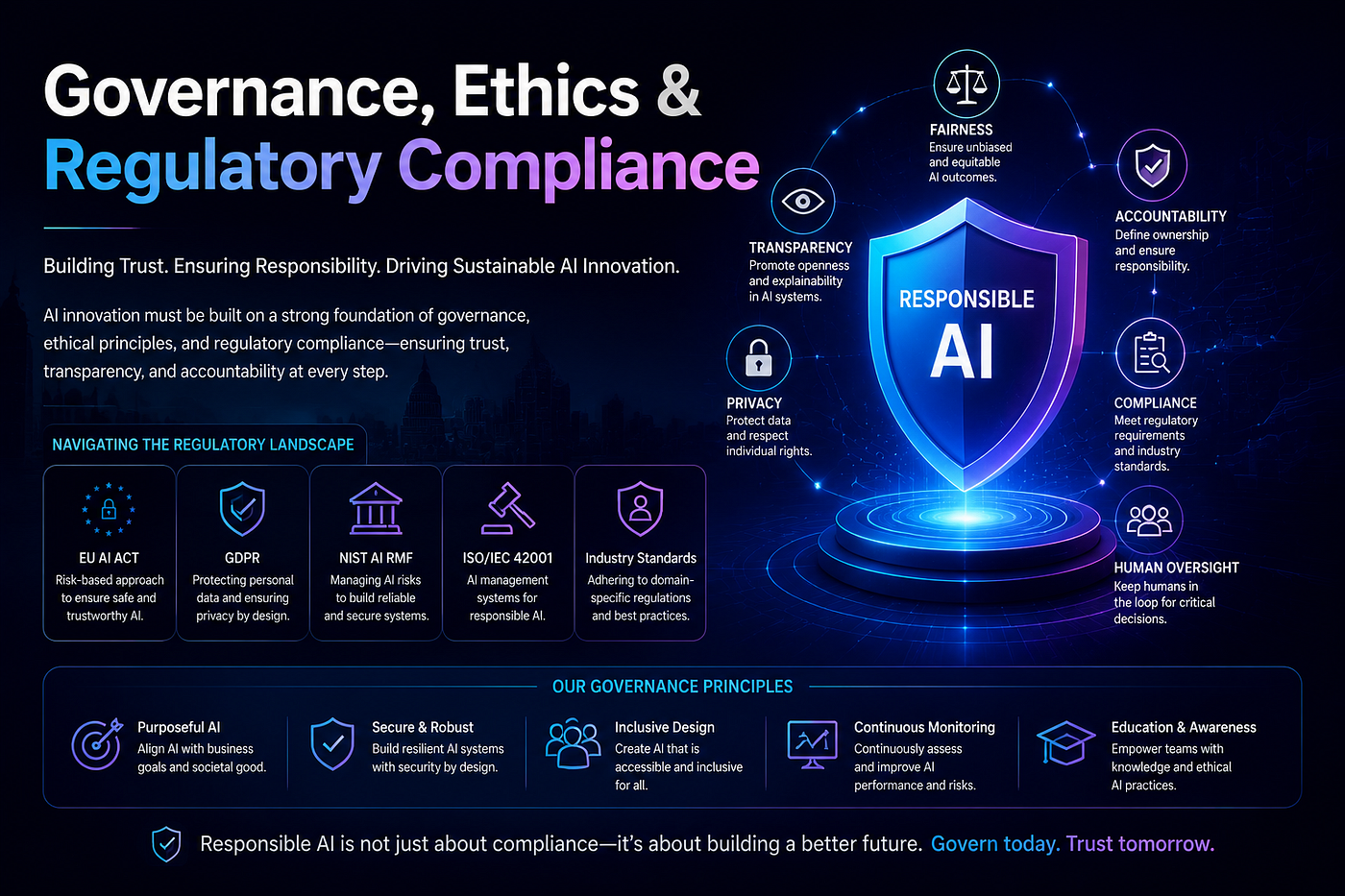
Bias and Fairness — Ensure models behave equitably across demographics.
- Transparency & Explainability
Users and regulators must understand how decisions are made, especially in critical domains like lending or medical diagnoses.
- Data Privacy
Adhere to U.S. compliance frameworks such as HIPAA, CCPA, and sector‑specific standards.
Governance Checklist
✔ Data lineage and audit trails ✔ Explainability reports for models ✔ Periodic fairness evaluations ✔ Privacy impact assessments ✔ Secure access and encryption
Conclusion
The age of artificial intelligence demands a fundamental rethink of the Software Development Life Cycle. Traditional SDLC models are no longer sufficient for systems where data drives behavior, models evolve over time, and continuous learning is part of operational reality.
To thrive in the AI era, organizations — particularly in the USA — must rethink workflows, tools, and delivery models to support data‑centric development, continuous integration and delivery of models, robust monitoring, and ethical governance. These changes unlock faster innovation, higher quality software outcomes, and measurable business value across industries.
AI‑ready SDLC is not simply a set of tools — it is a collaborative, iterative, and adaptive process that aligns engineering, data science, product leadership, and compliance teams toward shared goals.
By adopting AI‑aware workflows, development teams can move beyond incremental improvements and unlock transformational capabilities that reshape how software is built and how organizations innovate.
메타데이터
- post_id
- a1a8d60db4e3
- slug
- from-tools-to-processes-modernizing-the-sdlc-for-ai-driven-development-a1a8d60db4e3
- url
- https://medium.com/@maritzapeter85/from-tools-to-processes-modernizing-the-sdlc-for-ai-driven-development-a1a8d60db4e3
- canonical_url
- https://medium.com/@maritzapeter85/from-tools-to-processes-modernizing-the-sdlc-for-ai-driven-development-a1a8d60db4e3
- author_url
- https://medium.com/@maritzapeter85
- status
- ok
- fetched_at
- 2026-06-09 15:37:30