Why Playwright Is Rapidly Gaining Momentum Over Selenium: A Practical Perspective from Modern QA…
Over the past decade, Selenium has been the backbone of web test automation. For many organizations, it remains deeply integrated into…
Why Playwright Is Rapidly Gaining Momentum Over Selenium: A Practical Perspective from Modern QA Teams
Over the past decade, Selenium has been the backbone of web test automation. For many organizations, it remains deeply integrated into their testing strategy.
However, a noticeable shift is underway.
An increasing number of engineering teams are either experimenting with or actively adopting Playwright as their primary automation tool. This transition is not driven by trend alone, but by practical challenges that modern applications and delivery pipelines have introduced.
This article explores why Playwright is gaining momentum, based on real-world implementation patterns, architectural differences, and observed outcomes in QA teams.
The Shift Is Not About Speed Alone
It is often said that Playwright is faster than Selenium. While this is technically accurate, it does not fully explain the migration trend.
The more meaningful distinction lies in operational efficiency.
Selenium typically requires teams to build and maintain a supporting ecosystem:
- Custom wait mechanisms
- External test runners
- Reporting integrations
- Parallel execution infrastructure
In contrast, Playwright provides many of these capabilities out of the box.
As a result, teams are not just improving execution speed — they are reducing the total cost of maintaining automation.
Architectural Differences and Their Impact
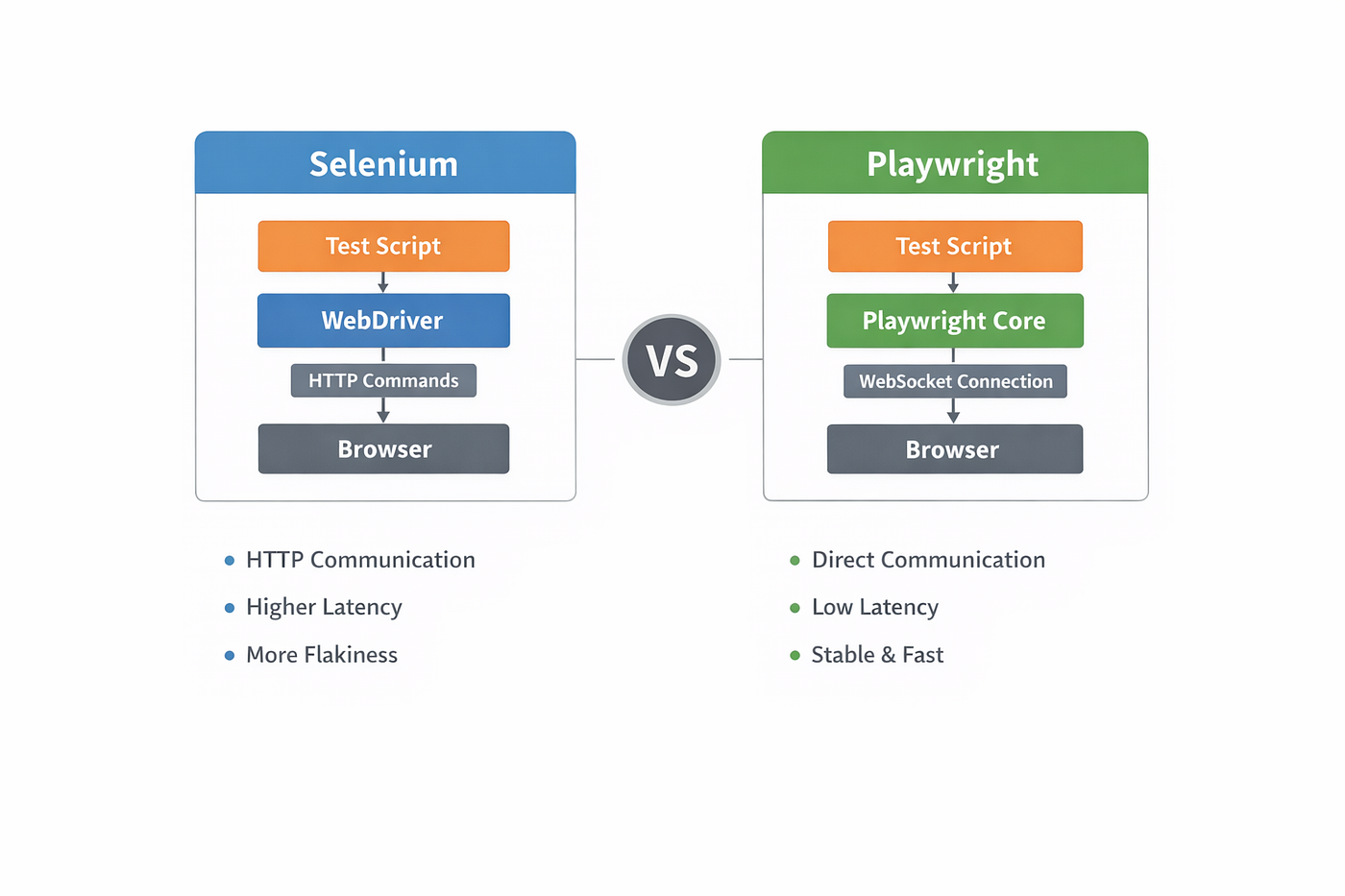
The core architectural distinction between the two tools plays a critical role in their behavior.
- Selenium operates through the WebDriver protocol, introducing an additional communication layer between the test script and the browser.
- Playwright communicates directly with the browser using modern protocols such as WebSocket.
This difference leads to:
- Reduced latency in command execution
- Improved synchronization with browser state
- Lower probability of timing-related failures
In practice, this translates to more stable and predictable test execution, particularly for modern, dynamic web applications.
Key Areas Where Teams Experience Tangible Benefits
1. Test Stability and Flakiness
Flaky tests are one of the most persistent challenges in automation.
With Selenium, teams often rely on:
- Explicit waits
- Custom retry logic
- Heuristic synchronization strategies
Playwright introduces automatic waiting mechanisms, ensuring that actions are performed only when elements are ready.
This significantly reduces:
- False negatives in test results
- Time spent debugging intermittent failures
2. Setup and Maintenance Overhead
A typical Selenium-based framework often includes multiple components:
- WebDriver configuration
- Test framework (e.g., JUnit, TestNG)
- Reporting libraries
- Grid or cloud setup for parallel execution
Playwright simplifies this by offering:
- A built-in test runner
- Native assertion library
- Integrated reporting and tracing
This consolidation allows teams to focus more on test design and coverage, rather than framework engineering.
3. Debugging and Failure Analysis
Understanding test failures quickly is critical for maintaining velocity.
Selenium debugging often depends on:
- Logs
- Screenshots (if configured)
- Manual reproduction
Playwright enhances observability through:
- Trace viewer with step-by-step execution
- Video recording of test runs
- Network request inspection
These capabilities provide clear visibility into failures, reducing investigation time.
4. CI/CD Integration and Scalability
Modern development practices demand:
- Fast feedback cycles
- Reliable pipeline execution
- Scalable test infrastructure
Playwright supports:
- Native parallel execution
- Seamless containerization
- Straightforward CI integration
In contrast, Selenium typically requires additional setup, such as Selenium Grid or third-party services, to achieve similar scalability.
Comparative Overview
The following table summarizes the differences in practical terms:

Where Playwright Delivers the Most Value
Playwright is particularly effective in scenarios involving:
- Modern single-page applications (React, Angular, Vue)
- Continuous integration pipelines requiring rapid feedback
- Teams starting automation from scratch
- Environments where test flakiness impacts delivery timelines
Where Selenium Still Holds Relevance
Despite its limitations, Selenium remains a viable choice in certain contexts:
- Projects requiring support for legacy browsers
- Organizations with large, established Selenium frameworks
- Teams relying on a wide range of programming languages
Its maturity and ecosystem continue to provide stability for long-standing implementations.
Understanding the Timing of This Shift
Playwright was introduced in 2020, yet its adoption has accelerated more recently. This can be attributed to several factors:
- Increased complexity of frontend architectures Modern applications rely heavily on asynchronous rendering and dynamic DOM updates.
- Evolving CI/CD expectations Faster and more reliable pipelines are now essential.
- Rising maintenance costs of traditional frameworks Teams are prioritizing tools that reduce long-term overhead.
- Maturity of Playwright as a tool It has reached a level of stability and community support suitable for production use.
A Practical Perspective: Coexistence Rather Than Replacement
In practice, many organizations are not completely replacing Selenium.
Instead, a hybrid approach is emerging:
- Selenium continues to support legacy systems and stable regression suites
- Playwright is adopted for new development and high-velocity pipelines
This strategy enables teams to balance stability with innovation, without incurring unnecessary migration risk.
Conclusion
The growing adoption of Playwright is not driven by novelty, but by alignment with modern engineering needs.
It addresses key challenges that QA teams face today:
- Reducing test flakiness
- Simplifying framework maintenance
- Improving debugging efficiency
- Accelerating delivery pipelines
While Selenium remains relevant, Playwright represents a shift toward more integrated, efficient, and scalable test automation practices.
메타데이터
- post_id
- a1a904802ea6
- slug
- why-playwright-is-rapidly-gaining-momentum-over-selenium-a-practical-perspective-from-modern-qa-a1a904802ea6
- url
- https://medium.com/@amrutalohabare/why-playwright-is-rapidly-gaining-momentum-over-selenium-a-practical-perspective-from-modern-qa-a1a904802ea6
- canonical_url
- https://medium.com/@amrutalohabare/why-playwright-is-rapidly-gaining-momentum-over-selenium-a-practical-perspective-from-modern-qa-a1a904802ea6
- author_url
- https://medium.com/@amrutalohabare
- status
- ok
- fetched_at
- 2026-06-10 08:17:25