MCP, Vector DBs, Agents, Shared Memory: The State Management Shift You Need to Know (An…
At the start of 2025, memory Model Context Protocol (MCP) servers were largely treated as a curiosity — a handful of community-driven…
MCP, Vector DBs, Agents, Shared Memory: The State Management Shift You Need to Know (An Architectural Comparison)
At the start of 2025, memory Model Context Protocol (MCP) servers were largely treated as a curiosity — a handful of community-driven projects built by developers who wanted their AI agents to remember small details between separate chat sessions. By mid-2026, the landscape shifted dramatically. The “memory” category inside the curated awesome-mcp list has expanded to include dozens of active projects, major frameworks have published official reference packages, and adding a dedicated memory server has become a standard step in modern AI agent setup guides.
This rapid transition signals a deeper architectural evolution. The industry is beginning to realize that the fundamental blocker to building truly capable, autonomous AI systems is no longer a lack of reasoning power or tool access, but rather the severe limitations of statelessness.
Yet, as developers rush to plug the memory gap, a critical architectural divide has emerged. Most popular memory servers operate as simple, isolated “private notepads” tied to a single agent or client instance. If an organization’s workflow spans multiple models, platforms, and sessions, these isolated databases fall short. To build resilient AI systems, we must understand the difference between local memory utilities and a cross-AI shared memory layer.
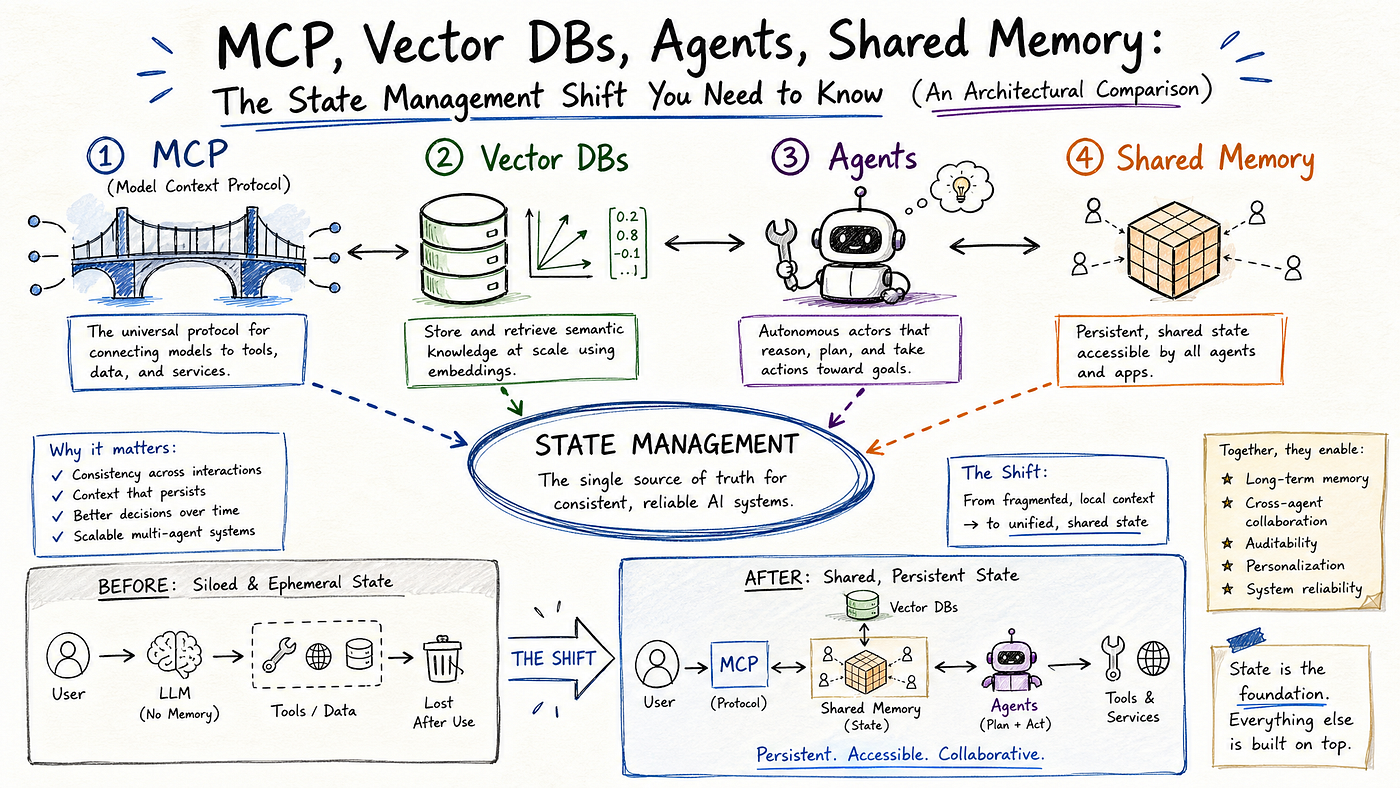
The Year Memory Became a Standard MCP Layer
Memory became a standard layer in the AI engineering stack because statelessness turned from an accepted architectural trade-off into a hard ceiling for agent utility.
When the Model Context Protocol (MCP) was introduced, it provided a clean, unified standard for connecting AI models to external tools, databases, and environments. Almost overnight, standardizing the “tools” layer became a solved problem. Once an agent could seamlessly browse the web, execute SQL queries, or interact with local file systems through unified MCP interfaces, developers immediately ran into the next bottleneck: the agent had no continuous sense of identity, historical preference, or past state.
To lower the adoption friction of adding persistent state, the developer community began building specialized MCP servers. Reference packages like @modelcontextprotocol/server-memory and official integrations from specialized memory projects like Mem0 MCP provided concrete patterns for storing key-value pairs or semantic graphs. With the integration barrier removed by the protocol itself, memory transitioned from an experimental feature to a default layer in standard setup guides.
Why Statelessness Stopped Being Acceptable
For years, developers worked around the stateless nature of large language models using temporary patches: stuffing raw chat histories into the context window, performing simple vector retrieval over past transcripts, or replaying past sessions. While these approaches worked for basic chatbots, they failed under the weight of long-running, multi-step agent workflows.
- The Context Window Overhead: While context windows have expanded to millions of tokens, filling them with raw chat history is incredibly inefficient. It introduces massive token costs, increases latency, and degrades the model’s reasoning capability due to “lost in the middle” phenomena.
- The Noise of Chat Replays: Simply replaying raw transcripts does not equal learning. An agent does not need to re-read every typo and tangential conversation from three weeks ago; it needs the distilled, synthesized insights derived from those interactions.
- The Multi-Session Chasm: When an agentic workflow is split across multiple sessions, tools, or physical machines, the lack of a persistent memory layer means the agent must be re-onboarded at the start of every session.
When agents are tasked with executing complex, multi-week software migrations, running continuous market analysis, or managing ongoing operations, statelessness ceases to be a minor inconvenience — it becomes an absolute barrier.
What an MCP Memory Server Actually Solves
To evaluate potential solutions, we must first define the core technology at play. An MCP memory server is a standardized middleware component that exposes a persistent state-storage interface to AI models via the Model Context Protocol.
AI agents need memory because raw model endpoints are inherently stateless; without an external storage mechanism, they cannot retain user preferences, historical decisions, or procedural context across API calls. An MCP memory server solves this by giving the model a structured set of tools (such as create_memory, search_memories, or update_relations) that allow the model to actively read from and write to a persistent database during a conversation.
While these servers successfully solve the immediate problem of local recall — allowing a single chatbot instance to remember a user’s name or preferred programming language — they are structurally bounded. Most basic MCP memory servers store data in a local JSON file or a lightweight SQLite database tied directly to the client running the agent. They do not naturally support multi-user security, cross-model synchronization, or semantic governance across independent platforms.
The Comparison That Actually Matters
When evaluating memory architectures, developers often get bogged down in database comparisons (e.g., Graph vs. Vector vs. Relational). However, the most critical architectural distinction is not how a server stores memories, but where those memories reside and who can access them.
The division can be categorized into four distinct layers of scope and portability:
One agent’s memory (Single-agent private notepad)
This is the architecture of a standard, direct memory MCP server. The database is bound directly to a single agent client instance. The memory is highly localized; if you spin up a second agent, or access the same LLM from a different application, that new instance is completely blind to the historical context stored by the first agent.
One stack’s memory (Framework-bound runtime memory)
Many developers rely on the built-in memory utilities of agent frameworks like LangChain, CrewAI, or AutoGen. While these frameworks handle complex internal states well, the memory is tied strictly to that framework’s runtime environment. Migrating those memories to a different framework or calling them from a lightweight custom script requires writing custom translation layers and APIs.
Shared memory across agents (Cross-agent memory)
In an orchestrated multi-agent system, multiple specialized agents (e.g., a writer agent, a researcher agent, and a reviewer agent) need to collaborate. This setup requires an orchestrated shared context where agents can pass state and memory to one another. However, this memory remains bounded by the overarching parent application; it cannot easily escape that specific software ecosystem.
Shared memory across AIs (Cross-model, portable memory layer)
This is the emerging paradigm for robust AI systems. In this model, memory does not belong to a specific agent framework or a single client application. Instead, memory is treated as a persistent, secure infrastructure layer that travels with the user or organization.
Whether you are interacting with Claude Desktop, writing code in Cursor, running a background automation script via an API, or using a specialized enterprise agent, every tool accesses and updates the same standardized semantic memory profile. It shifts the paradigm from app-bound memory to truly portable memory.
Why Retrieval Is Not the Same as Memory
A common point of confusion among developers is the conflation of vector databases and RAG (Retrieval-Augmented Generation) with true agent memory.
- Is a vector database the same as agent memory? No. A vector database is a raw retrieval utility designed to find semantically similar document chunks from a static corpus. Agent memory, by contrast, requires a state-management engine capable of active synthesis, temporal updates, relationship tracking, and selective forgetting.
- Is chat history the same as memory? No. Chat history is a raw, chronological transcript of an interaction. Memory is the distilled, structured extraction of facts, rules, and behavioral preferences derived from that history over time.
While a vector database is often used as an underlying storage component for a memory system, it lacks the logic required to handle memory consolidation. True memory requires:
- Semantic synthesis: Merging new information with existing knowledge (e.g., updating “User prefers Python 3.10” to “User has upgraded to Python 3.12 and now prefers uv for package management”).
- Decay and reinforcing: Fading out irrelevant or transient details while reinforcing long-term behavioral patterns.
- Traceability and provenance: Keeping track of exactly why a certain memory was formed, which session it originated from, and which model wrote it.
Where MemoryLake Fits
As developers move past the limitations of simple, single-agent MCP servers, they require an enterprise-grade approach to persistent state. This is where MemoryLake enters the conversation.
MemoryLake positions itself as a persistent AI memory infrastructure designed to act as a secure, cross-AI memory passport. Rather than serving as another isolated database plugin, it is built to sit horizontally beneath all of an organization’s AI touchpoints.
According to MemoryLake’s public materials, its architecture is built to address the exact limitations of traditional, app-bound memory:
- Cross-Model and Cross-Session Portability: MemoryLake allows an AI system to maintain continuity whether the underlying model is swapped from Claude to GPT-4o, or whether the user moves their workspace from a terminal assistant to a web-based portal.
- Structured Semantic Governance: Public documentation suggests that MemoryLake does not merely store raw text; it manages the lifecycle of the data, ensuring memories are synthesized, deduplicated, and kept accurate over time.
- Traceability and Provenance: To maintain security and compliance, the platform provides clear lineage for stored memories, tracking which specific agent session or document contributed to a given memory state.
By separating the cognitive compute (the LLM) from the persistent state (the memory layer), MemoryLake enables an architecture where models can remain completely ephemeral, while the system’s “second brain” remains continuously updated and secure.
Who Should Care About This Distinction?
Choosing between a lightweight local MCP server and a dedicated memory infrastructure depends heavily on your scale and operational requirements:
- Solo developers with a single coding assistant: If your primary goal is to ensure a local command-line assistant remembers your API keys or project directories, a lightweight, single-agent MCP memory server running locally is entirely sufficient.
- Product teams building multi-agent applications: If you are developing an application that coordinates multiple internal agents, framework-bound memory or orchestrated cross-agent memory is a practical choice to maintain conversational flow.
- Power users switching platforms: If you routinely jump between Claude Desktop for writing, Cursor for coding, ChatGPT for brainstorming, and custom Python scripts for automation, you will quickly hit a wall with local servers. You require a portable, cross-AI memory passport to avoid fragmenting your digital context.
- Enterprises with compliance and governance needs: If your organization deploys AI across multiple departments, you cannot afford to have fragmented memory silos containing sensitive information. You require an infrastructure layer that offers strict data ownership, security compliance, and auditable memory provenance.
Conclusion
The rapid growth of the memory category in the MCP ecosystem throughout 2026 is not merely a trend of tools multiplying; it represents a fundamental transition in how we architect AI systems. We have reached the limits of what stateless agents can achieve, and memory is now recognized as a mandatory layer of the modern AI stack.
As we build more complex workflows, the focus must shift from simply giving an agent a local notepad to establishing a secure, unified memory layer that spans across different models and applications.
If your current architecture is struggling under the weight of fragmented context, split sessions, or isolated data silos, it may be time to look beyond local utilities. For those seeking a governed, highly portable, and persistent memory layer that travels seamlessly across your entire AI ecosystem, evaluating MemoryLake is a logical next step.
메타데이터
- post_id
- a1bc0758ef82
- slug
- mcp-vector-dbs-agents-shared-memory-the-state-management-shift-you-need-to-know-an-a1bc0758ef82
- url
- https://medium.com/@memorylakeai/mcp-vector-dbs-agents-shared-memory-the-state-management-shift-you-need-to-know-an-a1bc0758ef82
- canonical_url
- https://medium.com/@memorylakeai/mcp-vector-dbs-agents-shared-memory-the-state-management-shift-you-need-to-know-an-a1bc0758ef82
- author_url
- https://medium.com/@memorylakeai
- status
- ok
- fetched_at
- 2026-07-09 23:37:22



