AWS Database Services: An Introduction to Databases and Analytics
AWS provides a broad portfolio of database services designed to support different data models, workloads, and performance requirements…
AWS Database Services: An Introduction to Databases and Analytics
AWS provides a broad portfolio of database services designed to support different data models, workloads, and performance requirements. These services remove the operational burden of database management while offering high availability, scalability, and security. Below is a proper, detailed article-style explanation of each major AWS database and analytics service, covering their architecture, features, working principles, and real-world relevance.
Amazon RDS (Relational Database Service)
Overview
Amazon RDS is a managed relational database service that simplifies the setup, operation, and scaling of traditional databases in the cloud. It supports widely used engines such as MySQL, PostgreSQL, MariaDB, Oracle, and SQL Server, making it suitable for enterprise and application-level workloads.
Architecture and Working
Amazon RDS runs database engines on managed EC2 instances while AWS handles operating system management, database software installation, backups, patching, and monitoring. It supports Single-AZ and Multi-AZ architectures. In Multi-AZ deployments, data is synchronously replicated to a standby instance in a different Availability Zone, ensuring high availability and automatic failover.
Use Cases
- Enterprise applications
- ERP and CRM systems
- Content management systems
Advantages
- ACID-compliant transactions
- Automated backups and point-in-time recovery
- Easy scaling and strong security
Amazon Aurora
Overview
Amazon Aurora is a cloud-native relational database compatible with MySQL and PostgreSQL. It is designed to deliver higher performance, availability, and durability than standard relational databases while maintaining compatibility.
Architecture and Working
Aurora separates compute and storage layers. Compute instances handle SQL processing, while a distributed storage system replicates data six times across three Availability Zones. This architecture enables fast failover, continuous backups, and automatic storage scaling up to 128 TB.
Use Cases
- High-traffic web applications
- E-commerce platforms
- Financial and banking systems
Advantages
- High throughput and low latency
- Automatic scaling and self-healing storage
- Strong fault tolerance
Amazon DynamoDB
Overview
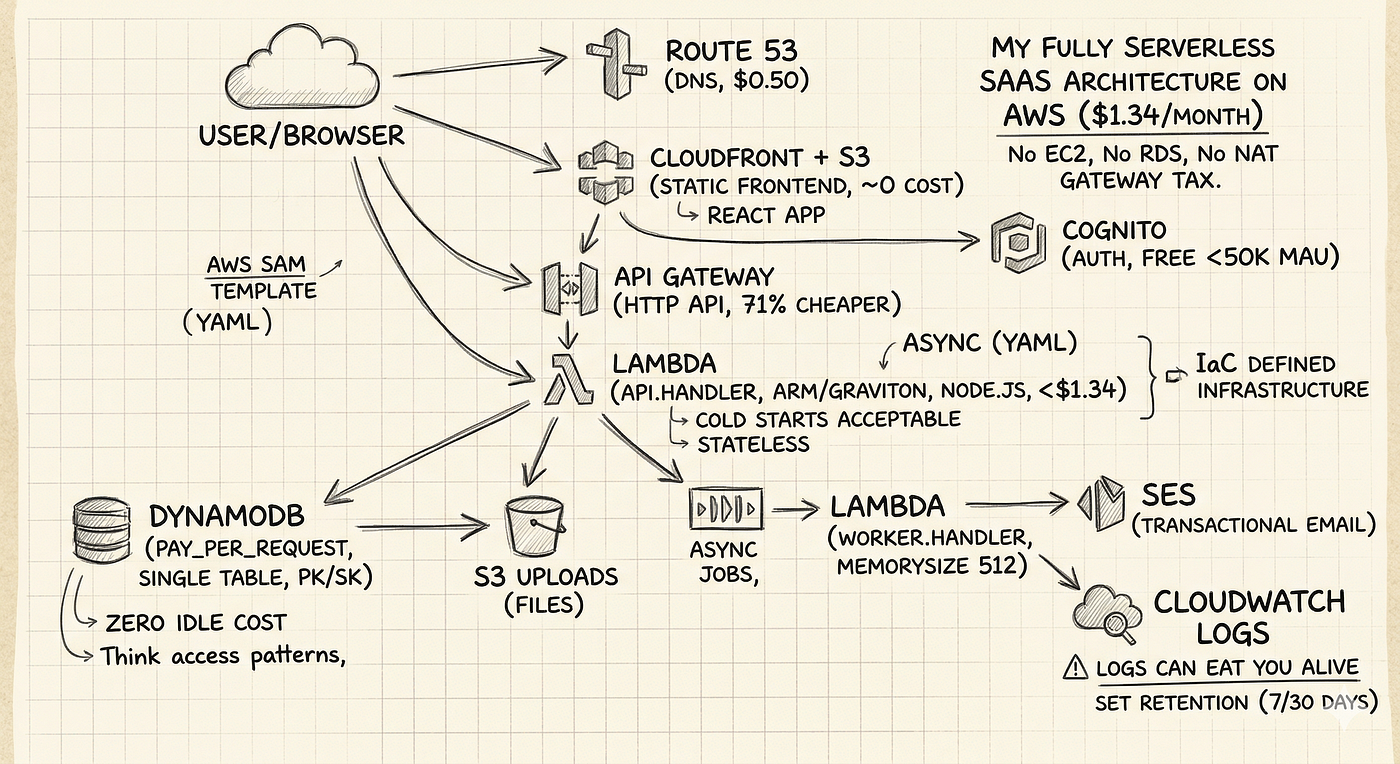
Amazon DynamoDB is a fully managed NoSQL key-value and document database designed for applications that require low-latency performance at massive scale. It is serverless and does not require capacity planning.
Architecture and Working
DynamoDB partitions data using a primary key and distributes it across multiple nodes. It supports both eventual consistency and strong consistency reads. Global Tables allow multi-region, multi-active replication, enabling global applications with low latency.
Use Cases
- Serverless applications
- Mobile and gaming platforms
- Internet of Things (IoT) applications
Advantages
- Automatic scaling and high availability
- Millisecond-level performance
- Flexible schema design
Amazon ElastiCache
Overview
Amazon ElastiCache is a managed in-memory data store and caching service that supports Redis and Memcached. It is primarily used to reduce latency and improve application performance.
Architecture and Working
ElastiCache stores frequently accessed data in memory rather than on disk. Redis supports data persistence, replication, and advanced data structures, while Memcached focuses on simple, high-speed caching.
Use Cases
- Session management
- Real-time analytics
- Caching database query results
Advantages
- Microsecond response times
- Reduced database load
- High scalability
Amazon Redshift
Overview
Amazon Redshift is a fully managed cloud data warehouse designed for large-scale analytics and reporting workloads. It enables organizations to analyze structured data using SQL.
Architecture and Working
Redshift uses columnar storage and Massively Parallel Processing (MPP) to distribute queries across multiple compute nodes. Redshift Spectrum allows querying data directly from Amazon S3 without loading it into the warehouse.
Use Cases
- Business intelligence and reporting
- Data analytics and trend analysis
- Large-scale data processing
Advantages
- High-performance analytical queries
- Seamless integration with AWS ecosystem
- Scales to petabyte-sized datasets
AWS Glue
Overview
AWS Glue is a fully managed ETL (Extract, Transform, Load) service that simplifies data preparation for analytics, machine learning, and reporting.
Architecture and Working
Glue automatically discovers data, infers schemas, and stores metadata in the Glue Data Catalog. ETL jobs transform raw data into structured formats and load it into data warehouses or data lakes.
Use Cases
- Data lake creation
- Data cleansing and transformation
- Analytics pipeline automation
Advantages
- Server less and cost-effective
- Centralised metadata management
- Easy integration with analytics services
Amazon Athena
Overview
Amazon Athena is a serverless interactive query service that allows users to analyze data stored in Amazon S3 using SQL.
Architecture and Working
Athena uses a distributed query engine and a schema-on-read approach. It reads data directly from S3, applies the schema at query time, and returns results quickly.
Use Cases
- Log analysis
- Ad-hoc analytics
- Data exploration
Advantages
- No infrastructure to manage
- Pay-per-query pricing model
- Supports multiple data formats
Conclusion
AWS database services offer specialised solutions for different data storage and analytics needs. Amazon RDS and Aurora handle relational workloads, DynamoDB supports scalable NoSQL applications, ElastiCache improves performance through in-memory caching, Redshift enables large-scale analytics, Glue prepares data for analysis, and Athena provides serverless querying. By understanding each service in detail, organisations can choose the right tools to build reliable, scalable, and data-driven applications in the AWS cloud.
메타데이터
- post_id
- a1c028a79602
- slug
- aws-database-services-an-introduction-to-databases-and-analytics-a1c028a79602
- url
- https://aws.plainenglish.io/aws-database-services-an-introduction-to-databases-and-analytics-a1c028a79602
- canonical_url
- https://aws.plainenglish.io/aws-database-services-an-introduction-to-databases-and-analytics-a1c028a79602
- author_url
- https://medium.com/@The_Devops_Girl
- status
- ok
- fetched_at
- 2026-07-17 17:14:00