Hajj, Radical Hope and the Search for Sakinah
May 27th or 28th, 2026 (depending on when you celebrate) is the second most important Eid in the Muslim calendar. Eid al-Adha, as it is…
Hajj, Radical Hope and the Search for Sakinah
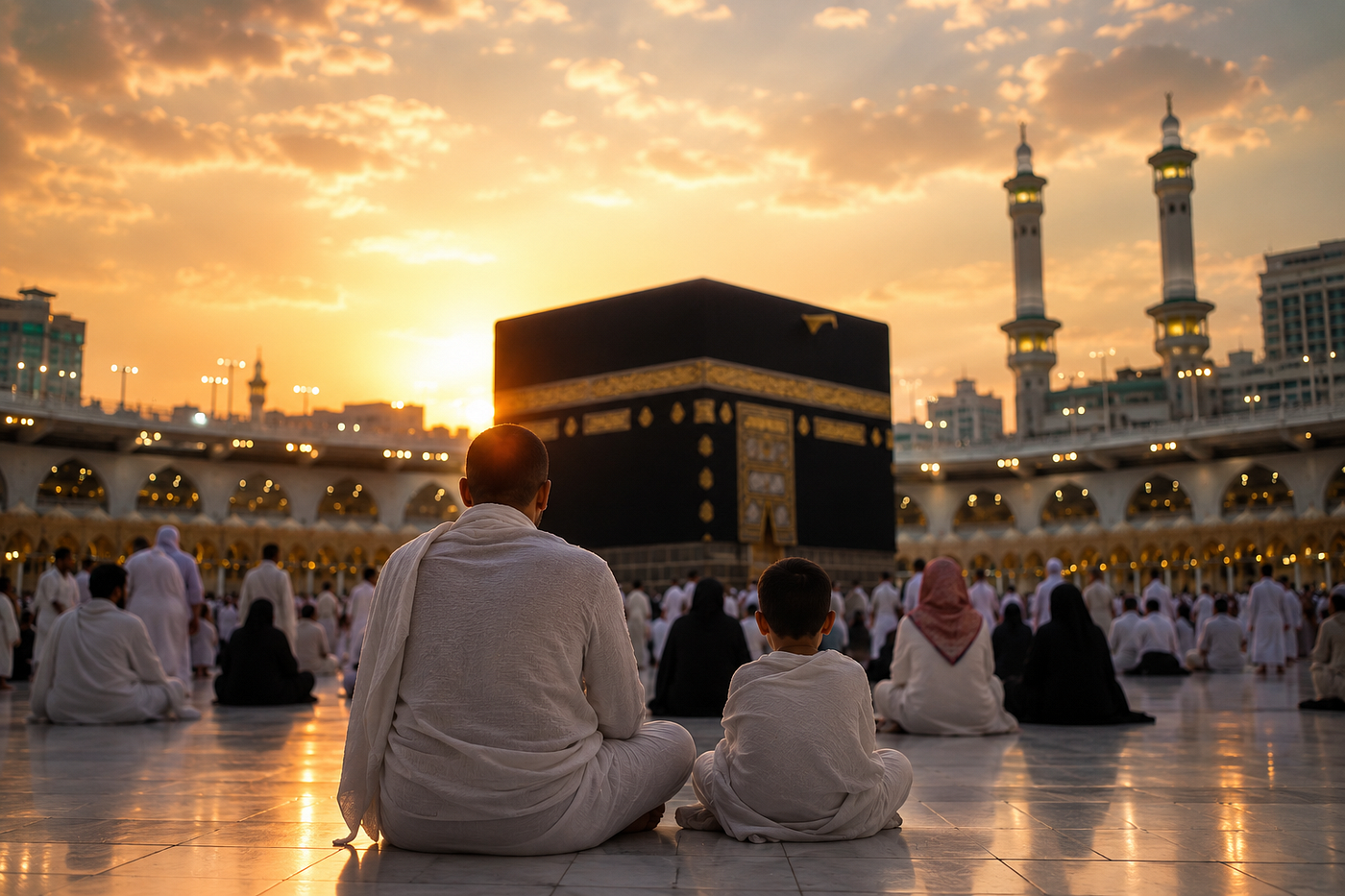
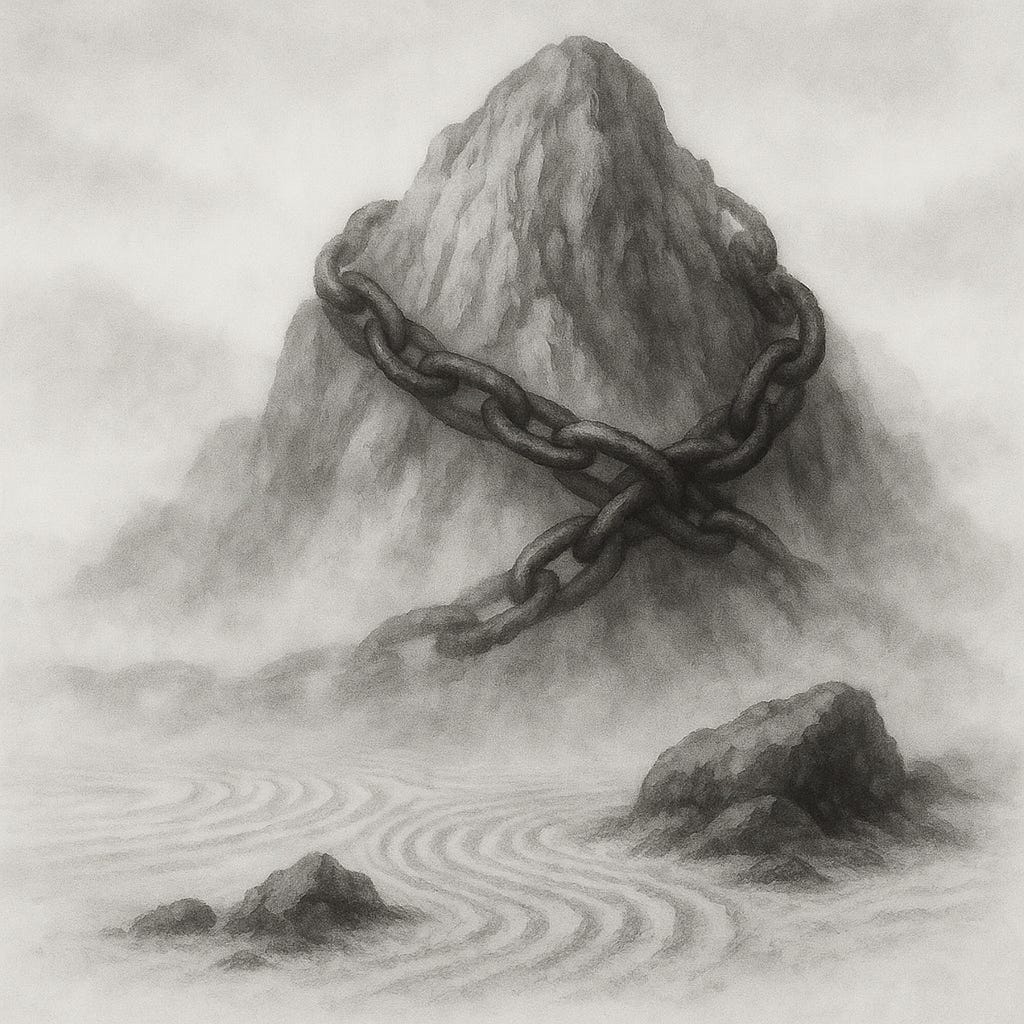
Sunset at the Kaabah (Amjad Saleem — AI Generated Image)
May 27th or 28th, 2026 (depending on when you celebrate) is the second most important Eid in the Muslim calendar. Eid al-Adha, as it is known, marks the end of the Hajj.
Each year, millions of people from diverse races, languages, cultures, classes, and nations come together in Makkah dressed in simple white garments. They are united by a single purpose, regardless of their social status: kings stand next to labourers, refugees beside CEOs, and the famous alongside the unknown. For a moment, the barriers that separate humanity fade away, and a sense of equality fills the air.
As Malcolm X wrote in 1964 after performing the Hajj himself: “We were all participating in the same ritual, displaying a spirit of unity and brotherhood… I have never before seen sincere and true brotherhood practised by all colours together, irrespective of their colour.”
Performing Hajj is one of the fundamental pillars of Islam, and Muslims are expected to undertake this journey at least once in their lifetime. Each year, fewer than 2 million people physically perform Hajj — less than 0.1% of the 2 billion Muslims worldwide — fewer than 1 in every 1,000. As a result, most Muslims celebrating Eid al-Adha do so in solidarity with pilgrims they will never meet, re-enacting rituals they may never personally perform. This unity, rather than physical presence, is perhaps the most remarkable aspect of the Hajj, demonstrating its power to connect humanity beyond the plains of Arafat — reaching homes, mosques, and communities across every continent. While the pilgrimage itself is experienced by a privileged few, its significance belongs to all.
Ultimately, Hajj is more than a journey. It is a living reminder and a source of hope for what humanity can aspire to become.
Over more than ten years of reflection beginning in 2011, I have revisited the stories, rituals, and lessons of Hajj. Each revisit reveals new layers as the world evolves around me, yet the core message becomes increasingly urgent and remains just as relevant.
In a world fractured by war, nationalism, inequality, loneliness and the erosion of trust, the Hajj offers something deeply countercultural: a radical reorientation toward humility, unity, sacrifice, patience and hope.
So, this year, I want to bring those reflections together into one meditation on what Hajj means, what it demands, and what humanity might yet become.
The Invitation as a Protest Against Superiority
Whilst Hajj is seen as a core tenet of Islamic practice, it is essentially an answer to a Divine invitation. In the Qur’an, God commands Prophet Ibrahim (Abraham, peace be upon him): “Proclaim the pilgrimage to humankind; they will respond, coming to the sacred house on foot, riding every possible conveyance coming from every distant path.” (22:27)
And so people arrive from all continents, regardless of age, speaking many languages, answering that timeless call that feels both ancient and urgent. Those who come declare Labbaik Allahumma Labbaik — “Here I am at your service, O Lord, here I am.”
It is perhaps one of the most profound declarations a human being can make. A voluntary, conscious surrender of the self to something greater.
You come because you were invited. You come because you answered.
This declaration signifies a uniquely direct relationship between humans and the Divine, unmediated by status, wealth, or privilege. In contrast, the world outside Makkah offers no such equality. Modern society continuously ranks individuals based on colour, race, gender, wealth, passport, productivity, likes, followers, and power. The ongoing machinery of inequality relentlessly classifies people, suggesting that some matter more while others matter less.
Hajj dismantles that machinery.
With the Ihram — the simple, unstitched white garments worn by every pilgrim — titles dissolve with the wealthy and the poor wearing the same clothes, and standing side by side irrespective of status.
In many ways, Hajj is a protest against the illusion of superiority. It is a living embodiment of what the Prophet Muhammad (peace be upon him) declared in his final sermon on the day before the Hajj: “All humans are descended from Adam and Eve. There is no superiority of an Arab over a non-Arab, or of a non-Arab over an Arab, and no superiority of a white person over a black person or of a black person over a white person, except based on personal piety and righteousness.”
Many Muslims quote this as a sign of equality, but few understand its true significance. It is more than a spiritual statement. It is a moral and ethical obligation — a call for anti-racism and equality. It emphasises that human dignity is innate and sacred, not something earned through wealth, race, nationality, or power. In a time marked by rising nationalism, racial dehumanisation, and border violence, this message remains not just historical but urgently relevant.
The Radical Hope of Hajar
Perhaps one of the most powerful stories at the heart of the Hajj is not one of power, but of desperation, vulnerability and trust.
Hajar, a noble and weary woman, is stranded in the desert near Makkah with her infant son, Ismail, alone in the wilderness, without family, support, and water. Her story, therefore, is not one of effortless triumph but a testament to radical hope amid hardship.
Faced with absolutely nothing, she starts to run back and forth between the hills of Safa and Marwah seven times. Her running — without certainty or guarantees — is perhaps one of the greatest acts of radical hope in human history. Radical hope is the courage to keep believing and acting for a better humanity even when the future feels uncertain, fractured or beyond our control. And so in running, Hajar embodied that courage.
Because hope requires movement.
Today, as part of the rituals of the Hajj, millions retrace her footsteps during Sa’i. What was once the lonely struggle of one woman in the desert has become a sacred ritual embedded in global spiritual consciousness — a reminder that to dream, to hope, and to trust in the Divine are not signs of naivety, but of profound courage.
There is also something profoundly symbolic about this act. In a world that often marginalises women’s stories, especially when it is connected to the Muslim world, Islam places Hajar’s struggle at the very centre of one of the largest annual spiritual gatherings on earth.
Her story teaches us that hope should not be passive. Hope must run, search, persist and be radical in trusting, even when certainty is absent. And eventually, from that struggle, Zamzam emerges — a sacred source of water, life, and mercy.
This story remains important for humanity today, just as it did for Hajar. Though we might not always see the water beneath our feet, it does not mean we should cease our search.
Ibrahim, Ismail and Building Through Uncertainty
The story of the Kaaba itself is born from the same radical hope. Ibrahim and his son Ismail are tasked with building something that would outlast them — a sanctuary not for one tribe or nation, but for all of humanity. They built it in a barren desert, with no certainty of what it would become.
The importance is not just what was built, but who built it — and who he belongs to. Not one faith. All of them.
Ibrahim is regarded as the ancestor of the line of prophets, connecting Isaac, Moses and Muhammad (peace be upon them all). The Qur’an describes him as a leader for all humanity, a “nation” in his own right (16:120), and as God’s friend (4:125). These qualities — extraordinary faith, sacrifice and an uncompromising dedication to righteousness — are not exclusive to one tradition.
They are the shared inheritance of all three Abrahamic faiths.
This is why Eid al-Adha carries significance beyond Islam. It is an occasion that should resonate for Christians and Jews as well — not merely as a mark of tolerance, but as a recognition of shared origin and shared responsibility. The Hajj and the life of Ibrahim provide some of the most fertile ground available for genuine interfaith dialogue and, more importantly, multi-faith solidarity.
As the Qur’an says: “Who could be of better faith than the one who surrenders utterly to God and is a doer of good and follows that faith of Abraham, the upright one?” (4:125)
We live in what many scholars refer to as post-normal times — an era marked by uncertainty, contradictions, and escalating crises. Climate breakdown, war, polarisation, loneliness, and distrust are prevalent, causing more and more people to ask: “What is the point? Can things truly improve? Is there a future worth striving for?”
The story of Ibrahim and Ismail building the Kaaba answers by example. Meaningful work is often done without knowing the result. You build because it is the right thing to do. You plant to benefit future generations. You serve because dignity calls for it. You keep going because faith entails responsibility, even in the face of uncertainty.
That is radical hope.
Reimagining Sacrifice
I have previously written about how sacrifice is often misunderstood — seen merely as loss, suffering, or a ritual fulfilled through a transaction. But the story of Hajj encourages us to explore a much deeper understanding of what sacrifice truly signifies.
The story at the heart of Eid deserves far more contemplation. The conversation between Ibrahim and his son — the consultation of a father with his child in the most challenging of circumstances, and the firm yet gentle acceptance of a parent’s wish by a child — highlights a dying relationship in today’s world. It reminds us of the delicate balance necessary in human relationships: respect, understanding and acceptance across generations.
The spirit of the sacrifice, however, goes deeper. It is about letting go of ego, arrogance, and greed. It is about letting go of the illusion that we are the centre of existence.
By demonstrating the ultimate sacrifice of giving up our most cherished possessions for the One we will ultimately return to, we understand that all our possessions and attachments are nothing compared to what matters most — our relationship with the Most High.
At a time of the most likes, followers, reposts and shares, we are reminded to humbly surrender.
Hajj confronts the modern obsession with hyper-individualism. You are no longer exceptional in the crowd. You move with others, wait with them, pray with them, eat with them, share the same sleeping space on the ground and struggle with them under the heat.
Perhaps that is precisely the point. The sacrifice is not about glorifying pain. It is about understanding what is truly important — and choosing that over what is merely comfortable. At the heart of our consumer society, where materialism and individualism drive daily life, we face a challenge against modern consumerism and narcissism that fails to account for the beauty of human nature or the crushing debt and poverty that millions face. We must be prepared to sacrifice all that is dear to us to resist it.
The Search for Sakinah
At its core, Hajj is a quest for sakinah — inner peace and tranquillity grounded in Divine connection.
It is an inner stillness that endures through hardship, often found in the most unlikely moments: the plains of Arafat, the silence following Tawaf, tears during collective prayer, the quiet awareness of human fragility. Perhaps because modern life has conditioned us to seek comfort rather than meaning, some of the most transformative moments arise precisely when we are stripped of distraction.
Hajj teaches us that sakinah is not found in consumption, prestige, or constant achievement.
It lies in surrender, in perspective, in remembrance and in recognising how small we are — and yet how deeply connected we remain to one another and to the Creator.
Paulo Coelho wrote in The Alchemist: “Go; travel the world, look for the truth and the secret of life — every road will lead you to this sense of initiation: the secret is hidden in the place from which you set out.”
This is the apparent paradox of the spiritual journey of Hajj: the constant effort to purify and liberate our hearts ultimately leads to reconciliation with the deepest level of our being — the spark that the Creator breathed into us — That spark of humility; That awareness of fragility; That consciousness of limitation; That accountability to live justly and fairly, and that responsibility that connects us to the “other.”
Unity in Diversity
One of the most extraordinary aspects of Hajj is witnessing humanity in its full diversity. Millions of people from different walks of life — different ethnicities, languages, cultures, schools of thought — all moving together with shared purpose.
At a time when diversity is so often framed as a threat — exploited by nationalism, weaponised by demagogues — Hajj presents diversity not as a threat but as a harmonised Divine reality.
The Qur’an reminds us that God made us into nations and tribes so that we may know one another (49:13). Hajj operationalises that verse in real time. You hear languages you do not understand. You pray beside strangers whose histories are entirely different from yours. You witness ways of being Muslim that challenge your assumptions.
And in doing so, you are reminded that no single culture owns Islam — just as no single culture owns humanity.
Hajj reminds us that we are much more than a label. That our plurality and diversity are not divisive elements but a cause for celebration — and that within that celebration lies an understanding of common humanity and universal principles. Belonging to humanity must take precedence over belonging to the ego.
No testimony captures this more powerfully than that of Malcolm X himself. He had spent over a decade as a national spokesman for the Nation of Islam — a movement that preached racial separatism and regarded white people as inherently oppressive. He broke from it in March 1964, and just weeks later, made his way to Mecca. What he witnessed there — pilgrims of every race moving together in shared devotion — shattered that worldview entirely. He returned with a new name, El-Hajj Malik El-Shabazz, and a new conviction: that a blanket indictment of any people based on race was as wrong as racism itself. The Hajj did not merely confirm what he already believed; it dismantled what he had believed and completely rebuilt him. That a pilgrimage of a few weeks could so completely reorient a life is perhaps the most powerful testimony to the transformative force of Hajj in the modern era.
Returning to What It Means to Be Human
Much of the world treats hope as a personal project — individual resilience, private optimism, self-improvement. But Hajj demonstrates something fundamentally different: that hope, at its most powerful, is collective.
Millions come together to care for strangers, pray, share hardships, and build something that endures beyond any individual.
The greatest lesson of Hajj may be that humanity does not heal alone.
We heal through compassion, shared rituals, and remembering our interconnectedness. Through rebuilding trust and through recognising that dignity is universal — not limited to those who look, pray, or come from the same place as us.
In this sense, Hajj is a blueprint for a different kind of world — one where dignity is valued more than status, service outweighs performance, diversity becomes a strength rather than a source of division, and hope persists amidst uncertainty.
The rituals are ancient, but the lessons are more urgently needed now than ever before.
This is radical hope. Not naïve optimism. Not denial of suffering. But the courageous decision to keep moving toward meaning, even through uncertainty.
It is the hope of Ibrahim. The hope of Hajar. The hope of Ismail. The hope of a fractured humanity still searching for sakinah.
Because ultimately, Hajj is not only about reaching Makkah.
It is about returning to what it means to be human — rooted in humility, compassion and shared humanity.
May the Almighty, who loves you, guide and protect you. May there be peace and respite for all those who are suffering. May you spend time with your loved ones in a happy atmosphere.
Eid Mubarak.
메타데이터
- post_id
- a1da2cb0528e
- slug
- hajj-radical-hope-and-the-search-for-sakinah-a1da2cb0528e
- url
- https://medium.com/@amjad-49880/hajj-radical-hope-and-the-search-for-sakinah-a1da2cb0528e
- canonical_url
- https://medium.com/@amjad-49880/hajj-radical-hope-and-the-search-for-sakinah-a1da2cb0528e
- author_url
- https://medium.com/@amjad-49880
- status
- ok
- fetched_at
- 2026-07-10 04:31:59