Buried Beginnings: The Lost Traces of Phool (1945)
We all now recognize Mughal-e-Azam as one of the greatest works of cinematic art, it’s a film born from K. Asif’s relentless ambition…
Buried Beginnings: The Lost Traces of Phool (1945)
We all now recognize Mughal-e-Azam as one of the greatest works of cinematic art, it’s a film born from K. Asif’s relentless ambition, realized through years of trials and turbulence. It’s a vision we still celebrate today. But Asif as a director remains an enigma, because aside from Mughal-e-Azam, he officially directed only two other films, one before it, and one after. His directorial debut was the 1945 Muslim social drama Phool.
We rarely talk about his first film, though, perhaps because Mughal-e-Azam casts too long a shadow. Yet it fascinates me to think about what Phool might have been. In a way, Phool feels like the seed from which Asif’s later greatness grew. The experiments, the early steps, the creative risks, all of it must have informed the magnum opus to come. But we might never truly know, because Phool is a ghost on celluloid, it’s a lost film we can only imagine.

Promotional material for the 1945 film Phool, directed by K. Asif and featuring Veena.
Plot Synopsis
Phool is a drama set in a traditional joint family, unfolding a tale of duty, faith, and personal sacrifice. The story centers on Safdar, the patriarch of a Muslim family, who loses his rightful inheritance due to the scheming of his sister-in-law. Despite this setback, Safdar remains bound by a promise made to his late father: to complete the construction of a village mosque that his father had started. Fulfilling this pious obligation becomes Safdar’s mission and a point of honor. However, the loss of the family wealth means he may not have the means to finish the mosque, introducing the film’s central conflict between upholding familial/religious duty and the harsh realities of circumstance.
Safdar’s hope for completing the task eventually shifts to the younger generation. His prospective son-in-law, Salim, is expected to take on the responsibility if Safdar cannot. But Salim’s path diverges when he leaves home to fight abroad in the Balkan War (implying the story is set in the early 20th century during the Ottoman-related conflicts). While in Turkey, Salim falls under the sway of a cabaret dancer and is led into moral disarray, neglecting his promise and duties back home. This plot turn introduces one of the film’s key themes: the conflict between duty and temptation. Salim’s character embodies how personal desires and outside influences can lead one away from familial obligations.
With both Safdar and Salim unable to fulfill the vow, the burden dramatically falls on Safdar’s daughter (Salim’s fiancée). The young daughter — an orphaned girl in the family — finds herself in a poignant dilemma: she can devote herself to completing the mosque, thereby honoring her father’s legacy, or pursue her own personal freedom and happiness. Choosing the former would mean sacrificing her individual desires (possibly even postponing or forsaking her marriage), as the responsibility is enormous and traditionally not shouldered by a young woman. The climax of Phool thus hinges on her choice. In line with the film’s title (which means “Flower”), the daughter’s character can be seen as a metaphorical flower offering herself in devotion, symbolizing purity and sacrifice.
Themes
Looking at what’s left of the story, I can’t help but trace the thematic threads that seem to foreshadow K. Asif’s later preoccupations. Phool, from what we can gather, wrestles with duty versus self-interest, faith and piety, and the weight of gender roles within a conservative society. There’s something strikingly symbolic about the mosque under construction, it’s becoming a living legacy in a form of architecture, passed from father to child, a visible marker of devotion to faith and family honor.
The one thing that really piques my interest is the daughter’s arc, which, even in its fragmentary descriptions, feels like an early whisper of feminist narrative. A woman, stepping beyond her prescribed domestic sphere, taking on the public responsibility of overseeing the mosque’s completion, that’s really a statement of the film rather than a minor plot point. For a 1940s film to stage a woman making such a critical choice for the greater good must have felt quietly revolutionary. I can imagine how that would’ve played out visually with her standing amidst the scaffolding, perhaps, burdened but resolute.
But there’s also this moral dichotomy: Salim’s descent abroad, his entanglement with a dancer, contrasted against the heroine’s steadfastness. That tension between worldly temptation and spiritual integrity, between personal desire and collective responsibility, feels almost like a narrative rehearsal for what Asif would later perfect in Mughal-e-Azam where the clash of love and duty reaches operatic heights. Phool seems to set the groundwork for those grand conflicts of loyalty and desire.

An original poster for the 1945 film Phool, directed by K. Asif, with music by Ghulam Haider, and starring Veena, Durga Khote, and Surraiya, among others.
And without even needing the full film to spell it out, the resolution, as suggested, lands on sacrifice which is the idea that fulfilling a sacred promise, especially when it exacts a personal cost, is the ultimate virtue. The completed mosque, whether shown or implied, becomes this quiet monument to faith, duty, and promises kept. I can’t help but feel a sense of longing knowing I’ll probably never witness these moments unfold on screen , but even through scattered details, the emotional and thematic echoes remain vivid.
Historical and Cultural Context
Phool was released in 1945, right at the tail end of World War II and just two years before India’s independence. That alone places the film at a fascinating historical intersection when a turbulent yet creatively fertile time for Indian cinema. Despite wartime shortages and censorship constraints, Bombay’s studios kept churning out musicals and social dramas that struck a chord with the masses. Phool inherently stand out even in this crowded landscape, is because of its ambition: it was a big-budget production by the standards of the time, not just in scale but in assembling an ensemble cast of major stars. Having the likes of Prithviraj Kapoor, Veena, Suraiya, Durga Khote, and Mazhar Khan together was no small feat in an era when films typically revolved around one or two leads. It feels, in retrospect, like an early experiment in the “multi-starrer” format that wouldn’t really become a Bollywood staple until decades later.

The November 1944 cover of Film Pictorial magazine, featuring the upcoming film Phool and its lead actress, Veena.
Culturally, Phool is rooted in the “Muslim social” family drama, it’s a genre that flourished in the 1940s that’s portraying Muslim households with empathy and layered storytelling. Mehboob Khan’s Najma (1943) had already laid some groundwork, and Phool seemed to follow that path that’s weaving together religious devotion, familial duty, and the intricate codes of honor that structured community life. The building of a mosque as the film’s central symbol feels especially important that’s also showing a legacy, faith, and the burdens passed down through generations.
Phool also had this flirtation with historical events beyond India’s borders. One of the characters departs to fight in the Balkan Wars of the 1910s, surely it’s a narrative choice that links the story to a broader pan-Islamic consciousness and suggesting solidarity that stretches far beyond the subcontinent. This wasn’t common in Indian cinema of the time, and I can’t help but wonder how audiences reacted to that, did it evoke a sense of pride, or did it feel distant and abstract?
Can’t also forget the music of Phool. The 1940s was the decade where Hindi cinema truly became synonymous with its songs, and with Ghulam Haider composing the soundtrack and Suraiya singing for herself, Phool was firmly in line with that tradition. A song like “Ae Bahaduron, Ae Mujahidon” (“O brave ones, O warriors”) carries clear echoes of the wartime atmosphere, tapping into both patriotism and spiritual sacrifice. All of this situates Phool as a cultural artifact of its time that’s caught between the fading shadows of colonial rule and the imminent dawn of independence. I keep thinking that understanding Phool is, in some way, understanding the anxieties and aspirations of 1945 India itself.
[embed]The song “Ae bahaduron, ae mujahidon” from Phool (1945).
A Star Studded Cast
The film featured some of the most celebrated performers of the 1940s. Prithviraj Kapoor, already a towering figure in Indian theatre and cinema, lent the project a commanding presence. Veena, billed prominently in the film’s publicity materials, brought her dramatic prowess to the screen, while the teenaged Suraiya, already beloved for her singing, would’ve been contributed to the youthful charm and melodic appeal. Durga Khote, a seasoned actress, surely provided gravitas that audiences had come to expect from her roles.
Adding further prestige to the cast was Sitara Devi, renowned not just as an actress but as one of the era’s greatest Kathak dancers. Her participation likely added vibrant musical and dance sequences that were highlights of the film. Yakub, known for his distinctive character roles, and Mazhar Khan, an established actor from earlier decades, rounded out the principal cast, bringing additional depth and credibility to the production.

Film still of Phool that was found on Filmindia magazine
This ensemble was further supported by a top-tier creative team. Kamal Amrohi, who would later direct the iconic Pakeezah, contributed the dialogues, ensuring a literate and emotionally resonant script. The music was composed by Ghulam Haider, a pioneering figure in Hindi film music, with Suraiya lending her own voice to several songs , a dual talent that made her a standout performer of the time.
Looking at the individual that contributed, Phool was a testament to the ambition and scale that K. Asif envisioned even in his debut. It’s no wonder that the film succeeded commercially. The film’s very existence hints at the grandeur Asif would later fully realize with Mughal-e-Azam.
Production Background and Challenges
The making of Phool in the mid-1940s carries an intriguing backstory that reflects the unpredictability of such cinematic journeys and I find myself drawn to this kind of genesis. K. Asif’s entry into filmmaking feels almost accidental, or maybe fated. He arrived in Bombay to work as a tailor under his uncle Nazir Ahmed Khan, a filmmaker. Asif was supposed to direct a film titled Society for his uncle, but that fell through. Rather than retreat, he pivoted and teamed up with his close friend Kamal Amrohi to launch Phool. Amrohi, already an established writer, not only penned the script and dialogues but also quietly produced the film, ensuring that Asif’s directorial debut had a solid foundation. I can’t help but appreciate how vital such camaraderie is in shaping a director’s first leap.
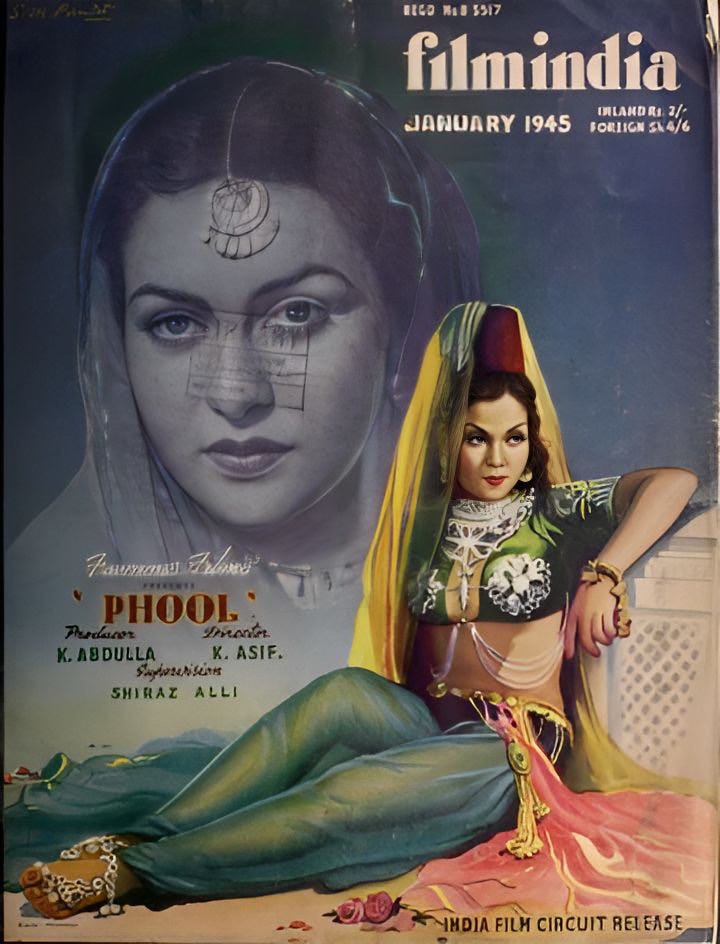
Filmindia’s January 1945 issue, featuring an artistic rendition of Phool’s themes and star on its cover, promoting the K. Asif directorial.
Financing a large-scale film during the wartime 1940s was no small feat, and when I read about Phool’s production scale, I’m genuinely impressed. Phool was ambitiously mounted, with elaborate sets and costumes, aimed at capturing both the genteel world of a rural Muslim family and the distant, war-ravaged Balkans. Producer K. Abdulla, co-producer Kamal Amrohi, and financier Shiraz Ali Hakim — the owner of Cine Studio — poured resources into the project. Hakim’s name is one I find particularly fascinating, knowing that he later backed Mughal-e-Azam before Partition. Taking such risks on a newcomer director must have seemed daunting, but history shows it paid off.

Early magazine reviews praising Phool (1945) as an “excellent motion picture” even before its full release.
From the beginning, K. Asif’s perfectionism stood out. Even in his debut, crew members spoke of how he’d act out each scene himself, showing actors the precise emotions and gestures he wanted. I love this detail, it’s as if Asif was directing both the actors and the camera through his own body. That kind of hands-on method was a glimpse of the obsessive craftsman he’d become.
Luckily, Asif was surrounded by a skilled crew. Cinematographer Kumar Jaywant and experienced art directors created striking visuals with the family mansion and the half-built mosque that carried symbolic weight. The use of high-contrast black-and-white photography contributed to its emotional depth, especially in scenes of family tension and moral conflict. Another detail that stands out to me is how music and dance were integral to the story’s heart. Ghulam Haider composed an impressive number of songs, with Suraiya’s vocals and Sitara Devi’s dances elevating the narrative’s emotional stakes. Songs like “Ae Bahaduron, Ae Mujahidon” echo the zeitgeist of a world still engulfed in war. It’s fascinating to see how Asif and Amrohi consciously used music to articulate themes of devotion, longing, and patriotism, which is a formula that would mature in Asif’s later work.
Trade anticipation was high, and FilmIndia’s write-ups capture that excitement. Distributors were keen, even before release, which is telling of the confidence the industry had in this production. I particularly like this line from the magazine:
“Though the picture has cost a pretty bit in production and though the young producer had to go through heart-breaking difficulties at times… it is a welcome news that the picture itself has become excellent.”
This kind of endorsement feels validating , not just for Asif but for anyone who’s ever taken a creative leap under less-than-ideal circumstances. The film was also promoted as a “rare treat in versatile talent,” spotlighting an ensemble cast, a move that wasn’t common back then. That ensemble focus feels modern in hindsight.
Thematic Criticism & Reception
Phool premiered on 10 August 1945 in Bombay, entering the world just as India stood on the brink of independence and the war-worn global order was shifting. It quickly became one of the year’s most successful films. Commercially, Phool was a clear hit, earning approximately ₹40 lakh net — a remarkable figure for the time — making it the fourth highest-grossing Indian film of 1945. It was labeled a “Semi-Hit” because, while not quite a blockbuster, its profits were significant, trailing only Zeenat, Gaon Ki Gori, and Badi Maa in revenue rankings. For a directorial debut, this was an extraordinary outcome that immediately put K. Asif on the industry’s radar.
Critically, Phool received a mixed but generally positive reception. Although detailed reviews from 1945 are scarce, contemporary industry press, including Filmindia, acknowledged the film as a well-made entertainer with impressive production values and an enviable ensemble cast. The story’s familiar melodrama didn’t necessarily break new ground, but the execution won praise. Prithviraj Kapoor’s gravitas and Suraiya’s emotive singing and acting were singled out, as were the film’s elaborate sets, like the mosque construction site, and the ambitious war scenes that elevated it above typical productions of the time.
Yet not all critics were kind. Filmindia in particular published sharply negative assessments, dismissing Phool as unoriginal and emotionally flat. It was derided as a chaotic mishmash of tired themes like memory loss and manufactured Hindu-Muslim unity, which the reviewer felt lacked genuine depth. The music, despite Ghulam Haider’s reputation, was criticized as inappropriate and even absurd in places, especially pointing out Veena’s ghazals as misplaced within the narrative. The review argued that, despite its constellation of stars, Phool floundered under the direction of an inexperienced filmmaker, with its political and social commentaries falling frustratingly shallow.

Few of the negative criticism of Phool were found on Filmindia magazine
One review even took issue with a specific scene where a character prays to Lord Krishna in a moment of crisis, criticizing it as a clichéd and lazy dramatic device, especially inappropriate in a Muslim social context. This, paired with complaints about the songs being derivative — some allegedly indistinguishable from tracks in Kismet and Manorama — painted a picture of creative fatigue. To some critics, Phool represented overproduction without enough originality.
Despite these criticisms, Phool succeeded where it mattered: with audiences and in the trade circuits. Its success cemented K. Asif’s reputation as a talented new filmmaker with a distinctive eye for scale and drama. Film scholar Shoma Chatterji later wrote that Phool “did fairly well and established Asif as a talented director who was a perfectionist.” His deft handling of a large ensemble cast and ability to draw strong performances, even in his first outing, did not go unnoticed within the industry. Asif’s name became associated with ambition, and that reputation paved the way for the grand visions he would later pursue.
Audiences in the immediate post-war era connected with Phool’s blend of family drama, romance, patriotic sentiment, and moral instruction. Suraiya’s songs became radio staples, further endearing her to the public, and her performance helped bolster her rapidly rising career. Reportedly, the film left many viewers teary-eyed, especially during the emotionally charged moments when the daughter character sacrifices her personal happiness for the greater good. That narrative of selflessness aligned perfectly with the national mood of the 1940s, it’s a time when India itself was bracing for sacrifices in its final push for independence.
While Phool didn’t necessarily revolutionize cinema, it surely reinforced the viability of big-cast, high-production social dramas, especially within the Muslim social genre. It may have been slightly overshadowed by the year’s musical giants like Zeenat with its famous qawwali, but Phool still left an indelible mark. Its reception boosted the careers of its leads , Suraiya became even more bankable, and Prithviraj Kapoor added another prestigious role to his growing legacy.
For Asif himself, Phool was a successful debut and it was proof that his penchant for grandeur and meticulous detail could translate into both critical notice and box-office rewards. That balance of artistry and popular appeal would become his signature, one that he would refine and immortalize with Mughal-e-Azam years later.
Archival Status and Availability
Today, Phool stands as a quietly significant piece of India’s cinematic heritage, though it never enjoyed the visibility or cultural afterlife of K. Asif’s Mughal-e-Azam. To be honest, I’m not even sure if a complete print of Phool survives. There’s no public confirmation, no archival announcements, there’s just an unsettling absence of information. That uncertainty itself has made me all the more obsessed with it, as if the film has transformed into a phantom, half-remembered, half-lost.
Unlike Mughal-e-Azam, which was lovingly restored and even colorized for contemporary audiences, Phool remains untouched. No restoration, no re-release. It exists, if at all, in its original black-and-white, gathering dust out of sight. There’s been no official DVD or Blu-ray, and certainly no version on streaming platforms, at least not as of 2025. Sometimes it gets mentioned in retrospectives about 1940s cinema or in tributes to Asif but the conversation always seems to veer back to Mughal-e-Azam. Phool remains the lesser-known, the under-seen.
Still, fragments have survived. A handful of songs remain accessible, scattered across YouTube and music streaming services. Tracks like “Kahin Dil Lene Wala / Yeh Dil Gaya” or “Naina Bawre Pee Bina Bhaye Udas”, sung by Suraiya, are still floating around, and they offer a fleeting window into the film’s mood and artistry. For vintage collectors, 78 RPM records of Phool’s soundtrack are sought-after gems, small, tangible relics of an otherwise ephemeral film.
There are suggestions that a few film clubs or private collectors abroad might hold surviving copies. The National Film Archive of India (NFAI) sometimes surprises us with forgotten prints from the 1940s, though whether Phool is tucked away in their vaults is anyone’s guess. I’ve read scattered reports that a poor-quality VCD surfaced in the early 2000s, but those copies are long out of circulation.
In recent years, the movement to restore classic Indian cinema has gathered steam, and I keep hoping Phool finds its place on that list. As K. Asif’s directorial debut and a commercial success of its time, it absolutely deserves another life with a proper restoration, cleaned visuals, remastered sound. Seeing it anew would be a gift, not just to scholars, but to anyone curious about the early hints of Asif’s grandeur that would later fully bloom in Mughal-e-Azam. Until that happens, Phool remains that elusive chapter in Indian film history which partially remembered, mostly unseen, quietly waiting for rediscovery.
Influence on K. Asif’s Later Work
The legacy of Phool extends far beyond its immediate success, it directly shaped K. Asif’s trajectory and led him, however circuitously, to the creation of Mughal-e-Azam. I’ve come to think of Phool as Asif’s first sketch of an idea he would later paint in monumental scale. The connections between the two films — in theme, in personnel, and in Asif’s evolving craft — are too pronounced to dismiss.
First, there’s the most practical connection: Phool gave Asif the clout he needed to chase his ultimate dream project. He had conceived the idea of Mughal-e-Azam or “the Anarkali project,” as it was informally called, as early as 1944, while still working on Phool. That detail alone makes Phool feel like an essential prelude, the ground on which his ambitions first stood steady. Riding on Phool’s positive reception, Asif plunged straight into development for Mughal-e-Azam. Early plans included a cast of 1940s stars — Chandramohan as Akbar, Nargis as Anarkali, Sapru as Salim — but the project collapsed under financial strains, particularly when Asif’s producer Shiraz Ali Hakim (also Phool’s backer) moved to Pakistan after Partition in 1947. That setback pushed Mughal-e-Azam into limbo, but the impulse to make it — sparked during Phool — never died.
There’s also a web of continuity in the actors and crew that ties Phool and Mughal-e-Azam together. Prithviraj Kapoor and Durga Khote, both of whom featured in Phool, reappeared in Mughal-e-Azam in towering roles: Kapoor as Akbar, Khote as Jodha Bai. I can’t help but think that Asif’s rapport with them, first forged on Phool, gave him the confidence to rely on them again when the stakes were infinitely higher. There’s something oddly satisfying in knowing that Asif returned to familiar faces when crafting his magnum opus.
Thematic links between the films also stand out to me. Both narratives hinge on a tension between personal desire and duty, Phool presents this in the daughter’s struggle between love and familial obligation; Mughal-e-Azam scales it up with Salim’s rebellion against imperial duty in the name of love. Sacrifice, honor, faith , all these motifs echo across both works, and I like to imagine Asif wrestling with these themes over time, refining them, testing how to express them on a bigger canvas.
Stylistically too, Phool feels like a workshop for Asif’s later flourishes. It proved he could handle grandeur with lavish sets, intricate costumes, battle scenes, albeit on a more modest budget than Mughal-e-Azam. The obsession with visual perfection, that almost mythic quality of Asif’s directing methods, can be traced back to Phool. Even then, he was known to personally demonstrate scenes to his actors, fuss over lighting, and insist on emotional precision. In Mughal-e-Azam, that perfectionism turned operatic, pausing shoots for real pearls, removing electric poles for authenticity, practices that feel like extreme extensions of habits he first nurtured in Phool.
Music and dialogue were another throughline. Kamal Amrohi’s dialogues and Ghulam Haider’s music made Phool rich in literary Urdu and emotive melody, setting a standard that Asif exceeded in Mughal-e-Azam with Amanullah Khan’s dialogues and Naushad’s unforgettable compositions. I find it telling that Asif understood the value of marrying poetic language with visual opulence , something that Indian cinema still reveres.
More than anything, though, it was Phool’s box office triumph that paved the path forward. Without that success, financiers like Shapoorji Pallonji might never have gambled on reviving Mughal-e-Azam in the 1950s. There’s a direct cause-and-effect here: Phool announces Asif’s arrival and it sustained his credibility long enough for his most ambitious vision to find backing. As an early multi-starrer, Phool was already pioneering; Mughal-e-Azam simply took that to a colossal level. I see Phool as much more than a historical curiosity , it’s the blueprint of Asif’s cinematic philosophy. The balance of spectacle and storytelling, of music and morality, all germinated there. Without Phool, there would be no Mughal-e-Azam, at least not the one we revere today. It feels right, then, to view the two not as isolated works but as chapters of a single, evolving vision, a director’s relentless pursuit of cinematic perfection across decades.
So, what do I think about Phool? Ever since I fell into this obsession with early cinema — especially Hindi cinema — I’ve been chasing every lead about this film. I’ve gone deep down the rabbit hole, trying to figure out what happened to it, whether it still exists somewhere, where it might be available, or if there’s even the faintest chance I could watch it. After all, it’s one of only three films that a great filmmaker like K. Asif ever completed. Isn’t that alone enough to spark anyone’s curiosity to see what this early piece of his artistry looked like? I’m not even sure if this film is officially ‘lost’ or if it’s simply that no one cares enough to look for it, but I hope that’s not the case. I’d like to believe that, somehow, somewhere, Phool survives. And maybe, just maybe, one day we’ll get to see this ‘phool’ blossom on screen again.
메타데이터
- post_id
- a1ee4d79bee0
- slug
- buried-beginnings-the-lost-traces-of-phool-1945-a1ee4d79bee0
- url
- https://medium.com/@theanglosaxon/buried-beginnings-the-lost-traces-of-phool-1945-a1ee4d79bee0
- canonical_url
- https://medium.com/@theanglosaxon/buried-beginnings-the-lost-traces-of-phool-1945-a1ee4d79bee0
- author_url
- https://medium.com/@theanglosaxon
- status
- ok
- fetched_at
- 2026-06-14 11:28:49