THE HALL-OF-FAME’S NEWEST ADDITION IN MEDICAL HISTORY: PRIME EDITING
Prime Editing: WHAAAAAAA???
THE HALL-OF-FAME’S NEWEST ADDITION IN MEDICAL HISTORY: PRIME EDITING
Prime Editing: WHAAAAAAA???
PRIME EDITING IS
THE NEXT BIGGEST THING EVER,
a “search-and-replace” genome-editing technology that can ENHANCE the precision and flexibility of the CRISPR/Cas9 system. This technology is a revolutionary genome editing technique that has the potential to change the course of scientific history by enabling targeted modifications of DNA sequences without having strings attached to double-stranded breaks/ donor templates, or DSBs for short. Prime Editing uses a catalytically impaired Cas9 protein or nickase AND a reverse transcriptase (RT) enzyme. The prime editing guide RNA or pegRNA is used as a safari guide for the Cas9 nickase to successfully venture off to the target DNA site and creates a single-stranded crease on the unedited DNA strand. The RT uses the pegRNA as a helping hand to create a new DNA strand with the appropriate edit. Then, a modified DNA sequence with precise changes is created when the DNA repair machinery repairs the nicked strand becoming the next SUPERHERO in a world full of crime. A plethora of changes can be made from this technique, such as insertions, point mutations, base conversions, and deletions. The PE system allows for precise and controlled altering of DNA sequences which makes the world of genome editing a better place to live in by offering slim to no off-target effects, improved accuracy, and a chance to create history in the genetic HALL OF FAME through research and therapeutic applications.
WHO IN THE WORLD USES PRIME EDITING????
The link below provides a somewhat detailed report of what companies use Prime Editing currently worldwide, how FAST the Prime Editing and CRISPR market is growing around the world, and when PRIME EDITING will become the NEXT BARRY ALLEN in the medical universe.
https://www.alliedmarketresearch.com/prime-editing-and-crispr-market-A11781#:~:text=Rest%20of%20LAMEA)-,Key%20Market%20Players,Inc%2C%20Horizon%20Discovery%2C%20Ltd-,Key%20Market%20Players,Inc%2C%20Horizon%20Discovery%2C%20Ltd).
A SNEAK PEAK: The global prime editing and CRISPR market was valued at $2,694.2 million in 2020, and is estimated to reach $23,493.0 million by 2030, growing at a CAGR of 24.3% from 2021 to 2030.
IMPORTANT THINGS TO KEEP IN MIND:
- A GENOME describes all of an organism’s DNA, like a blueprint laying out the direction for an organism’s body throughout its lifetime.
- HOMOLOGY ARMS keep the functional gene in line to the exact location in the genome. Once aligned, homologous recombination basically corrects the variant gene in the genome and is replaced with the desired edit
- GROUP II INTRONS: present in bacteria, archaea and eukaryotic organelles
- found in rRNA, tRNA, and mRNA of organelles (chloroplasts and mitochondria) in fungi, plants, and protists, and also in mRNA in bacteria
- CATALYTIC RNAs (ribozymes) that can literally of self-splice or separate itself, i.e. getting themselves out of RNA transcripts and tieing up or otherwise closing off (an artery or vessel) their flanking (DNA sequences extending on either side of a specific locus or gene) RNA sequences (hereafter referred as exons)
DNA REPLICATION:
DNA replication is the CONTINOUS unwinding and separation of the double helix, or double-stranded DNA molecule by enzymes called helicases. ATP hydrolysis practically FUELS the separation between both strands of DNA allowing helicase to bind to the original areas of relocation, separating both strands and creating a replication fork. Single-stranded DNA-binding proteins, commonly known as SSBs, are responsible for stabilizing separated DNA strands and preventing the formation of secondary structures.
So, WHERE’D it come from???
The magic of CRISPR/Cas9, discovered in 2012 by Emmanuelle Charpentier and Jennifer A, presented revolutionary findings in which CRISPR’s system and the Cas9 protein could edit any desirable DNA by providing the correct template, ultimately becoming the most efficient, accurate, and effective gene-editing method tool in all living cells and therefore became the next Mother Teresa in a MAJORITY of applied sciences.
Genome-editing techniques, before CRISPR/Cas9 was discovered, involved the use of restriction enzymes which make a dent in DNA molecules, such as ZFN (zinc finger nucleases) and TALENs (Transcription activator-like effector nucleases). ZFN has a zinc finger DNA binding domain from zinc finger proteins (a special fancy protein) used to bind a specific target DNA sequence and a restriction endonuclease domain (from the Fokl restriction enzyme, an unusual class of restriction enzymes whos sole purpose in life is to recognize a specific DNA sequence and cleave nonspecifically a short distance away from that sequence) which ultimately cleaves the DNA at the target site. The DSB which occurs as a result of the cleave can be fixed by cellular repair mechanisms performing their desirable duties, for example, NHEJ or HDR to introduce genetic alterations. TALENs, short for Transcription Activator-Like Effector Nucleases, are also composed of DNA binding domain and restriction domain like ZFN but their DNA binding domain has more potential target sequence than the ZFN gene-editing tool. TALENs utilize a customizing DNA-binding domain from TALEs or transcription activator-like effectors which are commonly found within specific plant pathogenic bacteria. They can also enable target editing through being designed to recognize individual DNA sequences.
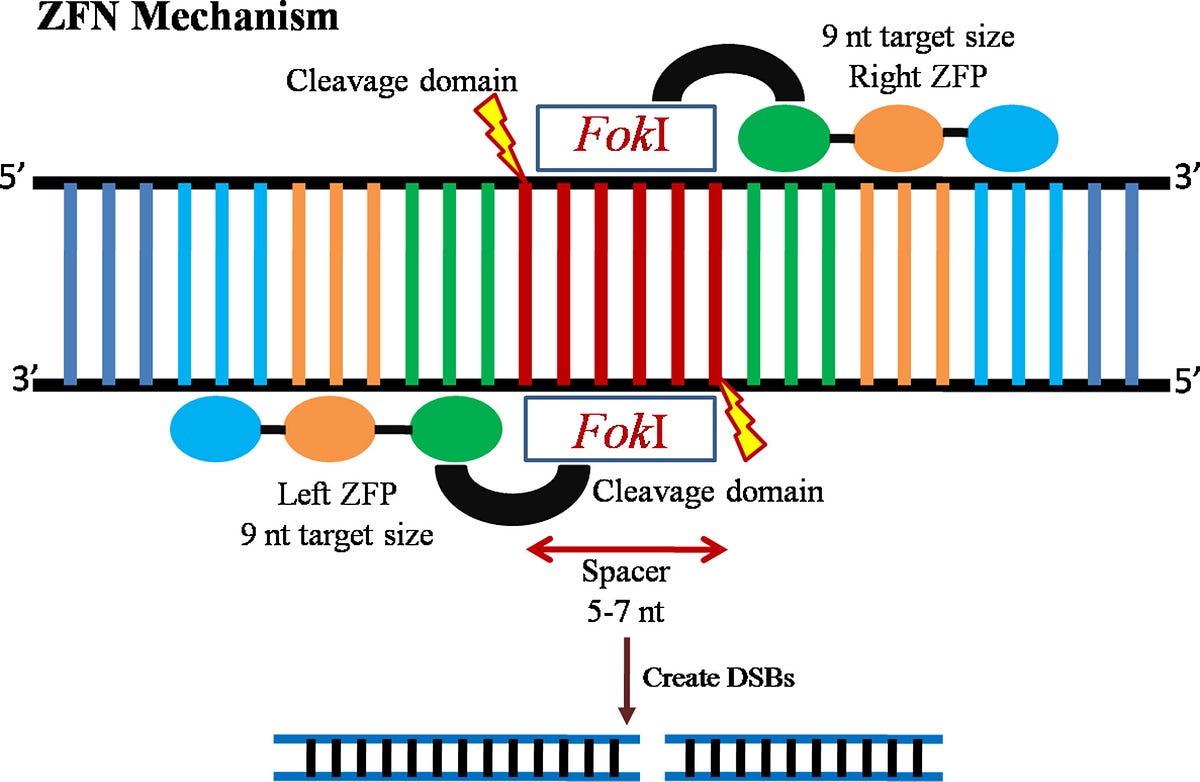
Fig. 1. Mechanism of zinc finger nuclease (ZFN) inducing double-stranded breaks (DSBs) at the target region in the genome. Two different (“left” and “right”) ZFN monomers consisting of a tandem array of different zinc finger protein (ZFP) recognize a nucleotide triplet (shown in blue, brown, and green color). Each ZFN is fused with Flavobacterium okeanokoites (FokI) nuclease and results in dimerization of the FokI. DNA cleavage takes place in the 5–7 base pair (bp) of the spacer sequence (shown in red) between ZFP recognition sites.

David Liu, a researcher at Harvard University, made a HUGE advancement when he created “prime editing” — a molecular device that can correct any form of genetic error without shattering a DNA strand as CRISPR does. According to Liu, the device uses an engineered protein and can correct any of the 75,000 known mutations that lead to genetic disease in people. Since many human cell types don’t have the capacity to create HDR at highly efficient levels, Prime Editing has the potential to allow high-frequency edits while excluding HDR in various human cell types.
CRISPR/Cas9 — WHAT IS IT???
CRISPR/Cas9, the ultimate and revolutionizing genome-editing technology, allows scientists to precisely alter the DNA within living organisms, specifically the base pairs of a gene. In the genomes of prokaryotes, their uniquely organized DNA sequences which are partially repeated and short, are eventually edited by being cut with ABSOLUTE precision and allowing the use of naturally guiding repair processes of DNA, involving the Cas9 enzyme and a guide RNA, to “makeover” such damaged sequences. CRISPR, also known as “Clustered Regularly Interspaced Short Palindromic Repeats” assists in the prevention of viral infections found in various bacterias and guides the Cas9 protein, which acts almost identical to “MOLECULAR” SCISSORS”, to pinpoint and cut specific DNA segments with SUPER DUPER precision.
CRISPR as genetic DNA sequence engineering with gene mutation outline diagram. Labeled educational explanation with Cas9, guide RNA and new helix part vector illustration. Artificial genome editing.
Guide RNA (gRNA) and CRISPR-associated (Cas-9) proteins are two
SUPER DUPER IMPORTANT
components in the CRISPR/Cas9 system.

CRISPR/Cas9 system can be broken down into two classes: Class I (type I, III, and IV) and Class II (type II, V, and VI)
Class I (type I, III, and IV): Class 1 systems are divided into multi-subunit CRISPR complexes, which have a majority Cas proteins.
- Type I systems are found in GREAT range of bacteria and archaea, similar to Type III systems. They are RED-CARPET FAMOUS for their large Cas protein complexes that have multiple subunits. HOWEVER, unlike Type I systems, Type III systems have a TINY Cas9 protein complex and are used in RNA and DNA targeting.
- Type IV systems are LESS well-studied and are found in a limited number of bacteria. So unfortunately, scientists have a much smaller range of information BUT are still studing these systems in as much detail as possible.
THE EPIC WORLD OF Cas9
Gene editing experienced its FIRST EVER use of the Cas9 protein, extracted from a common bacterium called Streptococcus pyogenes (SpCas-9), a GINORMOUS DNA endonuclease (basically a group of enzymes that breaks down a nucleotide chain into short chains by pulling apart the internal covalent bonds that link nucleotides) with 1,368 AMINO ACIDS!!! and multiple domains responsible for creating a double-stranded break by separating the target DNA, also known as a genetic scissor.
In addition, the Cas9 protein has two EXTREMELY IMPORTANT regions called the recognition (REC) lobe (which consists of two specific domains, RNA-DNA hybrid recognition and PAM recognition, and is responsible for binding gRNA or guide RNA and also leading the Cas9 protein to the target location of the DNA sequence) and the nuclease (NUC) lobe (who’s primary function is to locate and cut the target DNA at its EXACT location and also contains two nuclease sites called HNH and RuvC which work as one to split the DNA strands). The RNA-DNA hybrid recognition domain, a fancy word for describing the process of identifying and cloning specific genes, operates solely to recognize and bind to its precise, target DNA sequence. In addition, the PAM recognition domain, short for the LOOOOOOOONG SCIENTIFIC TERM Protospace Adjacent Motif Recognition works to initiate the breakup of DNA. To continue, the nuclease (NUC) lobe contains endonuclease activity meaning it can form DSBs or double-standed breaks within any DNA molecule and contains HNH and RuvC nuclease sites. Ultimately, the HNH creases the target DNA strand which is correlative to gRNA or guide RNA while the RuvC domain, also commonly referred to as the complementary strand opposite to the guide RNA, creases the non-target DNA strand.

THE WONDERS OF GUIDE RNA:

Guide RNA (gRNA) literally GUIDES Cas9 like a molecular GPS to perform genome editing on its specific target DNA sequence and consists of two particular processes, CRISPR RNA or crRNA for short and Trans-activating CRISPR RNA aka tracrRNA. CrRNA is produced from the CRISPR array within archaeal or bacterial genomes as a short RNA sequence containing repeating DNA sequences intermingled with distinctive sequences called spacers which are produced from various foreign DNA the organism has made contact with and survived in past encounters. In addition, crRNA correlates to the unique spacer sequence equivalent to the target DNA sequence and is an 18–20 base pair in length that specifies the target DNA by pairing with the target sequence. The second part of guide RNA involves the Trans-Activating CRISPR RNA of tracrRNA, an artificial RNA molecule created to increase efficiency and specificity of operations within the CRISPR-Cas9 system, forming a complementary base-pairing relationship with the crRNA ultimately stabilizing the guide RNA structure. A single-guide RNA or sgRNAstructure allows for both the crRNA and tracrRNA to form the full gRNA within a laboratory setting of within a cell itself, producing a chimeric RNA molecule which combines the crRNAs target region with the tracrRNAs structural support. Researches focus energies on modifying the target DNA sequence that the gRNA is fully COMPLEMENTARY to, meaning when two complementary strands of DNA or RNA are alongside one another, their bases match up with their complement. After the Cas9 protein is guided by the gRNA to that specific genome location and base-paired with the target DNA sequence, the Cas9 protein “cleaves” the DNA and begins the genome-editing process. The required DNA region is efficiently targeted while off-target effects are minimized thanks to optimization and careful selection of the gRNA sequence.
GUIDE RNA IN PROKARYOTES AND IN GENE-EDITING:

Guide RNA or gRNa in prokaryotes are used to target viral or plasmid DNA or more commonly known as spacers integrated within the CRISPR array in a prokaryotic genome. The CRISPR array is translated into a precursor RNA molecule known as pre-crRNA containing multi-spacer sequences mixed with repeated sequences. The processing of this precursor molecule results in the production of individual crRNAs, each of which has a single spacer sequence. An enzyme complex called Cascade, short for CRISPR-associated complex for antiviral defense identifies, binds to, and cleaves the pre-crRNA, allowing for the removal of repeat sequences and creating mature crRNAs in the process. Then, the CRISPR-Cas system is activated and an effector complex is created through the combination of crRNAs and Cas proteins allowing for the binding to complementary sequences within invading plasmid or viral DNA. Therefore, once thee Cas proteins are fused with their specified target DNA, they are RRRRREADY and INNNNNN POSITION to carry out their normal enzymatic activiitiies to cleave foreign DNA, deeming it non-functional ultimately preventing the plasmid/viral DNA from replicating or infecting in the prokaryotic host.

In the gene-editing tool, guide RNA in gene editing carries out an almost identical process to that of the process within prokaryotic cells since the gRNA is designed specifically to be complementary to the target DNA sequence researchers desire to modify, is located adjacent to a specific PAM sequence identified by the Cas9 protein, provides specificity by creating a base-pairing interaction with target DNA within the editing process, and uses both the trans-activating CRISPR RNA (tracrRNA) and CRISPR RNA (crRNA). However, single-guide RNA or sgRNA, created when the tracrRNA and crRNA are fused into one single molecule and combines advantages of both the tracrRNA and crRNA into one compact, simplifies the extended process of delivering the gRNA into cells. The delivery process of the gRNA cells include a wide variety of methods such as viral vectors, direct introduction of synthetic gRNA molecules or plasmid infections. Once the gRNA wiggles itself inside the cells, the ribonucleoprotein complex OR RNP complex is formed and re-performs the process of guiding, searching, and targeting once again. Once the target DNA sequence is reached, a double-stranded break or DBS is formed the that exact location induced by the Cas9 protein. Then, the natural repair mechanisms within the cell are triggered and result in either a homology-directed repair (HDR) or non-homologous end joining (NHEJ). The homology-directed repair offers a DNA template with the Cas9-gRNA complex where a donor DNA molecule along with the desired genetic alterations can be introduced by researchers and used by repair mechanisms within the cell to precisely insert or replace DNA sequences in need of repair.
RECOGNITION, CLEAVAGE, REPAIR: The Ins and Outs of CRISPR/Cas9:

The RECOGNITION phase of the CRISPR/Cas9 genome editing series begins with the designing of the pegRNA, short for prime editing guide RNA, which contains three primary regions, the targeting region (complementary to target DNA site), the primer-binding site (PBS for short, intermixes to the DNA template), and the reverse transcriptase template (commonly known as the RT template which stores the desired edit information). The combination of the Cas9 enzyme, synthesized to an RT domain, and pegRNA, which guides the complex within the genome to the desired target site, forms the RNP/Prime Editing Ribonucleoprotein complex. Then, the target site is recognized and binded to by the Cas9 enzyme through base pairing between the pegRNA’s target region and the complementary DNA sequence. While the Cas9-RT complex is guided by the pegRNA for DNA synthesis and cleavage, sgRNA is of utmost assistance when recognizing and binding to the target DNA sequence. The Cas9 protein is directed by the designed sgRNA and recognizes the target sequence in the desired genome through the 5’crRNA complementary base pair aspect.The pegRNA, containing the required edit information and acting as a DNA synthesis and a reverse transcription template in the PE (Prime Editing) system, is different from the sgRNA in this system of editing. The Cas9-RT complex is recognized and bound to the target DNA with the help of the sgRNA, which facilitates the initiation of the primary editing process.
CLEAVAGE AND REPAIR: Once the Cas9 protein is activated for DNA cleavage, the non-complementary strand of target DNA is cleaved by the RuvC domain while the the complementary strand is cleaved by the HNH domain producing mainly blunt-ended double-stranded breaks. Then, the host cellular machinery repairs the double-stranded break. However, going back to the sgRNA during DNA cleavage, once the Cas9-RT binds to the target DNA, with help from teh sgRNA ensuring precise cleave and subsequent DNA editing processes, a single-strand nick is formed on the unaltered DNA strand, forming a subsequent DNA synthesis “primer”.
REPAIR: The repair process in PE involves the displaced DNA strand being used by the cellular DNA repair mechanisms as a DNA template in order to synthesize the complementary strand, eventually incorporating the desired edit. The freshly synthesized DNA strand replaces the original unedited DNA strand (remains hybridized with the editing DNA strand for a short period of time) while carrying the preferred edit, following the reverse transcription (RT) step. The non-edited DNA strand, recognized by the cellular DNA repair enzymes, acts as a DNA repair synthesis template and thereby begins the creation of the complementary strand derived from the template. Following DNA synthesis, the original, undisturbed DNA strand is joined with the newly generated strand using DNA repair enzymes. By joining the newly created strand carrying the desired edit to the original strand, the ligation procedure closes the nick in the DNA. Once DNA synthesis and litigation have crossed the finish line, cellular DNA proofreading enzymes scan the editing DNA strand to check for potential mismatches or errors that may have popped up during the repair process, and therefore perform correction techniques, ensuring greater accuracy within the DNA sequence. Homology-directed repair (HDR) and non-homologous end joining (NHEJ) routes are two systems utilized to repair Cas9 protein double-stranded breaks. In the absence of external homologous DNA, NHEJ speeds up the repair of DSBs by connecting DNA fragments through an enzymatic mechanism while remaining active throughout all cell cycle phases. Although it is the most prevalent and effective cellular repair process, it is prone to mistakes and can produce minor random insertions or deletions (indels = “an insertion or deletion of bases in the genome of an organism”) at the cleavage site, which can result in untimely stop codons (“three nucleotides which together form a unit of genetic code in a DNA or RNA molecule”) or frameshift mutations. In the S and G2 phases of the cell cycle, HDR is a more accurate repair process that uses a homologous DNA template to fix the double-stranded break.
WHAT’S BETTER THAN A HELPING HAND?
[embed]
“Knock-ins” and “Knock-outs” are certain types of genetic modifications and are used to study the creation of disease models, developing therapeutic strategies, and gene function. “Knock-ins” are basically where more DNA is added to where a cut has been made and “knock-outs” remove and replace a specific segment of DNA with different DNA or can delete specific genes to inactivate them. Researchers can better understand the expression of various proteins — which are necessary for the function, control, and structure of the tissues and organs within the body — by altering or disrupting the gene sequence and can also observe how adding or deleting genetic information alters the functioning of biological mechanisms.
WHAT’S ALL THE BUZZ ABOUT???
Prime Editing and microorganisms can be applied in various fields or life science related to industrial, agricultural, and health productions. Researchers first applied Prime Editing technology within mammalian cells and also discovered that up to 89% of common gene variations associated with human diseases could be corrected in the original PE system. In addition, Prime Editing variant technologies offer promising potential for advancing plant genome editing, now constrained by restricted donor transmission and limited homologous recombination frequency and have also been rapidly deployed and developed within plants. Prime Editing technology was also recently used to study and applied in the E. coli, the model bacterium.
CRISPR defense mechanism protects bacteria from repeated viral attacks through three basic stages: adaptation (spacer acquisition), crRNA synthesis (expression), and target interference. CRISPR loci are an array of short repeated sequences found in chromosomal or plasmid DNA of prokaryotes. Cas gene is usually found adjacent to CRISPR that codes for nuclease protein (Cas protein) responsible to destroy or cleave viral nucleic acid
APPLICAIONS of PE:
The development of a reliable and efficient method of a gene-editing tool in living cells has been a long-standing goal for biomedical researchers. After figuring out the CRISPR mechanism in prokaryotes, scientists understood that it could have beneficial use in humans, plants, and other microbes.
- The CRISPR/Cas-9 genome-editing tool has a wide number of applications in many areas including medicine, agriculture, and biotechnology.
- In agriculture, it could help in the design of new grains to improve their nutritional value.
- In medicine, it is being investigated for cancers, HIV, and gene therapy such as sickle cell disease, cystic fibrosis, and Duchenne muscular dystrophy.
- The technology is also being utilized in the regulation of specific genes through the advanced modification of Cas-9 protein.
In the future, researchers hope that this technology will continue to advance for treating and curing diseases, develop more nutritious crops, and eradicating infectious diseases.
The latest research shows that the CRISPR/Cas-mediated single-base editing and prime editing systems can create direct mutations in cellular DNA without the need for a donor template. The CRISPR/Cas-base editor and prime editor system do not produce DSB, which reduces the possibility of indels that are different from conventional Cas-9. So far, two types of base editors have been developed: cytosine base editor (CBE) and adenine base editor (ABE). The CBE is a type of base editor composed of cytidine deaminase fused with catalytically deficient or dead Cas-9 (dCas-9). It is one of the greatest gene therapy strategies that can produce precise base changes from cytidine © to thymidine (T).However, the target range of the CBE base editor is still restricted by PAM sequences containing G, T, or A bases. Recently, a more advanced fidelity and efficiency base editor called nNme2-CBE (discovered from Neisseria meningitides) with expanded PAM compatibility for cytidine dinucleotide has been developed in both human cells and rabbits embryos. The ABE uses adenosine deaminase fused to dCas-9 to correct the base-pair change from adenosine (A) to guanosine (G). Overall, single-base editing through the fusion of dCas-9 to cytidine deaminase or adenosine deaminase is a safe and efficient method to edit point mutations. But both base editors can only fix four-transition mutations (purine to purine or pyrimidine to pyrimidine). To overcome this shortcoming, the most recent member of the CRISPR genome editing toolkit called Prime Editor (PE) has been developed to extend the scope of DNA editing beyond the four types of transition mutations. PE contains Cas-9 nickase fused with engineered reverse transcriptase and multifunctional primer editing guide RNA (pegRNA). The pegRNA recognizes the target nucleotide sequence; the Cas-9 nickase cuts the non-complementary strand of DNA three bases upstream from the PAM site, exposing a 3ʹ-OH nick of genomic DNA. The reverse transcriptase then extends the 3ʹ nick by copying the edit sequence of pegRNA. Hence, PE not only corrects all 12 possible base-to-base transitions, and transversion mutations but also small insertion and deletion mutations in genetic disorders.
PRIME EDITING IN MICROORGANISMS:

Bacteria, archaea, and eukaryotic microorganisms like filamentous(threadlike) and yeast fungi are super common microorganisms that are everywhere in nature around the world. SOME microorganisms are harmful and can infect people, plants, and animals with diseases BUT the good news is that a large handful of microorganisms bring lots of benefits for both agricultural and industrial productions and human health and are also very beneficial for basic life science research. For example, a bacterium with filaments called Streptomyces is the main source of a majority of anti-infective drugs in clinical trials. Plus, it was discovered that Streptomyces has a large handful of recessive (a trait that must be given by both parents to appear in the offspring) gene clusters and is still a very significant source of active metabolites. The beauty of eukaryotic microorganisms, or organisms that have a nucleus and other membrane-bound organelles, like fungi with yeast and filaments, can create a variety of metabolites and proteins which are important to industrial microorganisms which are used to produce things like food, cosmetics, pharmaceuticals and construction materials. Most importantly, the CRISPR/Cas9 system also comes from not only microorganisms but has been used, since birth, in gene editing with microbes.
For the very first time in 2013, the CRISPR/Cas9 system was introduced in species of yeast used in biotechnology ALL OVER THE WORLD AND which greatly improved the ability of genome editing, called Saccharomyces cerevisiae or S. cerevisiae for short. Plus, the genome of Streptococcus pneumoniae and E. coli made history when the CRISPR/Cas9 system successfully edited both bacteria and since then, the CRISPR/Cas9 system has been trusted as a reliable system applied in various filamentous fungi. In addition, the CRISPR/Cas9 system was once again used in Penicillium chrysogenum, Trichoderma reesei, Neurospora crassa, Acremonium chrysogenum, and many more filamentous fungi as well as in Aspergillus nidulans (A. nidulans, a fungi able to fertilize by itself and a model organism to study the production of cells) once again in 2015.
Footnote:
- The pyrimidine salvage uses extracellular nucleosides and nucleobases from the bloodstream or intracellular recycled nucleic acids (UMP, CMP, TMP) which come from DNA and RNA degradation. This allows to synthesize nucleotides for efficient DNA replication and repair as well as mRNA synthesis.
- Pyrimidines are one of two chemical compounds that cells use to make the building blocks of DNA and RNA. Examples of pyrimidines are cytosine, thymine, and uracil. Cytosine and thymine are used to make DNA and cytosine and uracil are used to make RNA.
E. coli, a model microbial material, is very popular in the world of research since scientists and experts have studied this microorganism in agricultural and industrial applications. However, editing the genome of E. coli still presents it challenges that scientists and researchers must overcome since early techniques of gene editing based on the CRISPR/Cas9 system still rely on homologous (similar) DNA donors because many prokaryotes don’t have NJEH (non-homologous end junction). In recent years, a PE-based genome editing kit was created for studying prokaryotic microbes like E. coli. Pretty cool! In this genome editing kit was a three-plasmid system (pCDF-GFPplus used as a report plasmid to report back to researchers the the expression and localization of GFP-tagged proteins or monitor cellular processes in real-time through the green fluorescence caused by GFP, pPEgRNA used to carry the gRNA sequence for precise targeting to specific DNA sequences, and pCRISPR-PE which contains the necessary components for Prime Editing like the prime editing guide RNA and the fusion protein of Cas9 and reverse transcriptase). The new and improved PE system was closely studied in editing the E. coli genome by finding the change of the lactose metabolism pathway and the D-galactose metabolism pathway. Plus, SNP which stands for Single Nucleotide Polymorphism (a common type of genetic variation found in a population) was used as an analysis method to evaluate the potential off-targeted mutation and the targeted mutation. The best rate of success possible in single base deletion was as high as 40% and the DNA sequences up to 97 bases were successfully deleted in E. coli. Plus, up to 30 bases of DNA sequences were successfully inserted using this genome editing kit. What’s the catch?? Well, the editing efficiency of PE in E. coli was still very low BUT this work is only in its very first stages as attempts of the PE system in prokaryotic microorganisms. The rate of success of genome editing is expected to completely shoot high off charts and show mass improvement by advancing conditions.
Footnotes:
- D-galactose metabolism pathway — a type of sugar found in dairy products and broken down in the body to produce energy — a monosaccharide and classified as an aldohexose which means it has 6 carbon atoms and an aldehyde functional group
- Green Fluorescent Protein (GFP), a protein that emits green light when exposed to specific wavelengths of light
This figure is a diagram representing how the Prime Editing system is used in E. coli.
OPTIMIZING THE PE SYSTEM:
The accuracy and efficiency of PE, which has been used and evaluated in animals, plants, and E. coli, is not a perfect system. The pegRNA and the effecter protein which is formed by blending both nCas9 and the reverse transcriptase together make the dream team of the PE system and are like the CEOs when determining the success rate of the application and editing efficiency of the PE system. It is important to note that the effecter protein and pegRNA are still being improved and growing stronger which is an ongoing process ever since the PE system was discovered. (FIGURE 3). Nonstop research is being done on the connection between the effecter proteins and pegRNA in order to improve and adapt.

The above Figure 3 shows a photographic representation of several strategies used to boost the PE system and maximize its full potential. As you can see in diagram A, seven diagrams are used as examples to show how pegRNA is optimized in the PE system in PRIME-Del, GRAND, HOPE, Bi-PE, twinPE, ePE, and epegRNA. PRIME-Del is one of many genome deletion methods based on Prime Editing that use state of the art precision techniques to accurately delete any unworthy gene. With that said, PRIME-Del is a precise gene deletion technique based on PE and uses two pegRNAs for opposite DNA strands to accurately edit the DNA targets, as shown in the first row. The second row shows the GRAND editing technique, a simple acronym for Genome-Regulated Activation of a New Donor, which introduces a regulatory element (a specific DNA sequence or region that controls gene expression or the activity of certain genes) into a target genome to control the activation of a new donor template who’s just been introduced during the PE process. Therefore, GRAND joins two pegRNAs with target DNA sequences and different but matching RTT or Reverse Transcriptase Template. The third row shows a foolproof visual of HOPE (High-fidelity Prime Editing), a term used to describe a new and improved version of PE whose goals is to increase the loyalty and accuracy of gene modifications, which designs and uses a pair of pegRNAs containing matching 3′terminals and used to target DNA double strands. The fourth row in diagram A shows Bi-PE or Bidentate Prime Editing with pegRNA, a more sophisticated version of Prime Editing that uses a modified pegRNA (prime editing guide RNA) with two RNA “handles” to improve the stability of the pegRNA-DNA hybridization process. What’s most important to know is that row 4 specifically shows Bi-PE uses a nick sgRNA near the pegRNA template sequence. However, row 5 shows how twinPE or Twin Prime Editing, which uses a single PE system to edit two target sites at the same time in the same genome at once, uses two pegRNAs and a prime editor protein. Then again, in the sixth row of diagram A describes the ePE technique in which the nicking RNA (an enzyme that cuts one strand of double-stranded DNA) and pegRNA come together in one transcriptional unit, causing a pegRNA skeleton to come about. Last but not least, the seventh and last diagram in diagram A shows how pegRNA (epegRNAs) was engineered in epegRNA by including RNA patterns into the 3′end of pegRNAs.
Diagram B shows how the length of the RT template or Reverse Transcriptase template greatly affected the ratio of targeted editing to off target editing, BUT this ratio did not change WITH the PBS length or the location of the nicking sgRNA.
In Diagram C, the ePPE system (Engineered Plant Prime Editor), a type of base editor, deletes the RNase H domain in M-MLV RT (DNA polymerase or transcriptase that relies on RNA) and adds a virus nucleocapsid (combinations of viral nuclein acid, like RNA or DNA, and the proteins that surround it and protect it) protein in its place. Next up on our list of candidates is the PPE system which stands for Prime Editing Protein that combines an reverse transcriptase enzyme with any activity going on inside the nuclease of Cas9. In the PPE system, the CaMV-RT or Cauliflower Mosaic Virus Reverse Transcriptase which comes from…..YOU GUESSED IT, the cauliflower mosaic virus, and reverse transcriptase from E. coli. The fusion effecter protein split into split nSpCas9 (“nSp” stands for “nuclear localization signal peptide” a sequence that targets the protein to the cell nucleus) and MMLV-RT or Moloney Murine Leukemia Virus Reverse Transcriptase in Split-PE in diagram C …Isn’t that a pretty thing?? The MMLV-RT is an example of an RT enzyme that can be used to jump start the RT step in the PE process.
Diagram D shows how PE2 variants like PE2-ng, PE2-vrer, PE2-spg, PE2-spry, PE2-vqr, and PE2-vrqr can tell apart different PAM sequences and greatly contribute to the search-and-find part of recognizing specific challenges so researchers and scientists can find solutions and improve Prime Editing. Daigram E shows how each promoter maximizes its potential for expressing the effecter protein gene and pegRNA. For example, in PPE (Plant Prime Editor), the Ubi-1 promoter, which comes from the ubiquitin-1 gene a highly active and common promoter in molecular biology, from maize is used as like a motivation coach to drive the expression of the effecter protein coding gene (the gene that encodes the modified protein) after its codon was modified per the codon preference of rice. Then again, the osu3 promoter from rice (TaU6 promoter from wheat) and the TaU3 from wheat were used to motivate the transcription of pegRNA and the nicking sgRNA. Osu3, TaU6, and TaU3 are all examples of promoters used in the more advanced Prime Editor 2 system which is a makeover from the Prime Editor 1 system.
Diagram F shows how the PE system is enhanced but limits DNA mismatch repair or MMR, a cellular mechanism that recognizes and corrects errors or mismatches during the editing process. MLH1dn is a coding gene and is used to disrupt the flow of the MMR pathway in prime editing experiments, which is a GOOD thing because this will allow scientists and researchers to successfully minimize the activity of the MLH1 protein and reduce the normal DNA repair activity of the MMR pathway in order to have successful DNA editing outcomes. The PE4 and PE5 systems were created by only activating the MMR inhibitor protein MLH1dn coding gene for a short period of time; by changing SpCas9, improving the NLS sequence, and modifying the RT codon, the PEmax was made, another very important gene editing tool in the Prime Editing process. The ePE5max system, a very advanced prime editor, is made of ePE3max and a dominant negative OsMLH1 variant that minimizes the activity of MMR. I know, I know, it sounds like a hot mess right? Well, to sum it up a bit, the ePE3max is just another super prime editor like ePE5max just with a fancy name, the OsMLH1 variant is literally just a super fancy name for super fancy MLH1 gene from Oryza sativa, the super duper fancy scientific name for rice. I KID YOU NOT! With that being said, the ePE3max system has a PEmax protein that combines the combines the inner workings of the Cas9 nuclease with the RT enzyme and meshes them together, an epegRNA with evopreQ1, an RNA pseudoknot, and a nicking sgRNA. Sound familiar?? That’s because a nicking sgRNA is a modified version of sgRNA that’s meant to introduce a single-strand break or nick in the non-edited DNA strand during the PE process.
SOOO…WHAT’S THE CATCH??? — Challenges
Toxic cellular reactions to double-stranded DNA donor templates are a challenge that many CRISPR-HDR projects face, and the best part is Prime Editing offers one heck of a solution. While AAV techniques have opened up doors to possibly overcome double-stranded DNA donor toxicity, they still need lengthy homology arms and for packing AAV, which may be restrictive for labs conducting CRISPR research quickly. With the use of prime editing, the Cas9 protein and pegRNA can be delivered as a pure compound without harming dsDNA or requiring viral packaging.
One of the most difficult challenges that Prime Editing is associated with is that protein engineering can sometimes be costly and time-consuming for manufacturers and researchers conducting labs or experiments, however, this technology is totally worth every penny.
The main obstacles of biotechnology and opportunities to discover breakthroughs in this science as well as in clinical applications include the off-target effect, the lack of a safe and effective delivery system to ensure the best quality of life, immunogenicity, and ethical concerns. Host immunity may cause an immune response against components of the CRISPR/Cas9 system, derived from bacteria. In addition, researchers discovered that in healthier people, the Cas9 protein had caused both cellular (anti-Cas9 T cells) and humoral (anti-Cas9 antibody) immune responses, therefore, detecting and reducing Cas9 protein immunogenicity is one of utmost importance and a great challenge in the clinical trails of the Prime Editing world.

Prime Editing uses two specific delivery methods in the CRISPR/Cas9 complex into cells, including physical and chemical (non-viral) methods.
Physical methods include the use of electroporation, microinjection, and hydrodynamic injection.
- Electorporation allows CRISPR/Cas-9 complex, PE components, RNA or DNA molecules, and more, access to the target cell’s cytoplasm using a high electric field to temporarily boost the cell membrane’s accessibility (permeability). However, the main limitation of this method is that it can possibly cause cell death. In vitro and ex vivo applications, such as modifying cells before transplantation, are also possible with electroporation.
- Microinjection is a technique that uses a needle to inject the CRISPR/Cas9 complex directly into the nucleus or cytoplasm within each cell, and allows for a more precise and faster delivery system of components into target cells. This method is also commonly used for editing certain cell types of embryos as well. HOWEVER, a major downside to this approach is that researchers and labs must spend A TON of money for equipment and expertise, and using this method can cause great damage to cells, making this a limited approach.
- Hydrodynamic Injection is when a large volume of DNA high-pressure liquid is rapidly injected into an animals’ bloodstream causing a short weakening of cell membranes therefore allowing DNA to enter by neighboring cells. The liver’s high vascularity, or blood flow, make this method very effective when delivering genetic components. DNA then goes through the transcription and translation phases of the cycle leading to the expression of the delivered gene and also future biological effects, once inside the cells. Unfortunately, HI can create unwanted stress in the injected tissue and has not yet been used in clinical trials BUT is very flexible, efficient, and rapid in DNA delivery throughout various applications, like functional genomics and gene therapy.
Footnote:
- Gene therapy is a technique that modifies a person’s genes to treat or cure disease. Gene therapies can work by several mechanisms: Replacing a disease-causing gene with a healthy copy of the gene. Inactivating a disease-causing gene that is not functioning properly.

Chemical methods include the use of lipid and polymer-based nanoparticles.
- Lipid Nanoparticles, more commonly known as LNPS, are used in the CRISPR/Cas9 system as non-viral delivery systems for prime editing components into target cells and are made of LNPS, which can enclose and shield nucleic acid loads like the PE components. These round structures, positively charged, are made of lipid bilayer membrane and are created from Lipofectamine–based reagents in water-based solutions. Plus, an LNPs positivity combined with the negatively charged nucleic acids allow for a smooth delivery process since they can easily transport these components within target cells through the cell membrane. FUN FACT: Target cells can be treated with LNPs in vitro(Latin for “within the glass”) or in vivo(Latin for “within the living”), and they help cells take up the primary editing components.
- Polymeric nanoparticles or polynanoparticles for “short”, are tiny particles made of recyclable and biocompatible (naturally occurring) polymers that range from as little as 10 to AS BIG as 200 nanometers in DIAMETER!!! This is what makes these particles SOOOO $$$ in areas like drug delivery, nanotechnology, and medicine. They can also be modified with coatings or functional groups to increase biocompatibility (“the ability of a material to perform with an appropriate host response in a specific application”) AND can house therapeutic agents or pharmaceuticals for a targeted and controlled release in the body. In addition, PEI, which is MUCH MORE STRESSFUL to understand, stands for the SIMPLE Polyethyleneimine and PPL strands for Poly-L-lysine, both of which are two of the most commonly used CRISPR/Cas9 carriers. PEI and PPL are similar to lipid nanoparticles in the sense that they can move through the complex into the membrane through endocytosis (a cellular process by which a cell internalizes any material (liquid as well as solid) from the external environment)
SOME OTHER CHEMICAL METHODS:
- Cell-Penetrating Peptides (CPPs): Cell-penetrating peptides are short peptides that can begin the entry of macromolecules, including nucleic acids, into cells. CPPs can be joined together with the prime editing components, such as the pegRNA or the prime editing protein, to enhance their cellular uptake. These peptides have the ABILITY to travel through cell membranes and deliver the cargo to the cytoplasm or nucleus of target cells, kinda like a waterpark. CPP-mediated delivery can be used for efficient delivery of prime editing components in various cell types.
- CRISPR Ribonucleoprotein (RNP) Complexes: RNP complexes offer faster gene editing with pre-assembled ribonucleoprotein complexes and PE components because the nuclease is ready to go in the cell and the complexes are quickly broken down and cleared making the editing activity short-lived. In this approach, the Cas9 protein is joined with the reverse transcriptase and the pegRNA and delivered as a complex to target cells. This direct delivery of the RNP complex bypasses the need for transcription and translation processes in the cells, enhancing the efficiency and reducing off-target effects.
BUTTTTT…..
VIRAL VECTORS use Adeno-Associated Virus (AAVs), Lentiviral Vectors(LVs), Retroviral Vectors (RVs), and Adenoviral Vectors (AVs).
Allow me to explain:
AAVs, short for Adeno-Associated Viruses, is a small, non-pathogenic virus that may infect a diverse range of cell types and aids in the delivery of PE components into target DNA cells. AAVs ability to easily weave its way into target cells, long-term transgene expression, and stable integration into the host genome. They can also allow for target gene editing since these vectors can be distributed to target organs or tissues.

HOWEVER, the HUMONGOUS size of the Cas-9 protein and the tiny ability of the virus to clone are still major issues, BUT one solution to combat this issue is to package Cas9 and sgRNA into different AAVs. Once the package is set, sgRNA and Cas9 will then be co-transfected (a fancy word to describe a simultaneous process of introducing two separate nucleic acid molecules into a cell allowing each to carry out its function in the same cell). New and improved techniques have introduced the packaging of Cas9 and sgRNA in the same AAVs through a smaller strain of Cas9 which comes from SaCas9, short for Staphylococcus aureus as opposed to the more widely used SpCas9. In addition, EVs, or extracellular vesicles “for short”, have shown promising potential for in vivo CRISPR/Cas9 delivery by ignoring some non-viral and viral drawbacks.
NEXT UP…….
Lentiviral vectors mainly perform the same mechanisms as AAVs do since they can also be used for delivering PE as well. Plus, DID YOU KNOW HIV-(human immunodeficiency virus)based lentiviral vectors is a lentivirus? LVs affect both non-dividing and dividing cells while offering stable integration of transgenes and efficient gene transfer into the host genome.

RVs, or Retroviral Vectors, on the other hand, ALSO uses delivery methods for transferring PE components BUT are derived from retroviruses which can insert their genetic material into the host genome. HOW PE components are delivered HEAVILY depends on safety, how long it takes to achieve gene expression, the required amount of efficiency, target cell type, and the specific requirements of the therapeutic or experimental application.

The off-target effect is a relevant factor to consider in Prime Editing since once DNA recognition and cleavage of the Cas9 component occurs, potential off-target effects like nonspecific, unexpected genetic modification can happen all at once. The PAM sequences AND sgRNA (made of 20-nucleotide) sequences near the target genome are what determine how well CRISPR/Cas9 can cut the target genome.
Recent studies have proven that off-target effects can be caused by three or more mismatches between the 20-nucleotide sgRNA and the target sequence, which can lead to deletion, oncogene activation, rearrangement, and immune response, therefore decreasing the changes for the CRISPR/Cas9 editing system to be used for therapeutic purposes.

HOWEVER, solutions like modifying the Cas9 nuclease, improving sgRNA, using anti-CRISPR proteins as well as other Cas9 variants. Finding the “PERFECT” or MOST APPROPRIATE sgRNA through creating different designs and selecting the best match, is one of the most important first steps towards reducing any and all off-target effects. Considering options such as the length of the sgRNA, the GC content, and its chemical modification are crucial factors to consider when designing just the right sgRNA.
According to studies by researchers, there are some recommended techniques by professions that increase the efficiency of editing genomes of CRISPR/Cas9 like adding 2-O-methyl-3-phosphonoacetate (a chemical compound that can stop active enzymes involved in creating new DNA) , or MPA for short, and the GC (guanine-cytosine — IN CASE you were wondering) content of between 40% and 60% in the sgRNA ribose-phosphate backbone. In addition, making changes to the Cas9 protein to increase the specificity of its nuclease, to lessen off-target effects, like modifying either of the RuvC or HNH catalytic residues (sites) in the Cas9 nuclease will create a CRAZY reaction and cause the enzyme to change into nickase creating a blunt cleavage, rather than a single-stranded break.

Target-Primed Reverse Transcription, or TPRT for short, was first characterized in detail by Alan Lambowitz and his team at the University of Texas in Austin where the TPRT mechanism illuminated its skills by studying how group II introns (selfish genetic elements that act as a delivery system and can separate by themselves in the world of PE), spread themselves through the bacterial world. During their studies of TPRT, the Lambowitz lab found that group II introns use a single protein (LtrA) and an intron RNA to target specific genomic sequences and insert copies of themselves. They located regions of the intron RNA which were responsible for binding to genomic DNA, serving a guide RNA function similar to CRISPR’s mode of operation.
The TPRT mechanism was illuminated by studying how selfish genetic elements, called group II introns, spread themselves throughout the bacterial world. During their studies of TPRT, the Lambowitz lab found that group II introns use a single protein (LtrA) and an intron RNA to target specific genomic sequences and insert copies of themselves. They located regions of the intron RNA which were responsible for binding to genomic DNA, serving a guide RNA function similar to CRISPR’s mode of operation. Acting opposite to Prime Editing, when the LtrA proteins of group II introns reverse transcribe copies of the intron RNA into the genome, they copy a much larger fragment of 1,000 BP OR LARGER. While applications of group II introns remain largely at bay due to bacteria, similar to parental controls on a child’s iPad, TRPT allows them to sort of work around and cut across the most twisted parts of DNA repair of various species of bacteria. PLUS, group II introns also helped TargeTron, a type of RNA-based genetic tool used for targeted gene disruption or gene insertion in bacteria, become the FIRST EVER widely portable tool for microbial genome engineering.

- Prime Editing and CRISPR introduced an unnatural complex, Cas9 mingling with a reverse transcriptase, that makes TPRT suitable in mammalian systems for small edits. Similar to the group II introns in bacteria, Prime Editing allows the efficient replacement of stretches of mammalian genomic DNA with RNA-specified edits. Ultimately, new approaches like Prime Editing, which are based on the TPRT mechanism, are DESTINED to make the next generation of genome engineering tools even more precise and applicable than the current systems. CRAZY UNBELIEVABLE, AM I RIGHT???
메타데이터
- post_id
- a2196e906c65
- slug
- the-hall-of-fames-newest-addition-in-medical-history-prime-editing-a2196e906c65
- url
- https://medium.com/@evacara128/the-hall-of-fames-newest-addition-in-medical-history-prime-editing-a2196e906c65
- canonical_url
- https://medium.com/@evacara128/the-hall-of-fames-newest-addition-in-medical-history-prime-editing-a2196e906c65
- author_url
- https://medium.com/@evacara128
- status
- ok
- fetched_at
- 2026-06-09 15:37:30