The Mosaic World
Once someone asked where Diogenes came from, he replied,” I am a citizen of the world.”
The Mosaic World
Once someone asked where Diogenes came from, he replied,” I am a citizen of the world.”

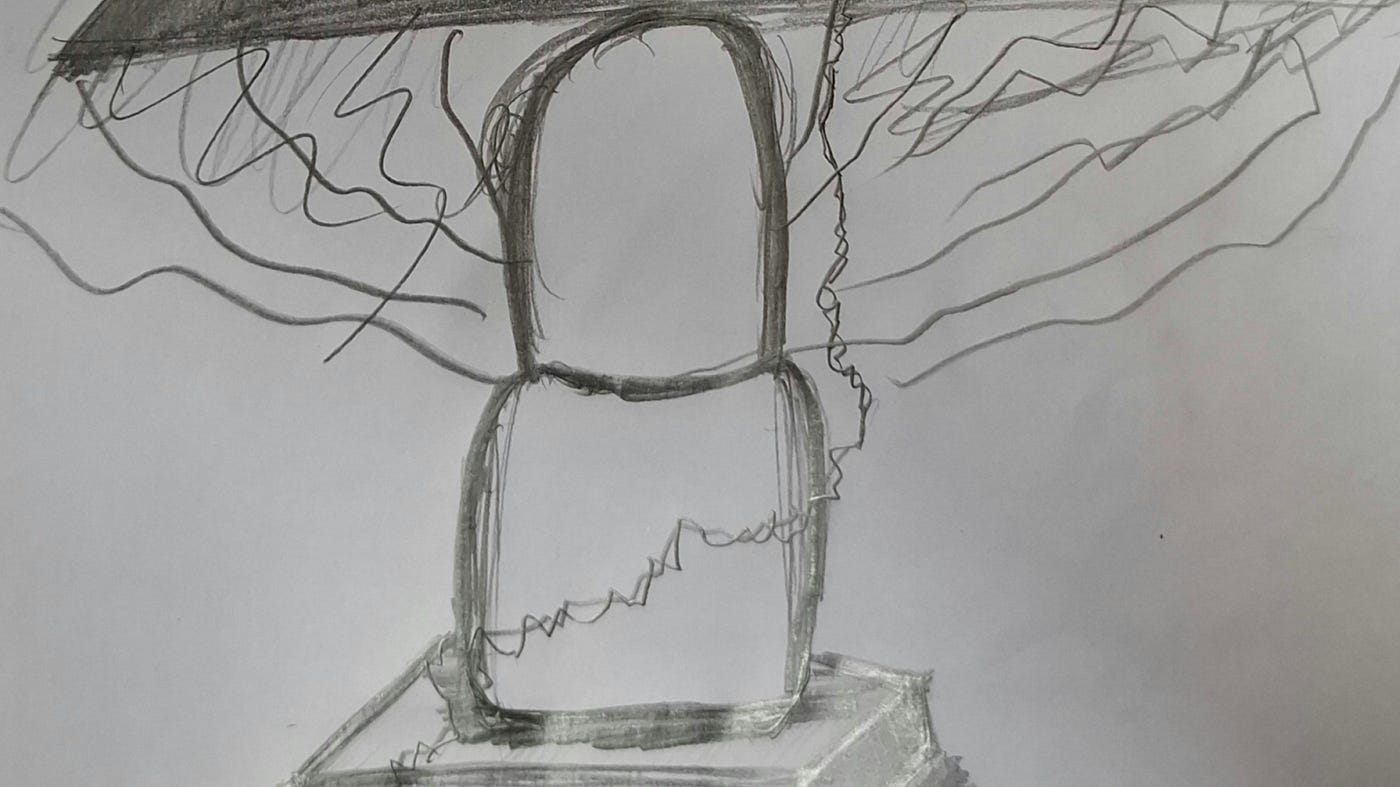
Sphere into pieces into blood — Image by the author
From the north, the feminists arrive, the masculine boulders roll from the south, the west blows the red air of the war while the east lags and plans for another attack. While this happens on a macroscopic level, zoom in, kid, and read below.
Influencers hooting — “Education system is garbage, focus on skills”; “Mr. Mango is fake”. In the thick of this, someone with a barely developed moustache is advising and prophesying, and calling everyone an idiot with an air of holier-than-thou. Add some moralists with their superior and pristine values. While this happens on a microscopic level, further zoom in, boy, read below.
Good Listeners. Good Speakers. Life-long Learners. Internet — a marionette with strings spreading down the knowledge equally where the algorithmic performer hands the niche ideas — whispering “yours is superior, believe me! There’s no luck!” While all this happens, someone comes and inaugurates the coteries club.
In the thick of this, the search for a human is met with nothing.
In modern times, the fragmented world echoes the call for the past — to escape in its rosiness. On the other hand, the past with illiteracy and lack of pen-paper privilege speaks only the voices that were otherwise. At present, the media’s exaggeration and its tracking and attacking of tiny moments have left us cynical. With the internet, people have got voices to stand and point the inefficiencies and cruelties — which is a virtue. However, it has led to more criticisms, hatred in the name of ‘discussions’, and debates that stage intellect’s fake performance.
On social media such as X, people complain about trivial things — governments’ tiny errors, how everything should be ideal or according to their beliefs. They fail to acknowledge pluralism, the belief that having diverse features in a society is good. Sometimes these discussions are a debate, but most often an independent argument created based on one’s projection that finds no place in reality. On top of that, memes and posts provide a space to vent one’s inner feelings. Some reach our doorstep before their prefrontal cortex rationalises— somehow it is nurtured by the emotional amygdala. It is good to remember, in my opinion, that one’s meaning is as broken as another’s — a nihilistic feature that should be coped with existentialist meaning or absurdist rebellion.
In a world obsessed with doing, why would someone take time out of their schedule to look at what the other person shares, for each one of us has an idiosyncratic set of videos that we label more mature and sophisticated. Hence, the connection of the society might flicker. Psychologically, it is found that one cannot live for long thinking ill of other people.
After the proliferation of non-fiction writing, the articles that use ‘you’ have skyrocketed. “Why you will never succeed”; “Why most people are dumb couch potatoes?” — the titles designed for algorithms and hook end up creating a FOMO that garners views out of individual insecurity. Out of nowhere, polarization of views happens that creates ‘Them/Us groups’, which in turn leads to in-group favouritism and out-group discrimination.
The following explains the gist.
Within a class, there are groups, some we like and some we don’t. Imagine the class is shifting to another room, and a student of another class or subject happens to pass by, suddenly, the whole class broadens their chest and becomes one while the outsider walks with a chin high as if to proclaim — “How difficult is my subject.”
It can be explained psychologically by a theory known as social identity complexity. It has 4 levels.
- Intersection: It means combining your distinct identities into a single one. For example, instead of separating philosophy and poetry, one says philosophical poetry. Therefore, people with such combinations (P&P) form the ingroup and others the outgroup. It signifies the lowest complexity and lesser tolerance for diversity.
- Dominance: It means having some identity that dominates the given number of identities and that one considers other ones as subordinate. For example, instead of saying philosophy and poetry, one considers oneself more as a poet than a philosopher. Therefore, in a philosophical gathering, he might be brimming to say, “But you aren’t a poet, sir!”
- Compartmentalisation: It means being adaptable as per a given situation in terms of identity. For example, at work, one might be an employee, but at home, a poet.
- Merger: It means acknowledging the distinct identities of oneself and avoiding simplification into a single cohesive identity. For example, in comment sections people tend to find what’s common between them and the creator instead of pointing out their differences. It signifies higher complexity and leads to more tolerance for diversity.
Can thinking of ourselves as ‘humans’ be a form of low complexity, and therefore less tolerance for diversity? As common ground breeds envy, does being human also invite such a fate? If teenage rebellion is required, then it can also be said that some form of discrepancies and oppositions among people are required for a healthy form of society.
Interestingly, those who endure prejudices have to go through ego depletion — a theory that suggests willpower is a fixed muscle and its effectiveness decreases with subsequent resistances. Discriminated ones need to allocate their mental reserves to resisting the hatred against them, and thus it wastes humanity’s collective resources.
John Lennon (1940–1980), in his song Instant Karma writes,
Come and join the human race
How in the world you gonna see? Who on earth d’you think you are? Laughing at a fool like me? Superstar, right you are
[…]
Better recognize your brothers Every one you meet
Why in the world are we here? Surely not to live in pain and fear? Why on earth are you there? You’re everywhere, come and get your share
Similarly, in Imagine, he pens a message of togetherness, a call to cease our relentless dividing as a species into taxonomies, leading no permutation-combination to ever repeat, deluding us into believing we are unique.
Imagine there’s no countries
[…]
Imagine all the people Sharing all the world […]
I hope someday you’ll join us And the world will live as one
Bob Dylan in Tangled Up in Blue, writes, how we all live under the same sky — separated by the demands of our professions.
All the people we used to know They’re an illusion to me now Some are mathematicians Some are carpenters’ wives Don’t know how it all got started I don’t know what they’re doing with their lives But me, I’m still on the road A-heading for another joint We always did feel the same We just saw it from a different point Of view Tangled up in blue
After seeing Earth from space people, experience a cognitive shift where they start blurring the boundaries between countries and identify more as Earthians. It is known as the overview effect.
An experiment called ‘Robbers Cave Experiment’ conducted in 1954 showed that the two chosen groups unified more when the collaboration of both was required for the attainment of a superordinate task. It can explain why people with goals such as helping improve the world, or taking humans to Mars, as Elon Musk says, propels one to see the world as one and provides a purpose to improve.
Even in ‘Tuesdays with Morrie’, love is preached as an answer to cynicism. ‘Ubuntu’ or “I am because we are” is the same message that lies at the heart of an ancient African philosophy.
“If sub specie aeternitatis there is no reason to believe that anything matters, then that does not matter either, and we can approach our absurd lives with irony instead of heroism or despair.” — Thomas Nagel
The Latin word ‘sub specie aeternitatis’ for ‘under the aspect of eternity’ carries similar significance. It can eradicate our everyday worries and make them appear irrational and nihilistic. It can be classified as optimistic nihilism. Just how things written in a commonplace book, become hard to distinguish, thinking of ourselves as one would make our idiosyncrasies redundant, a populace left to numbers, without any emotional, relational, or individual significance. While at the same time we feel more connected with the universe, like the microcosm-macrocosm analogy. The same reminder lies in the famous photograph taken by Voyager 1, known as Pale Blue Dot.
I once commented on an article (while struggling for my work’s reach:) ), which I would like to revisit here — “Being right as an individual might give you a spike of superiority. However, being right as a society means nothing, it is ‘We’ and since everyone is one and one is right, no one is wrong.”
Unless you are a solipsist and believe that others are a mere figment of your imagination or actors, cultivating love and affection among each other is a good idea, even if it sounds fairy tale-ish. Countering solipsism, John Stuart Mill (1806–1873) writes, “In other words, other people act like I do in similar circumstances, implying they have similar inner lives.”
I think. A solipsist thinks he can create anything from absolute nothing with the sole help of his internal self. However, that creation is also a result of his abilities. And abilities are a result of the mutual effort of our species. So they are connected. Further, a monk cannot make up anything from nothing he has. His abilities differ. He might not be able to create what the solipsist above can. So if everyone’s abilities differ, what everyone perceives differs, and their perception of solipsism differs to the extent of the quantity, quality and nature of their crystallized and fluid knowledge.
In the Monster anime, Johan Liebert plans a perfect suicide by trying to massacre everyone who knew him. However, it leads to a world where no one is there to even call his name. It reminds us how one can reach the mountaintop at the cost of relationships, that when he looks around, he finds that no one is there to even testify to such achievement.
Poem based on the same theme
The rich wear dandy
The poor tend their lily
The oak’s bushes and branches
have grown very far
They break now and then
fading into the sound of a car.
메타데이터
- post_id
- a22743640dd2
- slug
- the-mosaic-world-a22743640dd2
- url
- https://long.sweet.pub/the-mosaic-world-a22743640dd2
- canonical_url
- https://long.sweet.pub/the-mosaic-world-a22743640dd2
- author_url
- https://medium.com/@phil.cognito.writesgmail.com
- status
- ok
- fetched_at
- 2026-06-21 09:28:28