Port Grimaud: The Provencal Venice Born from a Dream
Part Venetian maze, part Provencal escape: the story behind St. Tropez’s quiet neighbor.
Port Grimaud: The Provencal Venice Born from a Dream
Part Venetian maze, part Provencal escape: the story behind St. Tropez’s quiet neighbor.
Photo by Julius Hildebrandt on Unsplash
On my way back from Saint-Tropez, I decided to drop by Port Grimaud. It had thoroughly intrigued me on Google Maps: seen from above, the town resembles a giant coral reef, stretching its branches from the shore straight into the sea.
Wandering down the very first lane, I couldn’t help being awed by the charming, neat little houses, huddling close to one another along one side of the street like chilled sparrows. On the opposite side, the pier bristled into the canal with moored boats.
Almost every street here turned out to be a cul-de-sac, terminating at the water’s edge…
This part of town is blissfully quiet: no fiercely debating petanque players beneath the plane trees, no classic French town squares featuring the ubiquitous trio of pharmacie, boulangerie, brasserie.
Photo by Gilles MENGHETTI on Unsplash
It looks for all the world like a delightful fishing village built two or three centuries ago. You would be hard-pressed to find two identical facades here: each boasts a slightly different shade, a distinct roofline, its own shutters, its own unique door…
And yet, it felt far too pristine and immaculate for an authentic fishing village… A quick dive into the town’s history — and bingo, its secrets immediately surfaced.
This town is the dreamchild of a single visionary.
Up until the mid-1960s, the site was nothing more than a flat, marshy lowland of salt marshes and agricultural plots — though thanks to the Giscle River, the soil here was surprisingly fertile.
Architect François Spoerry — a man of immense soul and incredible fortitude, who had survived the Resistance and endured two long years in Nazi concentration camps — always dreamed of living in a place where he could tie up his boat right outside his front door. In 1962, he bought around 30 hectares of practically unwanted marshland, spending the next three years fighting for building permits.
Construction finally kicked off in 1966, and in a mere six years, the landscape was transformed beyond recognition. Canals were dug, banks reinforced, and a network of moorings established. Bridges were thrown across the newly formed waterways, and the residential blocks were planned so that nearly every single house enjoyed its own private boat berth.
Today, what appears at first glance to be a tiny enclave actually encompasses over seven kilometers of canals, roughly twelve kilometers of quays, and more than 2,000 moorings.
Spoerry was determined not to build just another generic modern resort with soul-crushing high-rises. Instead, he crafted a town that felt as though it had organically existed here for centuries. He gave each cottage a unique facade, laid out narrow lanes and intimate squares, and, naturally, built a church that fits seamlessly into the townscape.
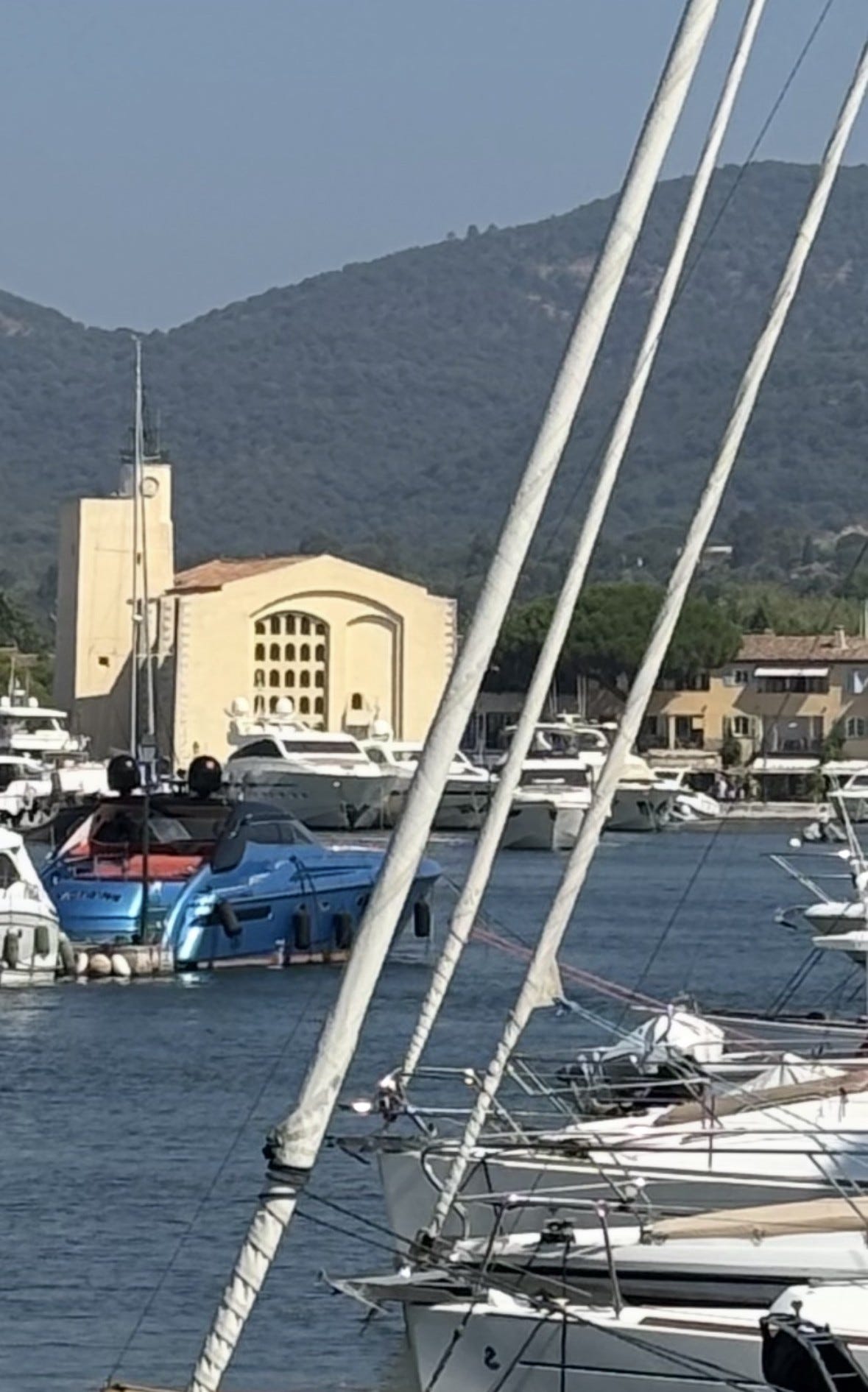
Photo by author. View of the St. Francis of Assisi Church
The Church of St. Francis of Assisi is a curiosity in its own right. For starters, it operates under complete spiritual democracy: space in a waterborne town is at a premium, so Roman Catholics and Protestants take turns conducting services here. This likely explains its minimalist, light-filled interior with crisp whitewashed walls.
Furthermore, its vibrant stained-glass windows were crafted by none other than the father of Op Art himself, Victor Vasarely! Rather than depicting saints or biblical allegories, the artist used a harmony of color and geometric form to depict the sun’s journey across the sky at different times of day.
François Spoerry, the founder of the town, rests in peace within this very church.
If you are fortunate enough to climb the bell tower, you’ll be rewarded with a breathtaking panoramic view: the almost Venetian canals and bridges of Port Grimaud, the yachts and gentle skiffs tethered beside Provencal cottages, and the pier where water buses ferrying passengers across the bay to Saint-Tropez depart.
A amusing historical tidbit: until the late 19th century, the body of water was officially known as the “Gulf of Grimaud.” It was only as Saint-Tropez rose to international fame that the name gradually morphed into what we know today — the “Gulf of Saint-Tropez.”
By the way, traveling to this legendary haunt of film stars and movie gendarmes by sea from Port Grimaud during summer is by far the smarter choice — it spares you the grueling, endless traffic jams that plague the roads from June through September.
The district surrounding the ferry terminal and the church is considerably livelier; after all, this is where tourists congregate in search of food and entertainment. Here, you’ll discover a bustling pocket of affordable eats alongside higher-end bistros.
Photo by Benaja Germann on Unsplash
Today, the French Ministry of Culture recognizes Port Grimaud as an outstanding monument of 20th-century architecture. So, should you fall under its spell and decide to purchase one of these enchanting homes, be prepared: the local municipality keeps a watchful eye to ensure facades and shutters are painted regularly — and strictly in their original colors!
메타데이터
- post_id
- a22a3098a0fc
- slug
- port-grimaud-the-provencal-venice-born-from-a-dream-a22a3098a0fc
- url
- https://medium.com/@villa.thaissia/port-grimaud-the-provencal-venice-born-from-a-dream-a22a3098a0fc
- canonical_url
- https://medium.com/@villa.thaissia/port-grimaud-the-provencal-venice-born-from-a-dream-a22a3098a0fc
- author_url
- https://medium.com/@villa.thaissia
- status
- ok
- fetched_at
- 2026-08-23 10:43:56