How Big Should Your First Project Be?
When people build their first product, they often make it too large without noticing. The idea begins as a small problem, but soon they…
How Big Should Your First Project Be?

When people build their first product, they often make it too large without noticing. The idea begins as a small problem, but soon they want login, memberships, admin panels, team collaboration, template marketplaces, analytics, referral systems, AI assistants, and automation workflows. Every feature sounds reasonable. Together, the project turns from a testable tool into a platform that is hard to finish.
The first project usually becomes too big not because the founder has too much ambition, but because they feel unsafe. They worry that too few features will not convince users, a simple page will not look like a product, and a narrow scope will make the market too small. So they keep adding features, hoping completeness will create safety. But early products do not need completeness. They need a loop.
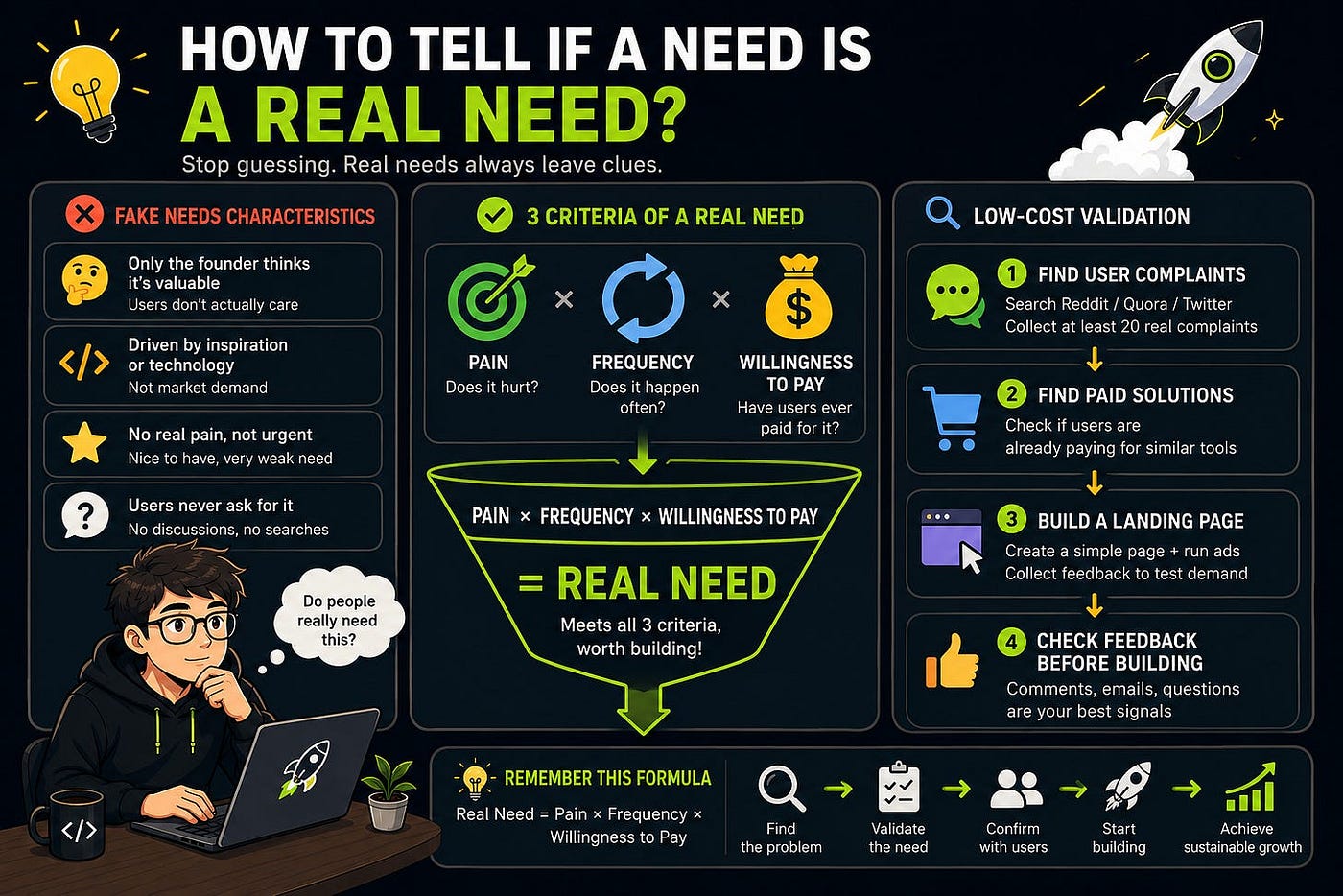
A loop means that in one specific scenario, users can use your product to achieve one clear result, and they have a reason to use it again or pay. How big should your first project be? Not as small as possible, and not as complete as possible. It should be big enough to complete one payment or retention loop, and small enough for you to build, launch, collect feedback, and iterate quickly.
A Small Project Is Not a Small Feature. It Is a Small Loop.
Many people misunderstand MVP. They think a small project means fewer features, rougher pages, and something that barely works. The result may be small, but it has no value. Users open it, do not know what they can complete, and have no reason to return. That is not an MVP. It is an unfinished fragment.
A real small project should center on one complete task. “Batch-generate App Store screenshot sizes” is a small loop: users upload screenshots, choose device sizes, and export usable images. It does not need a design platform, team collaboration, or asset marketplace. It completes one clear result.
“Send weekly SEO issue alerts to small site owners” is also a small loop: users connect a site or submit URLs, the system checks titles, indexing, and traffic changes, then sends alerts and suggestions. It does not need to become a full Ahrefs. Users still receive a useful result every week.
Do not ask “which features can I remove?” Ask “what minimum steps are needed for users to move from problem to result?” If those steps complete the result, the project can be small. If a key step is missing, even many features do not create a loop.
Use One Sentence to Set the Boundary
The first project needs boundaries. Without boundaries, every feature can sound useful “later.” Write one boundary sentence:
This project only helps [target user] complete [one result] in [specific scenario].For example: “This project only helps indie developers batch-generate store screenshot sizes before submitting an app.” Once this sentence is written, many features are clearly out of scope: social publishing, design communities, asset marketplaces, and team permissions. They may be useful later, but they do not belong to the first loop.
Another example: “This project only helps Shopify sellers find low-conversion issues in product descriptions.” Then you do not need a full store operations platform, inventory management, or ad management. First, make “find and improve description issues” work well.
A boundary sentence does not limit imagination. It protects execution. When one person builds a project, the most dangerous thing is expanding scope. Every extra feature brings design, testing, copywriting, support, edge cases, and maintenance. The first project should win a small battle first.
Four Questions to Judge Scope
First: can users understand it in five minutes? If you need half an hour to explain it, the scope may be too large or positioning too vague. Early products should be easy to understand: what goes in, what comes out, and why it matters.
Second: can users get a result in the first use? If users must configure many things, import lots of data, or learn a complicated workflow, early conversion becomes hard. The first product should help users see a result quickly, even if the result is not perfect.
Third: can you build a usable version in two to four weeks? Not a perfect version, but something real users can try. If the first version requires three months, you can drift far away before getting feedback.
Fourth: does the result create a reason to use again or pay? One-time tools can work, but if you want a long-term product, look for recurring scenarios: weekly reminders, every launch, every listing, every article, every lead-generation task. Repetition creates product value.
If a project is understandable, useful on first use, buildable quickly, and repeatable, it is suitable as a first project. If it fails two or more of these questions, shrink the scope.
Do Not Start With a Platform
One of the most dangerous words for a first product is “platform.” Platforms imply multiple roles, workflows, modules, rules, and network effects. They look more ambitious, but they are the hardest to cold-start. Without supply, demand does not come. Without demand, supply does not stay. Without scale, every module feels empty.
Many platform ideas can start as tools. Do not begin with an “AI tool marketplace.” Start with “AI image tool selection and tutorials for ecommerce sellers.” Do not begin with a “freelancer matching platform.” Start with “proposal and scope templates for designers.” Do not begin with a “startup resource community.” Start with “a product launch checklist tool for indie builders.”
Tools are better first steps because they do not require both sides to exist at the same time. One user can arrive, complete a task, and get value. A platform needs an ecosystem. A tool needs one task loop. Once the tool has users, data, and frequent scenarios, you can consider expanding.
Avoid “huge future, empty present.” You need something that helps one user get a result now, not a vision deck for a future ecosystem.
Start With Service Before System
If you are unsure how large the first version should be, run the process as a service first. Users submit materials, you process them manually. Users describe a need, you generate the result manually. Users want a report, you send it by hand each week. A process that works as a service can later become software.
Service-first has two advantages. First, it forces you to face real demand. Users will show you what is unclear, what they care about, and what they might pay for. Second, it reveals which steps deserve automation. You may think generation is the key step, but data cleaning may take the most time. You may think users need a full report, but they may only want three suggestions.
Many founders avoid service because it feels less like a product. But early on, speed of learning matters more than looking cool. A manually delivered result that users want is more valuable than an unused system.
After 5 to 10 manual deliveries, the process begins to repeat and user questions become similar. Then you will know what the first product version should contain. Code written at that point naturally has a smaller scope and sits closer to real demand.
What to Cut From Version One
Version one can often cut account systems unless users need saved history or paid permissions. You can use email, one-time links, forms, or manual result delivery first. Login is not the product value. It is only a way to manage value.
Version one can often cut complex admin panels. Use Airtable, Notion, Google Sheets, a database UI, or manual scripts for operations. The admin panel is for you, not what users pay for. Users do not care whether your internal tools are elegant. They care whether the result helps them.
Version one can often cut team collaboration, permission systems, invitation flows, complex settings, multi-language support, themes, points, levels, and full analytics dashboards. These are not banned forever. They come after the core task is validated. Every “maybe useful later” feature slows down demand validation.
Keep the core path: user enters, provides input, receives result, understands the next step. If this path works, version one has value. Every other feature should serve this path, not distract from it.
Summary
How big should your first project be? Big enough for users to achieve a real result, small enough for you to build quickly and show real users. Do not chase completeness. Do not start with a platform. Do not use feature count to create a false sense of safety. Early products need loops, not scale.
For indie builders, the goal of the first project is not proving you can build a large product. It is proving you can find a specific demand, deliver a specific result, and collect feedback from real users. Once that loop works, the small project earns the right to grow.
Homework
- Write your project boundary in one sentence: who, scenario, and result.
- List the 3 to 5 required steps for users to achieve that result. Move everything else to later.
- Check whether the first version can be built in two to four weeks. If not, shrink the scope.
- Cut at least 5 “maybe useful later” features and keep only the core path.
Next Lesson
Why You Should Not Start With a Platform: platforms look bigger, but their cold-start cost is also bigger.
https://en.harries.blog/how-big-should-your-first-project-be/
메타데이터
- post_id
- a23a4ced58fe
- slug
- how-big-should-your-first-project-be-a23a4ced58fe
- url
- https://medium.com/indie-hack-lab/how-big-should-your-first-project-be-a23a4ced58fe
- canonical_url
- https://medium.com/indie-hack-lab/how-big-should-your-first-project-be-a23a4ced58fe
- author_url
- https://medium.com/@jxausea
- status
- ok
- fetched_at
- 2026-06-12 18:14:10