Ebola Is Back And This Time, the World Is Unprepared
A new variant with no vaccine, a fractured global health system, and a superpower that walked away
Ebola Is Back And This Time, the World Is Unprepared
A new variant with no vaccine, a fractured global health system, and a superpower that walked away
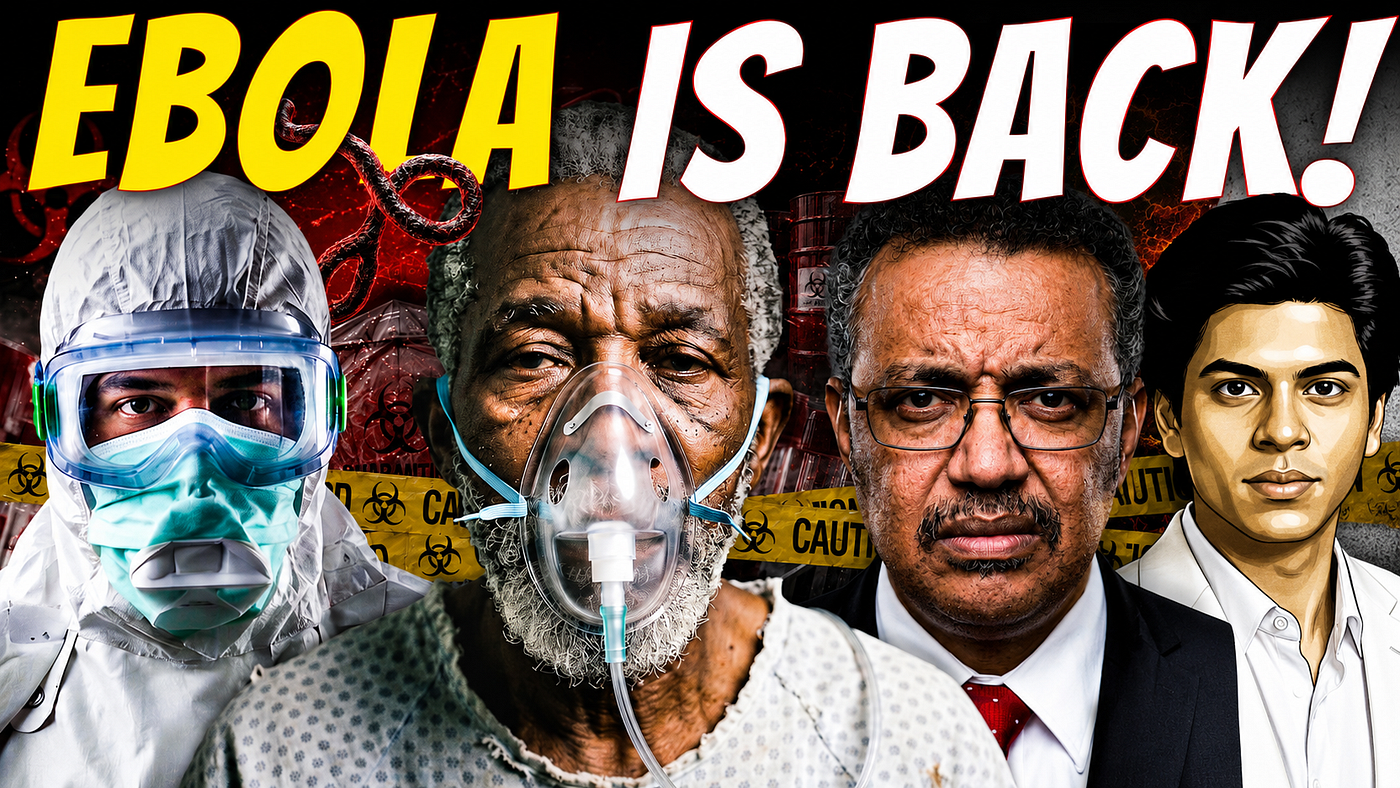
On May 17, the World Health Organization sounded the alarm for the entire world once again. The wounds of COVID had not yet fully healed when an international health emergency was declared over yet another virus. This time, the enemy is not new. It is the well-known, long-feared Ebola virus. But it has returned in its most lethal form to date. Scientists say they have never seen Ebola behave quite like this before.
So far, this virus has claimed 140 lives in the Democratic Republic of the Congo. Over 600 suspected cases have already emerged. There are reports that six Americans have been infected, one of whom was emergency-evacuated to Germany for treatment.
According to WHO, the average death rate for this new Ebola variant, the Bombali strain, sits between 25 and 40 percent. And the most terrifying fact of all: there is currently no approved vaccine for this variant. No specific treatment exists either. Neither medicine nor prayer will be of much use here.
The last time WHO declared a global health emergency over a virus was on January 30, 2020. The world did not take it seriously. That virus was the coronavirus. Within just two months, by March 11, 2020, that same health emergency had been upgraded to a global pandemic. What followed is now history: mass deaths, lockdowns, quarantines. The face of the entire world changed, arguably forever.
“But Ebola Gets Contained. We’ve Done It Before.”
That argument is correct, but dangerously incomplete.
This time, the Ebola virus is not confined to some remote jungle in Congo. It has already reached densely populated areas like Ituri and North Kivu, regions that have international airports. As a result, the virus has already crossed Congo’s borders and reached Uganda, where at least two confirmed cases have been identified, one of whom has already died.
What makes this even more alarming is that the two infected individuals in Kampala, Uganda’s capital, had traveled from Congo independently. They did not know each other. They had no connection whatsoever. And remember: Kampala sees over four million people commuting daily.
Mysterious, unexplained deaths occurring across multiple locations within Congo suggest that the true scale of the outbreak is already far larger than the numbers being reported. As a matter of fact, the doubling rate is the subject of serious concern. The rate of infection is expected to keep doubling in the days ahead.
WHO has made it clear: when the virus is no longer contained within a single country, controlling it becomes exponentially harder.
A Timeline of Catastrophic Delay
The most shocking aspect of this new variant is the speed at which it spread, entirely undetected.
The first suspected case was a 59-year-old healthcare worker. He came into contact with the virus on April 24. Three days later, on April 27, he was dead from severe fever and internal bleeding.
The first critical failure: WHO was not informed until May 5. For two full weeks, the virus moved freely among people without any surveillance, containment, or intervention. By the time the alarm was raised, the virus had already killed 50 people.
On May 14, blood samples collected in Rwampara confirmed what scientists had feared: this was a new form of Ebola, the Bundibugyo variant. No vaccine exists for it. Between 25 and 40 percent of those infected face an agonizing death.
By May 16, the virus had crossed into Uganda’s capital, Kampala. By May 18, the United States had already imposed entry restrictions on foreign nationals who had visited Congo, Sudan, or Uganda within the previous 21 days.
The question now being asked in diplomatic and health circles alike is this: could global travel come to a halt again in the days ahead?
What Ebola Does to the Human Body
The Bundibugyo Ebola virus takes between 2 and 21 days after entering the body before symptoms appear. The initial signs are deceptively ordinary: fever, fatigue, muscle pain, headache. This is precisely why doctors frequently fail to identify Ebola in its early stages, and by the time a diagnosis is made, critical time has already been lost.
As the disease progresses, the body begins to hemorrhage, both internally and externally. Blood seeps from the gums, the eyes, and the nose. In some cases, patients vomit blood. As the virus consolidates its grip on the body, internal organs begin to fail, one by one. The end, when it comes, is extraordinarily painful.
This is not a clinical abstraction. This is the documented reality for every confirmed patient.
Ebola vs. Hantavirus: A Critical Distinction
In recent weeks, the Hantavirus has received significant media attention. But consider the difference in transmission dynamics.
If a nurse is caring for a Hantavirus-infected patient and maintains basic hygiene, proper gloves, standard precautions, her risk of infection remains relatively low. Hantavirus typically does not spread from human to human. If one person is infected, the chain usually stops there. Its reproductive number, the R-value, is estimated to be between 0.1 and 0.7, well below the threshold of sustained transmission.
Hantavirus primarily travels from rodents to humans through contaminated urine, saliva, or droppings. When rodent excrement dries and becomes airborne as microscopic particles, inhaling that air is enough to infect a person.
Ebola operates on an entirely different and far more dangerous principle.
Ebola spreads directly from human to human. If a person comes into contact with the blood, sweat, saliva, tears, or urine of an infected individual, the probability of infection is extremely high. A single infected person can, over time, infect an entire neighborhood.
The danger does not end with death. Even a corpse carries the active virus. Attending the funeral of an Ebola victim without proper precautions can trigger a new chain of infection. Body disposal itself must be managed with extreme clinical precision. In multiple past outbreaks, funerals became the very mechanism through which Ebola spread further.
Healthcare workers are not protected observers in an Ebola outbreak, they are among the primary victims. During the 2014–2016 West African outbreak, 881 healthcare workers contracted Ebola. Of those, 513 died. A mortality rate of 58 percent among those tasked with fighting the disease.
The Variants, the History, and Why This Time Is Different
Ebola was first identified in 1976, near the Ebola River in Congo, when a cluster of deeply disturbing, rapidly fatal deaths drew scientific attention. The current outbreak is Congo’s 17th Ebola outbreak on record.
There are four major Ebola variants capable of infecting humans: Zaire, Sudan, Bundibugyo, and Taï Forest. No two variants behave identically. Their fatality rates differ. Their transmission dynamics differ.
A brief history of major outbreaks:
In 1976, the Zaire variant emerged in Congo with 318 cases. Of those, 280 people died. Fatality rate: 88 percent. Only 38 survived.
In 1995, Zaire returned to Congo. A total of 315 cases were recorded; 254 people died.
In 2007, the Bundibugyo variant appeared in Uganda. Over 1,131 people were infected; 42 died.
Between 2014 and 2016, the West African epidemic, spanning Guinea, Liberia, and Sierra Leone, became the most catastrophic Ebola event in history. Approximately 28,000 to 30,000 cases were documented. More than 11,000 people died.
Between 2018 and 2020, the Zaire variant resurged in Congo. Approximately 3,600 people were infected; over 2,300 died.
Today’s outbreak most closely resembles the Bundibugyo variant, but scientists have not ruled out the possibility that its genome sequence represents an entirely new variant. And critically, outside of the Zaire variant, neither Bundibugyo nor any other Ebola variant has an approved vaccine or specific treatment.
Why Congo Cannot Fight This Alone
Standard containment protocol during a vaccine-absent outbreak is straightforward: isolate the infected, quarantine them in treatment centers, and break the transmission chain.
In eastern Congo, this protocol is nearly impossible to execute.
The region sits atop vast reserves of gold and precious minerals. Over 100 armed rebel groups are actively fighting one another for control of these resources. The most dangerous among them are the M23 movement and the Allied Democratic Forces, an organization linked to ISIS. Their sustained campaigns of violence have displaced entire communities. Sexual violence is rampant. The atmosphere of terror and mistrust means that people avoid hospitals and treatment centers, even when they know they are sick.
In plain terms, the virus has been given a free pass to operate. No one is stopping it.
How America Dismantled the Last Line of Defense
The United States has historically been the primary responder to international medical emergencies of this scale, not out of altruism, but out of rational self-interest. The logic was always simple: contain it there before it arrives here.
During the 2014–2016 West African epidemic, the United States spent over two billion dollars alongside WHO to suppress the outbreak. Between 2018 and 2020, America spent another billion dollars to help contain the Congo outbreak. USAID, the United States Agency for International Development, and the CDC deployed expertise, funding, protective equipment, and personnel to build containment zones and stop the spread at its source.
Then, in January 2025, the Trump administration issued an executive order as part of its cost-cutting measures, dissolving USAID entirely, until then the world’s largest humanitarian donor. Its $40 billion annual budget was frozen overnight. By March 2025, 80 percent of all USAID spending had been permanently terminated.
The dismantling was led by Elon Musk as head of the Department of Government Efficiency. Among the programs eliminated was a $100 million initiative called the Stop Spillover Program. Its mandate: prevent dangerous viruses from jumping from animals to humans and contain them immediately if a spillover did occur. DOGE shut it down with an automated email on the grounds that the research provided no benefit to America or American taxpayers.
The consequences were immediate. Cross-border disease surveillance programs were abruptly cancelled. Spillover prevention infrastructure was dismantled. Experts now argue that this is a primary reason why this Ebola outbreak was not detected in time: the virus was given weeks of unmonitored spread before anyone knew it existed.
A report from the University of Minnesota estimated that since USAID’s shutdown, violent conflicts have intensified across Africa, and tracking models suggest that the shutdown has contributed to the deaths of approximately 700,000 people globally, including 500,000 children.
On January 22, 2026, the United States formally severed its nearly 80-year relationship with the World Health Organization, accusing it of mishandling COVID-19 and favoring China despite receiving disproportionate American funding. All U.S. contributions to WHO were placed on hold.
WHO expressed regret, stating clearly that this decision would make not just America, but the entire world, measurably less safe.
And now six Americans have contracted the virus in Congo. One has been evacuated to Germany for treatment.
The Trump administration, which dismantled the very programs designed to prevent exactly this scenario from unfolding, is now confronting its own reality check. The program it defunded was doing the groundwork in poor African countries that made Ebola containable. That infrastructure is now gone.
The One Factor Keeping This From Becoming COVID
There is one structural weakness in Ebola that, for now, separates it from becoming a COVID-scale global pandemic: it does not spread through the air.
Even if an infected individual boards a flight, the risk of transmission to fellow passengers remains low as long as no one comes into direct contact with that person’s bodily fluids. Airborne transmission, the mechanism that made COVID so devastatingly difficult to contain, is not part of Ebola’s profile.
This is why experts continue to maintain, at present, that Ebola will not become a global pandemic in the way COVID did.
But that assessment carries a caveat that no one can afford to ignore.
We are dealing with a new strain. A new genetic sequence. What this variant is capable of, how it may evolve, no one can guarantee. If it is not contained in time and continues to spread, a new mutation could alter everything. If the virus evolves to transmit more efficiently between humans, the situation will move from manageable to completely out of control with terrifying speed.
And if COVID taught the world one lesson above all others, it is this: never underestimate a virus.
The Reckoning
The funding that was pulled, the institutions that were dismantled, and the surveillance programs that were cancelled, none of that was done because Ebola had been eliminated. It was done because Ebola was not, at that particular moment, on American soil.
It is now at America’s door.
Diseases and viruses cannot be prevented from emerging. That is the nature of biology. But the systems built to detect them early, contain them before they spread, and protect populations from their worst consequences, those systems are entirely the product of human decision-making. And human decision-making, in this case, made a catastrophic error.
The virus has no ideology. It does not care about budget cycles, executive orders, or geopolitical posturing.
It only moves forward.
메타데이터
- post_id
- a23c1b96ae41
- slug
- ebola-is-back-and-this-time-the-world-is-unprepared-a23c1b96ae41
- url
- https://medium.com/@shashwatabhattacharjee9/ebola-is-back-and-this-time-the-world-is-unprepared-a23c1b96ae41
- canonical_url
- https://medium.com/@shashwatabhattacharjee9/ebola-is-back-and-this-time-the-world-is-unprepared-a23c1b96ae41
- author_url
- https://medium.com/@shashwatabhattacharjee9
- status
- ok
- fetched_at
- 2026-06-09 15:37:30