Claude Cowork for Clinical Psychologists: How AI Is Transforming the Way Psychologists Work
Clinical psychology is one of the most cognitively demanding professions on the planet. Every day, clinical psychologists carry the weight…
Claude Cowork for Clinical Psychologists: How AI Is Transforming the Way Psychologists Work
Clinical psychology is one of the most cognitively demanding professions on the planet. Every day, clinical psychologists carry the weight of complex human suffering — navigating intricate diagnostic puzzles, crafting individualized treatment plans, writing mountains of documentation, staying current with a rapidly expanding research base, and managing the emotional labor of sitting with people in their darkest moments. The clinical work itself is irreplaceable. But the administrative and documentation burden surrounding it? That’s where too many brilliant clinicians are quietly drowning.
Go Deeper: The Complete Implementation Guide
If you are ready to bring Claude Cowork into your clinical practice with a clear, step-by-step roadmap, the Claude Cowork for Clinical Psychologist e-book gives you everything you need to start immediately.
👉 **Claude Cowork for Clinical Psychologist: Powerful Use Cases — Get the Guide**
Enter Claude Cowork — Anthropic’s powerful desktop AI tool that is rapidly changing what’s possible for mental health professionals. Not a simple chatbot. Not a generic writing assistant. A genuine AI co-worker that can access your local files, read your documents, automate multi-step workflows, and execute complex professional tasks directly on your computer — without you ever copy-pasting a single thing into a chat window.
For clinical psychologists specifically, this is not a marginal productivity upgrade. It is a fundamental transformation of how the profession operates.
The Documentation Crisis Nobody Talks About
Ask any clinical psychologist what’s eating their evenings, and the answer is almost always the same: notes. Reports. Treatment plans. Assessment documentation. Letters to GPs and schools and insurance companies. Psychoeducational materials. Case presentations for supervision.
Research consistently shows that mental health clinicians spend between 35% and 50% of their total working hours on documentation and administrative tasks — time that is not billable, not clinically meaningful, and not why they spent seven to ten years training. The psychological toll of this imbalance is real. Burnout rates among clinical psychologists are among the highest in any profession, and documentation burden is one of the primary cited causes.
Claude Cowork addresses this directly — not by cutting corners on clinical quality, but by doing the structural and organizational heavy lifting so that the clinician can focus on the judgment, the relationship, and the care.
What Claude Cowork Actually Does for Clinical Psychologists
Unlike generic AI tools, Cowork operates at the level of real clinical workflows. Here are some of the most powerful applications:
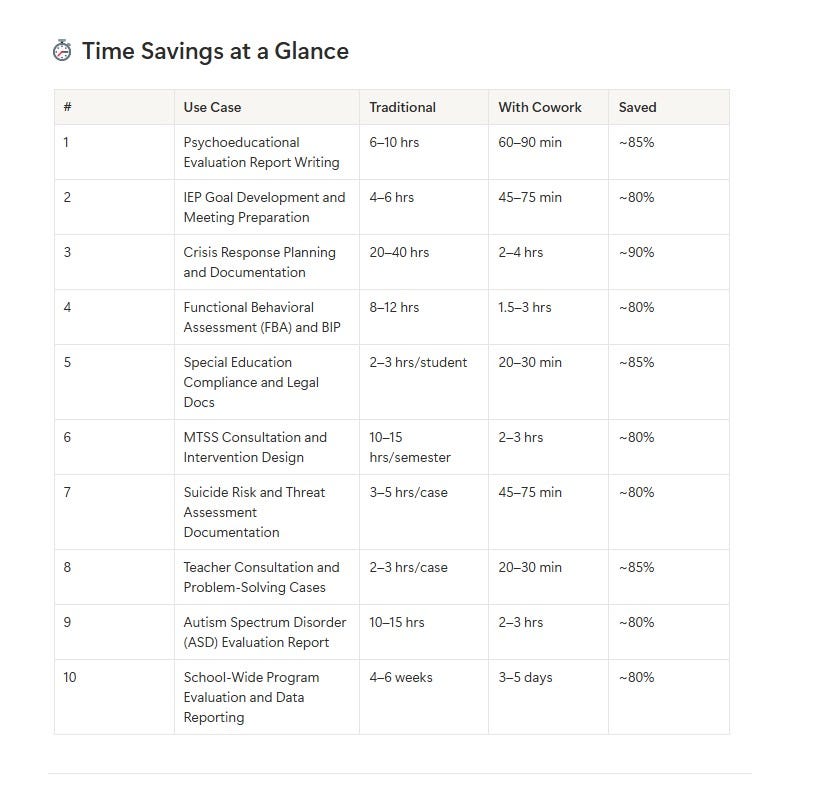
Psychological Assessment Report Writing. A comprehensive psychological assessment report — integrating WISC-V scores, BASC-3 results, clinical interview findings, DSM-5-TR diagnostic impressions, and detailed recommendations — typically takes 6 to 10 hours to write. With Cowork, you feed it your raw scored protocols, observation notes, and intake documentation, and it synthesizes everything into a structured, professionally written draft report. The psychologist reviews, refines, and signs. The process collapses to 1 to 2 hours.
Evidence-Based Treatment Plan Development. Treatment planning requires integrating diagnostic formulations, client goals, and the latest evidence on effective interventions into a coherent, phase-based treatment structure. Cowork can generate a complete, individualized treatment plan — with measurable goals, specific short-term objectives, crisis planning, and discharge criteria — in a fraction of the time it takes manually.
Session Progress Note Writing. Post-session notes are the biggest daily documentation drain in any clinical practice. Cowork transforms brief, raw post-session jottings into complete SOAP or DAP notes in minutes — preserving your clinical voice and judgment while handling the structural writing work. A task that takes 20 to 40 minutes per session becomes a 5 to 10 minute review-and-sign process.
Psychoeducational Material Creation. Every client needs materials tailored to their diagnosis, reading level, cultural context, and treatment stage. Creating these from scratch takes hours. Cowork can produce custom, evidence-based psychoeducation handouts, worksheets, skills guides, and between-session practice assignments personalized to each individual client — complete with culturally sensitive examples and plain-language explanations.
Differential Diagnosis Formulation. When a presenting picture is complex and diagnostic uncertainty is high, Cowork can systematically analyse your clinical data against DSM-5-TR criteria across multiple diagnostic possibilities simultaneously — producing a structured diagnostic evidence matrix, ruling out competing diagnoses, flagging data gaps, and writing a complete diagnostic formulation with biopsychosocial analysis.
Research Literature Synthesis. Staying current with the evidence base is a professional obligation that competes brutally with clinical time. Cowork can read and synthesize 20 to 30 research papers simultaneously, extract key findings, assess methodological quality, identify areas of consensus and controversy, and produce a complete evidence synthesis document with clinical implications — turning a 15-hour literature review into a 2 to 3 hour process.
Crisis Risk Assessment Documentation. The documentation of a crisis assessment must be thorough, legally defensible, and completed promptly. Cowork transforms your raw post-assessment notes into a complete, structured risk documentation package — covering suicidal ideation assessment, risk and protective factors, risk formulation, safety plan documentation, intervention log, and a clinical summary narrative that demonstrates rigorous professional judgment.
The Compounding Effect Across a Full Caseload
The power of Claude Cowork is not just what it does for a single task. It is what happens when you apply it consistently across a full clinical caseload.
Consider a psychologist carrying 25 active clients. If Cowork saves 30 minutes per session note, that is 12.5 hours per week returned to clinical care, professional development, or personal recovery. If it reduces assessment report writing from 8 hours to 90 minutes per report, and a psychologist completes 3 assessments per month, that is over 19 hours per month reclaimed. If treatment plan development drops from 4 hours to 45 minutes per client across a full caseload refresh, the savings run into days.
Across a year, a clinical psychologist using Cowork at full capacity can reclaim hundreds of hours — enough to add a new service stream, complete a research project, reduce their working week, or simply arrive home before their family has gone to bed.
Clinical Quality Rises, Not Just Efficiency
There is a common concern among clinicians that AI assistance somehow compromises clinical quality — that speed comes at the cost of rigor. The opposite is true when Cowork is used well.
Because Cowork handles the structural and organizational work, psychologists have more cognitive space for the genuinely clinical tasks: the interpretive synthesis, the nuanced formulation, the therapeutic relationship. Reports are more thorough, not less, because Cowork ensures no section is rushed or skipped under time pressure. Treatment plans are more evidence-aligned because Cowork draws on the research literature when generating intervention recommendations. Risk assessment documentation is more complete because Cowork flags any element that was not captured in the raw notes.
The psychologist’s expertise does not diminish — it is amplified by a tool that handles the parts of the work that don’t require years of clinical training.
Ethical and Professional Considerations
Using AI in clinical practice requires the same ethical thoughtfulness that governs every aspect of professional psychology. Claude Cowork is a tool for drafting and organizing — never for replacing clinical judgment, diagnosing, or making treatment decisions. All Cowork output must be reviewed, refined, and approved by the licensed clinician before entering the official record. Identifying information should be anonymized or managed according to your jurisdiction’s privacy and data protection requirements. The clinician remains fully responsible for every document they sign.
When used within these professional boundaries, Cowork is not a liability — it is a powerful extension of clinical capacity that lets psychologists serve more people, with greater depth, without burning out.
The Future of Clinical Psychology Practice
The integration of sophisticated AI tools into professional practice is not a future possibility — it is happening now, across every field that involves complex knowledge work. Clinical psychology is no exception. The psychologists who learn to leverage tools like Claude Cowork effectively will not only be more productive — they will be more sustainable, more research-aligned, and better positioned to deliver the kind of thoughtful, individualized care that defines excellent clinical practice.
The question is not whether AI will change clinical psychology. It already is. The question is whether individual clinicians will shape how that change happens — or simply react to it after the fact.
Go Deeper: The Complete Implementation Guide
If you are ready to bring Claude Cowork into your clinical practice with a clear, step-by-step roadmap, the Claude Cowork for Clinical Psychologist e-book gives you everything you need to start immediately.
This premium guide covers 10 complex, pro-level use cases built specifically for clinical psychologists — each with a detailed 10-step implementation walkthrough, exact Cowork prompts you can copy and use, folder structures, and expected outcomes including time savings estimates. Every use case follows a proven format: The Challenge, How Cowork Helps, Step-by-Step Implementation, and Expected Outcome.
Whether you work in private practice, community mental health, a hospital setting, or academia, this guide will show you exactly how to integrate Claude Cowork into the workflows that consume the most time in your professional life.
👉 **Claude Cowork for Clinical Psychologist: Powerful Use Cases — Get the Guide**
More AI Resources for Mental Health and Allied Health Professionals
The Clinical Psychologist guide is part of a growing library of profession-specific AI implementation guides available through Hams AI Tech — a resource store dedicated to helping professionals across every industry work smarter, faster, and more effectively using the latest AI tools.
From legal professionals and engineers to healthcare practitioners and business consultants, Hams AI Tech publishes detailed, premium-quality guides that bridge the gap between powerful AI technology and real professional workflows.
👉 **Explore the full Hams AI Tech resource library here**
The tools exist. The only thing left is knowing how to use them.

메타데이터
- post_id
- a243872f69b5
- slug
- claude-cowork-for-clinical-psychologists-how-ai-is-transforming-the-way-psychologists-work-a243872f69b5
- url
- https://medium.com/@ismailsaleem/claude-cowork-for-clinical-psychologists-how-ai-is-transforming-the-way-psychologists-work-a243872f69b5
- canonical_url
- https://medium.com/@ismailsaleem/claude-cowork-for-clinical-psychologists-how-ai-is-transforming-the-way-psychologists-work-a243872f69b5
- author_url
- https://medium.com/@ismailsaleem
- status
- ok
- fetched_at
- 2026-06-09 15:37:30