Your Book Is Intellectual Property: Lessons from Disney’s 1937 Snow White Strategy
Multiple revenue streams from a single creative work — a time-tested business model
Your Book Is Intellectual Property: Lessons from Disney’s 1937 Snow White Strategy
Multiple revenue streams from a single creative work — a time-tested business model
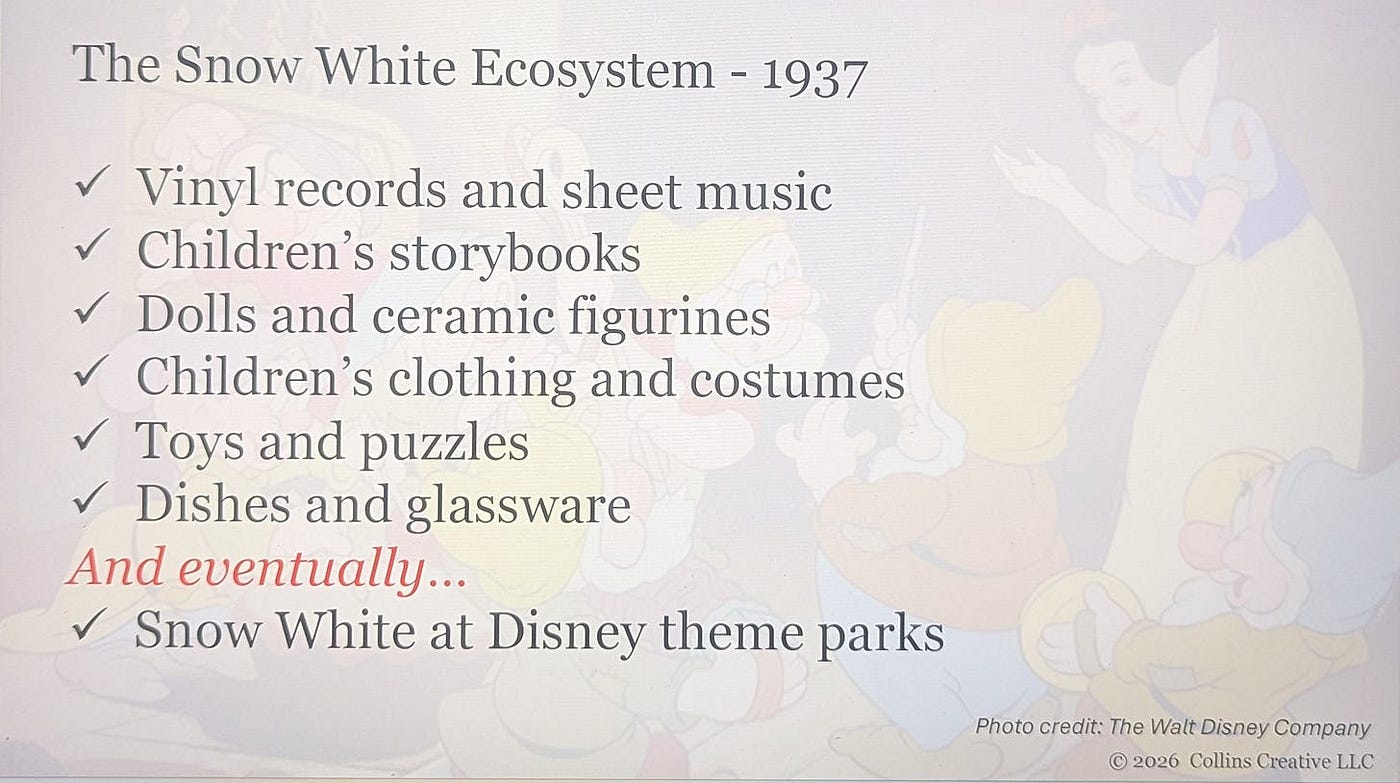
Snow White ecosystem slide from Experience-Driven Marketing presentation by David Jay Collins, April 16, 2026.
Walt Disney was a complicated historical figure.
Disney is a complicated brand.
But I personally do not have complicated feelings about Disney. I stand in utter admiration of their consummate creativity, attention to every last detail, supreme customer service, merging of art and engineering, merging of creativity and commerce, construction of immersive environments, creation of transcendent experiences.
I first loved Sunday-night airings of the Wonderful World of Disney in the 1970s (though this was partly because it was the only night we could eat in the living room in front of the TV and it usually came with pizza and our only cup of Pepsi for the week).
As an older teenager, I had my first remembered encounter with the Disney parks. The Magic Kingdom and the fairly new Epcot Center in Orlando. After years of camping in state and national parks across the country, we stayed in the Disney Fort Wilderness Campground, where my 17-year-old self was floored at the amount of forethought that must have gone into every last component of the campground experience. One short trip. An explosion of self-discovery: I am someone who notices and appreicates immersive experiences, high-concept creativity, big-picture planning and concern for the smallest of details, strategy, logisitcs, customer care.
When I became a parent, I knew a Disney trip was a must. Our first attempt, we discovered we hadn’t budgeted enough and took a lovely trip to Puerto Rico instead. Because my rabbit-hole research and back-of-the-envelope math suggested to me that the company wants Disney to be a stretch goal for every family — whatever their normal travel price points, they want for it to cost roughly double your normal vacation. There are tiers and workarounds and a range of properties, eateries, and add-ons, but when you find what looks to be the norm and comfort level of your socio-economic group, it’s twice what you want to pay.
My husband still bemoans the cost. My son soured on the length of the lines from Day 1. Not me. I hungrily soaked in the creativity and details all around me for seven days, gasping, sighing, shaking my head in wonder, simply absorbing. Years later, I know that the two hours in line for the 18-minute Star Wars: Rise of the Restistance ride/experience at Disney’s Hollywood Studios was worth every second and I still bring my hands to my heart when relaying the magnificence of it to anyone who will listen.
This brings me to my recent awestruck introduction to the Snow White Ecosystem of 1937.
What Disney Did That Changed Everything
David Jay Collins opened his recent Beyond the Margins Zoom Power Hour presentation on experiential marketing and creative partnerships with a slide about Walt Disney’s 1937 Snow White marketing strategy. The slide laid out the challenge Disney faced:
The conventional wisdom in 1937 said Disney was taking an enormous gamble. Yes, his short cartoons like Steamboat Willie had proven commercially viable. But nobody had ever made a feature-length animated film. Animation was dismissed as children’s entertainment — something you showed before the real movie started. And Disney needed to raise $1.2 million (roughly $27 million in today’s dollars during the Depression) betting on a hand-drawn, full-color animated feature aimed at kids.
David used this as his opening example because Disney didn’t just make a movie in 1937. He built a business model around a creative property.
Before Snow White even premiered, Disney was already thinking beyond ticket sales: Dolls, books, records, sheet music, clothing, household items — further monetizing his characters and story in the marketplace. Whether through licensing deals, direct production, or partnerships, Disney understood that the film’s IP could generate revenue in multiple formats. The movie itself was one income stream. Products featuring the Seven Dwarfs and Snow White were others. The music was another. Book adaptations were another. Multiple revenue sources from one creative work.
This wasn’t standard practice. Movies were movies. You made them, you screened them, you moved on to the next one. But Disney saw Snow White as intellectual property that could live in multiple formats, reach multiple audiences, create multiple revenue opportunities. He treated his creative work as worthy of serious investment — and then built a comprehensive business model to ensure that investment paid off in more ways than ticket sales.
The film’s success validated the model. Snow White became the highest-grossing film of 1938. But more importantly, it established a template: create compelling IP, then find every way to extend that IP into products, experiences, and partnerships that serve your audience while generating sustainable income.
What Authors Can Do Today
Many authors think of their creative output simply as books. Period. Write a book. Publish a book. Sell a book. Hope it finds readers. Move on to the next one.
But your book is intellectual property. Characters, worlds, concepts, frameworks, stories are all things can live in multiple formats, reach multiple audiences, create multiple revenue streams. You’re being strategic about serving your readers in ways they actually want to be served and strategic about building something sustainable.
Merchandise That Make Sense
Not every book needs a T-shirt line. But if your readers are asking Where can I get X? or you notice them creating fan art or quoting specific lines, you have signals that merchandise might serve them. Print-on-demand services make this low-risk. Design a few items. Test demand. Expand what works.
Character-driven fiction can support mugs, tote bags, bookmarks, art prints featuring quotes or imagery. Nonfiction frameworks can become downloadable worksheets, planners, card decks, posters. Cookbooks can become aprons, tea towels, specialty-ingredient boxes.
Don’t start with What can I sell? Think, What would genuinely delight my readers and extend their experience with my work?
Collaborations and Partnerships
Disney partnered with manufacturers, distributors, retailers. Authors can partner with businesses whose customers align with their readers.
The author of a gardening book partners with a local nursery for events and cross-promotion. The mystery novelist partners with a wine shop for themed tastings in a candlelit store (on a dark and stormy night?). The business book author partners with a consulting firm for workshops. The children’s book author partners with a toy store or educational supply company.
These partnerships create value for everyone: the business gets content and programming, you get access to customers who are already interested in your topic, readers get enhanced experiences beyond just buying a book.
Experiential Events
Disney understood that people crave immersive experiences. Eventually this became theme parks, but it started with the film premiere itself — a full production, not just a screening.
Authors can create experiences around their books: themed dinners for culinary mysteries, walking tours for historical fiction, workshops for how-to books, staged readings for literary works, murder mystery events for thriller writers, nature hikes for environmental nonfiction.
Don’t confine these experiences to marketing. Determine how they can become income streams. Charge for tickets. Partner with venues that handle logistics. Create VIP tiers with signed books or exclusive content. The experience becomes its own product, its own revenue source, its own way of serving your audience.
Rights Beyond Book Rights
Snow White became a book, a soundtrack, a stage production, merchandise, and eventually theme park attractions. Your book can become:
- Audiobook (different format, different audience, different income)
- Workbook or companion guide
- Online course or workshop series
- Card deck or tool based on your framework
- Board game or educational materials
- Licensed content for corporate training
- Adapted screenplay or stage play
- Podcast or video series
- Foreign language editions
Each format serves different readers in different contexts and generates different income. Not every author pursues every format. But recognizing that your creative work can live beyond a single book format begins to open up possibilities.
The Underlying Principle
Disney invested $27 million in today’s dollars in an untested concept during the Depression because he believed in the work. But he also built a business model that would recoup that investment through multiple revenue streams, not just ticket sales.
Authors can do the same: believe in your work enough to invest in it properly (editing, design, marketing), then build a business model that creates multiple ways for readers to engage with and purchase from you. The underlying principle to not forget: Your creative property has value in multiple formats and contexts.
Not every author wants or needs this level of business building. Some prefer to focus exclusively on writing the next book. That’s valid too — especially if this direct route is your best, fastest, easiest, most preferred path to an income-generating sustainable author life you love.
For most of us though, building a business around our books needs to go beyond just writing and selling books. Disney’s 1937 model offers a time-tested template and decades-proof inspiration: Create something excellent, then find every cool, exciting, appropriate way to extend that excellence into products, experiences, and partnerships that genuinely serve your audience while generating sustainable income for you.
It’s summoning your creativity as your prime resource, then merging creativity and commerce, treating your creative work as worthy of serious business strategy.
Tell Us in the Comments
Have you thought about your book as intellectual property with multiple revenue possibilities, or do you focus exclusively on book sales? What merchandise, experiences, or partnerships have you explored (or been curious about)? What feels realistic for your work now versus what feels like a stretch?
Our Next Power Hour: The Tax Knowledge You Need When Building Multiple Revenue Streams
If you’re thinking about building a business model around your books — merchandise, events, partnerships, licensing — you need to understand the tax implications. That’s where our next Beyond the Margins Power Hour comes in.
On May 14, author and tax professional Michael Haupt presents “You’re an Author — Not an Accountant: But Numbers Tell a Story, So What Do You Need to Know About Taxes?” Mike will share his best tax advice for authors and creatives (10–15 minutes, big-picture to nitty-gritty write-offs), then we’ll open it up for Q&A with a tax pro who actually understands author businesses. Plus you’ll get one free month of full access to the 400+ article archive here and other freebies.
The more revenue streams you develop — royalties, merchandise sales, event ticket sales, licensing income — the more important it is to understand how to track and report them properly. Mike breaks it down so you can focus on building the business, not worrying about the taxes. **Register here**.
Sharon Woodhouse is a publisher, author coach, partnership architect, and book-business strategist with 30+ years helping authors and publishers build sustainable, profitable businesses they love. Through Conspire Creative, she provides strategic coaching, consulting, and project management for authors and publishers. Her award-winning book is *The Profitable Author: 1,001 Ways to Build a Business You Love Around Your Books*.
메타데이터
- post_id
- a26d1eda4da7
- slug
- your-book-is-intellectual-property-lessons-from-disneys-1937-snow-white-strategy-a26d1eda4da7
- url
- https://medium.com/@slowcharacter/your-book-is-intellectual-property-lessons-from-disneys-1937-snow-white-strategy-a26d1eda4da7
- canonical_url
- https://medium.com/@slowcharacter/your-book-is-intellectual-property-lessons-from-disneys-1937-snow-white-strategy-a26d1eda4da7
- author_url
- https://medium.com/@slowcharacter
- status
- ok
- fetched_at
- 2026-06-09 15:37:30