Why Most Proxy Users Get Detected in 2026 (And How Residential IPs Help)
For years, many internet users assumed that simply connecting through a proxy server was enough to stay anonymous online.
Why Most Proxy Users Get Detected in 2026 (And How Residential IPs Help)
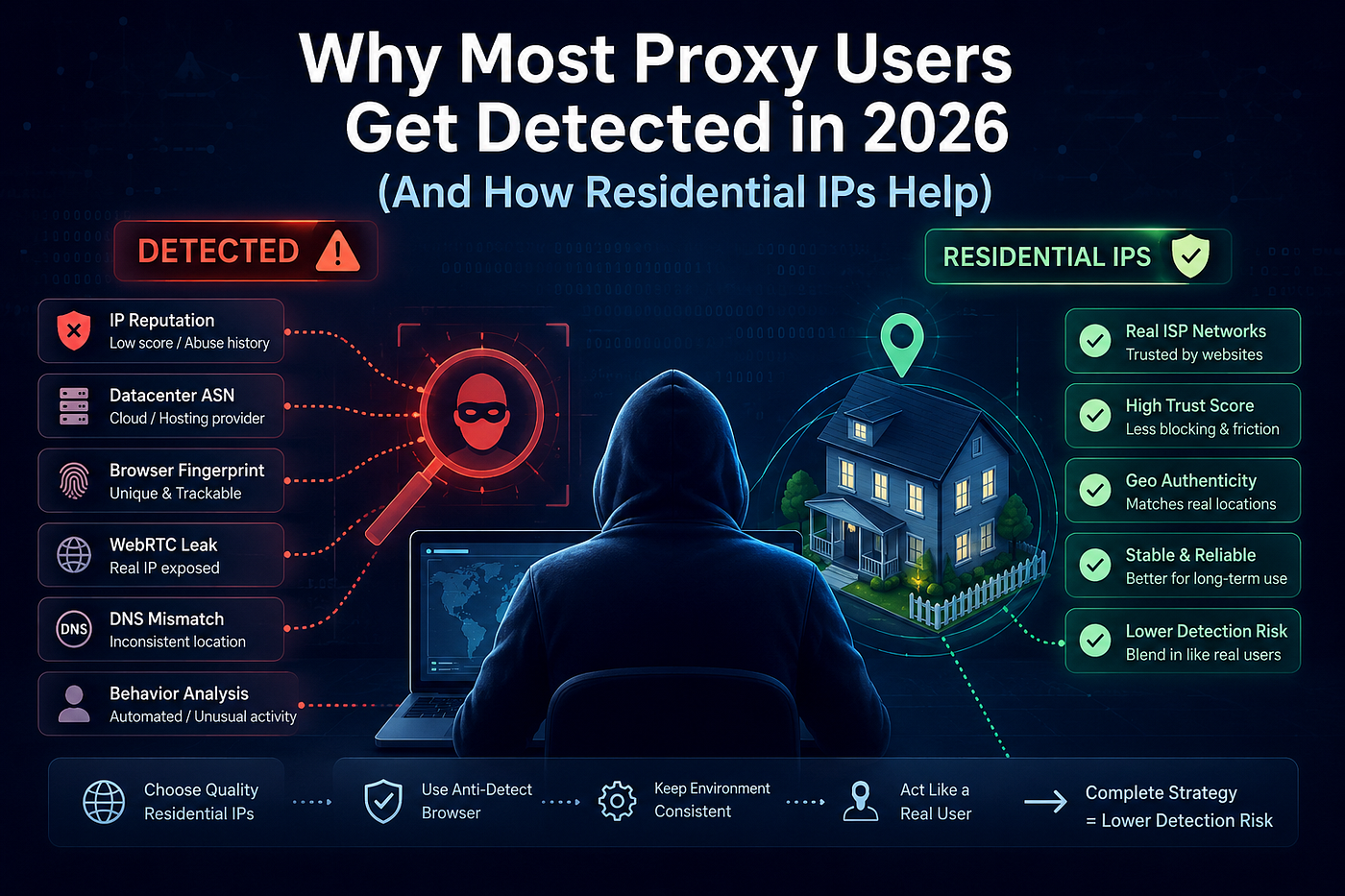
For years, many internet users assumed that simply connecting through a proxy server was enough to stay anonymous online.
That might have been true a decade ago.
In 2026, however, websites have become significantly better at identifying proxy traffic. Social media platforms, e-commerce marketplaces, advertising networks, and anti-fraud systems now analyze dozens of signals beyond your IP address.
As a result, many users are surprised when their accounts get flagged, verification requests increase, or automated workflows stop working — even though they are using a proxy.
So why does this happen?
Let’s explore the most common reasons proxy users get detected and how residential IPs can help reduce those risks.
The Biggest Misconception: A Proxy Alone Makes You Invisible
A proxy only changes one part of your online identity: your IP address.
Modern websites evaluate many additional factors, including:
- Browser fingerprints
- Device characteristics
- DNS behavior
- WebRTC information
- Connection patterns
- Historical IP reputation
- Account behavior
Think of your online identity as a puzzle.
Changing only the IP address while leaving every other piece unchanged often makes detection easier rather than harder.
How Websites Detect Proxy Users in 2026
1. IP Reputation Analysis
Most major websites maintain databases that classify IP addresses according to their historical behavior.
If an IP has previously been associated with:
- Spam
- Account creation abuse
- Automated scraping
- Credential stuffing
- Excessive automation
its reputation score may become negatively affected.
When a website sees traffic coming from a low-reputation IP, additional verification measures may be triggered automatically.
This is particularly common with heavily used datacenter proxies.
2. Datacenter ASN Detection
One of the easiest signals to identify is the network an IP belongs to.
Many proxy users rely on cloud hosting providers such as:
- Amazon AWS
- Google Cloud
- Microsoft Azure
- DigitalOcean
- Vultr
Websites can easily determine whether an IP originates from a hosting company rather than a residential internet provider.
While using a cloud server is completely legitimate, large-scale abuse has caused many platforms to treat datacenter IP ranges with additional scrutiny.
As a result, datacenter proxies often face higher detection rates than residential IPs.
3. Browser Fingerprinting
Even if your IP changes, your browser may remain highly identifiable.
A browser fingerprint can include:
- Screen resolution
- Time zone
- Installed fonts
- Operating system
- Browser version
- Canvas rendering
- WebGL characteristics
- Hardware information
Combined together, these attributes can create a surprisingly unique profile.
This means two sessions using different IP addresses may still appear to belong to the same user.
Browser fingerprinting has become one of the most powerful detection techniques used by modern websites.
4. WebRTC Leaks
Many users focus exclusively on their public IP address and forget about WebRTC.
WebRTC is a browser technology designed for real-time communication.
If improperly configured, it may reveal information about:
- Your real IP address
- Local network addresses
- Network characteristics
Some websites actively test for WebRTC leaks and use the results as an additional verification signal.
5. DNS Mismatches
Another common mistake involves DNS requests.
Imagine:
- Your proxy IP appears to be located in Germany.
- Your DNS requests are resolved in another country.
This inconsistency may indicate that a proxy is being used.
Sophisticated anti-fraud systems frequently compare network signals to identify unusual patterns.
6. Behavioral Analysis
The most advanced detection systems don’t rely solely on technical fingerprints.
Instead, they analyze behavior.
Examples include:
- Typing speed
- Mouse movement patterns
- Session duration
- Navigation flow
- Click timing
- Login frequency
Even perfect proxy setups can attract attention if account behavior appears automated or unnatural.
Why Residential IPs Are Harder to Detect
Residential IPs are addresses assigned by real Internet Service Providers (ISPs) to household users.
Examples include:
- Home broadband connections
- Fiber internet subscriptions
- Residential cable networks
Because these IPs represent ordinary consumer internet traffic, they generally blend in more naturally with normal website visitors.
This does not make residential IPs “undetectable” — nothing online is truly undetectable.
However, residential IPs often provide several advantages.
Better Trust Signals
Many websites associate residential networks with legitimate users.
As a result, residential IPs frequently encounter fewer challenges than datacenter IPs.
Lower ASN Risk
Residential IPs originate from consumer ISPs rather than cloud hosting providers.
This removes one of the easiest detection signals.
Improved Geographic Authenticity
Residential IPs typically match realistic user locations and ISP networks, helping maintain greater consistency across sessions.
Better Long-Term Account Stability
For account management, e-commerce operations, social media marketing, and other long-term activities, stable residential IPs often produce more predictable results.
Residential IPs Are Only One Piece of the Puzzle
Many beginners assume that buying a residential proxy instantly solves all detection problems.
Unfortunately, it doesn’t.
A successful setup usually requires consistency across multiple layers:
Network Layer
- High-quality residential IPs
- Clean IP reputation
- Consistent location selection
Browser Layer
- Proper browser fingerprint management
- Cookie isolation
- Separate browser profiles
System Layer
- Matching timezone settings
- Consistent language settings
- Realistic device characteristics
Behavioral Layer
- Human-like interaction patterns
- Reasonable activity frequency
- Gradual account growth
The strongest setups focus on all four areas rather than relying on a single solution.
Choosing a Residential Proxy Provider
When evaluating residential proxy providers, consider factors such as:
- IP quality
- Session stability
- Geographic coverage
- ISP diversity
- Connection reliability
- Transparent pricing
- Customer support
For users who need stable residential IP resources for account management, market research, automation workflows, or international access testing, services such as OperIP offer residential proxy solutions designed for long-term use cases.
Regardless of which provider you choose, quality and consistency generally matter more than simply finding the lowest price.
Final Thoughts
The proxy landscape in 2026 is very different from what it was a few years ago.
Websites no longer evaluate only your IP address. Instead, they analyze a wide range of technical, behavioral, and environmental signals to determine whether traffic appears trustworthy.
This is why many proxy users still get detected despite changing their IP addresses.
Residential IPs help because they more closely resemble normal consumer internet traffic and avoid some of the most obvious indicators associated with datacenter infrastructure.
However, the most effective approach combines residential IPs with proper browser management, realistic behavior, and a consistent online environment.
In short: proxies are important, but successful online identity management requires a complete strategy — not just a different IP address.
메타데이터
- post_id
- a281f5d7c407
- slug
- why-most-proxy-users-get-detected-in-2026-and-how-residential-ips-help-a281f5d7c407
- url
- https://medium.com/@koowave/why-most-proxy-users-get-detected-in-2026-and-how-residential-ips-help-a281f5d7c407
- canonical_url
- https://medium.com/@koowave/why-most-proxy-users-get-detected-in-2026-and-how-residential-ips-help-a281f5d7c407
- author_url
- https://medium.com/@koowave
- status
- ok
- fetched_at
- 2026-07-27 06:40:12