The Flattering Malady
A Gothic-Modern tale of a doctor’s attempt to create beauty through Victorian medical practices.
The Flattering Malady
A Gothic-Modern tale of a doctor’s attempt to create beauty through Victorian medical practices.
Wikimedia Commons
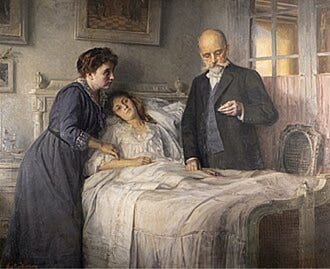
When Claudio Venera moved into his deceased parents’ house, he found several boxes in the attic. Inside were leather-bound journals, stiff and cracked, which appeared to belong to a doctor. There were also old-fashioned photographs of women seated or reclining in bed.
The women all had pale skin, dark shading around the eyes, delicate hands, and thin torsos with slight limbs. Each photograph had careful notes written on the back: “pallor increasing,” “weight loss continuing,” “appetite restrained,” “shadow around eyes deepening.”
The journals described a methodology involving different tonics and tinctures, along with precise measurement of the patients. There were mentions of laudanum and cocaine preparations.
Venera read slowly, word by word, noting the rhythm of the doctor’s apparent obsession: observe, measure, note, photograph, adjust. He felt a growing fascination with these procedures.
He called his aunt and asked about the boxes. She told him they had belonged to a distant cousin, a doctor in late Victorian times, and said she was surprised they were still in the attic.
As he studied the photographs, Venera became increasingly drawn to the women, especially one who was described as suffering from consumption, now known as tuberculosis. The journals revealed that the doctor had introduced the disease without her knowledge. Venera was shocked when he realized this and avoided the boxes for several weeks, yet the image of the young woman remained fixed in his mind.
When he returned to the attic, he read more carefully, focusing not only on the notes but on the methods behind them: selection, observation, and adjustment, the slow shaping of the body toward a particular aesthetic.
Now Venera was a doctor too, a naturopath, which many people don’t consider a real doctor. But his patients depended on him for what conventional medicine couldn’t always explain: fatigue, headaches, anxiety, sensory sensitivity, rashes. He gave them attention and sympathy where others had dismissed them.
He thought of one patient in particular, Eliza, who had been told repeatedly that her fatigue and anxiety were psychosomatic. Her skin was pale, with a faint shading beneath her large blue eyes. She trembled when she stood, her heart rate rising with the effort. He had always thought she was beautiful, not in spite of her condition but because of it.
At their next appointment, Venera offered her a tincture, saying it would support her constitution and calm her nerves. In fact, it was a form of laudanum he had compounded himself from morphine. In addition to taking this tincture several times a day, he suggested small changes like avoiding sunlight, taking walks only in the shade, and following a measured daily routine. She should eat slowly, observe her appetite, and keep a record of her sleep. She followed all of his instructions.
Within weeks, subtle changes appeared. The dark circles beneath her eyes deepened, and her appetite diminished. He measured her weight, pulse, and temperature. In time, he introduced a tincture of cocaine, stimulating her during the day, with the opiate calming her at night.
Months passed. He adjusted the tinctures. Occasionally she questioned her lack of improvement, but Venera explained that delicate constitutions required delicate treatments. Weakness, he told her, was a form of refinement rather than failure, and she accepted this.
He began to photograph Eliza, telling her that she had a condition he had never encountered before and that he hoped, eventually, to publish a professional paper about it. The photographs, he said, were necessary to document changes in her appearance.
Eliza worried that she looked ugly, but he told her that in Victorian times, women who looked like her were considered the most beautiful. When she asked more about it, he felt a flicker of concern that he might have said too much, that she might begin to suspect what he was doing to her.
He took her hand and said, “Maybe this is unprofessional to say, but I think you are exceptionally beautiful.”
One afternoon, as she sat across from him with her hands folded in her lap, he noticed what seemed like her childlike trust in him. He had created in Eliza a complete surrender to his authority.
He returned to his distant cousin’s journals, reading the passages he had once flinched from, those describing the introduction of tuberculosis. Timing, the Victorian doctor insisted, was everything: not too early, not too late, but at the point when the patient’s body had already begun to decline from the drug dependence.
That night, Venera wrote in his notebook:
“Conditions suitable. Preparation complete. Introduction to commence.”
Acquiring samples of the tuberculosis bacterium proved less difficult than he had expected. He already had connections through the dark web for the controlled substances he used, and they put him in touch with others who could supply what he needed. Why tuberculosis was marketable, he didn’t understand. Was it a biological weapon? He paid for it in bitcoin, as he did for everything else.
The package arrived in an ordinary padded envelope. Inside was a plastic container holding a standard laboratory vial, unmarked. He didn’t know how much to use. Infecting someone with tuberculosis wasn’t something people did intentionally, or at least not something they documented. He decided to begin with a small amount and increase it gradually.
He visited Eliza the next day. He was making house calls now, charging an additional fee, which meant little to her given her parents’ wealth. When he arrived, the intercom instructed him to enter and come to her bedroom. He already knew the way.
He pulled a chair close to her bed and sat beside her. He took her pulse, felt her neck for swollen glands, and estimated her temperature with his hand against her forehead. The familiar, almost antiquated gestures seemed to relax her. It was strange; the more time he spent with her, the more he found himself adopting older methods of examination. He had even, at one point, considered bleeding her. He felt himself becoming like his distant cousin and had begun dressing more formally, wearing a paisley silk vest over a clean white shirt.
He told her he had a new treatment he wanted to try, describing it as an autoimmune inhibitor to be inhaled through a nebulizer, like those used by asthmatics. He poured a carefully diluted measure of the TB sample into the receptacle and positioned the mask over her nose and mouth. He had added a trace of menthol so that the vapor carried a faint, pleasant scent.
She held his hand as she breathed in the mist and looked up at him with something he could not quite name — dependence, perhaps, or trust, or even love.
Venera was deeply moved by this. Did he return that love? Still, he was determined to go through with the process. Tuberculosis is curable, and he could wean her off the drugs. He pulled his hand away gently and began making notes in his journal.
At Eliza’s request, he began staying at her house — not in her bed, but in a guest room. After finishing his appointments each day, he would go to her home and give her a thorough examination. Eliza seemed to crave this attention and the medical conversations he carried on with her. She told him that no one had ever really seen her before.
Later they would eat dinner, though she ate very little, and watch television or a movie together. She would recline on the couch while Venera sat at her feet, massaging them. He told her it stimulated circulation, though he knew he was moving into dangerous territory. Romantic entanglement would ruin everything. He would not be able to complete her transformation. At bedtime, he would prepare her nebulizer and hold her hand as she took the treatment.
Then, one morning, Eliza began coughing up sputum streaked with blood. Venera cancelled his appointments and stayed with her.
He had to hide his excitement as he comforted her. He gave her a cough syrup he had compounded from heroin, chloroform, and cannabis. He had known he would need such a preparation eventually, having read of similar remedies in accounts of Victorian medicine. The syrup calmed her coughing, and she fell asleep, her breathing uneven.
Venera gazed at her: the pallor of her skin, the faint bluish tint of her lips, the darkening shadows beneath her eyes. He set up his photographic equipment, an antique large-format camera mounted on a wooden tripod, and made several exposures, already imagining how they would compare to those in his cousin’s journals. When he was done, he took her hand, stroked her hair, and kissed her lightly on the forehead.
Weeks passed, and he wondered how much longer he should allow the illness to progress. He could cure her easily enough, yet he remained fascinated by the wasting of her body. Her face had grown drawn, her eyes sunken. She looked years older, and still he found in her a kind of terrible beauty.
He kept her heavily sedated with intravenous propofol, drifting in and out of consciousness. When awake she would gaze at him with those luminous, trusting eyes. He had closed his practice and now spent all his time with her, continuing to photograph her decline.
Each morning, her sheets were stained with blood. Rather than wash them, he bought new ones. At night, he lay beside her. She always seemed to seek the warmth of his body, and he wanted to ensure she didn’t choke in her sleep.
At last, Venera began introducing intravenous antibiotics that would bring her out of the illness. He started to taper the drugs as well, slowly. He planned to eventually tell her that she had taken a severe turn and that he had needed to sedate her while treating her, not trusting other physicians to manage her care.
The explanation proved unnecessary. One morning, Venera woke to find Eliza’s body cold and stiff beside him.
Venera began to panic. He rolled Eliza onto her back and checked again, carefully this time, to be certain she was dead. Then he stood and paced the length of the bedroom, moving back and forth in front of her bluish body, not recognizing that he had finally achieved the very aesthetic he had been pursuing all along.
He went to the nightstand and took a swig of the laudanum. He rarely touched the substances he prescribed for Eliza, but now he needed calm and patience.
He reminded himself that Eliza’s family lived out of state and that she had no close friends. It would be days before anyone came looking for her. There was time, but not enough to waste. He would leave the country, and soon.
First, he gathered everything in the house that belonged to him, moving methodically from room to room. Then he arranged the scene he would leave behind. On Eliza’s nightstand, he placed several unlabeled bottles: opiates, cocaine, sedatives. It would account for the substances in her system. The tuberculosis would remain unexplained. His connection to her would eventually come to light, but he intended to delay that discovery for as long as possible.
⸻
Epilogue
Claudio Venera sat outside a café in a mountain city in Ecuador, slowly sucking on a piece of coca candy to ease the effects of the altitude. He reflected on his good fortune in being born to a Colombian father. His Spanish was fluent, and South America felt familiar to him, shaped by the trips he had taken there as a child.
He had traveled overland into Mexico, then made his way to Tulum, where he kept a low profile. Through his dark web contacts, he obtained a passport under a fictitious name. Before leaving the United States, he had withdrawn cash, purchased traveler’s checks, and converted the remainder of his money into bitcoin. His naturopathic practice had been lucrative; his wealthy clients had trusted him, and he had charged them exorbitantly.
From Mexico, he flew to Ecuador, a place where he believed himself beyond reach. Ecuador had no extradition treaty with the USA.
In time, he began visiting the red-light district. It was something he had never done before. He had always considered his desires muted, almost absent. Even with Eliza, he had never acted on anything physical, despite sensing that she might not have resisted him.
Here, the encounters felt less like desire and more like a way of managing the pressure building inside him. The memory of Eliza’s death was rarely out of his mind.
Among the ladies in the burdeles, he developed a preference for one in particular. She was lighter-skinned than the others, the abandoned daughter of a European expatriate and his Ecuadorian housekeeper. Slight of build, with bright blue eyes, she said she was nineteen, though the work had already begun to wear on her.
Her name was Daniela.
Eventually, he asked her to live with him. She would take care of the household and attend to him. She accepted.
In the mornings, he would wake before her and lie still, watching her sleep beside him. Already, her health seemed improved. He would run his hands over every inch of her body, studying its texture, its tone. The action was more sensual than sexual. Her softness seeped back into him, calming him.
When she stirred, they spoke quietly to one another. He sometimes imagined a future in which they might marry.
He found her beautiful, but there was something incomplete about her, something unformed. As he watched her, he couldn’t help but wonder what she might become under his care, what kind of art he might yet create in her.
메타데이터
- post_id
- a28d8ae405fe
- slug
- the-flattering-malady-a28d8ae405fe
- url
- https://medium.com/never-stop-writing/the-flattering-malady-a28d8ae405fe
- canonical_url
- https://medium.com/never-stop-writing/the-flattering-malady-a28d8ae405fe
- author_url
- https://medium.com/@jimparks
- status
- ok
- fetched_at
- 2026-06-21 20:33:08