A blonde woman commands the most ruthless tribe in the Sahara — Witch of the Sahara [Free Preview]
Is she a goddess, a demon, or something far more dangerous?
A blonde woman commands the most ruthless tribe in the Sahara — Witch of the Sahara [Free Preview]
Is she a goddess, a demon, or something far more dangerous?
Dec 07, 2025
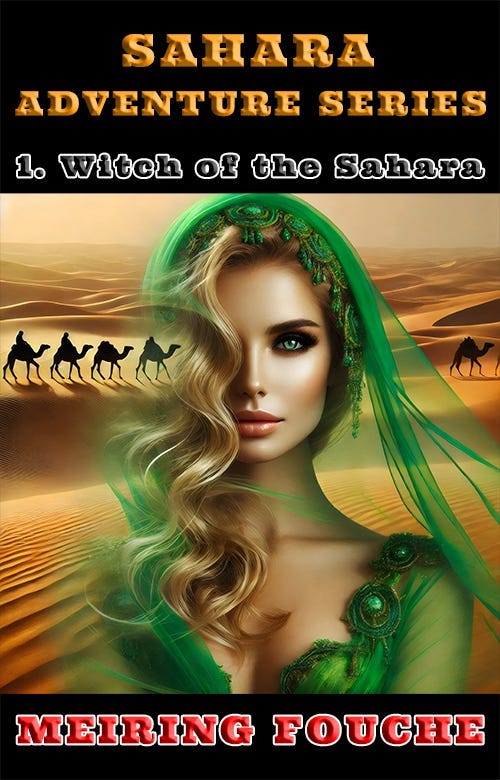
Get the full ebook on Amazon **here**.
Below is a free preview of the opening chapter of Witch of the Sahara.
WITCH OF THE SAHARA
Chapter 1: A Woman on Horseback
Private Podolski, of the French Foreign Legion, turned his back to the biting desert wind blowing from the distant Atlas Mountains and gazed anew towards the East to see if there was yet any sign of the red dawn. He wished he were rather in the barracks in Dini Salam now, where he could at least have covered himself under the woollen blanket. Dini Salam is a fly-ridden oven of a place, where the Sahara sun scorches you mercilessly, but it is nevertheless better than this solitude in the desert that seeks to destroy you with its heat by day, and then makes you shiver with cold by night.
Podolski wondered what had possessed him to get angry with the Russians. If he hadn’t become angry with them for occupying his fatherland, Poland, he wouldn’t have had to stand guard here now on this godforsaken sand dune in the cold wind. Here at his solitary sentry post, however, he made a gesture with his hands, a gesture of acceptance. For what would it avail to stand here dwelling on it now? He was in the French Foreign Legion, and that was the end of everything. The French Foreign Legion must guard the Sahara and its inhabitants.
“Accursed Doelaks,” Podolski sighed aloud. “If they hadn’t got it into their heads to attack caravans, I wouldn’t have had to stand here now. They should just shoot the whole lot dead, then there would be an end to this nonsense,” Podolski said bitterly.
He felt the slight tingling down his back and he spun around quickly, peering intently into the darkness around him to see if he might perhaps spot a lurking enemy. It was, however, still too dark to see well. Therefore, with his long Lebel rifle, to which he had fixed the bayonet, he drew a circle around him on the ground. Then he quickly swung the firearm around him again.
For these Doelaks are worse than cats, silent, virtually invisible when the light is not strong, and utterly lethal. Podolski thought of that gruesome night in the foothills of the Atlas Mountains, when the stealthy Doelaks had slit the throats of all the sentries of a Legion regiment before they even knew what was happening.
But Private Podolski spotted nothing. There was only the thin whine of the wind blowing through the tiny camel thorn bushes and through the old desert grass tussocks that stood here and there on the crest of the dune.
If only it would become day, it yearned within Podolski. If only one could see. He could not understand why the commander in Dini Salam had not yet sent out a proper expedition against these Doelaks. They should have been exterminated long ago.
But the ways of the brass in the Legion are utterly obscure. All they do is send a small escort of Legionnaires with the camel caravans each time to protect them. Quite a few caravans, escorts and all, have already been wiped out by these bloodthirsty Doelaks. Just last week, again.
Podolski’s reverie was suddenly broken and he turned completely cold where he stood, even colder than the touch of the pre-dawn wind.
Could that be a horse that whinnied somewhere?
He could swear he heard something. Something not far off, perhaps behind the next dune, which now rose up before him out of the darkness like a great black whale, for the dawn was slowly shifting from behind the earth.
Podolski quickly cocked the Lebel, doing it slowly and silently, as they had been taught to do. He suddenly wondered how many hours he had had to spend in the terrible sun on the parade ground, just to learn how to cock a Lebel silently.
There was only a very slight clicking sound as he slid the bolt open and shut. He then stared with intense concentration at the dune before him, at its dark crest. Then he slowly turned around again and tried to survey the surroundings around him. His trained ears searched for the slightest sounds… But there was only the sighing of the wind and nothing more.
Perhaps he had just imagined he heard something. Perhaps his nerves were simply too strained. If only it would become day, bright day, so that one could see an enemy’s eyes!
Podolski completed the circle and stared eastwards again, from where the saving light of day must come. And Private Podolski, formerly of the Polish army and currently an ordinary private in the Foreign Legion, suddenly stiffened as if he had taken a shot through the heart.
He was no longer aware of the singing wind. He no longer felt the Lebel in his cold hands. He did not even know that he was still breathing. For there before him on the crest of the red dune, black against the first thin glow of day, was a rider. Black as a statue. A motionless silhouette, menacing and still.
Podolski swallowed hard and ran his tongue over his dry lips.
“Doelak,” he whispered into the wind, and he almost choked on the word, so dry was his throat.
He quickly looked around him again with furious concentration. He imagined that every camel thorn bush and every grass tussock had become an enemy, with the feared dagger and the equally feared scimitar in their hands. When Podolski looked eastwards again, he saw others. Like dark phantoms, they had appeared alongside the first rider on the crest. And still they came, one after the other, until they stood arrayed on the crest.
The Polish private waited no longer. He sprang around and sprinted back towards the camp, where the small group of Legionnaires had formed a circle around the camel caravan… He hurried, stooping low, towards the small tent here on one side of the camp. It was completely silent in the small laager. Everyone was still asleep, and one or two snored so loudly that Podolski imagined the Doelaks there on the dune could hear them too. Here and there a camel sighed contentedly.
Podolski flew into the tent and went to shake the man sleeping on the camp cot by the shoulders.
“Sergent, mon Sergent,” Podolski said, panting. “Doelaks, at four hundred paces, eastwards.”
The young Sergeant Lazarre nearly knocked the anxious Polish private over as he sprang out of bed. “How many?” he asked hastily as he grabbed his revolver belt and quickly buckled it on.
“A good forty, there could be more. I didn’t wait,” said Podolski.
“Mon Dieu!” Lazarre said aloud, slapped his kepi onto his head and flew out of the tent. “Wake the fellows up,” Lazarre ordered Podolski, “but don’t make noise. Perhaps that band of heathens hasn’t spotted us yet. Could be that they’ll pass us by?”
But even as he spoke these words, the young sergeant knew he was being an optimist. Doelaks are some of the best spies in the world, and it would certainly be a miracle if they passed by a caravan lying here openly exposed between two dunes.
Podolski jumped among the fellows and woke them. There was protesting and groaning aplenty, but they immediately got to their feet and grabbed their Lebels. Lazarre himself jumped among the Arab traders and woke them quietly. Camels protested, snorting, and Lazarre felt as if he could strike their large mouths shut with the butt of his revolver.
Silently the camp awakened, and some of the other sentries now also came running up.
“Form a circle!” Sergeant Lazarre ordered hoarsely and not too loud. “Number off for now.”
Forming a circle is the only tactic here in the open where the small group of Legionnaires is going to be far outnumbered by the Arabs. When the men had formed a circle, they numbered off. Then the even and odd numbers would fire in turn so that uninterrupted fire could be maintained on the attackers. In this way, some fellows could also reload while other fellows continued firing.
This proven tactic of the Foreign Legion was so familiar to this small group of men that everything was ready within seconds. Around the Arab traders and their pack animals, the thin line of men knelt, their Lebels cocked in their hands. In the middle of the circle stood Sergeant Lazarre, his heavy Luger revolver ready in his right hand, while he still gave orders to the Arabs. Some he sent in amongst the Legionnaires, where they took up positions with their antiquated old muzzle-loaders. Others he ordered to tie the camels together and hold them fast.
It was quickly becoming light, for here in the Sahara, day comes suddenly, just like the night. There was a bright red band in the East, and now one could at least see better. You could even make out camel thorn bushes against the nearest dune, where moments ago they were still veiled in darkness.
“The odd numbers will fire first,” Sergeant Lazarre ordered. “It will be rapid fire, and every shot must count. We are fifteen and they are probably more than fifty. I will fire one shot with the revolver and that will be the signal for the first volley. Mes amis, this morning you must shoot as you have never shot in your miserable lives, otherwise the vultures will soon be frolicking here among you. I know you. Remember, you are soldiers of the Foreign Legion. Long live France!”
It rang in Lazarre’s head. This was not his first skirmish with the Doelaks. He knew them. He had seen their torture. He had seen how men were spreadeagled on the hot sand, how their nails were removed… how their tongues were split… how their eyelids were cut off…
“Mes amis, we must prevail,” he said, and it was a strange, urgent command, and his voice sounded unsteady. “On this beautiful morning, we must not lose as you know what awaits us.”
“Mon Sergent,” said Schmidt, a German with a large red face, gesturing upwards with his hand.
Lazarre looked up, and what he saw filled him with revulsion and also with fear. High above the dunes, the first vultures circled, screeching and bold, as if they were already preparing for the outcome of the battle.
“Vultures have good noses,” said Podolski, and the laughter went like a ripple through the small circle of men.
Lazarre closed his eyes and was grateful anew for the courage of these desert fighters, some of them scum from the streets of many cities, some of them men with heavy sorrow in their hearts. Ruffians, murderers, and those who had innocently fallen by the wayside, but all braver than brave, all almost entirely without fear.
“Those accursed vultures are knocking on the wrong door,” Lazarre said courageously, looking up again at the circling birds.
“Where does one shoot a Doelak, mon Sergent?” someone asked.
“Between the eyes, mon ami,” the sergeant said grandly, toying with the trigger of his revolver.
“Silence!” Lazarre suddenly commanded.
Above the sighing of the wind, they heard it. The thundering of many hooves on sand.
“Here come the heathens,” said Levy, a Jew who had fled from Tel Aviv.
“Rifles ready!” the command snapped from Lazarre’s mouth.
Above the rushing of the wind, there was the single harsh glint of steel on steel, as the bolts of the Lebels were quickly slid open and shut. The clang of rifle bolts still hung on the wind when the first Arabs appeared in the East on the nearest dune. Their white cloaks billowed and fluttered in the wind, and they sat as firmly on the backs of their horses as only the proud Doelaks can.
“Mon Sergent,” whispered Petacci, a thin little Italian, suddenly behind Lazarre. “Look there!”
The sergeant spun around quickly and saw how a whole line of Arabs had just appeared behind them on the crest of another dune. A cold shudder went through the Frenchman. He felt that astonishing powerlessness one feels when you know you are lost. In these few seconds between him and death, he desperately sought a way out, but found none. He just stared, terrified, at the vague glint of the first light on the scimitars of the Arabs, the thin steel blades held proudly aloft.
But he did not have much time for fear. There were still a few terrifying moments in which he could be brave.
“Mes legionnaires, ready!” Lazarre bellowed and quickly cocked his revolver.
The next moment, more than two hundred Arabs came thundering down from the dunes towards the small circle of men, whose fingers trembled on the triggers.
Lazarre waited until they were at a hundred paces. Then his big Luger spoke, and the very front Arab of the group storming from the west fell screaming from the saddle. Instantly after Lazarre’s first revolver shot, the Lebels around him spoke. Every shot counted. But there were simply not enough shots. The Doelaks were a tidal wave that this small circle of men could not stop. With the very first charge, they overwhelmed the small camp in dust.
“Bayonets!” screamed Lazarre, shooting three Arabs, one after the other, from their saddles.
The next moment, it was bayonet against scimitar. It was a bloody struggle of fighting men, whinnying horses, wrestling camels, and babbling traders trying to knock their opponents from their saddles with rifle butts.
It was a brief and ghastly slaughter.
Just as the sun slowly climbed over the dunes, the first vulture settled down here beside Sergeant Lazarre of the Foreign Legion, who lay with his hands limp in the sand. Here and there, the white neck-flap behind the kepi of a Legion soldier fluttered in the light morning breeze. Here and there, the wind stirred the white cloak of a fallen Arab.
And all around, the first heat shimmered on the silent dunes.
Although it was already late afternoon, the heat still lay like a consuming wave over the Sahara. The dunes danced and shimmered in the heat waves, and it felt as if the sun wanted to wreak vengeance one last time on everything that breathed in this sandy wasteland.
Colonel Le Clerq, the pale little Frenchman who commanded the Foreign Legion garrison in Dini Salam, one of France’s outposts in this troubled region, fanned himself cool with his military kepi where he sat here behind his desk. He looked levelly at Captain D’Arlan, who had just saluted perfectly.
“Sit, D’Arlan,” said the colonel, gesturing wearily with his thin hand towards the chair in front of his desk.
D’Arlan, a lean, dark warrior of the desert who had survived so many bloody skirmishes with the Arabs by a hair’s breadth, sat down slowly and laid his short officer’s baton on the gleaming desk.
“Any news of Lazarre and the caravan?” Le Clerq asked with his thin little voice that so suited his small, tense body.
“I did say they should send word.”
“No word nor sign yet, mon Colonel,” D’Arlan replied, swatting at a fly that had become rather too bold.
“I’m afraid we’ve lost contact with them,” said D’Arlan.
“Lost contact?” Le Clerq said vehemently, his small eyes sparkling menacingly. “Mon Dieu, then there’s trouble, D’Arlan!”
“I’m afraid so, mon Colonel.”
Le Clerq slammed his kepi onto the desk. “D’Arlan, there must be an end to these raids by the Doelaks. It has now assumed serious proportions and could ruin my entire reputation as commander of this garrison.”
“It has already done us much damage, mon Colonel,” said D’Arlan, fussing somewhat nervously with his hands. “Supplies in Dini Salam have reached a low point due to the attacks on caravans. There is scarcely any coffee, sugar, or flour left, and textile traders are furious because they haven’t received any supplies in recent weeks. Not only have numerous caravans been wiped out, but traders along the coast no longer want to bring convoys through to Dini Salam. The Arabs are already whispering openly that the Legion is incapable of protecting them.”
“For God’s sake, what should I do, D’Arlan? I cannot dare to send out an expeditionary force against the Doelaks when all the tribes in the area are restless. That would be folly. I cannot strip Dini Salam bare to organise a punitive expedition against these wretched Doelaks.”
“We find ourselves in a dangerous dilemma, mon Colonel,” said D’Arlan. “The tribes are restless and trouble can be expected, as you say. On the other hand, we cannot stand by and watch one caravan after another be wiped out, together with groups of Legionnaires whom we can ill afford to lose.”
“If only I had more men,” sighed Le Clerq, wiping his forehead. “What does Algiers say about the reinforcements you requested?”
Le Clerq, who had grown old in the torment of the Sahara heat, just shook his head slowly. “Too many other commitments. The old story… they cannot spare more men for Dini Salam.”
“But what do they mean?”
D’Arlan got no further, for there was an urgent knock on the door.
“Entrez!” called Le Clerq.
The next moment, a tall, lithe man with sparkling blue eyes and an athletic build stood at attention before Le Clerq. It was Private Teuns Stegmann, the South African in the Foreign Legion.
“Yes, Private Stegmann?” Le Clerq barked, staring at the young man whose exceptional bravery he had heard of so often.
“Mon Colonel,” Teuns said quickly, “the… the detachment under Sergeant Lazarre has been completely wiped out.”
“What!” cried Le Clerq, leaping from his chair.
“The Doelaks, mon Colonel.”
“Where does this news come from?” asked Le Clerq.
“There is only one survivor, mon Colonel, Private Podolski.”
“Where is he?”
“He is waiting outside, mon officier,” Teuns replied.
“Bring him in immediately!” snapped the harsh command from Colonel Le Clerq.
Teuns and the big German, Fritz Mundt, brought Podolski in. He hung between them, for he could not walk. His head hung far forward, his uniform was in tatters, and his clothes were caked with dried blood. Both Le Clerq and D’Arlan gasped for breath when they saw the battered man.
“Let him sit in the chair,” commanded Le Clerq, then gestured for Teuns and Fritz to leave first.
“Good heavens!” whispered Le Clerq, staring bewilderedly at the stunned man before him. Podolski made a faint attempt to salute, but the colonel gestured for him to leave it.
“Give him some cognac, D’Arlan,” Le Clerq commanded and immediately went to the wounded Podolski. “Where are you wounded, legionnaire?” the colonel inquired, and when the Pole gestured to his left shoulder, the colonel tore away the uniform there and examined the wound. It was an ugly wound, but it looked to him merely like a flesh wound.
“Can you speak, mon legionnaire?” asked the colonel.
Podolski’s tongue moved slowly and painfully in his swollen mouth, and he murmured, “I will try to speak, mon Colonel.”
They first let him drink some of the strong cognac, and then Le Clerq said, “I’m listening, mon legionnaire.”
Podolski sank back in the chair, closed his eyes, and his face contorted with the pain in his shoulder. “A day or three ago,” he said softly and hoarsely, “we camped with the caravan far beyond the oasis El Soer. Just as day broke, they ambushed us there. There must have been a good two hundred of them. There was no chance for us. Everyone died, except me, and three others. Sergeant Lazarre also fell.”
He then fell silent and opened his eyes wide like someone waking from a nightmare. His right hand moved again to his shoulder. D’Arlan held the glass of cognac before Podolski’s mouth again, and he greedily drank away the last liquid.
“Where are the other three survivors, mon legionnaire?” asked Colonel Le Clerq, his voice soft and sympathetic.
A short gasp, almost like a sob, sprang from the tormented Pole. “I… I will tell you yet, mon Colonel.”
“Just tell the story as you see fit,” Le Clerq encouraged, leaning forward expectantly on the desk. “D’Arlan, more cognac for the fellow.”
“A camel fell partly on me and a dying Arab,” Podolski continued. “The Arab’s blood spurted over me, and I was wounded in the shoulder. They searched for wounded, but they just left me. They thought I was dead. They found three wounded, Karnak, Cunningham, and Tovash… They took the three of them away together. They also took all the goods, all the weapons, and the camels. I lay there for more than an hour. Then I crawled out from under the camel and headed this way. My water canteen had fallen underneath me, and it was almost still full. The day before yesterday, I luckily came across a caravan, which brought me here.”
D’Arlan brought more cognac, and Podolski drank it down in long, panting draughts. Podolski did not speak now. The only sound in the stuffy silence of Le Clerq’s office was the slow tick-tock of the wall clock beside the door.
Finally, Le Clerq said, “Your story isn’t finished, mon legionnaire.”
It was as if a shudder went through Podolski. He sighed once deeply, and tears made a shiny streak in his half-closed eyes.
“The morning before last, I came across them.”
“Came across whom?” D’Arlan asked encouragingly.
Podolski’s whole body trembled, and he pressed his hands before his eyes. His head had fallen forward so that his hair made streaks across his face, and he swung his head slowly, like someone wrestling with something he must not say.
“I can’t!” he suddenly screamed half hysterically. “I can’t tell it! It’s appalling!”
D’Arlan laid his hand encouragingly on the man’s shoulder and said, “We must hear the whole story, mon legionnaire. The whole story.”
Podolski sobbed once, hard, with a jerk, and then he said, “They were so mutilated, mon Colonel.”
Le Clerq gestured to D’Arlan, and the captain went to pour more cognac.
“They were so terribly mutilated,” said Podolski, crying softly like a child.
“How were they mutilated?” whispered Le Clerq, feeling anger rise within him like a hot wave.
Podolski bored his fists into his eye sockets and then slowly looked up at Le Clerq. He saw the dismay and sympathy on the elderly officer’s face.
“They, they were tied onto three horses,” Podolski whispered as if wanting to tell this bitter story with reverence.
“Tied onto horses?” Le Clerq asked, frowning.
The Pole nodded. “Apparently, they first mutilated them and then tied them onto the horses. They then drove the horses this way, probably so the garrison could see how the Doelaks can torture. When I found the horses, they were as good as dead. They weren’t walking anymore, they just stood there. I tried to drive them this way, but they wouldn’t walk. They lay down, one after the other, before I left there.”
“And the men?” whispered D’Arlan hoarsely, coming to sit beside Podolski on the edge of the desk.
Podolski’s throat moved as he swallowed. He touched his face and then gripped the armrest of the chair with his trembling hands. “The men,” he whispered, sighing, “their eyelids were cut away.”
Le Clerq jerked quickly backwards in his chair and looked out the window. The muscles twitched spasmodically on his jaws. D’Arlan’s hands jerked, and he quickly rubbed his sweaty neck.
“Their ears were also cut off, and their lips.”
The Pole looked pleadingly at Le Clerq. “I cannot tell further,” the Pole said, shuddering, and fell with his face on his arms on the desk.
“Enough, mon legionnaire,” said Le Clerq, stood up quickly, and went to pour himself and D’Arlan a glass of cognac there at the liquor cabinet. Then the commanding officer returned and sat down again in his chair. “You are a brave man, mon legionnaire,” he said to Podolski. “You have done a great deed. I thank you on behalf of the Foreign Legion. You have also suffered much. You can go rest now. I will ask the physician to attend to you immediately. You may go now.”
D’Arlan approached and took Podolski by the arm to help him, but the Pole slowly looked up and stared as if under hypnosis at Le Clerq. He pulled his arm from D’Arlan’s hand.
“Is there anything else, mon legionnaire?” Le Clerq inquired, uncomfortable under Podolski’s stare.
“There is something else, mon Colonel. It is so strange that I almost forgot it.” The colonel tilted his head and looked questioningly at the private before him. “And what is that, Private Podolski?”
“Mon Colonel,” Podolski said slowly, with a strange, abstracted expression in his eyes, “those Arabs were led by a woman.”
Le Clerq’s hand jerked so that he spilled some of the cognac over his knuckles.
“A woman? Come, come now, mon legionnaire.”
D’Arlan stood straight as a candle, and the veins stood out large and gleaming on his forehead.
“A woman, mon Colonel, a white woman,” said Podolski.
“But, but,” D’Arlan pleaded, disbelief and bewilderment clear in his words.
“A white woman, mon officier,” Podolski insisted. “As surely as I live…”
D’Arlan and Le Clerq stared at each other and then looked again at the stunned Pole sitting there.
“That is surely impossible!” the colonel burst out, making a helpless gesture with his hands.
“I saw her with my own eyes,” the Pole said decidedly, leaning forward. “When they came to search for the wounded and gathered the loot, I heard a woman giving the orders. I peeked and saw her. The hood of her riding cloak was pushed back, and I saw her face… she is fair-skinned, with dark blue eyes and blonde hair.”
D’Arlan laughed shortly and shook his head as if trying to wake from a dream. “Legionnaire Podolski, you are surely seeing visions and dreaming dreams.”
Le Clerq gestured with his hand for the captain to be silent.
“When they rode away, I looked well, mon officier,” the Pole continued hoarsely. “Her blonde hair shone in the sun, and she definitely led the Arabs away. She rides a dapple-grey stallion, the largest and most beautiful horse I have ever seen… Before the gods, I speak the truth…” and he raised his hand in the air as if he wanted to swear.
Le Clerq knocked back his cognac in one gulp, and D’Arlan went to stand before the window, shaking his head, staring out at the heat devils quivering and dancing on the distant sand dunes.
Who is the White Witch of the Sahara?
Podolski has seen the impossible. But for the Legion, the nightmare is just beginning. If you want to know who controls the dapple-grey stallion. And the woman behind the mask. You can read the full story right now.
Sahara desert, 1940–1960.
For the soldiers of the French Foreign Legion, it was supposed to be a routine patrol.
But they aren’t the hunters, they are the prey.
An unseen enemy strikes with supernatural cunning, destroying their water, poisoning their sanctuary, and leading them into a trap from which there is no escape. The architect of their doom is the beautiful and terrifying Karima, the “Witch of the Sahara.”
She offers them a choice. Surrender their honor and live as her slaves, or die of thirst under the watchful eyes of vultures. But when a defiant soldier challenges her, he is pulled into her inner circle, forced into a dark game of manipulation and desire where he must feign loyalty to save his friends.
Perfect for fans of Wilbur Smith and Beau Geste, this relentless desert thriller is packed with historical action and high-stakes suspense. In a war where your greatest enemy could be the woman you can’t resist, survival is only the beginning.
Buy “Witch of the Sahara” on Amazon
Watch the Trailer
See the mighty Sahara come to life:
[embed]
Enjoyed this preview? With nearly 350 ebooks on Amazon across multiple genres, I have plenty more for you to read. Browse my full library on my Amazon Author Page HERE.
I post a new free story preview every week. Subscribe for free to keep up with the Legion and receive a FREE Sahara ebook as a welcome gift.
Copyright © 2025 Panther Ebooks. All rights reserved.
Originally published at https://pantherebooks.substack.com.
메타데이터
- post_id
- a28dff4a28da
- slug
- a-blonde-woman-commands-the-most-ruthless-tribe-in-the-sahara-witch-of-the-sahara-free-preview-a28dff4a28da
- url
- https://medium.com/@pieterhbooks/a-blonde-woman-commands-the-most-ruthless-tribe-in-the-sahara-witch-of-the-sahara-free-preview-a28dff4a28da
- canonical_url
- https://medium.com/@pieterhbooks/a-blonde-woman-commands-the-most-ruthless-tribe-in-the-sahara-witch-of-the-sahara-free-preview-a28dff4a28da
- author_url
- https://medium.com/@pieterhbooks
- status
- ok
- fetched_at
- 2026-07-13 18:54:59