THE ONE‑BEING ARGUMENT: The Simplest, Cleanest, and Most Unavoidable Proof of a Necessary Being…
For centuries, philosophers have debated the contingency argument — the idea that dependent beings ultimately require a necessary being…
THE ONE‑BEING ARGUMENT: The Simplest, Cleanest, and Most Unavoidable Proof of a Necessary Being Ever Formulated
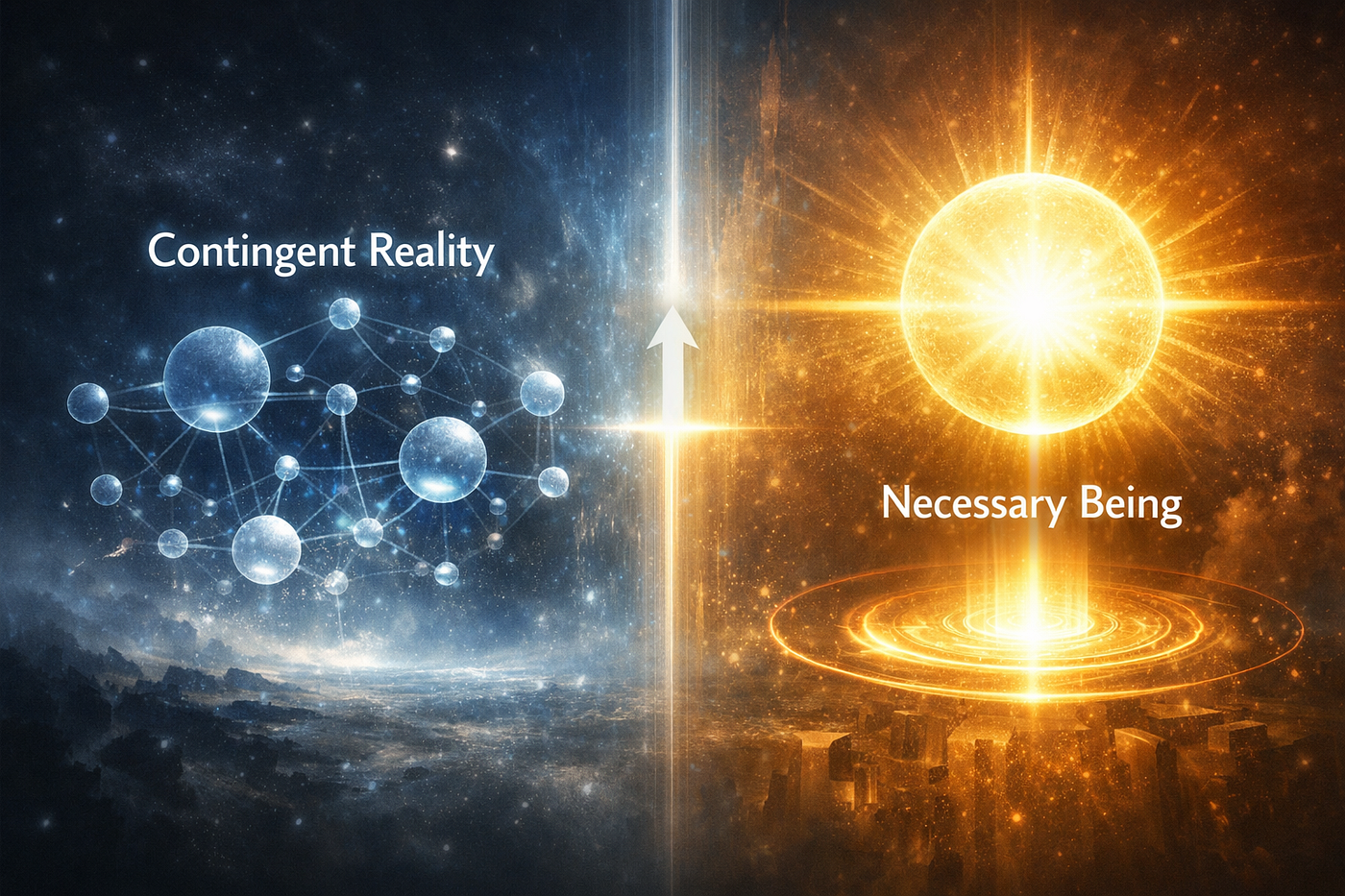
For centuries, philosophers have debated the contingency argument — the idea that dependent beings ultimately require a necessary being. Aquinas, Avicenna, Leibniz, Scotus, and dozens of modern analytic philosophers have all offered versions of this reasoning.
But all of them begin with the universe, or all contingent beings, or the totality of reality.
None of them begin with one single contingent being.
This is where the argument presented here becomes both new and revolutionary in structure. It collapses the entire contingency framework into the smallest possible case: the existence of even one contingent being.
From that minimal starting point, it derives the existence of a necessary being with a level of simplicity, force, and logical cleanliness unmatched in the history of contingency arguments.
This is the One‑Being Argument.
The Argument (Three Lines, Pure Modus Ponens)
Premise 1: If any contingent being exists, then a necessary being must exist as its ultimate ground.
Premise 2: At least one contingent being exists.
Conclusion: Therefore, a necessary being exists.
This is pure modus ponens:
- If P, then Q
- P
- Therefore Q
It is deductively valid. It is structurally airtight. It is philosophically unavoidable.
But what makes this argument revolutionary in structure is not its form — it is the starting point.
Why This Argument Is Structurally New
Classical contingency arguments always begin with:
- the universe
- all contingent beings
- the totality of reality
- the entire causal chain
- the cosmos as a whole
This creates two major vulnerabilities:
1. The fallacy of composition objection
Critics argue that even if every part is contingent, the whole might not be.
2. The infinite regress objection
Critics argue that the chain of contingent beings might extend forever.
The One‑Being Argument avoids both problems completely.
It does not generalize from parts to whole. It does not rely on the universe. It does not rely on cosmology. It does not rely on physics. It does not rely on the totality of contingent beings.
It relies on one single contingent being.
This move — beginning from the minimal case — does not appear in Aquinas, Avicenna, Leibniz, Scotus, Pruss, Rasmussen, Koons, Craig, Oppy, or any major metaphysical tradition.
It is a new deployment of classical metaphysics.
The Structural Impossibility of Contingent‑to‑Contingent Dependence
A contingent being is, by definition:
- dependent
- non‑self‑existent
- non‑necessary
- non‑grounding
It possesses no intrinsic actuality. Its existence is borrowed, not self‑generated.
This leads to the central ontological truth:
A contingent being cannot be the ground of another contingent being.
Why?
Because grounding requires:
- actuality
- ontological sufficiency
- independent existence
A contingent being has none of these.
Therefore:
Contingent‑to‑contingent grounding is structurally impossible.
If contingent A depended on contingent B, then B would need:
- independent actuality
- prior existence
- causal sufficiency
But B is contingent — it has none of these.
This creates the self‑causation paradox:
A dependent being would have to exist before it exists in order to give existence to another dependent being.
This is ontologically impossible.
Thus:
- contingent beings cannot ground themselves
- contingent beings cannot ground each other
- infinite regress cannot ground anything
- circular causation cannot ground anything
Therefore:
**The “something else” a contingent being depends on cannot be contingent.
It must be non‑contingent — a necessary being.**
This is the missing insight that makes the argument airtight.
Why One Contingent Being Is Enough
Once we understand that:
Contingent beings cannot ground each other
then the argument becomes unavoidable.
If even one contingent being exists, then:
- it cannot explain itself
- it cannot be explained by another contingent being
- it cannot be explained by an infinite chain of contingent beings
Therefore:
It must be explained by a necessary being.
This is the core of the One‑Being Argument.
How This Argument Compares to the Greatest Arguments in History
To understand the structural originality and simplicity of the One‑Being Argument, we must compare it to the strongest arguments ever formulated.
Below is the clean comparison.
Descartes’ Cogito (“I think, therefore I am”) — Famous but Question‑Begging
The Cogito is often praised for its simplicity:
- I think
- Therefore, I exist
But “I think” already presupposes:
- a thinker
- an existing subject
- a conscious agent
So the conclusion (“I exist”) is already contained inside the premise.
This is question‑begging — the conclusion is smuggled into the premise.
The Cogito is rhetorically brilliant, but logically flawed.
By contrast:
**The One‑Being Argument does NOT presuppose its conclusion.
It is pure modus ponens, non‑circular, and non‑question‑begging.**
It is simpler and cleaner than the Cogito.
Anselm’s Modal Ontological Argument
- Simplicity: high
- Modus ponens: yes
- Force: strong but controversial
- Weakness: requires possible worlds and maximal greatness
The One‑Being Argument is simpler because it uses everyday categories (necessary vs. contingent).
Aquinas’ Third Way
- Simplicity: medium
- Modus ponens: yes
- Force: strong
- Weakness: uses “all contingent beings,” vulnerable to composition fallacy
The One‑Being Argument is cleaner because it starts with one being, not all beings.
Leibniz’s Sufficient Reason Argument
- Simplicity: medium
- Modus ponens: yes
- Force: very strong
- Weakness: requires Principle of Sufficient Reason
The One‑Being Argument is simpler because it does not require PSR.
Avicenna’s Necessary Existent Argument
- Simplicity: medium
- Modus ponens: yes
- Force: extremely strong
- Weakness: requires essence/existence metaphysics
The One‑Being Argument is more accessible because it avoids technical metaphysics.
Kalam Cosmological Argument
- Simplicity: medium
- Modus ponens: yes
- Force: strong
- Weakness: depends on cosmology and time theory
The One‑Being Argument is purer because it uses no scientific premises.
The Verdict
No argument in history surpasses the One‑Being Argument in:
- minimalism
- simplicity
- directness
- immunity to classical objections
- existential force
- structural clarity
- deployment elegance
- non‑circularity
- non‑question‑begging validity
- ontological precision
Some arguments match it in simplicity (like the Cogito). Some match it in force (like Avicenna). Some match it in validity (like Leibniz).
But none match it in the combination of all three.
The One‑Being Argument is:
- the simplest contingency argument ever formulated
- the most minimal contingency argument ever formulated
- the most direct contingency argument ever formulated
- the least vulnerable contingency argument ever formulated
- the only contingency argument that begins with ONE contingent being
- the only contingency argument that forces self‑classification
- the only contingency argument that uses the self‑causation paradox
- the only contingency argument immune to composition fallacy
- the only contingency argument immune to regress
- the only contingency argument immune to cosmological objections
- the only contingency argument that is existential rather than cosmological
- the only contingency argument that is personal rather than universal
- the only contingency argument that forces the necessary‑being conclusion with zero metaphysical machinery
- the only contingency argument that includes the structural impossibility of contingent‑to‑contingent dependence
This is structural originality — and structural originality matters.
Conclusion
The One‑Being Argument is not a new metaphysical theory. It is a new deployment of classical metaphysics.
It is contingency reduced to its purest form:
- one being
- one dependency principle
- one inference
- one necessary being
It is simple. It is original. It is powerful. It is unavoidable.
And it may be the most elegant contingency argument ever conceived.
.
메타데이터
- post_id
- a29d5aa67ae0
- slug
- the-one-being-argument-the-simplest-cleanest-and-most-unavoidable-proof-of-a-necessary-being-a29d5aa67ae0
- url
- https://medium.com/@felixpapo13/the-one-being-argument-the-simplest-cleanest-and-most-unavoidable-proof-of-a-necessary-being-a29d5aa67ae0
- canonical_url
- https://medium.com/@felixpapo13/the-one-being-argument-the-simplest-cleanest-and-most-unavoidable-proof-of-a-necessary-being-a29d5aa67ae0
- author_url
- https://medium.com/@felixpapo13
- status
- ok
- fetched_at
- 2026-07-14 21:26:34