Black Indigenous Aspects of Pre-Columbian Art and Artifacts: THE BLACK AMERICANS, Part 3
INTRODUCTION
Black Indigenous Aspects of Pre-Columbian Art and Artifacts: THE BLACK AMERICANS, Part 3
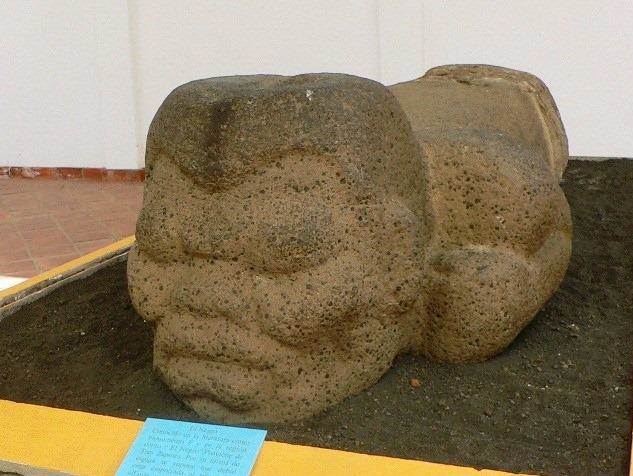
“Olmec sculpture called “El Negro” via Dr. Runoko Rashidi .” Caption by Chase McGhee. 13 Black Scholars Who Admitted there were Black people in the Americas before Columbus. Self-published. 2023.
INTRODUCTION
This third entry in the THE BLACK AMERICANS series examines art and artifacts left by the Black indigenous in the Americas. While the **first essay focused on (1) African shipbuilding and navigational ability, (2) Atlantic Equatorial currents from Africa to the Americas, and (3) sightings of Black people in the Americas, the [second** ](https://medium.com/@leemcqueen3/pre-columbian-negroid-skeletal-remains-in-the-americas-the-black-americans-part-2-c98e31804ca4?source=friends_link&sk=a4b6b65c7e6a92ded4f1b503c7bbb1c8)entry focused on (4) archaeological sites, (5) skeletal remains, (6) genetics, and the ongoing malicious effort to dismiss the growing accumulation of evidence.
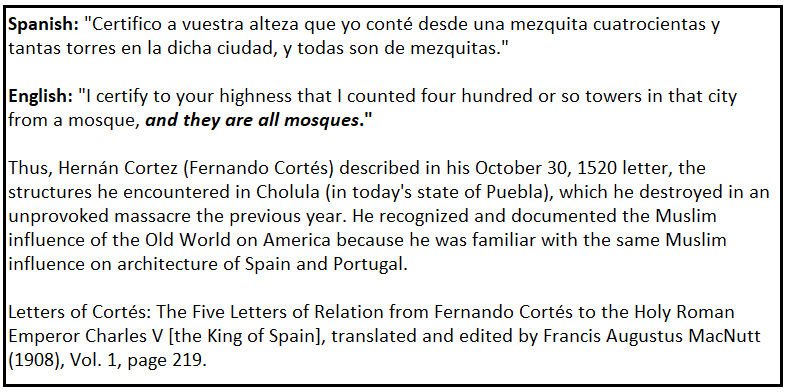
04/10/2026, added to this article is the fact that Hernan Cortez reported mosques in the New World, adding to the growing body of evidence that the conquistadors knew that Africans had journeyed to the Americas prior to their own arrivals. Cortez recognized the architecture of the temples and towers as mosques because Spain and Portugal had also been dominated by Muslims who built mosques in those territories for centuries. Europeans recognized the pyramids, having familiarity with Egyptian structures.
Fortunately for the reader, art and artifacts require more show than tell. Therefore, this entry will include many visuals which will accompany numerous quotations from a multitude of observers and witnesses across centuries who interpreted the artistic representations of Black indigenous and African voyagers and preserved their memories. Minimal original commentary from this author will be required as the works and words provided by others will have the greater impact. A picture, we know very well, is worth a thousand words.
ART AND ARTIFACTS
To begin, note the first Olmec image above called, “El Negro,” in the caption provided by Charles McGhee [13 Black Scholars Who Admitted there were Black people in the Americas before Columbus]. Large lips, flat nose bridge, wide nostrils, and noticeable prognathism (lower jaw juts forward) create a noteworthy impression.
Chase McGhee**. **13 Black Scholars Who Admitted there were Black people in the Americas before Columbus. Self-published. 2023.
The distinct physiognomy on this figure is not indicative of Siberian settlers. In fact, the facial features are reminiscent of the facial reconstruction of “Luzia,” the oldest American skull found in Minas Gerais, Brazil, dated from 11,500 BC to 9500 BC. Walter Neves interpreted Luzia’s facial features as distinct and different from those of Siberians, but similar to Australians or Africans. However, like the Olmec artifacts, Luzia’s skull was found on the east coast of the Americas making Africa, rather than Australia, the most likely origin of both. The same is likely for “Naia,” whose ancient skull dated to 12,000 years ago was found on the eastern coast of Mexico on the Yucatán Peninsula, Tulum, Quintana Roo.
![[FAR LEFT] 12,000-year-old skull of woman known as “Luzia.” [CENTER] Realistic sculpture of Luzia. The museum’s most popular exhibit, the 12,000-year-old remains of a woman simply known as “Luzia,” is one of the millions of irreplaceable artifacts lost in the fire. Using her skull, [Walter Neves] created a realistic sculpture of the woman. It too was destroyed. Will Adams. RelicRecord.com [RIGHT] Facial reconstruction of “Naia,” part of a female skeleton found in an underwater cave Tulum, Quintana Roo, Mexico in the Yucatán. Because she lived on the Caribbean coast of Mexico, it is likely that she or her ancestors originated from Africa. Image from “The Tragic Story Behind The Oldest Human Skeleton In The American Continent,” by Alejandro I. López and Isabel Carrasco. Cultura Colectivo. Accessed 12/29/2025.](https://miro.medium.com/v2/resize:fit:1124/1*r1FwQKIC6wIIAivxFP8XJg.png)
[FAR LEFT] 12,000-year-old skull of woman known as “Luzia.” [CENTER] Realistic sculpture of Luzia. The museum’s most popular exhibit, the 12,000-year-old remains of a woman simply known as “Luzia,” is one of the millions of irreplaceable artifacts lost in the fire. Using her skull, [Walter Neves] created a realistic sculpture of the woman. It too was destroyed. Will Adams. RelicRecord.com [RIGHT] Facial reconstruction of “Naia,” part of a female skeleton found in an underwater cave Tulum, Quintana Roo, Mexico in the Yucatán. Because she lived on the Caribbean coast of Mexico, it is likely that she or her ancestors originated from Africa. Image from “The Tragic Story Behind The Oldest Human Skeleton In The American Continent,” by Alejandro I. López and Isabel Carrasco. Cultura Colectivo. Accessed 12/29/2025.
Neves, Walter A., and Hector M. Pucciarelli. “Morphological Affinities of the First Americans: An Exploratory Analysis Based on Early South American Human Remains.” Journal of Human Evolution 21, no. 4 (1991): 261–273.
Neves, Walter A., and Mark Hubbe. “Cranial Morphology of Early Americans from Lagoa Santa, Brazil: Implications for the Settlement of the New World.” Proceedings of the National Academy of Sciences 102, no. 51 (2005): 18309–18314.
Neves, Walter A., and Eduardo G. Atui. “Cranial Morphology of Early South Americans and the African–Australoid Model.” Current Anthropology 45, no. 4 (2004): 509–514.
Hubbe, Mark, Katerina Harvati, and Walter A. Neves. “Paleoamerican Morphology in the Context of the Settlement of the Americas.” American Journal of Physical Anthropology 137, no. 1 (2008): 1–10.
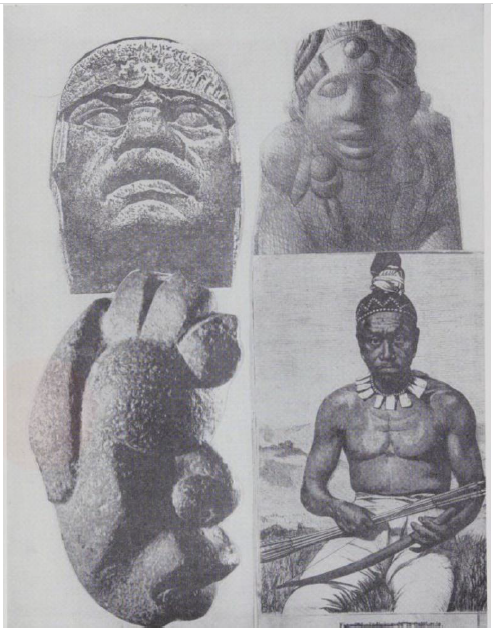
“Negroes in America before Columbus: TOP LEFT: Head of God from Tenochtitlan, Mexico. TOP RIGHT: Figure found in ancient Indian grave in Connecticut. BOTTOM LEFT: Massive head from Yucatan (National gallery, Washington). BOTTOM RIGHT: California Native before Columbus.” Caption by Chase McGhee. 13 Black Scholars Who Admitted there were Black people in the Americas before Columbus. Self-published. 2023.
The images of Black indigenous and Africans survived in pre-Columbian artwork located in regions ranging from the west coasts of the Americas like California and Peru to the east coasts of the Americas like Connecticut and Mexico. Chase McGhee provided additional vivid imagery and comprehensive commentary in his, 13 Black Scholars Who Admitted there were Black people in the Americas before Columbus.
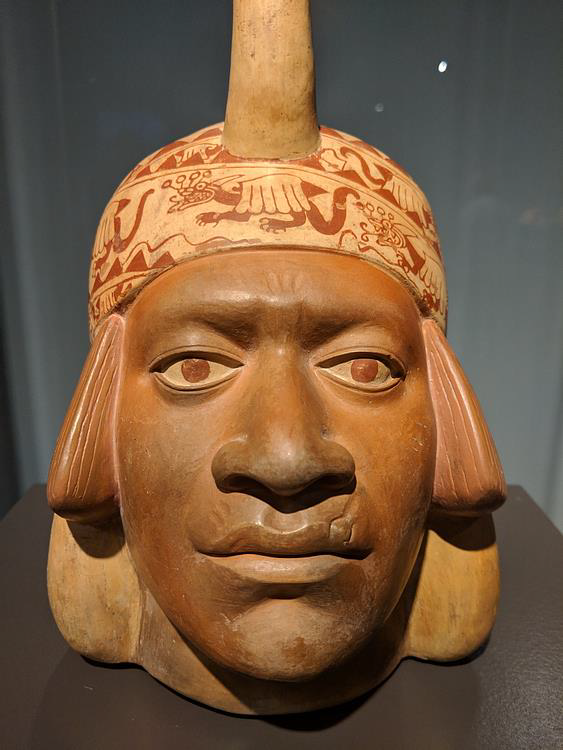
Portrait head of a Moche man. Peru, Moche Culture, Exhibited at Museum Rietberg, Zurich, Switzerland. Caption by Chase McGhee. 13 Black Scholars Who Admitted there were Black people in the Americas before Columbus. Self-published. 2023
Chase McGhee**. **13 Black Scholars Who Admitted there were Black people in the Americas before Columbus. Self-published. 2023.
![FAR LEFT: “Portrait head of a Moche man. Peru, Moche Culture, Exhibited at Museum Rietberg, Zurich, Switzerland.” Caption by Chase McGhee. LEFT MIDDLE: Moche artist, Peru, South America, ca. 200–800 [AD], Period 1 [AD]-500[AD], Clay with paint. Caption information by Anenberg Learner. Photo by David Bernstein Fine Art, New York, NY. CENTER: “Portraiture Vessel. Moche Culture. Peru. (2nd-8th Century AD).” Image and caption by Treasures and Beauty Tumblr. FAR RIGHT: “Larco Hoyle Mochica Phase Three Ceramic. Larco Museum, Lima.” Image and caption by Travel to Eat.](https://miro.medium.com/v2/resize:fit:1400/1*kyPqwvT1_rKU_pqQVzAotQ.png)
FAR LEFT: “Portrait head of a Moche man. Peru, Moche Culture, Exhibited at Museum Rietberg, Zurich, Switzerland.” Caption by Chase McGhee. LEFT MIDDLE: Moche artist, Peru, South America, ca. 200–800 [AD], Period 1 [AD]-500[AD], Clay with paint. Caption information by Anenberg Learner. Photo by David Bernstein Fine Art, New York, NY. CENTER: “Portraiture Vessel. Moche Culture. Peru. (2nd-8th Century AD).” Image and caption by Treasures and Beauty Tumblr. FAR RIGHT: “Larco Hoyle Mochica Phase Three Ceramic. Larco Museum, Lima.” Image and caption by Travel to Eat.
“The Moche culture, which thrived on the north coast of Peru circa 100 to 800 [AD], was one of the few to develop a form of portraiture that sought to capture individualized features in a naturalistic style and with a high degree of accuracy.” Noted by Annenberg Learner. Meaning, the artists created what they saw… Negroid-appearing men in pre-Columbian Peru.
Annenberg Learner. “Portrait Head.” Art Through Time: A Global View. Accessed March 13, 2026. https://www.learner.org/series/art-through-time-a-global-view/portraits/portrait-head/
“Similarities across early American and African religions also indicate significant cross-cultural contact. The Mayans, Aztecs and Incas all worshipped black gods and the surviving portraits of the black deities are revealing. For instance, ancient portraits of the Quetzalcoatl, a messiah serpent god, and Ek-ahua, the god of war, are unquestionably Negro with dark skin and wooly hair. Why would native Americans venerate images so unmistakably African if they had never seen them before?” Garikai Chengu, Harvard University
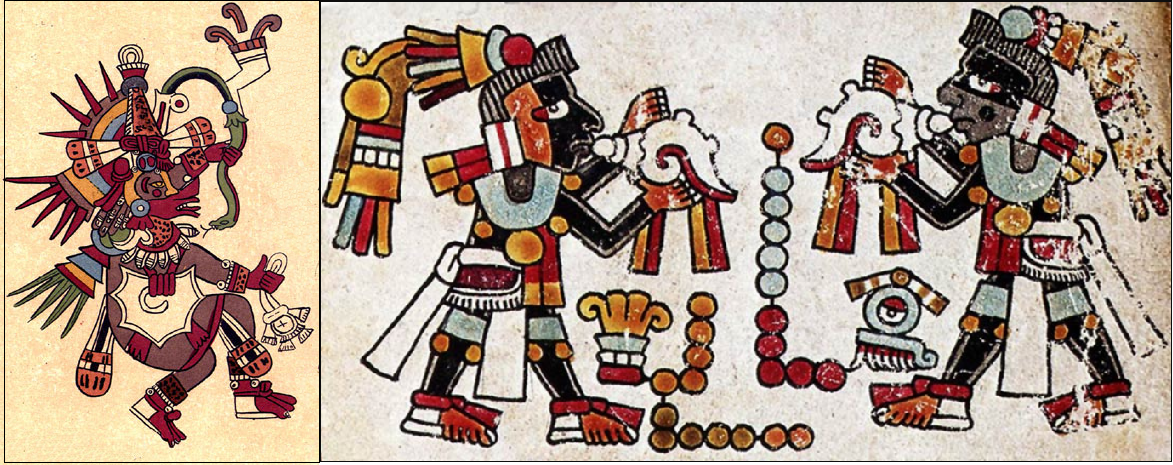
LEFT: “Quetzalcoatl.” Published in the Codex Borbonicus, 16th century, author unknown. Wikimedia Commons. Public domain. RIGHT: “Two named and semi-divine conch players face each other”; Original painted on deer hide approx 1350–1519 AD. Codex Vindobonensis pl. 16. Image scanned from ADEVA facsimile edition of the Codex Vindobonensis, Graz, Austria, 1974. Accessed from https://www.mexicolore.co.uk/aztecs/artefacts/sea-shell/1000
Chengu, Garikai. “Before Columbus: How Africans Brought Civilization to America.” Countercurrents, October 14, 2014. Accessed December 26, 2025. https://countercurrents.org/chengu141014.htm
Ignatius Donnelly (1831–1901), former lieutenant governor of Minnesota and Republican US Congressman wrote in Atlantis: the Antediluvian World, “Without Atlantis, how can we explain the fact that the early Egyptians were depicted by themselves as red men on their own monuments? And, on the other hand, how can we account for the representations of negroes on the monuments of Central America? Dêsirè Charnay, now engaged in exploring those monuments, has published in the North American Review for December, 1880, photographs of a number of idols exhumed at San Juan de Teotihuacan, from which I select the following strikingly negroid faces”:
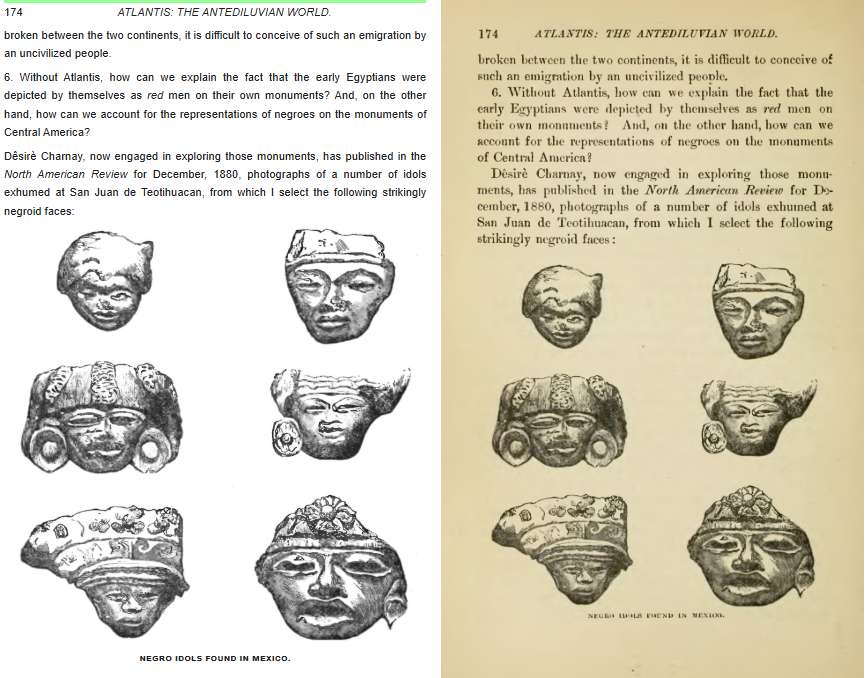
“Negro Idols Found in Mexico.” Exhumed at San Juan de Teotihuacán. Photographed by Désiré Charnay for December 1880 issue of American Review. Published in Atlantis: the Antediluvian World by Ignatius Donnelly, 1882.
The terracotta portraits, dated to approximately (c. 150–650 AD) are characterized by thick lips, broad noses, and distinct facial structures. Donnelly’s questions regarding what he described as “Negro Idols Found in Mexico” resulted in his being labeled a “pseudoscientist” and “fringe theorist.”
Donnelly, Ignatius. Atlantis: The Antediluvian World. New York: Harper & Brothers, 1882.
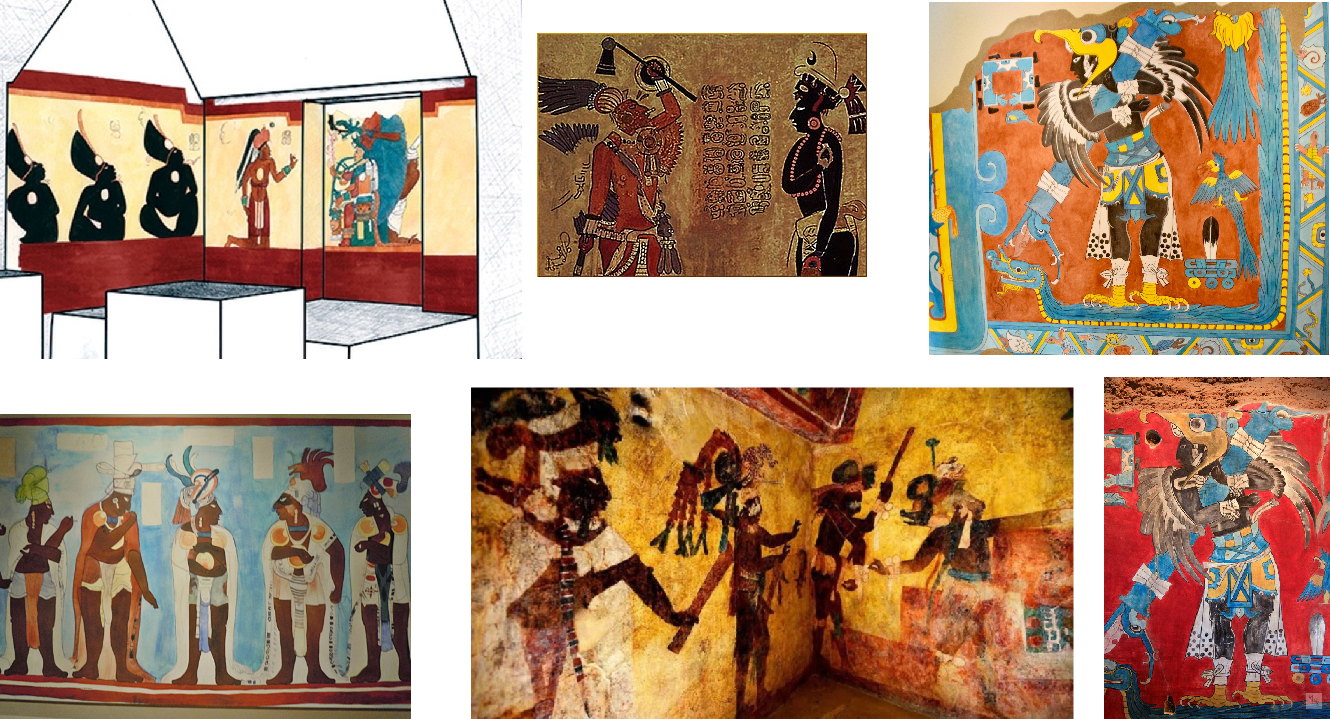
![Murals depicting black-skinned people in pre-Columbian ancient Mesoamerica. FAR LEFT TOP: “El Taller de los Sabios. La producción de murales y códices en Xultún, Guatemala, [ca. 800–820 AD], Late Classic Maya. “Reconstrucción del cuarto 2 de la Estructura 10K-2. Dibujo: H. Hurst” from arqueologia mexicana. CENTER TOP: “Mural maya en Uaxactún.” And, “Uaxactun — Affresco dell’Edificio B-XIII.” [ca. 380–450 AD], Early Classic Maya. Wikimedia Commons. Public domain. TOP RIGHT: “Copy of the Birdman Mural.” Taken from “Cacaxtla — Mexico’s Amazing Ancient Murals,” {ca. 650–750 AD], Epiclassic, Late Classic Transition. BOTTOM LEFT: “Murals at Bonampak Procession of Lords.” And, “The Murals at Bonampak, Chiapas, Mexico.” [792 AD] Late Classic Maya. Image and captions by leonidemartinblog. CENTER BOTTOM: “Murales de Bonampak [Chiapas]: el testimonio eterno de la cultura maya.” And, “Estos frescos, datados alrededor del siglo VIII d.C., son considerados unos de los mejor conservados y más completos de la región mesoamericana.” [ca. 790 AD], Late Classic Maya. Image and caption by Leonardo Ruiz at arrquelogia mexicana blogspot. BOTTOM RIGHT: Comparative version of the Birdman Mural. “Mayan mural, National Museum of Anthropology, Mexico City.” [date of original ca. 650–750 AD], Epiclassic. Image and caption by Michael Stephens.](https://miro.medium.com/v2/resize:fit:1330/1*g9_9LldvZ9lBsT3VucPoXw.png)
Murals depicting black-skinned people in pre-Columbian ancient Mesoamerica. FAR LEFT TOP: “El Taller de los Sabios. La producción de murales y códices en Xultún, Guatemala, [ca. 800–820 AD], Late Classic Maya. “Reconstrucción del cuarto 2 de la Estructura 10K-2. Dibujo: H. Hurst” from arqueologia mexicana. CENTER TOP: “Mural maya en Uaxactún.” And, “Uaxactun — Affresco dell’Edificio B-XIII.” [ca. 380–450 AD], Early Classic Maya. Wikimedia Commons. Public domain. TOP RIGHT: “Copy of the Birdman Mural.” Taken from “Cacaxtla — Mexico’s Amazing Ancient Murals,” {ca. 650–750 AD], Epiclassic, Late Classic Transition. BOTTOM LEFT: “Murals at Bonampak Procession of Lords.” And, “The Murals at Bonampak, Chiapas, Mexico.” [792 AD] Late Classic Maya. Image and captions by leonidemartinblog. CENTER BOTTOM: “Murales de Bonampak [Chiapas]: el testimonio eterno de la cultura maya.” And, “Estos frescos, datados alrededor del siglo VIII d.C., son considerados unos de los mejor conservados y más completos de la región mesoamericana.” [ca. 790 AD], Late Classic Maya. Image and caption by Leonardo Ruiz at arrquelogia mexicana blogspot. BOTTOM RIGHT: Comparative version of the Birdman Mural. “Mayan mural, National Museum of Anthropology, Mexico City.” [date of original ca. 650–750 AD], Epiclassic. Image and caption by Michael Stephens.
Naval strategist and ship-builder Rameses III reigned from 1183 BC to 1155 BC during the 20th Dynasty of Egypt. Nubians/Kushites controlled 25th Dynasty Egypt from 747 BC to 656 BC. The above murals [and terracotta portraits] that depict black-skinned people in pre-Columbian ancient Mesoamerica have been roughly dated to follow these Egyptian reigns. This author believes these murals represent the African voyagers who pre-dated the Malian voyagers. The murals corroborate precisely the numerous early conquistadors, explorers, and missionaries who wrote of black-skinned people when they visited the Americas, which by then, included the Malians. The murals also explain the negroid skeletons consistently found throughout Central America and the Caribbean, on the eastern coasts.
THE OLMECS
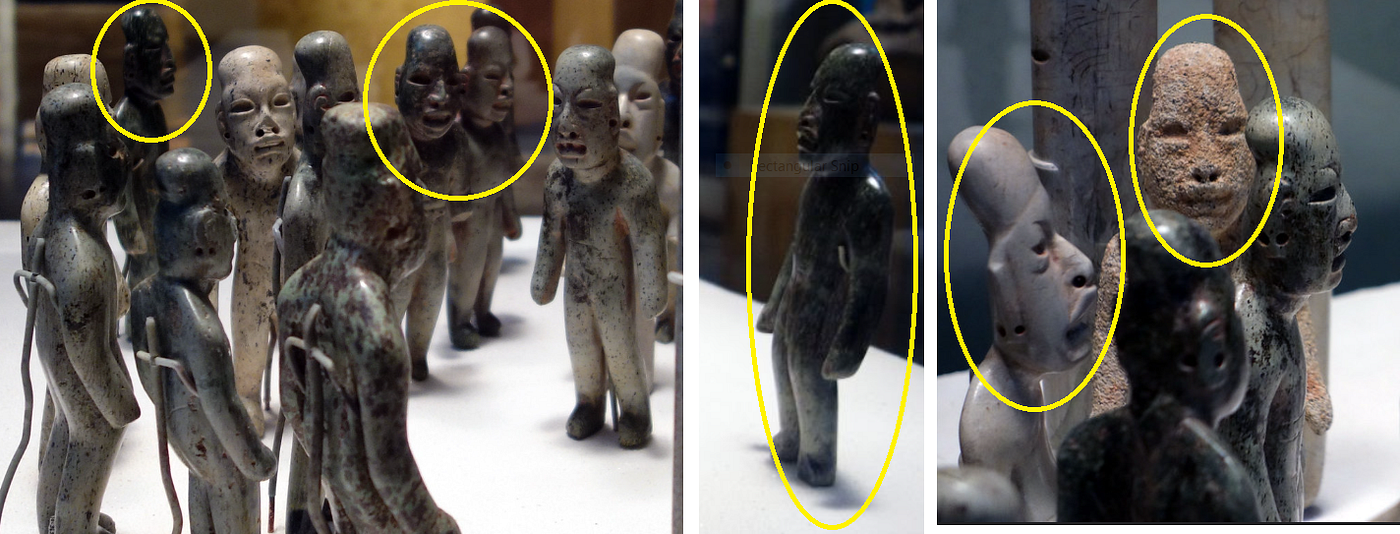
Note: dark colors, lower-jaw prognathism, broad noses, thick lips. Olmec Offering Figurines. c. 900–400 BC. Serpentine, jadeite, and granite. From La Venta, Mexico (National Museum of Anthropology, Mexico City). Caption and images by Dr. Billie Follensbee, “Offering #4, La Venta,” in Smarthistory, September 8, 2016, accessed May 28, 2026, https://smarthistory.org/offering-4-la-venta/. “Standing human figures excavated at La Venta are some of the most iconic works of Olmec art.” Caption by Olmec art on the Metropolitan Museum of Art’s Heilbrunn Timeline of Art History (by Dr. James Doyle)
Attention refocuses on the Olmecs and their impact on the pre-Columbian civilizations of the Inca, Maya, Toltec, and Aztecs in Central America and South America. How fortunate, these Olmec heads were rendered in rock and then buried, making alterations more difficult.
![“All of the 17 known Olmec colossal heads discovered so far. The heads date from at least 900 BCE, and it is thought that they represent portraits of powerful individual Olmec rulers. The head, in the 1st picture, is the largest of them all, measuring 3.4 m in height and weighs 40 tons [2205x2538].” Caption and image by ArtefactPorn via Museum of Artifacts. Reddit. Individual images available at Wikipedia.](https://miro.medium.com/v2/resize:fit:753/1*iSYgkXgJGNZbxX7C8-AslQ.png)
“All of the 17 known Olmec colossal heads discovered so far. The heads date from at least 900 BCE, and it is thought that they represent portraits of powerful individual Olmec rulers. The head, in the 1st picture, is the largest of them all, measuring 3.4 m in height and weighs 40 tons [2205x2538].” Caption and image by ArtefactPorn via Museum of Artifacts. Reddit. Individual images available at Wikipedia.
Multi-discipline, multi-national, multi-racial, multi-century groups of observers interpreted the visages of the Olmec statues as “Negroid, African,” and “Black.” None of these observers described the statues as Siberian, Asian, or Australian. Note the large lips, flat nose bridge, wide nostrils, and noticeable prognathism (lower jaw juts forward). Also note that the Olmec statues were depicted wearing African war helmets rather than Mesoamerican headdress. Finally, note that they were all found on the eastern coast of Mexico, facing the Caribbean and Africa. None were found on the Pacific side of Mexico facing Asia or Australia.
“In Aztec mythohistory, the Olmecs were known as ‘the people who lived in the direction of the rising sun’ …” von Hagen, The Ancient Sun Kingdoms of the Americas
Victor W. Von Hagen, archaeologist, The Ancient Sun Kingdoms of the Americas, 1957
José María Melgar y Serrano was the first discoverer of an Olmec head and the earliest to make an African phenotype claim.
Original Spanish: “Lo que me sorprendió fue la forma Ethiopica; observé que el diámetro mayor pasaba de un metro; vi en seguida que era una cabeza colosal… la nariz achatada, los labios gruesos, la expresión africana.” English Translation: “What surprised me was the Ethiopian shape; I observed that the larger diameter exceeded one meter; I saw immediately that it was a colossal head… the flattened nose, the thick lips, the African expression.”)
Melgar y Serrano, José María. “Observaciones sobre la cabeza colosal de Veracruz.” Boletín de la Sociedad Mexicana de Geografía y Estadística, 1869.
“[W]e can trace the progress of man in Mexico without noting any definite Old World influence during this period (1000–650 B.C.) except a strong Negroid substratum connected with the Magicians [Olmecs].” Frederick Peterson, Ancient Mexico
Peterson, Frederick. “Skull Types among the Ancient Inhabitants of Mexico.” American Anthropologist 9, no. 2 (1896): 45–62.
“As early as the nineteenth century” wrote Jonathan Leonard, a specialist on early Mexico, “reports had come from this coastal region [the Mexican gulf coast] of gigantic heads with Negroid features.” N. Leonard, Ancient America
Leonard, N. Ancient America. London: Faber & Faber, 1965.
“Cleared of the surrounding earth, it [the colossal head] presented an awe-inspiring spectacle. Despite its great size, the workmanship is delicate and sure, its proportions perfect… The features are bold and amazingly negroid in character.” Matthew M. Stirling, “Discovering the New World: Oldest Dated Work of Man,” National Geographic Magazine
Stirling, Matthew M. “Discovering the New World: Oldest Dated Work of Man.” National Geographic Magazine 109, no. 5 (1956): 543–572.
“…colossal ‘Negroid’ heads…” Selden Rodman, The Mexico Traveler
Rodman, Selden. The Mexico Traveler. New York: Crown Publishers, 1960.
European journalist and Olmec specialist, Walter Hanf, describes “carved colossal heads with Negroid features, deformed and close-shaven skulls, blunt noses, and protruding lips.” Walter Hanf, Mexico
Hanf, Walter. Mexico. New York: Scribner, 1960.
“inescapably Negroid.” Sharon S. McKern, Exploring the Unknown, Mysteries in American Archeology
McKern, Sharon S. Exploring the Unknown: Mysteries in American Archeology. New York: Harper & Row, 1970.
“exaggeratedly Negroid features” Nicholas Cheetham, Mexico, A Short History
Cheetham, Nicholas. Mexico: A Short History. London: Thames & Hudson, 1994.
“One might merely ask himself: if Africans were not present in the Americas before Columbus, why the typically African physiognomy on the monuments? It is in contradiction to the most elementary logic and to all artistic experience to suggest that these ancient Olmec artists could have depicted, with such detail, African facial features they had never seen.” W. Hayes III, “The African Presence in America Before Columbus,” The Black World
Hayes III, W. “The African Presence in America Before Columbus.” The Black World 24, no. 9 (July 1975): 4–21.
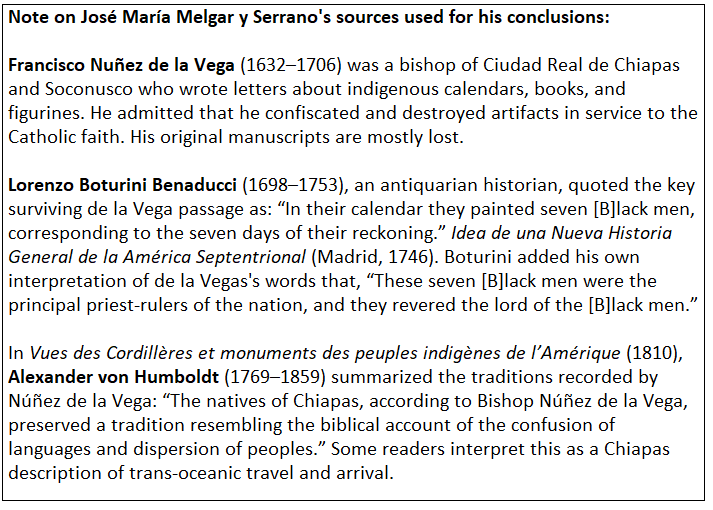
“The first of these heads was discovered by Jose Melgar in Veracruz in 1862. He wrote two articles about this particular head, one in the Boletin de Geografia y Estadistica, and the other in the respected Sociedad Mexicana de Geografia y Estadistica. “Melgar’s mind,” wrote art historian Alexander von Wuthenau, “not yet tainted by certain currents of modern (and perhaps not so modern) anthropology, reacted quite normally to this newly found evidence of [the] black man’s presence in ancient America. He furthermore cites a document of Francisco [Nuñez] de [la] Vega (1691), who describes an ancient calendar found in Chiapas that mentions seven ‘negritos’ representing the seven planets.” Alexander von Wuthenau, Unexpected Faces in Ancient America
von Wuthenau, Alexander. Unexpected Faces in Ancient America. Mexico City: Editorial Diana, 1980.
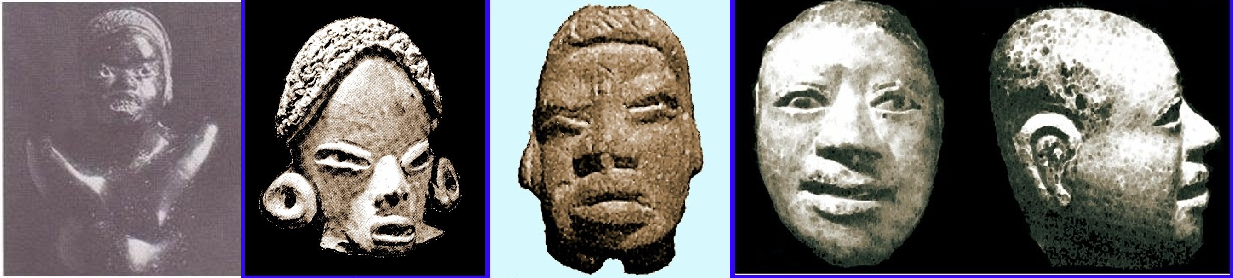
From the Wuthenau Collection: Large protruding lips, noses with wide-spread nostrils, lower-jaw prognathism, short tightly-coiled hair. These are not representations of Siberian migrants. These are Black indigenous or African voyagers. FAR LEFT: Pre-classic Period in America (circa 1800 BC — 150 AD). LEFT MIDDLE: Ceramic figure, 2 in. high, from Tlapacoyán, Mexico (circa 1000 BC), photo 1969. RIGHT MIDDLE: Ceramic head, 1.5 in. high from Tlatilco, Mexico (circa 1000 BC), photo 1965. FAR RIGHT: Ceramic sculpture of a man, frontal and lateral view, 2 1/3rd in. high, from La Venta area, Tabasco (circa 400 BC), photo 1975.
According to Von Wuthenau, “[t]he startling fact is that in all parts of Mexico, from Campeche in the east to the southeast of Guerrero, and from Chiapas, next to the Guatemalan border, to the Panuco River in the Huasteca region (north of Veracruz) archeological pieces representing Negro or Negroid people have been found, especially in archaic or pre-classic sites. This also holds true for large sections of Mesoamerica and far into South America — Panama, Columbia, Ecuador, and Peru…” Alexander von Wuthenau a: The Historical Testimony of Precolumbian Artists — 1500 B.C. to 500 A.D.
von Wuthenau, Alexander. The Historical Testimony of Precolumbian Artists, 1500 B.C.–500 A.D. Mexico City: Editorial Diana, 1982.
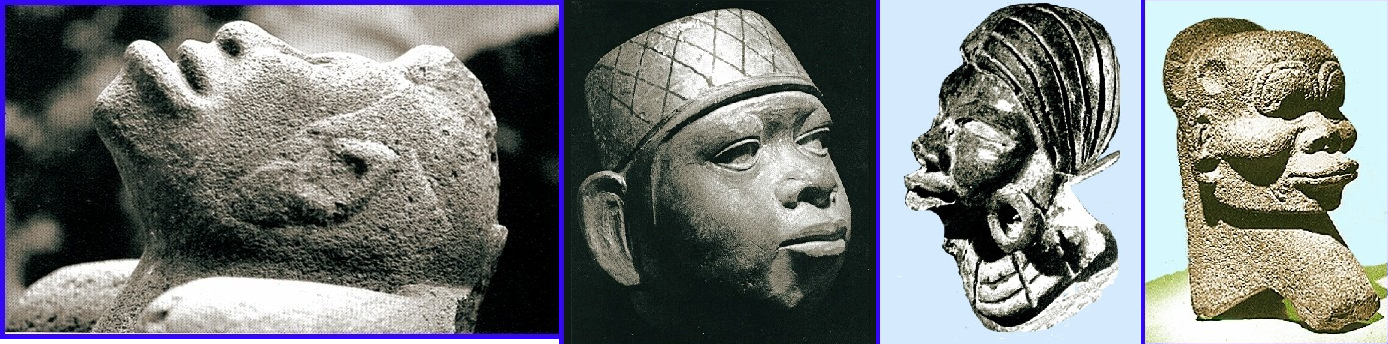
Not Siberian migrants. From the Wuthenau Collection: FAR LEFT: Olmec basalt sculpture of a man gazing at the sky with both hands clasped behind his neck, from La Venta, Tabasco, (circa 600 BC), photo by Stierlin, 1981). LEFT MIDDLE: Ceramic sculpture on a Mochica vessel, 5 1/2 in. high, from northern Peru (circa 600 AD, photo by von Wuthenau, 1975). RIGHT MIDDLE: Ceramic sculpture, 6 in. high, from Teotihuacán, Mexico (circa 150 AD–600 AD, photo by von Wuthenau, 1975). FAR RIGHT: Basalt, head of man, Central Veracruz, Mexico, 9 in. high, Late Classic Period in America (circa 900 AD-1521 AD), photo by Von Winning,
Regarding the Alexander von Wuthenau Collection of remarkable figurines depicting Black priests, chiefs, dancers, wrestlers, drummers, and others across the social spectrum housed at the Diego Rivera Museum of Mexico “reveals the unmistakable combination of the kinky hair, broad nose, generous lips, frequency of prognathism (projecting jaws), occasional goatee beard, and sometimes distinctly African ear pendants, hairstyles, tattoo markings, and coloration.” Van Sertima, “Evidence For An African Presence in Pre-Columbian America
van Sertima, Ivan. “Evidence for an African Presence in Pre-Columbian America.” In African Presence in Early America, 2nd ed., 101–128. New Brunswick, NJ: Transaction Books, 1986.
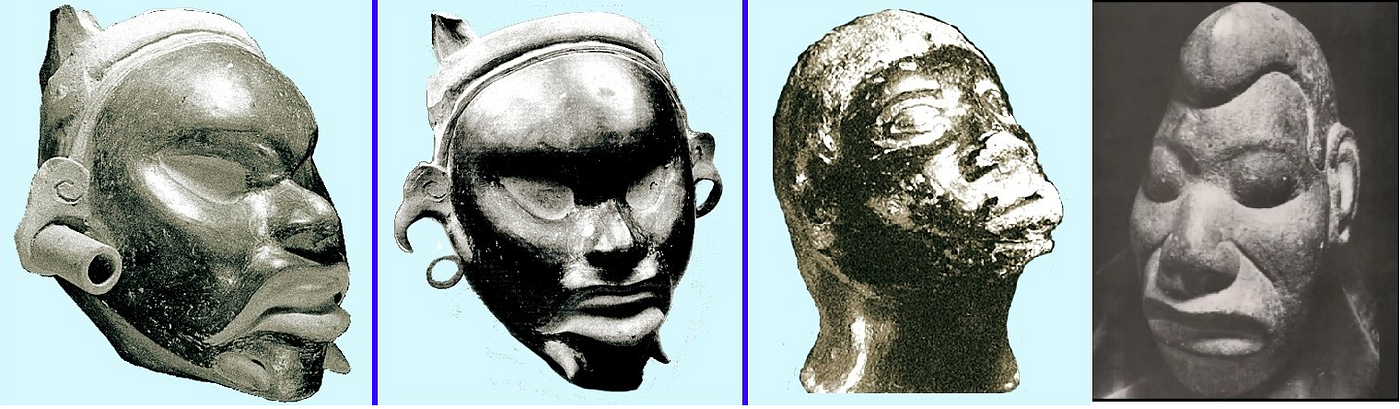
The crime of erasure. The silence of complicity. Neither do these figurines represent Siberian, Asian, or “mongoloid” populations. FAR LEFT: Ceramic figure, 7 in. high, from Oaxaca, Mexico (circa 900 AD–1300 AD), photo by von Wuthenau, 1969). LEFT MIDDLE: Ceramic sculpture, 7.8 in high, from the Mixtec Culture, Oaxaca, Mexico, (circa 1200 AD–1400 AD) photo by Bernonneau et al., 1985. MIDDLE RIGHT: Ceramic sculpture, 5 1/2 in. high, from a site in the Valley of Mexico (circa 1200 AD–1300 AD, photo by von Wuthenau, 1969). FAR RIGHT: Classic Period, Veracruz, Mexico. American Museum of Natural History.
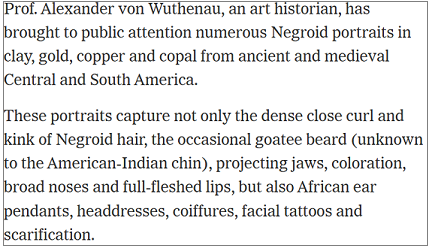
Excerpt from “Bad News for Columbus, Perhaps” by Ivan Sertima for Dec 04, 1975 New York Times. Van Sertima provides compelling visual description of certain pieces of the Wuthenau Collection. In the same article, he speculates Olmec artifacts represent members of the Egyptian navy during the rise of Nubian rulers who escorted Phoenicians on naval expeditions to the Americas.
The African presence is proven by stone heads, terra cottas, skeletons, artifacts, techniques and inscriptions, by oral traditions and documented history, by botanical, linguistic and cultural data. Ivan Van Sertima, They Came Before Columbus.
van Sertima, Ivan. They Came Before Columbus: The African Presence in Ancient America. New York: Random House, 1976.
“The oldest inhabitants of Mexico, according to some, were Negroes, and according to others, the Otomies. The existence of Negroes and giants is commonly believed by nearly all the races of our soil… Several archaeological objects found in various locations demonstrate their existence… Memories of them in the most ancient traditions induce us to believe that the Negroes were the first inhabitants of Mexico” Historian Nicholas Leon, quoted in J.A. Rogers, Sex and Race
Leon, Nicholas. Quoted in J. A. Rogers, Sex and Race, Vol. 1. New York: Morrow, 1952.
Pyramid construction is highly specialized. Ancient Egypt progressed from the original stepped pyramid of Djosser, to the more sophisticated finished product at Giza. However, at La Venta in Mexico, the Olmecs made a fully finished pyramid, with no signs of progressive learning. Olmecian and Egyptian pyramids were both placed on the same north-south axis and had strikingly similar construction methods. Tellingly, all of these pyramids also served the same dual purpose, tomb and temple. Professor Everett Borders
Borders, Everett. “Olmec and Egyptian Pyramid Construction: A Comparative Study.” Journal of Archaeological Research 12, no. 3 (1978): 215–237.
“The colossal heads depict African kings.” Clyde A. Winters. African Empires in Ancient America.
Winters, Clyde A. The Olmec Writing. 1997; African Empires in Ancient America. 2005.
“The great stone heads of the Olmec are clearly Negroid. The features are African by any standard of comparison.” *J.A. Rogers, Sex and Race, Vol. 1*
Rogers, J. A. Sex and Race. Vol. 1. New York: Helga M. Rogers, 1952.
“The colossal heads of the Olmecs show an undeniable Negroid physiognomy which cannot be explained away as mere coincidence.” R.A. Jairazbhoy, Ancient Egyptians and the Chinese in America
Jairazbhoy, R. A. Ancient Egyptians and the Chinese in America. New Delhi: Navrang, 1974.
“The ancient Olmec people were Black people. This is borne out by the physiognomy in the colossal sculptures.” Harold Lawrence, Journal of African Civilizations
Lawrence, Harold. “The Ancient Olmec People Were Black People.” Journal of African Civilizations 3, no. 2 (1979): 45–61
“The Negro countenance, clear and unmistakable, occurs repeatedly in Indian carvings, among the relics of the Mound Builders and in Mexican temples… W.E.B. Du Bois, The Gift of Black Folk: The Negroes in the Making of America
Du Bois, W.E.B., The Gift of Black Folk: The Negroes in the Making of America, Boston; Stratford Company. 1924.
“The colossal heads and Monument F of Tres Zapotes, principally, possess vigorous and striking negroid somatic characteristics, such as prominent cheekbones, thick lips, and a platyrrhine [broad, flat nose with wide nostrils]. For a long time there has been concern about knowing what the hair is or was like, since in the colossal heads it is invariably covered by a cap or helmet. This doubt may persist indefinitely; but there is now some relief with the discovery of two heads measuring 0.75 meters in height, corresponding to numbers 1 and 2 from Laguna de los Cerros, in which, together with the characteristic cheekbones and platyrrhine nose, there appears a headdress or hair of kinky or curly texture.” Alfonso Medellín Zenil
Medellín Zenil, Alfonso. 1963. The Olmec Tradition. Houston: The Museum of Fine Arts, Houston. Accessed at Internet Archive 02/05/2026.
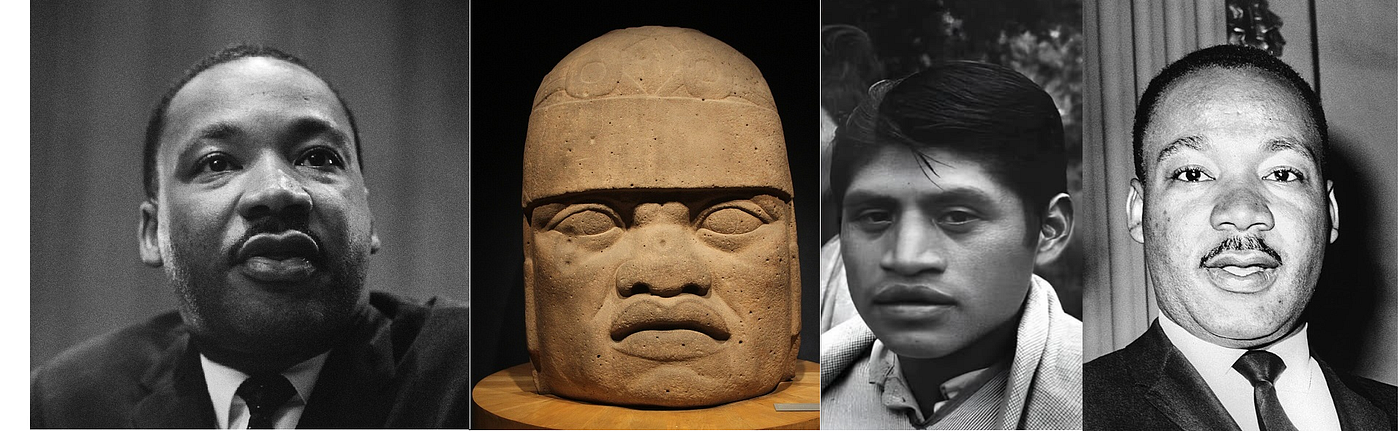
What does the reader see? LEFT: Black American civil rights activist Martin Luther King Jr, used with permission, Pixabay. LEFT MIDDLE: “Olmec Colossal Head,” used with permission, Wikimedia Commons, public domain. RIGHT MIDDLE: Unknown Siberian American, screenshot, no attribution available. RIGHT: Martin Luther King Jr, “Undated photo, pre-1968. Taken by Dick DeMarsico, photographer with the New York World-Telegram & Sun.,” “No copyright restriction known. Staff photographer reproduction rights transferred to Library of Congress through Instrument of Gift.”
The identities of the Olmecs are described by “modern historians” as mysterious, unknown, and uncertain. Some remain convinced that the Olmecs were aliens. The facial features of the Olmec statues do not match Siberians (which would be “brown-washing”), but they do match facial features of Africans and Black indigenous such as Luzia.
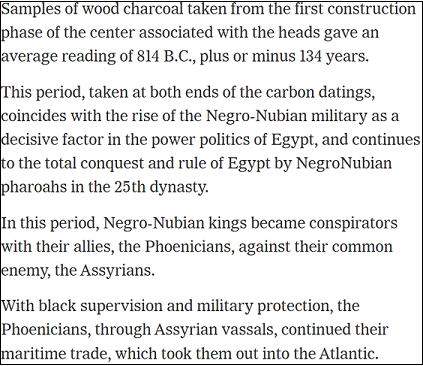
Excerpt from “Bad News for Columbus, Perhaps” by Ivan Sertima for Dec 04, 1975 New York Times. Van Sertima theorizes the rise of Nubian control over Egypt prompted joint naval military missions with the Phoenicians to the Americas. Those missions to the Americas coincided with the rise of Olmec civilizations.
More than likely, the Olmecs were Africans [Egyptians, Nubians, Phoenicians, Carthaginians, Cape Verdeans, Malians, or other West Africans etc] who found themselves pulled into the ocean river current, found themselves in the Caribbean or Central America, and then mixed with Black indigenous populations, as well as Siberian populations. Old and New Worlds collided to form a fantastic, dynamic culture. In fact, the awesome Olmec statues of Mesoamerica look like early editions of the awe-inspiring West African Benin Bronzes [stolen by British forces and parceled out to European collectors by the hundreds].
![16th Century Benin Bronzes. Note the head gear, the flat nose bridges, wide-spread nostrils, thick lips, lower jaw prognathism. Not unlike the Olmec statues and artifacts. Not unlike Luzia. “The Benin Bronzes are a group of several thousand[a] metal plaques and sculptures that decorated the royal palace of the Kingdom of Benin, in what is now Edo State, Nigeria… The Kingdom of Benin was a hub of African civilization long before Portuguese traders visited,” Caption by Wikimedia Commons. Public Domain.](https://miro.medium.com/v2/resize:fit:1351/1*ZYxdk-ag29ylAgNo5pzspg.png)
16th Century Benin Bronzes. Note the head gear, the flat nose bridges, wide-spread nostrils, thick lips, lower jaw prognathism. Not unlike the Olmec statues and artifacts. Not unlike Luzia. “The Benin Bronzes are a group of several thousand[a] metal plaques and sculptures that decorated the royal palace of the Kingdom of Benin, in what is now Edo State, Nigeria… The Kingdom of Benin was a hub of African civilization long before Portuguese traders visited,” Caption by Wikimedia Commons. Public Domain.
Alfonso Toro Castro, the Mexican scholar, lawyer, and archaeologist also recognized the different physiognomies represented in ancient Mexican figurines and sculptures from the Gulf area. Spanish: “…estas tenía rasgos negroides, mientras que la otra parecía de procedencia nahua. El profesor recomendaba iniciar las exploraciones en los alrededores…” English: “…these had Negroid features, while the other seemed of Nahua origin. The professor recommended starting explorations in the surrounding areas…” Alfonso Toro Castro
Toro, Alfonso. La Venida de los Españoles a México: Breve Resumen de la Conquista de México. Mexico City: Patria, 1930.
Toro continued his research and analysis on racial and/or ethnic variety of ancient American populations in another publication, Spanish: “La variedad de tipos que presentan las esculturas antiguas de México, demuestra que en la formación de sus razas entraron elementos muy diversos…” English: “The variety of types presented by the ancient sculptures of Mexico demonstrates that very diverse elements entered into the formation of its races…” Alfonso Toro Castro
Toro, Alfonso. “La importancia de la antropología en el estudio de la historia de México.” Boletín de la Sociedad Mexicana de Geografía y Estadística 42 (1930): 114.
MODERN ARTISTIC DEPICTIONS
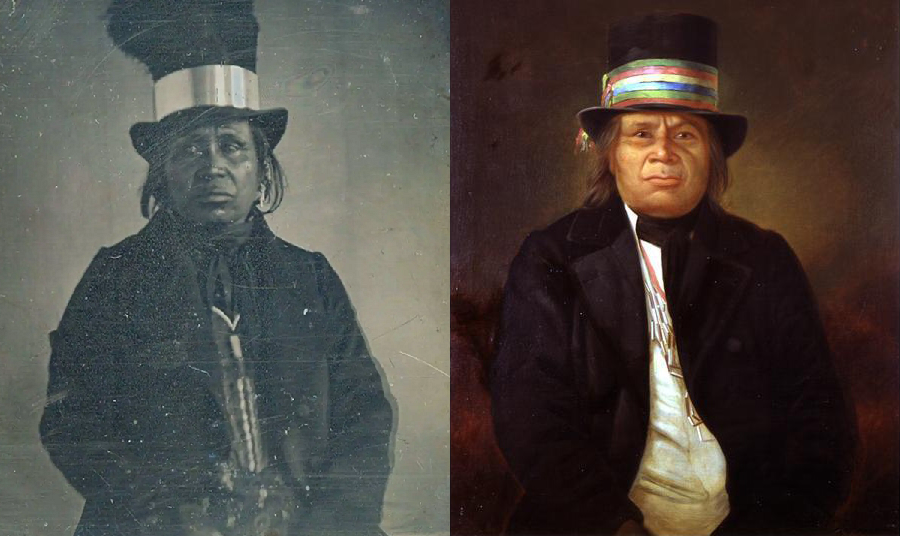
Left: Photograph of Chief Oshkosh of the Menomee in Wisconsin. Accessed from Weird History Stories from historian Chrissy Senecal. 12/25/2025 Right: Painting of Chief Oshkost of the Menomee in Wisconsin, available at Wikipedia. Public Domain.
The indigenous of the Americas appeared very dark-skinned. And some would call them black-skinned. And some of the dark, black-skinned represented the Black ancestors that arrived from the Pacific Islands or Australia via the Equatorial Counter Current to Central America. However, the artwork that represents the images of these dark-skinned, such as that of Chief Oshkosh, the Menominee leader (circa 1795–1858), has undergone some odd… changes. One wonders why Wikipedia prefers the painting of Chief Oshkhosh since it looks so different from his photograph.
People of Chief Oshkosh’s same phenotype would have either been “white-washed,” as above, or reclassified to “Negro” by Walter Plecker in Virginia’s Vital Statistics Office and thereby officially denied tribal identity and history, tribal affiliation, tribal ancestry, and tribal land claims.
![How was the West won, according to the Americans with the power to tell the story of the hunt? Left: “James Beckwourth (1798–1866) was an American mountain man, fur trader, and explorer. [A Black] American born into slavery in Virginia, he was freed by his father and apprenticed to a blacksmith; later he moved to the American West., circa 1856.” Wikimedia Commons. Public domain. Right Jack Oakie, cropped from still shot of the western film “Tomahawk,” portraying the fictional Sal Beckworth.](https://miro.medium.com/v2/resize:fit:726/1*vkM3tlnDBwmob0Q2mRvDIg.png)
How was the West won, according to the Americans with the power to tell the story of the hunt? Left: “James Beckwourth (1798–1866) was an American mountain man, fur trader, and explorer. [A Black] American born into slavery in Virginia, he was freed by his father and apprenticed to a blacksmith; later he moved to the American West., circa 1856.” Wikimedia Commons. Public domain. Right Jack Oakie, cropped from still shot of the western film “Tomahawk,” portraying the fictional Sal Beckworth.
James Beckwourth (1798–1866) was a Virginia-born fur trapper, rancher, businessman, explorer, author and scout of Black, Native, and White descent. Freed by his enslaver (who was also his father), Beckwourth moved West, connecting with fur traders in St. Louis, Missouri. A mountain man, he lived with the Crow Nation, associated with other nations and tribes through commerce and marriage. He discovered Beckwourth Pass, the lowest pass through the Sierra Nevada mountains that connected Reno with Portola, California during the California Gold Rush. He also improved the Beckwourth Trail which thousands of settlers followed to Central California.
Jack Oakie was chosen by Hollywood to portray the fictional Sol Beckworth in the movie Tomahawk about fur traders in the American West.
“James Beckwourth.” Wikipedia. https://en.wikipedia.org/wiki/James_Beckwourth. Accessed 01/29/2026.
![Which image has American media sent worldwide to represent the Old American West? Left: “Bass Reeves, the First [Black] American US Deputy Marshal, circa 1910.” Wikimedia Commons. Public domain. Right: Publicity photo of Clayton Moore as the Lone Ranger and Silver from a personal appearance booking, 1965.](https://miro.medium.com/v2/resize:fit:1050/1*pzbScxDi4XNI_whWOuTolA.png)
Which image has American media sent worldwide to represent the Old American West? Left: “Bass Reeves, the First [Black] American US Deputy Marshal, circa 1910.” Wikimedia Commons. Public domain. Right: Publicity photo of Clayton Moore as the Lone Ranger and Silver from a personal appearance booking, 1965.
Bass Reeves (July 1838 — January 12, 1910) “was a deputy U.S. Marshal, gunfighter, farmer, scout, tracker, railroad agent and an escaped enslaved person. He spoke the languages of several Native American tribes including Cherokee, Choctaw, Chickasaw, Seminole and Creek. Reeves was one of the first [Black]American Deputy U.S. Marshals west of the Mississippi River.”
Clayton Moore, a White man, portrayed the exploits of Bass Reeves on American television as the “Lone Ranger,” alongside a Native American “sidekick” called, “Tonto,” a Spanish word that translates to “stupid,” in English. It took only 55 years after his death to white-wash Bass Reeves from American memory.
“Bass Reeves.” Wikipedia. https://en.wikipedia.org/wiki/Bass_Reeves. Accessed 12/28/2025.
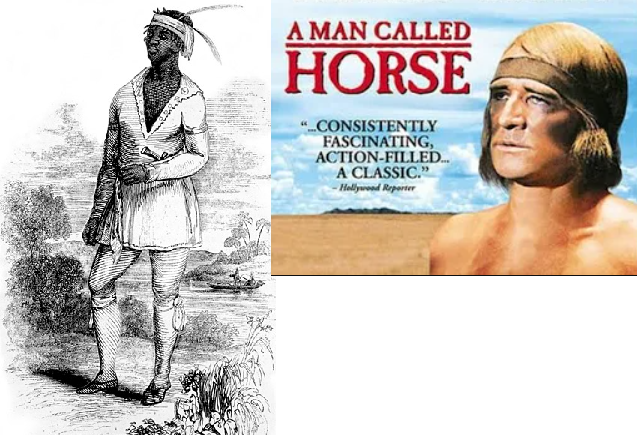
Art can be a tool of expression or a weapon of erasure depending upon who wields it. LEFT: “John Horse, a Black Seminole leader, from N. Orr’s engraving published in 1848 in The Origin, Progress, and Conclusion of the Florida War by John T. Sprague.” Wikimedia Commons. Public domain. RIGHT: “A Man Called Horse” poster of the 1970 film starring Richard Harris. Attribution unknown.
Born Juan Cabayo (ca 1812) in Florida, John Horse was a Black Seminole leader. In the Florida swamps, he fought Georgia enslavers and the US Army in a series of Seminole Wars and served as translator, scout, and field officer. He negotiated for his people’s relocation to Oklahoma, but when White and Creek slave raids against the Black Seminole continued, he led many Black Seminoles to Mexico where he fought for the Mexican Army and settled on land set aside by the Mexican government. The descendants are known in Mexico as mascogos.
Rather than tell this story, US media filtered John Horse’s life through several mediums. The 1970 film “A Man Called Horse,” starring White actor Richard Harris, is loosely based on the life of John Horse, but fictionalized as a White British aristocrat’s capture and adoption by the Sioux! The film is based upon a short story of the same name written by Dorothy M Johnson (1950), published in magazine and book form, and televised in a 1958 episode, “A Man Called Horse,” of the Wagon Train television series. Hollywood quadrupled down by releasing The Return of a Man Called Horse (1976) and Triumphs of a Man Called Horse (1983).
“John Horse.” Wikipedia. https://en.wikipedia.org/wiki/John_Horse. Accessed 01/29/2026.
“A Man Called Horse.” Wikipedia. https://en.wikipedia.org/wiki/A_Man_CalledHorse(film). Accessed 01/29/2026.
CONCLUSION
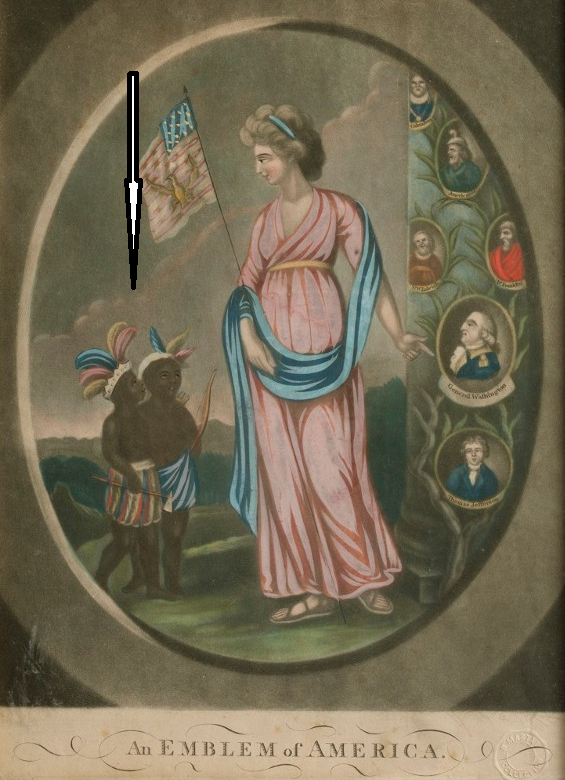
“An Emblem of America,” mezzotint by an Anonymous artist published in London by John Fairburn in 1798. The work depicts Columbia (a personification of the United States) standing beside a monument honoring American leaders like George Washington and Benjamin Franklin, while looking toward two children that represent the diverse or indigenous populations of the “New World.” Public domain.
At various times in prehistory, different African voyagers entered the Canary current off the coast of West Africa, navigated to the North Equatorial Current, which sent them to the northern part of South America. They carried gold and copper spears, seeds and agriculture, knowledge and wisdom, among many other trade items with them. They met Black indigenous. They entered the Caribbean and Central America from the south and southeast [Brazil] as the Siberians described to the Europeans.
Because they formed navies, some arrived wearing African war helmets, and transferred knowledge of Old World engineering, technology, science, agriculture, urban design, social organization, and astronomy to the New World. Some stayed in the regions where they landed, some migrated to North and South America, and some returned to the Old World on the Atlantic Drift carrying new products and new knowledge with them. And to this day, concerted effort is made to insist that these Black indigenous and pre-Columbian African voyagers either never existed, or if they did somehow exist, they began their existence as slaves to the Europeans and Siberians.
![LEFT: “A Female [Savage] of Tierra del Fuego.” RIGHT: “A Male [Savage] of Tierra del Fuego.” 1795. These hand-colored copperplate engravings were produced by J. Chapman, J. Pass, and Barlow. They based the engravings on drawings by Johann Ihle. Ihle’s original artwork was published in Ebenezer Sibly’s “Universal System of Natural History” (1794–1796). Public domain. Photos and captions from https://realhistoryww.com/world_history/ancient/Misc/Americas/Black_Indians.htm. Accessed 03/21/2026](https://miro.medium.com/v2/resize:fit:983/1*xY6LJuOwqH47waE_TkqP-g.png)
LEFT: “A Female [Savage] of Tierra del Fuego.” RIGHT: “A Male [Savage] of Tierra del Fuego.” 1795. These hand-colored copperplate engravings were produced by J. Chapman, J. Pass, and Barlow. They based the engravings on drawings by Johann Ihle. Ihle’s original artwork was published in Ebenezer Sibly’s “Universal System of Natural History” (1794–1796). Public domain. Photos and captions from https://realhistoryww.com/world_history/ancient/Misc/Americas/Black_Indians.htm. Accessed 03/21/2026
Luzia, Naia, Chief Oshkosh, John Horse, James Beckwourth, and Bass Reeves are but a few examples of weaponized artistic “white-washing.” To tell the real story of the real lives of the Black indigenous and the African and/or Australian/Melanesian voyagers would reveal what must never be acknowledged as anything other than legend, myth, mystery, fantasy, enigma, uncertainty, controversy, question, theory, hypothesis, opinion. The author notes that the presence of Black indigenous in the Americas was observed and accepted as a matter of fact because of historic documentation, skeletal remains, art and artifacts, and the then-emerging technology of photography throughout the antebellum period, as well as first-hand observation of tribal populations. However, at the turn of the 20th century, a concerted effort at erasure ensued.
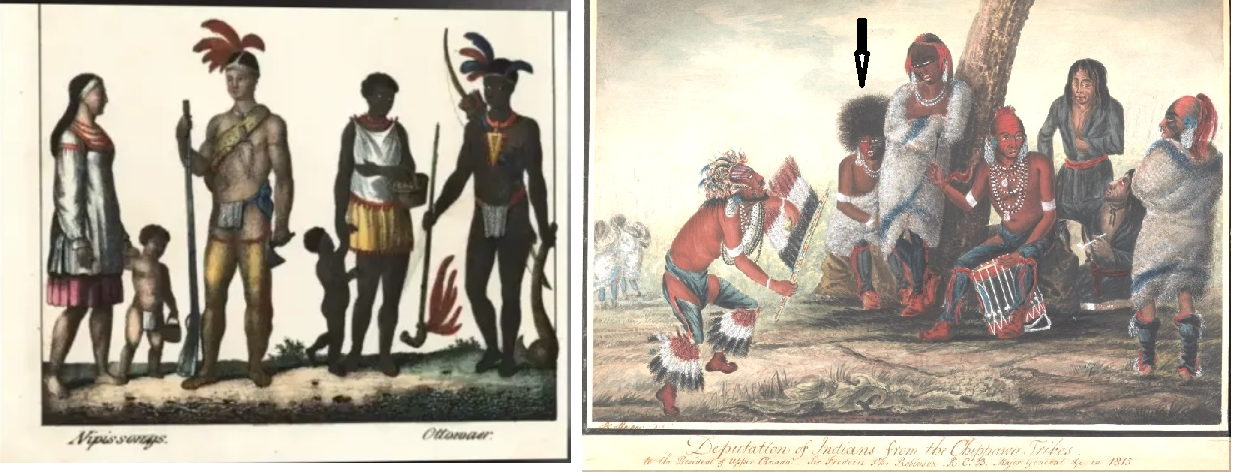
LEFT: “Costumes of Canadian natives: Nipissing and Ottowa people.” Hand-colored lithograph from Friedrich Wilhelm Goedsches’s Complete Gallery of Peoples in True Pictures, Meissen, circa 1835–1840. RIGHT: Deputation of Indians from the Chippewa Tribes to the President of Upper Canada, Sir Frederic Ph Robinson, KCB, Major General, etc., in 1815. By Rudolf Steiger (1815). National Gallery of Canada
Alteration of government identity records by persons such as Walter Plecker (Virginia Bureau of Vital Statistics, 1912 to 1946) and distortion of physical anthropology research by Alěs Hrdlička (physical anthropologist who joined the Smithsonian and became the head of the Division of Physical Anthropology, 1903–1943), intended to complete the destruction and concealment of Black indigenous history and identity. During this Jim Crow time period, Blacks who knew their indigenous identity and land claims and expressed them, risked mob violence as retaliation. This dirty work coordinated with that of Flinders Petrie (an “Egyptologist” 1880–1933), who dismissed Black African indigeneity in Egypt until scientifically disproven by Cheik Anta Diop. However, despite all that has been looted, concealed, destroyed, appropriated, and silenced, even with the assistance of Dr Henry Louis Gates (academic) and Rev Jesse Jackson Sr (civil rights activist), this “mysterious” history continues to emerge.
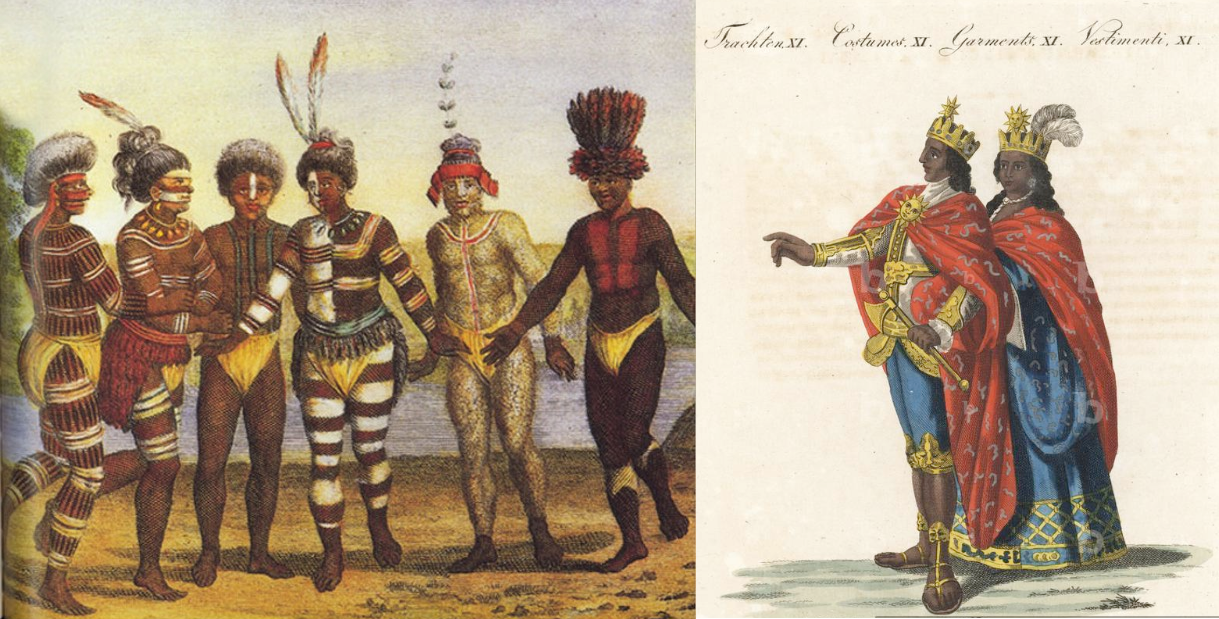
LEFT: “The Ohlone people performing a ceremonial dance at Mission San Jose,” by Louis Choris. 1816. Choris, a Russian artist and naturalist visited Alta California in 1816 as part of the Russian scientific expedition aboard the Rurik. His sketches and colorized engravings, including scenes of dancers at Mission Dolores, are among the earliest visual records of Ohlone culture. Public domain. RIGHT: Lithograph of Peruvian Incas, 18th century allegorical representation of Inca king and queen in modern western clothes with gold crown with sun emblem, embroidered cloak, gold axe and sandals with lion. Taken from Richard Phillips’ “Present State of Peru.” Handcoloured copperplate engraving from Bertuch’s “” Bilderbuch fur Kinder”” (Picture Book for Children), Weimar, 1807. Friedrich Johann Bertuch (1747–1822) was a German publisher and man of arts most famous for his 12-volume encyclopedia for children illustrated with 1,200 engraved plates on natural history, science, costume, mythology, etc., published from 1790–1830.
This concludes the art and artifact discussion of the Black indigenous and African voyagers in the Americas. The last essay will cover botanical evidence, writing systems, **legacy and [ethnogenesis](https://medium.com/@leemcqueen3/ethnogenisis-of-the-black-indigenous-the-black-americans-part-5-01aeb7a86196?postPublishedType=repub)** of this wondrous and fascinating prehistory of the ancient and early Americas.
메타데이터
- post_id
- a2af84f2e147
- slug
- black-indigenous-and-african-aspects-of-art-and-artifacts-the-black-americans-part-3-a2af84f2e147
- url
- https://medium.com/@leemcqueen3/black-indigenous-and-african-aspects-of-art-and-artifacts-the-black-americans-part-3-a2af84f2e147
- canonical_url
- https://medium.com/@leemcqueen3/black-indigenous-and-african-aspects-of-art-and-artifacts-the-black-americans-part-3-a2af84f2e147
- author_url
- https://medium.com/@leemcqueen3
- status
- ok
- fetched_at
- 2026-06-27 07:40:21