Your Brain in Milliseconds: The EEG Signals That Hint at Anxiety, Depression, and Psychosis
EEG Biomarkers in Psychiatry: A Quick-Check Marker Library (P50, MMN, P300, RewP)
Your Brain in Milliseconds: The EEG Signals That Hint at Anxiety, Depression, and Psychosis
EEG Biomarkers in Psychiatry: A Quick-Check Marker Library (P50, MMN, P300, RewP)
· 0. How to read this expanded library · 1. Sensory gating & early encoding (input filtering) ∘ P50 sensory gating (paired-click) ∘ N100 sensory encoding / gating · 2. Predictive processing (automatic deviance detection) ∘ Mismatch Negativity (MMN; ~100–250 ms) · 3. Attention, working memory, and cognitive speed ∘ P300 / P3b (oddball; ~300 ms) ∘ N2 (go/no-go, flanker; ~200–350 ms) ∘ CNV (S1–S2 expectancy) · 4. Performance monitoring & learning from outcomes ∘ ERN (error-related negativity; response-locked) ∘ Pe (error positivity) ∘ FRN (feedback-related negativity; ~200–350 ms post-feedback) ∘ Feedback-P3 · 5. Reward and motivation (positive valence circuits) ∘ RewP / reward positivity (~250–350 ms; gain–loss contrast) · 6. Emotion reactivity and regulation (negative valence circuits) ∘ LPP (late positive potential; sustained) · 7. Language & thought organization ∘ N400 (semantic expectancy; ~300–500 ms) · 8. Social cognition ∘ N170 / VPP (face processing; ~140–200 ms) · 9. Oscillatory “circuit probes” (E/I balance, coordination) ∘ 40-Hz ASSR (auditory steady-state; power + phase-locking) ∘ Resting frontal alpha asymmetry (FAA) · 10. Network dynamics & “whole-brain” summaries ∘ EEG microstates (A–D temporal parameters) · 11. Sleep EEG endophenotypes with psychiatric relevance ∘ Sleep spindles (sigma; density/amplitude; NREM Stage 2)
0. How to read this expanded library
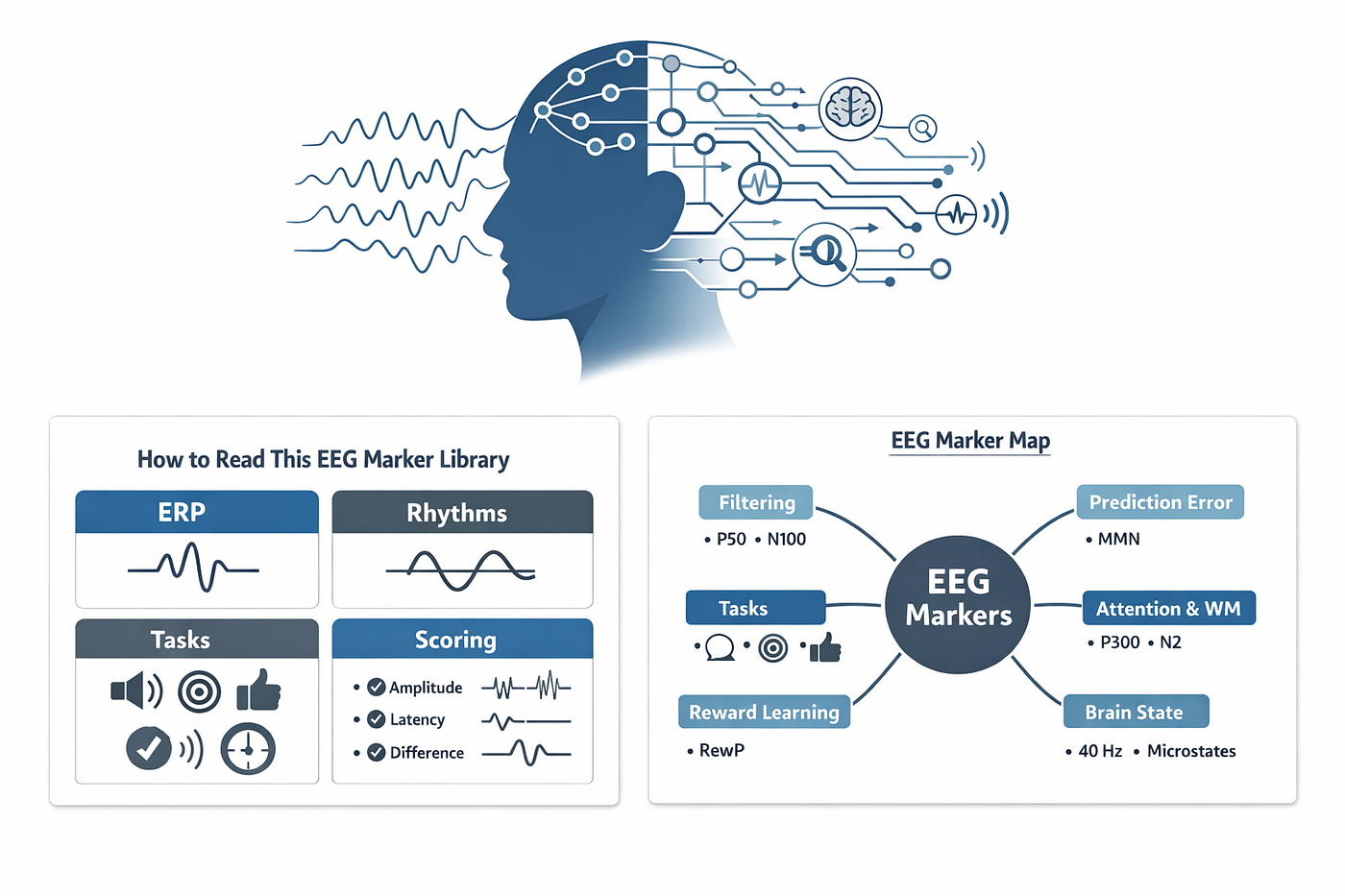
I compiled a list of meaningful psychiatry markers for non-experts seeking guidance in the EEG biomarkers. Keep in mind that these markers are best treated as probabilistic probes of circuit function instead of standalone points for diagnoses.
Being the brain a highly interconnected system with complex dynamics, the value of these biomarkers increases sharply when you lock down the paradigm (stimuli + timing), preprocessing (filters/ICA), scoring window, and brain topography, and when you interpret them as dimensions of function (gating, prediction error, control, salience, and reward).
Before we dive into the library, here a quick legend to explain common terms used in EEG field.
What kind of EEG “marker” are we talking about?
- ERP (Event-Related Potential): a small wave in the EEG that appears right after something happens (a sound, an image, a button press). You average many repeats to see it clearly.
- Brain rhythms (frequency markers): instead of a “wave after an event,” you look at how strong certain brain rhythms are, like alpha or gamma (measured in Hz, meaning cycles per second).
- Whole-brain patterns: summaries of overall activity shapes across the scalp (useful for “brain state” style descriptions).
How marker names work (P50, N100, P300…)
- P means the wave goes up (positive). N means it goes down (negative).
- The number is roughly when it happens, in milliseconds (ms) after the event.
- Example: P300 = a positive wave around 300 ms after a stimulus.
Common task labels (what people do during the EEG)
- Paired-click: two quick sounds (S1 then S2) to test “filtering” of repeated input.
- Oddball: many common sounds/images + a few rare ones to test noticing “something different.”
- Go/No-Go / Flanker: tasks that test self-control and conflict handling.
- Feedback / reward tasks: you see outcomes (win/loss) to study reward and learning signals.
How researchers measure a marker
- Amplitude: how big the EEG response is.
- Latency: how fast it happens (timing).
- Difference score: compare two conditions (e.g., rare — common).
- Ratio: compare two parts of a task (common in gating tasks).
Where it appears on the head (topography)
- Terms like front, center, back mean which scalp areas show the strongest signal.
- Always note reference montage (average, mastoids, etc.) because it can change appearance.
Now that we have shared some common references, let’s dive into this neuropsychiatry marker library collection!
1. Sensory gating & early encoding (input filtering)
P50 sensory gating (paired-click)
- What it is: A short-latency ERP (~50 ms) reflecting early auditory filtering.
- How it’s elicited/scored: Two clicks 500 ms apart (S1/conditioning, S2/test). “Gating” is typically summarized as T/C ratio, with <~50% often treated as “normal” suppression. (pmc.ncbi.nlm.nih.gov)
- Clinical pattern: Higher T/C ratios (weaker suppression) are consistently reported in schizophrenia-spectrum samples, including meta-analytic work; it’s also not fully diagnostically specific (reported in other conditions too). (pmc.ncbi.nlm.nih.gov)
- Mechanistic hooks: Linked to GABA_B-mediated inhibition and genetic associations (e.g., CHRNA7-related work discussed in reviews), but can be medication-sensitive (e.g., atypical antipsychotic effects), which complicates “trait marker” claims. (pmc.ncbi.nlm.nih.gov)
- Pitfalls: Reported test–retest reliability can be modest and varies by pipeline; gating ratios can move with state, medication, and recording quality. (pmc.ncbi.nlm.nih.gov)
N100 sensory encoding / gating
- What it is: Early auditory encoding response around ~100 ms, often scored in the same paired-click paradigm (as “N100 gating”). (pmc.ncbi.nlm.nih.gov)
- Clinical pattern: N100 gating deficits have also been reported in schizophrenia, and N100 is frequently analyzed alongside P50/MMN as part of an “early auditory processing” (EAP) battery. (pmc.ncbi.nlm.nih.gov)
2. Predictive processing (automatic deviance detection)
Mismatch Negativity (MMN; ~100–250 ms)
- What it is: A pre-attentive “prediction error” response to deviant stimuli within a regular sequence (auditory oddball).
- Why it’s favored: MMN is one of the most replicated ERP abnormalities in schizophrenia; beyond group differences, it often correlates with cognition and functional outcomes (daily functioning/independent living proxies). (pmc.ncbi.nlm.nih.gov)
- Stimulus-type nuance (important): Reviews highlight that duration/intensity deviants may show abnormalities earlier, while frequency deviance effects may become more prominent later in illness course — so “MMN” is not one thing unless you specify the deviant. (pmc.ncbi.nlm.nih.gov)
- Actionability: Higher MMN (or less-impaired MMN) has been reported to predict better response to auditory perceptual training in some studies — useful for enrichment/stratification hypotheses in trials. (pmc.ncbi.nlm.nih.gov)
- Pitfalls: Mixed findings for endophenotype claims in relatives/high-risk groups in some reviews — so it’s strong as a group-level marker, less settled as an individual-level risk screen. (pmc.ncbi.nlm.nih.gov)
3. Attention, working memory, and cognitive speed
P300 / P3b (oddball; ~300 ms)
- What it is: A classic marker of attentional allocation/context updating.
- Interpretation knobs: Amplitude tends to track engagement/available cognitive resources. Latency is commonly treated as an index of processing speed. (pmc.ncbi.nlm.nih.gov)
- What to report: oddball parameters (target probability, inter-stimulus interval), reference montage, and whether you’re quantifying P3b vs P3a (novelty/attention shift).
N2 (go/no-go, flanker; ~200–350 ms)
- What it is: A family of negativities linked to cognitive control, often prominent on no-go trials and in conflict tasks; literature emphasizes that multiple processes can contribute (control + mismatch/novelty depending on design). (pmc.ncbi.nlm.nih.gov)
- Practical note: N2 is highly task-dependent; label it by paradigm (e.g., “no-go N2”) and avoid over-interpreting as a single construct. (PubMed)
CNV (S1–S2 expectancy)
- What it is: A slow negative shift between warning cue (S1) and target (S2), commonly interpreted as anticipation/preparation and sustained attention.
- Why it matters: CNV provides a “continuous” measure of preparatory control (not just a peak), useful for ADHD/control paradigms and intervention studies where preparation is the target.
4. Performance monitoring & learning from outcomes
ERN (error-related negativity; response-locked)
- What it is: A rapid error-monitoring signal (often fronto-central) associated with performance monitoring/control.
- Clinical pattern: Meta-analytic work shows anxiety is associated with enhanced ERN (small-to-medium overall), with worry/anxious apprehension showing stronger effects than other anxiety dimensions. (pmc.ncbi.nlm.nih.gov)
Pe (error positivity)
- What it is: A later component often linked to error awareness/processing; typically analyzed with ERN to separate “rapid monitoring” from “conscious evaluation.” (Widely used in performance-monitoring batteries; interpret cautiously as it’s sensitive to task demands and awareness manipulations.)
FRN (feedback-related negativity; ~200–350 ms post-feedback)
- What it is: A feedback evaluation response often discussed in reinforcement-learning terms (ACC/dopamine teaching signals). (pmc.ncbi.nlm.nih.gov)
- Key nuance: Evidence suggests FRN can behave like a “more-or-less than expected” signal rather than purely “worse-than-expected,” and it is modulated by how expectations are formed (explicit cues vs learned). (pmc.ncbi.nlm.nih.gov)
- Pitfall: Avoid equating FRN = “negative valence” without modeling expectancy; consider computational RL regressors when possible. (pmc.ncbi.nlm.nih.gov)
Feedback-P3
- What it is: A later evaluative/updating component following feedback, often complementing FRN (FRN = rapid evaluation; P3 = updating/context revision).
5. Reward and motivation (positive valence circuits)
RewP / reward positivity (~250–350 ms; gain–loss contrast)
- What it is: An ERP difference often interpreted as reward responsiveness.
- State of evidence: The literature supports RewP as a candidate depression risk/symptom marker, but with heterogeneity and reproducibility concerns. (pmc.ncbi.nlm.nih.gov)
- Selective reporting / power reality-check: A registered-report p-curve analysis found weak evidential value and low average power (~20–27%) across ERN/RewP studies — meaning effects may exist, but many studies are underpowered and results can be unstable. (PubMed)
- Practical implication: Pre-register scoring/topography, standardize task and contrasts, and treat RewP as one feature in a panel rather than a single KPI. (PubMed)
6. Emotion reactivity and regulation (negative valence circuits)
LPP (late positive potential; sustained)
- What it is: A slow positive waveform emerging around ~200–300 ms for emotional stimuli (often parietal in adults; more occipital in children), reflecting facilitated attention to motivationally salient content. (pmc.ncbi.nlm.nih.gov)
- Regulation sensitivity: When participants reappraise (reinterpret) emotional stimuli, LPP amplitude typically reduces, and the magnitude of modulation can track subjective arousal. (pmc.ncbi.nlm.nih.gov)
- Depression angle: Studies show LPP can be blunted with higher depressive symptoms, consistent with reduced engagement with emotional material. (pmc.ncbi.nlm.nih.gov)
- Pitfalls: Developmental topography differs; separate “reactivity” (early window) from “regulation” (post-instruction window) when using reappraisal designs. (pmc.ncbi.nlm.nih.gov)
7. Language & thought organization
N400 (semantic expectancy; ~300–500 ms)
- What it is: A robust marker of meaning processing elicited by words and many nonverbal meaning-laden stimuli; latency is relatively stable, while amplitude is highly sensitive to context/expectancy and semantic access. (pmc.ncbi.nlm.nih.gov)
- Why it’s useful clinically: N400 paradigms can probe semantic prediction/integration — relevant to disorganized thought/language phenotypes — without relying on self-report. (pmc.ncbi.nlm.nih.gov)
8. Social cognition
N170 / VPP (face processing; ~140–200 ms)
- What it is: Early face-encoding response (N170 often occipito-temporal; VPP as its vertex-positive counterpart).
- Clinical pattern (broad): Systematic review work reports more consistent N170/VPP reductions to faces in schizophrenia than in ASD, but it’s not a stand-alone clinical test and is sensitive to stimulus properties (faces vs objects, emotion, gaze). (PubMed)
9. Oscillatory “circuit probes” (E/I balance, coordination)
40-Hz ASSR (auditory steady-state; power + phase-locking)
- What it is: Entrainment to rhythmic auditory stimulation around 40 Hz; readouts include power and phase-locking/ITC.
- Clinical pattern: Robust schizophrenia-spectrum deficits are repeatedly reported, making it attractive as a mechanistic “E/I balance / PV-interneuron” probe in translational work. (jamanetwork.com)
Resting frontal alpha asymmetry (FAA)
- What it is: A resting EEG asymmetry metric (often F4–F3 in alpha band) historically linked to approach/withdrawal models.
- State of evidence: Recent meta-analytic summaries indicate small group effects and emphasize limited diagnostic value plus sensitivity to analytic choices (reference, epoching, alpha definition). (semanticscholar.org)
10. Network dynamics & “whole-brain” summaries
EEG microstates (A–D temporal parameters)
- What it is: Recurrent whole-scalp topographies stable for ~60–120 ms (often summarized as ~90 ms). Metrics include duration, time coverage, and occurrence. (Nature)
- Schizophrenia endophenotype signal: In an open-access Nature Communications study, patients and unaffected siblings showed increased microstate C and decreased microstate D vs controls, supporting candidacy as an endophenotype. (Nature)
- Interpretation caution: Links to fMRI resting-state networks are suggestive but not definitive; pipeline choices (number of classes, clustering) matter materially. (Nature)
11. Sleep EEG endophenotypes with psychiatric relevance
Sleep spindles (sigma; density/amplitude; NREM Stage 2)
- What it is: A defining NREM Stage 2 oscillation implicated in memory consolidation, coordinated with other NREM rhythms.
- Schizophrenia signal: Reviews describe a specific spindle deficit in patients and unaffected relatives, correlating with impaired sleep-dependent memory consolidation, positive symptoms, and abnormal thalamocortical connectivity — implicating thalamic reticular nucleus dysfunction as a mechanistic node. (pmc.ncbi.nlm.nih.gov)
12. Closing chapter: A reference you can actually use
If you’ve made it this far, you’ve probably felt the core tension that runs through psychiatric neuroscience: mental health care deals with real suffering, yet many of our tools are still built around symptoms, interviews, and trial-and-error. This marker library exists to add one practical layer of objectivity — not as a shortcut to diagnosis, but as a clearer way to ask better questions. Across sensory filtering, prediction error, attention and working memory, reward learning, and broader “brain state” measures, the common theme is simple: EEG can offer measurable signals that map to functions and circuits we care about. Used well, these markers help us move from vague labels toward testable mechanisms.
The most important takeaway is also the most grounding: these markers are research- and stratification-grade. They become valuable when you treat them as probabilistic probes and specify the details that make them meaningful — the paradigm, preprocessing choices, the scoring window, and the scalp topography. In other words, a marker is not just a name like “MMN” or “P300”; it’s a defined measurement recipe. That is exactly why a library format matters: it turns scattered findings into a shared reference, improves communication across teams, and makes it easier to compare results across studies, cohorts, and platforms. For clinical research, this supports smarter trial design (enrichment, subtyping, endpoint selection). For clinical practice, it points toward a future where monitoring and personalization become more feasible — even if we’re not fully there yet.
Consider this library a starting point, not a verdict. The next step is application: pick a marker, define it precisely, link it to a hypothesis, and test it in the real world — with transparency about limits, confounders, and reproducibility. If you’re building, investing, or writing, use this as a map: a quick way to orient yourself, identify what’s credible, and decide what deserves deeper investigation. And if it sparks curiosity, that’s the best outcome — because psychiatry will progress fastest when more people can navigate the science with clarity, rigor, and the confidence to explore.
🧩 About me
With a background spanning Cognitive Neurosciences, R&D in Molecular Neurobiology, Clinical Development Management, I am earning my stripes in Venture Capital, because I love to explore new perspectives to evaluate Tech innovation and investments in Life Sciences. My commitment to transforming scientific insights into tangible health-tech solutions fuels my passion for this evolving AI-healthcare intersection especially when related to the brain and mental health.
If you want to discuss these exciting trends further — please feel free to reach out on LinkedIn or via email.
👉 You can find me on LinkedIn and keep up to date with my latest insights on Medium
메타데이터
- post_id
- a2bd720d8aef
- slug
- your-brain-in-milliseconds-the-eeg-signals-that-hint-at-anxiety-depression-and-psychosis-a2bd720d8aef
- url
- https://medium.com/@ugotomasello/your-brain-in-milliseconds-the-eeg-signals-that-hint-at-anxiety-depression-and-psychosis-a2bd720d8aef
- canonical_url
- https://medium.com/@ugotomasello/your-brain-in-milliseconds-the-eeg-signals-that-hint-at-anxiety-depression-and-psychosis-a2bd720d8aef
- author_url
- https://medium.com/@ugotomasello
- status
- ok
- fetched_at
- 2026-07-20 17:49:03