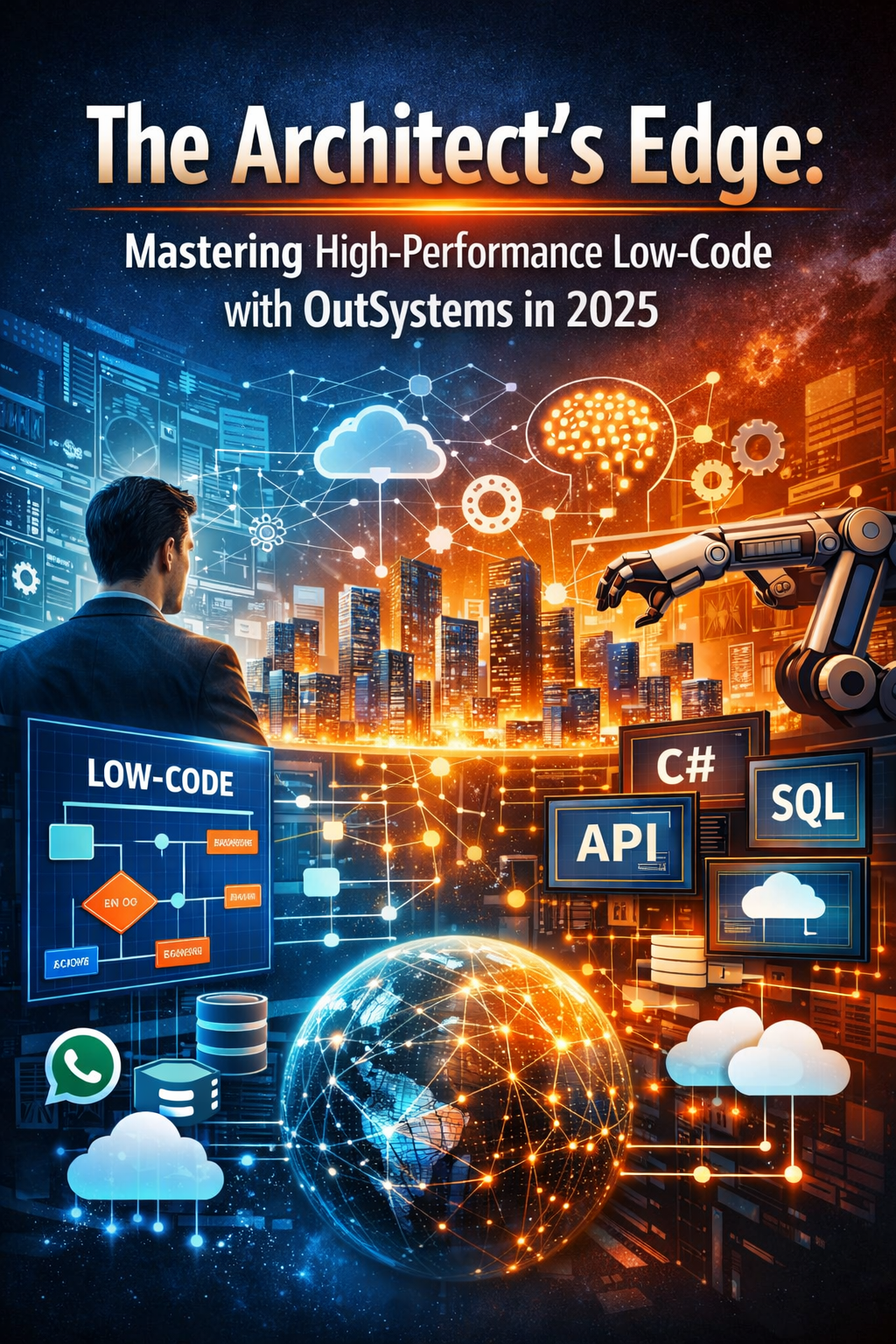
The Architect’s Edge: Mastering High-Performance Low-Code with OutSystems in 2025
Building software in 2025 is no longer about the number of lines of code, but about orchestrating complex systems that deliver immediate…
The Architect’s Edge: Mastering High-Performance Low-Code with OutSystems in 2025
Building software in 2025 is no longer about the number of lines of code, but about orchestrating complex systems that deliver immediate business value. Gartner predicts that nearly 70% of new applications by 2025 will rely on low-code or no-code platforms, signaling a major industry shift. For professional developers, OutSystems represents a “High-Performance” shift — moving from manual coding to high-level solution architecture without losing technical control.
1. Frontend Engineering: Precision Meets Agility
Professional developers often fear that low-code means “cookie-cutter” UIs. OutSystems dispels this through the OutSystems UI Framework, allowing pixel-perfect customization.
- Dynamic UI Customization: Build highly responsive pages where navigation, banners, and layouts change dynamically based on user roles or database triggers.
- Advanced Validations: While simple checks are automated, developers can implement complex form-level validations using Client Actions and JavaScript APIs for real-time feedback.
2. Backend & Extensibility: No More “Glass Ceilings”
A high-performance platform allows developers to break out of the visual environment when needed.
- Custom Code (C# Extensions): Using Integration Studio or the ODC NuGet SDK, you can write native C# code for heavy algorithms or legacy integrations.
- Database Integration: OutSystems provides native connectors for SQL Server, Oracle, and PostgreSQL.
- SharePoint Online: Through Integration Builder, SharePoint Lists can be treated as native entities with automated OAuth 2.0 via Microsoft Entra.
Example: C# Logic for Custom Financial Calculations (ODC)
using OutSystems.ExternalLibraries.SDK;

namespace FinancialSystems {
    public interface IRiskEngine {
        void CalculateScore(decimal assets, decimal liabilities, out int result);
    }
    public class RiskEngine : IRiskEngine {
        public void CalculateScore(decimal assets, decimal liabilities, out int result) {
            // Native .NET logic for complex enterprise math
            result = (assets > (liabilities * 1.5m)) ? 100 : 50;
        }
    }
}
3. Workflow & Process Automation: The Enterprise Pulse
OutSystems leverages Business Process Technology (BPT) and the Case Management Framework (CMF) to manage long-running enterprise workflows.
- Approval Cycles: Design sophisticated sequential or parallel flows that adapt at runtime.
- Delegation & Reassignment: Built-in features allow task delegation during absences, ensuring SLAs are maintained.
- Timers & Alarms: Asynchronous batch jobs (Timers) can be scheduled for off-peak hours, with automated alarms for pending deadlines.
4. The Integration Ecosystem
Modern apps cannot exist in isolation. OutSystems serves as a central hub connecting multiple enterprise systems:
- Central Hub: Connects all enterprise systems seamlessly.
- Observability: Dynatrace monitors real-time performance and user experience using RUM (Real User Monitoring).
- Communication: WhatsApp Cloud API enables automated customer engagement via REST-based services.
- ITSM & Legacy Systems: BMC Remedy and Oracle handle ticket management and provide access to legacy data, ensuring smooth enterprise workflows.
5. Success Gallery: Global & Regional Impact
Real-world metrics demonstrate the transformative potential of OutSystems:
- First Abu Dhabi Bank (FAB) — Egypt: In collaboration with Link Development, FAB improved its consumer onboarding process.
- Western Union: Launched a full-service digital bank in Germany and Romania in 11 months. A project previously requiring 10 people and 6 months was completed by one OutSystems developer in 15 days.
- Schneider Electric: Delivered 60+ apps in 20 months, saving 650 days of manual effort in the first year.
- Telkomsel: Modernized an employee “Super-App” serving 169 million customers six times faster than traditional coding.
6. Addressing Corporate Fears: The Truth About “Lock-in”
OutSystems addresses vendor lock-in concerns with a transparent architectural strategy:
- Standard Architecture: Applications are generated based on standard React and .NET architectures.
- Detachment Guarantee: Companies can extract source code and run it independently if leaving the platform.
- Governance & Security: The LifeTime console provides security scanning, dependency analysis, and automated deployments, mitigating risks of “Shadow IT.”
Key References
- Gartner: Low-Code Adoption Trends 2025
- Case Study: FAB Bank Digital Transformation
- Technical Guide: Extending ODC with C# SDK
메타데이터
- post_id
- a2ca89de3f7f
- slug
- the-architects-edge-mastering-high-performance-low-code-with-outsystems-in-2025-a2ca89de3f7f
- url
- https://medium.com/@kiroadel/the-architects-edge-mastering-high-performance-low-code-with-outsystems-in-2025-a2ca89de3f7f
- canonical_url
- https://medium.com/@kiroadel/the-architects-edge-mastering-high-performance-low-code-with-outsystems-in-2025-a2ca89de3f7f
- author_url
- https://medium.com/@kiroadel
- status
- ok
- fetched_at
- 2026-06-22 07:15:07