Ask Ethan: Can someone possibly see the edge of spacetime?
Our Big Bang could be just one region within an infinite, inflating multiverse. If we were born close to the cosmic edge, what would we…

Our view of a small region of the Universe near the northern galactic cap, where each pixel in the image represents a mapped galaxy. On the largest scales, the Universe is the same in all directions and at all measurable locations, with the major difference being that distant galaxies appear smaller, younger, denser, and less evolved than the ones we find nearby: evidence for cosmic evolution with time, but no changes in isotropy or homogeneity. (Credit: M. Blanton/SDSS-III)
Ask Ethan: Can someone possibly see the edge of spacetime?
Our Big Bang could be just one region within an infinite, inflating multiverse. If we were born close to the cosmic edge, what would we see?
Quick take:
- In all directions, in all locations, there seems only to be more Universe from our perspective, with the only edge to spacetime set by the limits of how far back in time we can see: all the way back to the Big Bang.
- But what we understand our Universe to be may not be all there is; our Big Bang could just be one location in space and time where cosmic inflation ended, giving rise to a bubble universe within a sea of inflating space.
- While we see no evidence for such an edge to the part of the Universe we can observe, it’s possible that someone born right up against such a bubble wall would indeed see an edge. Here’s what that would look like.
In our Universe, in all directions and in all locations, there’s simply more “stuff” that space is full of everywhere we look. On the largest scales of all, the richest galaxy clusters and the sparsest cosmic voids average away, leaving us with a Universe that’s isotropic, homogeneous, and almost perfectly uniform. The oldest light in the Universe, the cosmic microwave background radiation, is a similarly uniform relic left over from the Big Bang itself: a chilly 2.725 K in all directions. And yet, our view of the Universe is fundamentally limited, as we can only see for around 46 billion light-years in all directions: a limit set by the finite speed of light, the finite age of the Universe, and the amount that the Universe has expanded since the Big Bang.
The Universe, to the best that we can tell, may well be infinite in scale. But out there, somewhere beyond the observable Universe, there might yet be a fundamental limit to how far the unobservable universe extends for: a cosmic edge to the extent of the part of the Universe we inhabit. If someone (even though it isn’t us) were to exist close to that edge, what would they see? That’s what Jason Moorhead wants to know, asking:
“Is there a chance there is a galaxy that is close enough to the outside edge of space/time… that someone living in that galaxy could hypothetically see an edge of the current space/time “wall”? When they look in a specific direction, there is no “unobservable universe” and that some sort of boundary of the universe is part of what is observable for them?”
It’s not a guarantee that this picture is correct, of course. But it could be right, and if someone did indeed live close to that edge, what they’d see would be very, very different from the Universe we observe when we look out at it.
A visual history of the expanding Universe includes the hot, dense state known as the Big Bang and the growth and formation of structure subsequently. The full suite of data, including the observations of the light elements and the cosmic microwave background, leaves only the Big Bang as a valid explanation for all we see. As the Universe expands, it also cools, enabling ions, neutral atoms, and eventually molecules, gas clouds, stars, and finally galaxies to form. (Credit: NASA/CXC/M. Weiss)
It’s important to start with the standard picture of our Universe: both theoretically and observationally. From a theoretical perspective, our foundation is threefold.
- That Einstein’s general relativity holds as our theory of gravity: where matter and energy curve and evolve spacetime, and that curved, evolving spacetime dictate how matter and energy moves within it.
- That the Universe is isotropic: that no matter which direction we look in, we find a Universe with the same general properties, like density, temperature, composition, etc.
- And that the Universe is homogeneous: the same everywhere in space. This again applies to things like density, temperature, and composition.
Combined, these three things inform us that there shouldn’t be any large-scale regions of the Universe that look spectacularly different from any other regions. No direction or location should be particularly cold, empty, hot, or dense. There should be no overall directionality to the Universe, no large-scale, directional magnetic or electric or gravitational fields, and no evidence of the laws of physics to change or evolve with time.
The one thing that can — and must — occur, however, is that the physical properties of the Universe ought to evolve with time.
This selection of 55 galaxies from the JWST’s GLASS Early Release Science program spans a variety of ranges in redshift and mass. This helps teach us what shapes galaxies take on over a range of masses and stages in cosmic time/evolution, revealing a number of very massive, very early, yet very evolved-looking galaxies. However, it’s only at relatively late cosmic times, from about ~550 million years onward, that practically every galaxy starts possessing large amounts of dust; prior to that, the dust fraction is variable, with some galaxies having plenty of dust already but others, particularly among the faintest galaxies, displaying little evidence for dust. (Credit: C. Jacobs, K. Glazebrook et al., arXiv:2208.06516, 2022)
Specifically, a Universe that’s:
- governed by general relativity,
- isotropic on the largest scales,
- and homogeneous on the large-scale cosmic average,
cannot be both static and stable. Instead, it must evolve by expanding or contracting. Observations as early as the first few decades of the 20th century have indicated that the Universe is indeed expanding, and the case has only strengthened with time. This means that at any particular moment in time, any region of space should have the same large-scale properties as any other comparably sized region of space, but that overall, an expanding Universe will become cooler, less dense, and more “clumpy” as more cosmic time elapses.
This, again, is well-aligned with observations. Galaxies become more massive and more evolved with time. Galaxies clump together in groups and clusters over time, and galaxy clusters merge together on even larger cosmic scales at late times. The farther away we look, the farther back in time we look, and so we see the more distant Universe as denser, more uniform, hotter, and less evolved. At the earliest times and the greatest distances, we observe the Universe as it was in its primeval state: close to the Big Bang. And on those scales, we see the Universe in the most uniform state we’ve ever observed: where temperatures and densities are equivalent everywhere to the 99.997% level, with only 0.003% departures from the cosmic average.
The fluctuations in the cosmic microwave background were first measured accurately by COBE in the 1990s, then more accurately by WMAP in the 2000s and Planck (above) in the 2010s. This image encodes a huge amount of information about the early Universe, including its composition, age, and history. The fluctuations are only tens to hundreds of microkelvin in magnitude. On large cosmic scales, the error bars are very large, as only a few data points exist, highlighting a large inherent uncertainty. (Credit: ESA and the Planck Collaboration)
When we look at this Universe, we see that every region in the sky has its own unique properties, despite the overall similarities that exist from region-to-region. We see no evidence of repeating patterns in the Universe; if they were present, they could indicate that our Universe was of a finite size, a closed topology, and was “looping back” on itself. We see no evidence for large-scale departures from the cosmic average: violations of isotropy or homogeneity. We see no evidence of an “edge” or “limit” to how far back we can look; the only limits are set by our ability to observe the Universe through a thick, opaque, dense plasma. If we could directly see the cosmic background of neutrinos formed in the Big Bang or the primeval background of gravitational waves, we could indeed view the cosmic back to even earlier times.
In other words, the cosmos is entirely consistent with a picture where what we call “our Universe” is just the observable portion of a much larger — perhaps even infinite — universe that goes on well beyond the limits of the observable portion that we can see. This is bolstered by measurements of what we call the spatial curvature of the Universe, where:
- a positively curved (like a sphere) surface would cause distant light-rays to converge,
- a negatively curved (like a horse’s saddle or a Pringles potato chip) would cause distant light-rays to diverge,
- or an uncurved and flat universe would allow light-rays to travel in a straight line.
To the best of our measurements, the spatial curvature is zero, with our constraints indicating that if the Universe either is positively or negatively curved, it must have a radius of curvature that’s at least 400 times as large as the part of the Universe that’s observable.
The magnitudes of the hot and cold spots, as well as their scales, indicate the curvature of the universe. To the best of our capabilities, we measure it to be perfectly flat. Baryon acoustic oscillations and the CMB, together, provide the best methods of constraining this, down to a combined precision of 0.4%. To the best we can measure, the universe is indistinguishable from spatially flat. (Credit: Smoot Cosmology Group/LBL)
This is enough information for us to safely conclude that there’s no “edge” to the Universe within the portion that’s observable to us: within the observable Universe. However, the Big Bang cannot be extrapolated back infinitely far, to an infinitely hot and dense state in the past. Instead, the best picture we have of our cosmic origins instead indicates that there was a predecessor state to the hot, dense, matter-and-radiation-filled state that describes our early Universe: a state that came before and set up the initial conditions that the hot Big Bang began with.
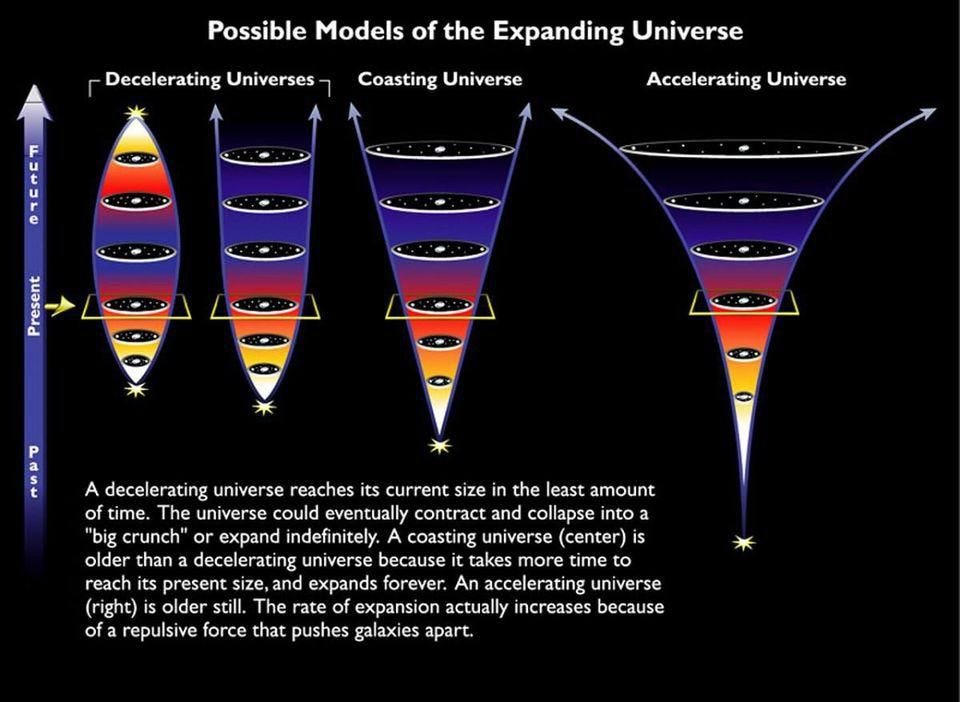
That prior state is known as cosmic inflation, where the end of cosmic inflation brought about the onset of the hot Big Bang. During inflation, instead of the energy of the Universe being in the form of matter, antimatter, radiation, neutrinos, and the other conventional quanta and particles that we’re familiar with, it was in the form of field energy: energy that was inherent to the fabric of space itself. Wherever space existed, so too did this large amount of field energy. And just as dark energy — itself equivalent to a form of field energy — causes the expansion of the Universe to accelerate today, the field energy that was present during inflation caused the expansion to accelerate way back in the period prior to the hot Big Bang.
This diagram shows, to scale, how spacetime evolves/expands in equal time increments if your Universe is dominated by matter, radiation, or the energy inherent to space itself (i.e., during inflation or dark energy dominance). The bottom-most scenario corresponds to exponential expansion via both dark energy (today) and inflation (at early times). Note that visualizing the expansion as either ‘the existing space stretching’ or ‘the creation of new space’ won’t suffice in all instances. (Credit: E. Siegel/Beyond the Galaxy)
Only, during inflation, the expansion rate was much, much greater than it is today. As a result, it would take only a tiny fraction of a second — perhaps no more than 10^-35 s — for any region of the Universe to double in all three dimensions, size-wise. That would imply that after only 10^-32 s of inflation, a region of space that started off at the smallest possible scale at which physics makes sense, the Planck scale, would be stretched to be larger than the entire observable Universe is today. Because of the relentless nature of inflation, this expansion would continue, again and again, until something caused inflation to come to an end.
Normally, we model inflation as a potential: a curved line that we draw in space, and imagine the inflationary field (i.e., the inflaton) as a ball that begins somewhere along that line. As long as the ball is high up, above the low-point (or minimum) of that line, inflation continues, and the Universe remains empty and keeps expanding: doubling again and again with each brief moment that elapses. If that ball rolls sufficiently slowly, inflation succeeds: we get enough inflation to match the observable properties of that Universe. But if we’re not careful, the Universe will continue inflating forever and ever, relentlessly: never ending, and never leading to the hot Big Bang.
If inflation is a quantum field, then the field value spreads out over time, with different regions of space taking different realizations of the field value. In many regions, the field value will wind up in the bottom of the valley, ending inflation, but in many more, inflation will continue so long as the ball remains on the flat part of the hill, where it can remain arbitrarily far into the future. The regions where inflation continues on are sufficiently important that they lead to a situation known as “Eternal Inflation,” where once inflation commences, it forever continues, at least in some places, arbitrarily far into the future. (Credit: E. Siegel/Beyond the Galaxy)
However, we can solve this problem if we remember that all of the fields in our Universe, at a fundamental level, aren’t “classical” fields that behave like balls, but rather are quantum fields that behave like wavefunctions. (The quantum nature of our Universe, in fact, is a mandatory ingredient in getting cosmic inflation to work!) As the Universe expands during inflation and creates new space, the wavefunction probabilistically spreads out. In any one region of space, it’s impossible to predict whether the wavefunction will:
- remain in the same location,
- move closer towards the low point of the potential,
- or move farther away from the low point of the potential.
But as you make more and more regions of space, all of the possible “fates” get occupied in those different, new volumes of space that inflation creates. Eventually, in some of those regions, the wavefunction rolls down into a minimum in the potential, and when it does, inflation comes to an end and a hot Big Bang ensues. But in most regions of space, inflation continues on. Eventually, as new space is continuously created, some regions within that space experience hot Big Bangs, but other regions surrounding them continue to inflate.
Wherever inflation occurs (blue cubes), it gives rise to exponentially more regions of space with each step forward in time. Even if there are many cubes where inflation ends (red Xs), there are far more regions where inflation will continue on into the future. The fact that inflation never comes to an end absolutely everywhere is what makes inflation ‘eternal’ once it begins, and where our modern notion of a Multiverse (where the regions with a red X describe separated, disconnected universes) comes from. (Credit: E. Siegel/Beyond the Galaxy)
This scenario — known as eternal inflation (eternal to the future, not to the past) — is pretty much impossible to avoid. If you require that the Universe gives you enough inflation to be consistent with the cosmic observations we’ve already acquired, this eternally inflating scenario simply arises. A consequence of this is that each individual hot Big Bang that occurs, in the regions where inflation ends, don’t collide or interact with any of the other hot Big Bangs that might occur within the inflating backdrop of spacetime.
There’s a reason for this: the rate at which a spacetime filled with matter-and-radiation expands will decrease over time, and will decrease rapidly: as it expands, the density drops, and it’s the total energy density that determines the expansion rate. But since inflating space has a constant energy density — one that does not dilute even as space inflates and more space gets created — the inflating regions, which surround the regions that experience hot Big Bangs, drive those “bubble universes” where hot Big Bangs occur apart.
As a result, no two regions where hot Big Bangs occur ever collide or interact. Inflation, therefore, sets a boundary to wherever a Universe does arise from such a hot Big Bang.
We normally conceive of our Universe as having emerged from a preceding period of cosmic inflation, with our Big Bang occurring where one region of inflating space ceased inflating and transitioned to being dominated by matter and radiation. However, in other locations, inflation continues indefinitely, giving rise to other baby (or bubble) universes, potentially with very different properties and conditions from our own. (Credit: Kavli IMPU)
Now, it’s true: we’re not close to one of those edges, and such an edge isn’t contained within our observable Universe. But we can imagine — if this picture is indeed correct — what someone would see if they did come into existence close to one of those edges.
The answer, as frustrating as it would be, is just that: an abrupt edge. We would see isotropy and homogeneity everywhere we looked, until we encountered that edge. And then, wherever that edge occurs in space, there would be absolutely nothing.
No stars. No galaxies. No normal matter. No dark matter. No neutrinos. Not even the leftover glow of the Big Bang, since all of the primordial radiation that originated in that direction would have already passed you by.
All that would be there, beyond the “edge” of the region where the hot Big Bang occurred, would be nothing. You’d simply observe an abrupt end that cuts across one hemisphere of the sky, ellipsoidally shaped from your perspective, with an angular size that corresponded to how close you were to that edge and how much time and expansion had elapsed since the hot Big Bang occurred in your region of space.

This simulated view of the large-scale structure of the Universe showcases what we’d see within the observable Universe if we had been located very close to the edge of the “bubble Universe” that began with the hot Big Bang at the end of our inflationary period. Beyond some cutoff, the edge of the bubble wall would appear, and there would be no structure: just the edge of eternally inflating space beyond it, with Unruh radiation emerging from the boundary rather than light from the CMB. (Credit: The Millennium Simulation, V. Springel et al.; Modifications: E. Siegel)
In fact, the only thing you’d be able to detect, assuming you built a detector sensitive enough to see it, would be the Unruh radiation that arises from the intense field energy in any inflating region of space. In our modern, dark energy-dominated Universe, that radiation is incredibly weak, at an emitted temperature of about 10^-30 K: far too cold to be detected given all of the much more energetic foregrounds and backgrounds, including the CMB, that would pollute our view.
But in an inflating region of space, that ellipsoidal “hole” will have a substantial temperature: somewhere around 100 K. The CMB that we see today is only around 2.7 K, but back when that radiation was last scattered off of the free electrons that existed as part of the primordial plasma, it was more like 3000 K: significantly hotter.
This would a specific telltale signature at the edge of the Universe: a signature that’s very different from what we’re used to. Beyond the last stars and galaxies that filled our Universe, beyond the limits of where a CMB still exists, in that ellipsoidal hole, there would be a background of radiation that’s hottest where the hole is closest: along the line that most directly connects yourself, the observer, to the center of that hole.

Our conventional CMB is isotropic: the same in all directions, with an average temperature at present of 2.7255 K. If there were instead an inflationary “edge” that was within the cosmic horizon of our observable Universe, we would have not only no large-scale structure beyond a certain distance, but no CMB; instead, we would have the Unruh radiation arising from the edge of that inflating space, which would appear hottest at the smallest redshifts and coldest near the edges, at the largest redshifts. (Credit: E. Siegel, modified from NASA/WMAP Science Team)
The temperature you observe will correspond to the inflationary temperature set by Unruh radiation (around 100 K), but stretched by the expansion of the Universe. If that radiation originates:
- at a redshift of z = 1, the observed temperature will be 50 K,
- at a redshift of z = 4, the observed temperature will be 20 K,
- at a redshift of z = 9, the observed temperature will be 10 K,
- at a redshift of z = 49, the observed temperature will be 2 K,
- at a redshift of z = 199, the observed temperature will be 0.5 K,
- at a redshift of z = 999, the observed temperature will be 0.1 K,
and beyond a redshift of z = 1089, we’ll only see the actual CMB instead. In other words, that radiation will be hottest at the center of the ellipsoid — potentially even hotter than the CMB — and then will fall off, cooling down to well below CMB temperatures, until at the edges of the ellipsoid, the CMB (and the usual structure of the Universe) returns. It isn’t a sight that’s present within our observable Universe, but if there’s a cosmic edge set by inflation, that’s indeed precisely what we’d find!
Send in your Ask Ethan questions to startswithabang at gmail dot com!
*Starts With A Bang is written by Ethan Siegel, Ph.D., author of (affiliate links following) Beyond The Galaxy, Treknology, [The Littlest Girl Goes Inside An Atom](https://amzn.to/44FQQOl), and [Infinite Cosmos](https://amzn.to/3zEUHjX). His latest, The Grand Cosmic Story, is out now!*
메타데이터
- post_id
- a2e2edb2df2f
- slug
- ask-ethan-can-someone-possibly-see-the-edge-of-spacetime-a2e2edb2df2f
- url
- https://medium.com/starts-with-a-bang/ask-ethan-can-someone-possibly-see-the-edge-of-spacetime-a2e2edb2df2f
- canonical_url
- https://medium.com/starts-with-a-bang/ask-ethan-can-someone-possibly-see-the-edge-of-spacetime-a2e2edb2df2f
- author_url
- https://medium.com/@startswithabang
- status
- ok
- fetched_at
- 2026-09-08 03:02:40