Zero-Trust on OKE: Automated Identity Governance for Oracle Kubernetes Engine
By Pavan Madduri
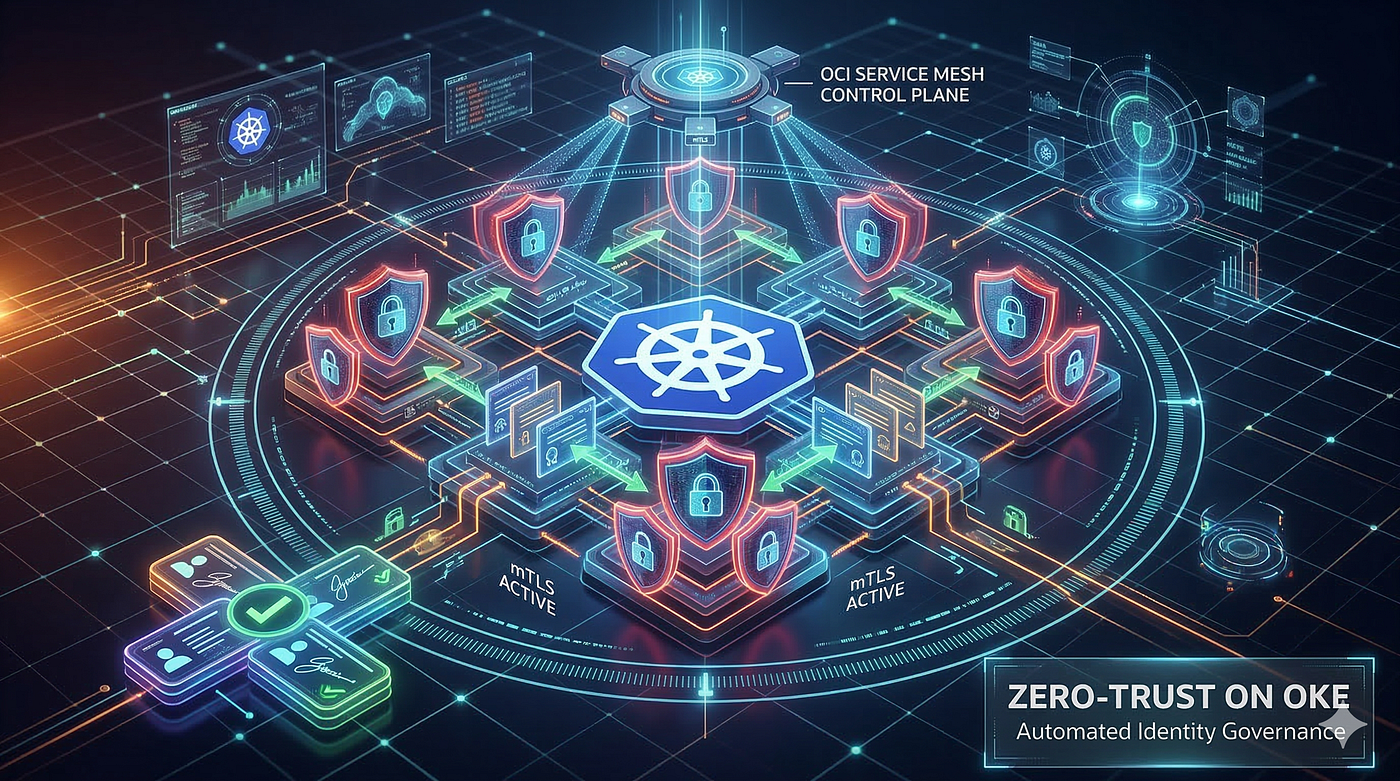
Zero-Trust on OKE: Automated Identity Governance for Oracle Kubernetes Engine
By Pavan Madduri
The rapid adoption of cloud-native architectures has fundamentally transformed enterprise security. In modern distributed systems, the traditional perimeter defense model is obsolete. Once a single pod is compromised, lateral movement across a Kubernetes cluster is often trivial if explicit identity governance isn’t enforced.
In my recent research paper, ZERO-TRUST INFRASTRUCTURE: AUTOMATED IDENTITY GOVERNANCE IN KUBERNETES — A FRAMEWORK FOR ZERO-TRUST MICROSERVICES [1], I demonstrated that implementing cryptographic identity verification and continuous authorization reduced lateral movement by 96.3% across production clusters.
Today, we will look at how to take those academic findings and implement them practically using Oracle Kubernetes Engine (OKE) and OCI Service Mesh. By leveraging Oracle’s native managed services, we can achieve true zero-trust architecture without suffocating developer velocity.
Defining the Boundaries: IAM vs. Service Mesh
A common pitfall when architecting Zero-Trust on Kubernetes is conflating cloud identity with workload networking. True Zero-Trust on OKE requires treating these as two distinct, complementary layers of defense. There is no single “silver bullet” configuration; instead, we must implement identity governance across two specific vectors:
1. Cloud Resource Authorization (OCI IAM Workload Identity) Workload Identity solves the “North-South” authentication problem. Historically, if a pod needed to access an OCI Autonomous Database or pull an object from OCI Object Storage, engineers would mount long-lived OCI API keys as Kubernetes Secrets. Workload Identity eliminates this by dynamically issuing short-lived, rotated IAM tokens directly to the Kubernetes ServiceAccount.
- The Scope: This strictly governs a pod’s access to OCI Cloud Services. It does not dictate cluster-internal network traffic.
2. Microservice Authorization (Service Mesh Policies) To secure “East-West” traffic — communication between the pods themselves — we must rely on a Service Mesh (such as OCI Service Mesh or Istio). Even if a pod has strict OCI IAM Workload Identity, if the internal cluster network is flat, a compromised frontend container could still move laterally and attack a backend database pod.
- The Scope: Service Mesh enforces mTLS for all pod-to-pod communication and applies L7
AccessPolicies. This ensures thatPod-Ais cryptographically authorized to send traffic toPod-B, regardless of what OCI IAM policies are attached to either pod.
The Unified Defense-in-Depth Strategy
Automated identity governance is only achieved when these two systems intersect. By binding OCI IAM Workload Identity to your service accounts, you eliminate static cloud credentials. By simultaneously applying strict Service Mesh AccessPolicies, you eliminate implicit network trust. A compromised pod is thereby trapped: it cannot move laterally within the cluster (blocked by the Mesh), and it cannot access unauthorized cloud infrastructure (blocked by OCI IAM).
The Zero-Trust Challenge in Kubernetes
Kubernetes was designed for orchestration, not native zero-trust security. By default, any pod can communicate with any other pod in a cluster.
To achieve zero-trust, we need three things:
- Cryptographic Identity: Every microservice needs a verifiable identity (like an X.509 certificate).
- Mutual TLS (mTLS): All pod-to-pod traffic must be encrypted and authenticated.
- Continuous Authorization: Fine-grained access policies must be evaluated at every request.
Building this from scratch using raw SPIFFE/SPIRE and managing your own Envoy proxies is an operational nightmare. This is where Oracle Cloud Infrastructure (OCI) shines.
Implementing Identity Governance on OKE
Instead of managing the heavy control plane of a standalone service mesh, we can integrate OCI Service Mesh directly into our OKE clusters.
1. Abstracting the Control Plane
OCI Service Mesh provides a fully managed control plane. When you deploy an application to OKE, the OCI Service Mesh operator automatically injects an Envoy proxy sidecar into your pods.
Because OCI handles the Certificate Authority (CA) natively, cryptographic identities are automatically provisioned, rotated, and revoked for your OKE workloads. You do not need to manage certificate lifecycles manually, which instantly eliminates a massive operational bottleneck.
2. Enforcing Access Policies Declaratively
With identities established, we enforce authorization using OCI Access Policies. Instead of writing complex network policies, we declare exactly which virtual services can communicate.
Here is an example of an OCI Service Mesh Access Policy applied to an OKE cluster, ensuring that only the frontend-service can talk to the backend-payment-service:
apiVersion: servicemesh.oci.oracle.com/v1beta1
kind: AccessPolicy
metadata:
  name: payment-access-policy
  namespace: e-commerce
spec:
  mesh:
    ref:
      name: prod-mesh
  rules:
    - action: ALLOW
      source:
        virtualService:
          ref:
            name: frontend-service
      destination:
        virtualService:
          ref:
            name: backend-payment-service
3. Pod-Level Authentication with Workload Identity
To extend zero-trust beyond pod-to-pod communication and into OCI cloud services (like Autonomous Database or OCI Vault), we utilize OCI IAM Workload Identity.
Rather than mounting static API keys into OKE pods, Workload Identity allows you to map a Kubernetes ServiceAccount directly to an OCI IAM Policy. The pod is granted temporary, strictly scoped credentials to access Oracle Cloud resources, ensuring that even if a container is breached, the blast radius is tightly contained.
The Two Pillars of OKE Zero-Trust:
Defining the Boundaries: IAM vs. Service Mesh
A common pitfall when architecting Zero-Trust on Kubernetes is conflating cloud identity with workload networking. True Zero-Trust on OKE requires treating these as two distinct, complementary layers of defense. There is no single “silver bullet” configuration; instead, we must implement identity governance across two specific vectors:
1. Cloud Resource Authorization (OCI IAM Workload Identity) Workload Identity solves the “North-South” authentication problem. Historically, if a pod needed to access an OCI Autonomous Database or pull an object from OCI Object Storage, engineers would mount long-lived OCI API keys as Kubernetes Secrets. Workload Identity eliminates this by dynamically issuing short-lived, rotated IAM tokens directly to the Kubernetes
ServiceAccount.
- The Scope: This strictly governs a pod’s access to OCI Cloud Services. It does not dictate cluster-internal network traffic.
2. Microservice Authorization (Service Mesh Policies) To secure “East-West” traffic — communication between the pods themselves — we must rely on a Service Mesh (such as OCI Service Mesh or Istio). Even if a pod has strict OCI IAM Workload Identity, if the internal cluster network is flat, a compromised frontend container could still move laterally and attack a backend database pod.
- The Scope: Service Mesh enforces mTLS for all pod-to-pod communication and applies L7
AccessPolicies. This ensures thatPod-Ais cryptographically authorized to send traffic toPod-B, regardless of what OCI IAM policies are attached to either pod.
The Unified Defense-in-Depth Strategy
Automated identity governance is only achieved when these two systems intersect. By binding OCI IAM Workload Identity to your service accounts, you eliminate static cloud credentials. By simultaneously applying strict Service Mesh
AccessPolicies, you eliminate implicit network trust. A compromised pod is thereby trapped: it cannot move laterally within the cluster (blocked by the Mesh), and it cannot access unauthorized cloud infrastructure (blocked by OCI IAM).
Balancing Security with Developer Experience
A common failure mode of zero-trust rollouts is the destruction of developer productivity. If developers have to understand complex mTLS configurations just to deploy a microservice, adoption will fail.
As I detail in my book, The Shift: Platform Engineering — Building the Modern Developer Experience on Kubernetes [2], the goal of an Internal Developer Platform (IDP) is to reduce cognitive load. By utilizing OKE and OCI Service Mesh, the security complexity is pushed down to the infrastructure layer.
Developers simply deploy their standard Kubernetes manifests. The OCI Service Mesh mutating webhook handles the proxy injection, and the OCI ingress gateways handle the traffic routing. The developer experience remains pristine, while the platform engineering team guarantees compliance.
Conclusion
Building a zero-trust architecture doesn’t require stitching together a fragile ecosystem of open-source tools. By combining the robust orchestration of Oracle Kubernetes Engine with the automated identity governance of OCI Service Mesh, organizations can deploy highly secure, scalable microservices that stop lateral threats in their tracks.
References:
- [1] Madduri, Pavan (2026). *ZERO-TRUST INFRASTRUCTURE: AUTOMATED IDENTITY GOVERNANCE IN KUBERNETES — A FRAMEWORK FOR ZERO-TRUST MICROSERVICES.*
- [2] Madduri, Pavan (2023). *The Shift: Platform Engineering — Building the Modern Developer Experience on Kubernetes.* Geh Press. ISBN: 978–1–971938–78–3.
메타데이터
- post_id
- a2e4ceec4c03
- slug
- zero-trust-on-oke-automated-identity-governance-for-oracle-kubernetes-engine-a2e4ceec4c03
- url
- https://medium.com/@pavan4devops/zero-trust-on-oke-automated-identity-governance-for-oracle-kubernetes-engine-a2e4ceec4c03
- canonical_url
- https://medium.com/@pavan4devops/zero-trust-on-oke-automated-identity-governance-for-oracle-kubernetes-engine-a2e4ceec4c03
- author_url
- https://medium.com/@pavan4devops
- status
- ok
- fetched_at
- 2026-06-12 22:02:08


