Secrets Sprawl Is a Platform Tax
3 warning signs your cloud estate is paying for unmanaged credentials
Secrets Sprawl Is a Platform Tax
3 warning signs your cloud estate is paying for unmanaged credentials
The short version
A secret is not just a password, token, key, or connection string. It is a promise that your platform knows where sensitive access lives, who owns it, how it rotates, and how it gets retired. When that promise breaks, the platform pays a tax. Security pays it. Engineering pays it. Finance pays it when work slows down and cleanup becomes a project instead of a habit.
Secrets sprawl is what happens when credentials multiply faster than ownership, lifecycle management, and evidence. The fix is not “buy one more vault.” The fix is to make secrets observable, owned, rotated, and disposable.
What “platform tax” means
A platform tax is the hidden cost created by weak operating habits. It shows up as extra review cycles, blocked deployments, manual change windows, audit stress, incident cleanup, duplicated tooling, and tribal knowledge. Secrets sprawl fits that definition perfectly because the pain rarely arrives all at once.
One hardcoded token in a script may look harmless. One stale service principal credential may feel manageable. One app setting copied into a troubleshooting note may seem temporary. Then six months later, nobody wants to touch the workload because nobody can prove what depends on the credential.
That is the tax. The platform becomes slower because the credential story is unclear.
Foundation: what counts as a secret?
In plain language, a secret is any sensitive value that grants access or proves identity. That can include passwords, connection strings, API keys, access keys, private SSH keys, application credentials, service principal secrets, certificates, personal access tokens, webhook secrets, and tokens used by CI/CD systems.
The mistake is treating secrets like normal configuration. Some configuration says how an app should behave. A secret can open a door. Those are different operating categories.
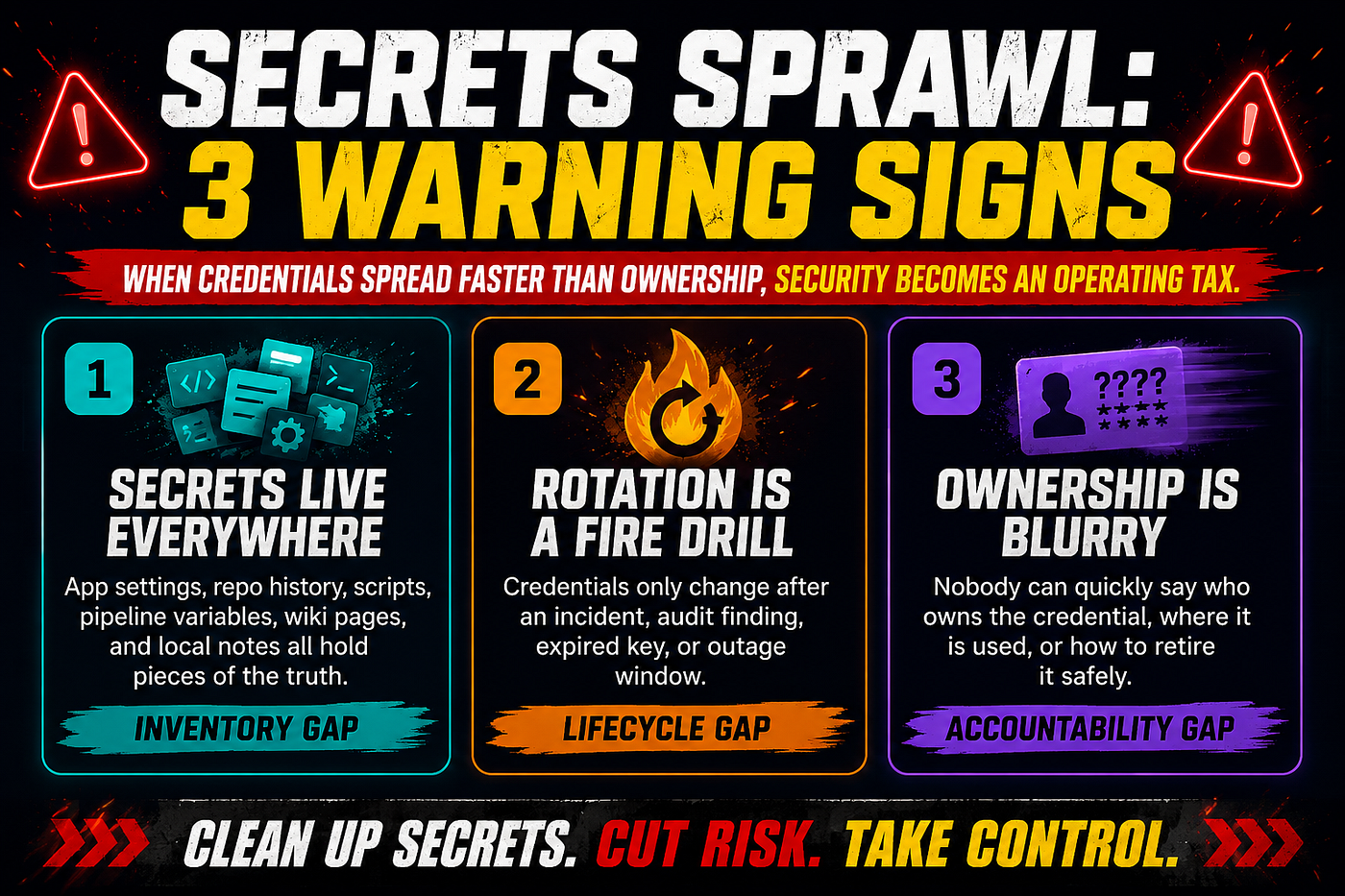
Warning sign 1: secrets live everywhere except the system of record
This is the easiest warning sign to ignore because it often starts with good intentions. A developer needs a quick local test. An operator needs a break-fix script. A pipeline needs a credential before the secure pattern is ready. Someone writes it down “just for now.”
The problem is that “just for now” becomes architecture when nobody owns the cleanup.
Common places secrets hide
· App settings copied across environments without a clean promotion path.
· Pipeline variables with unclear ownership or no rotation notes.
· Repository history, not only the current branch.
· ARM, Bicep, Terraform, or deployment parameter files.
· Deployment outputs and troubleshooting logs.
· Runbooks, wiki pages, chat threads, personal notes, and shared spreadsheets.
· Local scripts that become “production support tooling” without review.
What actually matters
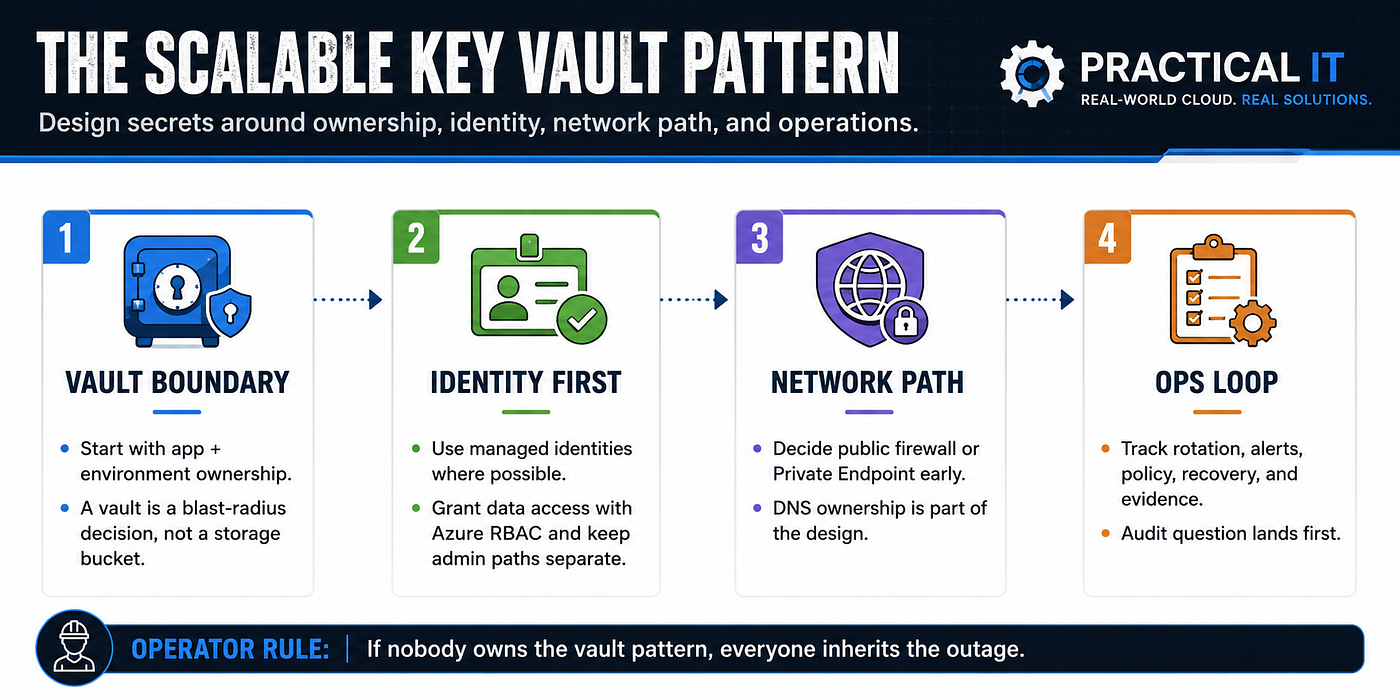
A vault helps only if the platform also has inventory, ownership, access control, rotation, monitoring, and retirement. Central storage without lifecycle rules is just prettier sprawl.
What to do next
1. Pick one high-risk application or platform workflow.
2. Search the repo, pipeline, app settings, deployment templates, and runbooks for credential patterns.
3. Create a first-pass inventory with owner, consumer, environment, expiry, and rotation status.
4. Move approved secrets into the standard store and remove unsafe copies from active paths.
5. Treat repository history and exposed credentials as separate remediation work, not cosmetic cleanup.
Warning sign 2: rotation is a fire drill, not an operating loop
A secret that never rotates is not stable. It is aging risk. It may still work, but the organization loses confidence every month it sits outside a controlled lifecycle.
Rotation gets painful when the team cannot answer three basic questions: what consumes this credential, what happens if it changes, and how do we prove the new value is active without breaking the service?
Healthy rotation has four parts
· A clear owner who can approve and coordinate the change.
· A consumer map so dependent apps, scripts, pipelines, and integrations are known.
· A tested path, ideally with dual credentials or a staged cutover when the service supports it.
· Monitoring that confirms access still works and old credentials are no longer used.
A simple operating loop that turns secret cleanup into repeatable platform hygiene.
Operator tip: tag the lifecycle, not the value
Store management metadata such as owner, rotation cadence, review date, application, environment, and retirement notes outside the secret value. Keep the sensitive value clean. Make the lifecycle easy to query.
Warning sign 3: ownership is blurry
This is where secrets sprawl becomes a real platform tax. The credential exists. The workload depends on it. The team is afraid to rotate it. Security wants it fixed. Finance wonders why every cleanup needs another meeting. Nobody is wrong. The operating model is incomplete.
Blurry ownership usually creates one of two bad patterns. Either the platform team becomes the permanent cleanup crew, or every app team is expected to “own their secrets” without a standard workflow, evidence model, or service catalog view.

A practical triage model
Not every secret cleanup item deserves the same urgency. Sort findings by blast radius and rotation difficulty. That keeps the work practical and helps teams avoid turning cleanup into a never-ending spreadsheet exercise.
A simple way to decide what gets cleaned first.
Start here if you have no formal program yet
1. Create a “known secret locations” list for repos, pipelines, app settings, vaults, deployment resources, and documentation spaces.
2. Pick one environment and one business-critical app. Do not start with the whole estate.
3. Inventory only the secrets you can prove exist. Avoid guessing.
4. Mark each finding as keep, move, rotate, retire, or investigate.
5. Assign every finding to a team owner with a review date.
6. Capture evidence: old value invalidated, new value stored correctly, consumers tested, stale references removed.
7. Turn the checklist into a recurring monthly platform hygiene review.
Tradeoffs and gotchas
· Secret scanning is not the same as remediation. Finding the mess is only the first step.
· Rotation without consumer mapping can create outages. Map before you rotate where blast radius is high.
· One vault per everything is rarely the right design. Consider environment, workload boundary, RBAC model, and operational ownership.
· Do not turn Key Vault into a general configuration bucket. Store sensitive credentials there, not every setting an application has.
· Repository history matters. Removing a secret from the current file does not mean the credential is safe if the old value still works.
· Break-glass credentials need stricter ownership and evidence, not casual exceptions.
Close
Secret cleanup does not need to start as a giant security transformation. Start with one application, one pipeline, one vault boundary, or one high-risk workflow. Prove the loop. Then repeat it.
A predictable platform is not built by hoping credentials stay hidden. It is built by making sensitive access visible enough to govern, safe enough to rotate, and clean enough to retire.
Here is the Secrets Sprawl Cleanup Checklist & Worksheet. I built it to help teams start small: inventory, owner mapping, rotation readiness, and evidence capture. You can get it here 👇
https://practical.cloudloom.co/p/secrets-sprawl-cleanup-checklist-worksheet
메타데이터
- post_id
- a2ffc207fd44
- slug
- secrets-sprawl-is-a-platform-tax-a2ffc207fd44
- url
- https://systemweakness.com/secrets-sprawl-is-a-platform-tax-a2ffc207fd44
- canonical_url
- https://systemweakness.com/secrets-sprawl-is-a-platform-tax-a2ffc207fd44
- author_url
- https://medium.com/@mrkoozer
- status
- ok
- fetched_at
- 2026-06-23 06:34:20