Product Positioning: How to Make Your Product Easier to Understand
A beginner-friendly guide to product positioning, differentiation, market categories, and why clear positioning comes before messaging.
Product Positioning: How to Make Your Product Easier to Understand
A beginner-friendly guide to product positioning, differentiation, market categories, and why clear positioning comes before messaging.
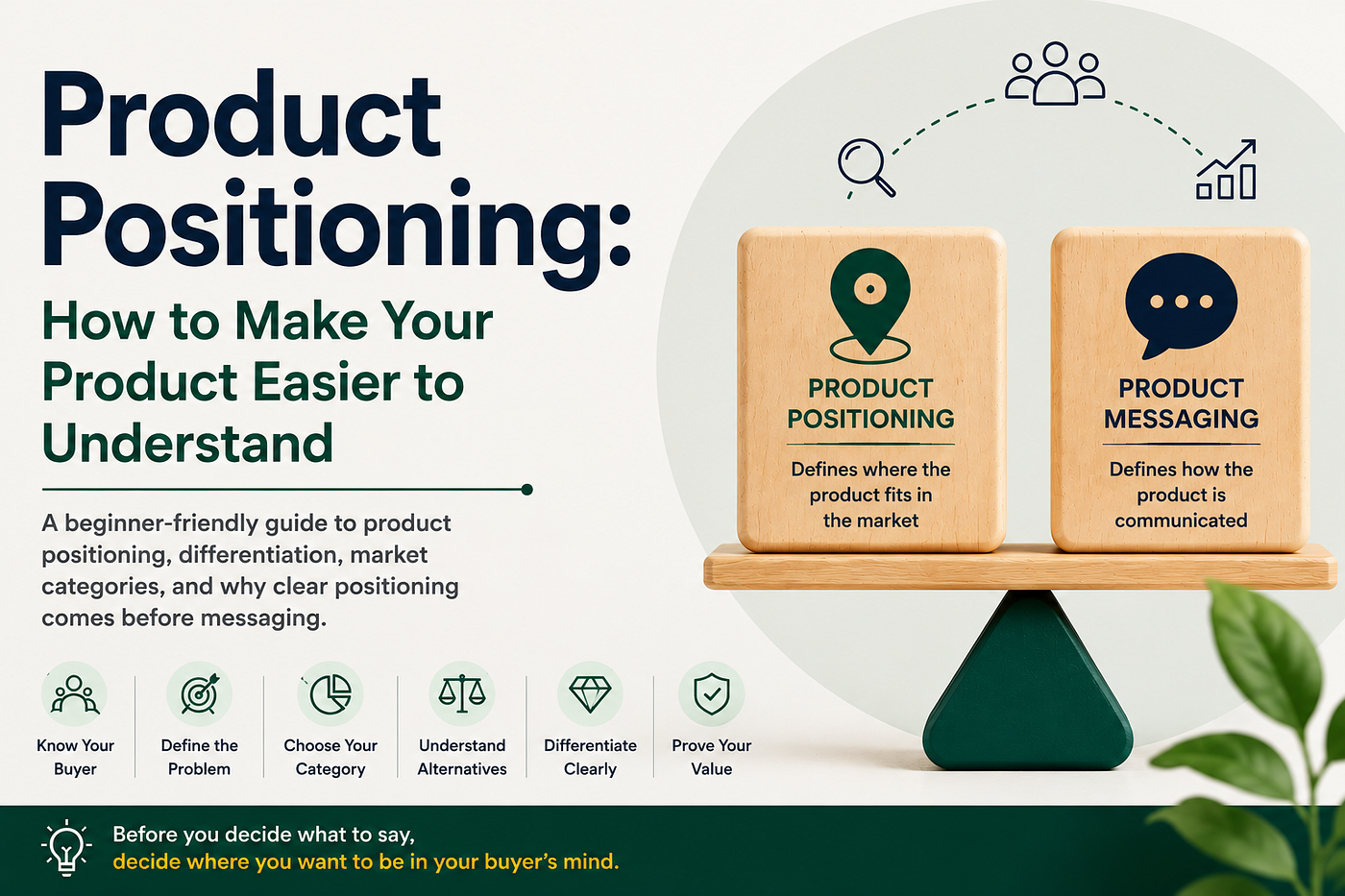
I used to think product positioning was mostly about writing a strong tagline or finding a catchy way to describe a product.
But over time, I realised positioning is much deeper than that.
Positioning is not just about how a product sounds.
It is about helping the market understand where the product fits, who it is for, what problem it solves, and why it is different from the alternatives.
That is why positioning is one of the most important parts of product marketing.
A product can have strong features. It can have clear messaging. It can have a good website. It can have a sharp sales deck.
But if the buyer does not understand what category the product belongs to, what problem it solves, or why it is different, the product will still feel confusing.
How should the product be positioned in the market?
That is what this article covers.
What You’ll Learn
By the end of this article, you will understand:
- What product positioning means
- Why positioning matters in B2B SaaS
- How positioning is different from messaging
- Why unclear positioning makes products harder to understand
- A simple positioning framework for beginners
- How to practice positioning with a positioning template
What Is Product Positioning?
Product positioning is the way you define where your product fits in the market and why your target buyer should choose it.
It answers:
Who is this product for? What problem does it solve? What category does it belong to? What alternatives does the buyer compare it with? What makes it different? What value should the buyer remember? Why should the buyer believe it?
In simple words:
Product positioning helps the buyer understand what your product is, who it is for, and why it is different.
Positioning is not only about words.
It is about context.
Buyers do not evaluate products in isolation. They compare your product with existing tools, current processes, competitors, internal workflows, and sometimes even doing nothing.
Good positioning helps the buyer place your product correctly in their mind.
Why Product Positioning Matters
In crowded B2B SaaS markets, many products start sounding similar.
Everyone says they are:
Fast. Scalable. Easy to use. AI-powered. Secure. Flexible. Built for modern teams.
These claims may be true, but they are not always memorable.
If a buyer cannot understand how your product is different, they may place it in the wrong category or compare it with the wrong alternatives.
For example:
A product may be built as a decision intelligence layer, but if it is positioned only as a verification tool, buyers may compare it with basic verification providers.
A product may be built as an infrastructure platform, but if it is positioned only as a dashboard, buyers may not understand its deeper value.
A product may be built to improve risk decisions, but if it is positioned only as an AI tool, it may sound like every other AI product.
That is why positioning matters.
It shapes how the market understands the product before messaging even begins.
Positioning Comes Before Messaging
One of the biggest lessons I have learned is that messaging becomes stronger only when positioning is clear.
Positioning answers:
Where do we fit?
Messaging answers:
What should we say?
Copywriting answers:
How should we say it?
If positioning is unclear, messaging becomes scattered.
The website may say one thing. The sales deck may say another. The campaign may focus on a different angle. The product team may describe the product technically. The sales team may explain it based on objections.
None of these may be wrong individually.
But together, they can create a fragmented story.
Good positioning creates the foundation.
Once the product’s place in the market is clear, messaging becomes easier to build.
Positioning vs Messaging
Here is a simple way to understand the difference:

Both are connected.
But positioning comes first.
Because before you decide what to say, you need to know what space you want to own in the buyer’s mind.
A Simple Positioning Example
Let’s say you have an AI-powered product for onboarding teams.
A weak positioning statement may sound like:
“An AI-powered platform for faster onboarding.”
This is not wrong, but it is too broad.
The buyer may wonder:
Is it a verification tool? Is it a workflow automation tool? Is it a risk engine? Is it a fraud detection product? Is it a customer onboarding platform? Is it a decisioning layer?
Now compare it with a clearer positioning direction:
“A decision intelligence layer that helps onboarding and risk teams combine verification, fraud, and risk signals to make faster approve, review, or reject decisions.”
This is stronger because it gives context.
It explains:
Who it is for: onboarding and risk teams What category it fits into: decision intelligence layer What it connects: verification, fraud, and risk signals What outcome it supports: faster approve, review, or reject decisions
That is the power of positioning.
It helps the buyer understand the product more accurately.
The Product Positioning Framework I Use
When I think about product positioning, I like to break it into six parts.
1. Target Buyer
Who is this product really for?
This could be:
- Marketing teams
- Sales teams
- Risk teams
- Product teams
- Operations teams
- Compliance teams
- Founders
- Developers
- BFSI institutions
- SaaS companies
The clearer the buyer, the sharper the positioning.
A product cannot be positioned well if it is trying to speak to everyone at the same time.
2. Problem
What urgent problem does the buyer face?
The problem should be specific.
Not just:
“Manual work.”
But:
“Onboarding teams spend too much time manually reviewing applications because risk signals are fragmented.”
Not just:
“Lack of visibility.”
But:
“Teams cannot see customer, verification, and risk signals in one place before making onboarding decisions.”
Specific problems create stronger positioning.
3. Market Category
What category does the product belong to?
This is important because buyers use categories to understand products.
For example:
- CRM
- Marketing automation platform
- Risk decisioning platform
- Payment infrastructure
- Customer support platform
- Product analytics tool
- Identity verification solution
- Sales enablement platform
The category helps the buyer quickly understand what kind of product this is.
But sometimes, the existing category may not fully explain the product.
That is when positioning becomes even more important.
You may need to define the product as a new layer, a new approach, or a better way to solve an existing problem.
4. Alternatives
What is the buyer comparing you with?
This is one of the most overlooked parts of positioning.
Your competition is not always another product.
Sometimes the alternative is:
- A spreadsheet
- A manual process
- An internal tool
- A legacy system
- A competitor
- Multiple disconnected tools
- Doing nothing
If you do not understand the alternative, you cannot position your product clearly.
Positioning is not only about what your product does.
It is also about why your product is better than the current way.
5. Differentiation
What makes your product meaningfully different?
Differentiation should not be a long list of features.
It should explain why your approach is better for the buyer.
Weak differentiation:
“We have real-time dashboards, automation, and AI.”
Stronger differentiation:
“We bring verification, fraud, and risk signals into one decisioning flow so teams can act faster without relying on disconnected checks.”
The second one is stronger because it connects differentiation to buyer value.
6. Proof
Why should the buyer believe you?
Proof can come from:
- Customer results
- Case studies
- Product capabilities
- Integrations
- Benchmarks
- Compliance readiness
- Use cases
- Testimonials
- Adoption metrics
Without proof, positioning can sound like a claim.
With proof, it becomes more credible.
Product Positioning Template
Here is a simple template beginners can use:
For [target buyer] Who struggle with [specific problem] Our product is a [market category] That helps them [business outcome] Unlike [alternative or competitor] We [key differentiation] With proof such as [evidence or credibility point]
Example:
For onboarding and risk teams Who struggle with fragmented verification and risk signals Our product is a decision intelligence layer That helps them approve low-risk customers faster and flag risky applications earlier Unlike disconnected verification tools or manual review workflows We bring verification, fraud, and risk signals into one decisioning flow With proof such as configurable workflows, connected risk inputs, and real-time decision support
This template may not become your final website copy.
But it gives you a clear foundation to build messaging, sales decks, campaigns, and launch assets.
Common Positioning Mistakes
Mistake 1: Positioning the Product Too Broadly
A broad positioning statement may feel safe, but it often becomes forgettable.
For example:
“A smarter platform for modern businesses.”
This sounds polished, but it does not tell the buyer enough.
Smarter how? For whom? For what problem? Against what alternative? With what outcome?
Specific positioning is usually stronger than broad positioning.
Mistake 2: Confusing Features With Differentiation
Features are not always differentiators.
If every competitor also has dashboards, automation, integrations, and analytics, those features alone may not make the product stand out.
Differentiation comes from the unique value your product creates, the way it solves the problem, or the specific buyer context it serves.
The feature may support the differentiation, but it should not replace it.
Mistake 3: Ignoring the Buyer’s Current Alternative
Many teams position their product only against direct competitors.
But the real alternative may be a manual process, a spreadsheet, an internal workflow, or a legacy system.
If the buyer is currently solving the problem manually, your positioning should explain why the current way is slow, risky, or inefficient.
Good positioning shows why the old way is no longer enough.
Mistake 4: Using Internal Language
Internal language often sounds clear to the team but confusing to the market.
For example:
“Unified intelligence orchestration infrastructure.”
This may make sense internally, but a buyer may not immediately understand it.
A clearer version could be:
“Bring customer, verification, and risk signals into one decisioning flow.”
The goal is not to sound complex.
The goal is to make the value easy to understand.
Why Positioning Is Hard for Complex Products
Positioning becomes more difficult when the product is technical, infrastructure-led, AI-powered, or built for a regulated industry like fintech.
That is because the product may solve multiple problems at the same time.
It may support workflows. It may improve decisions. It may reduce risk. It may connect systems. It may improve compliance. It may create operational efficiency.
When a product does many things, teams often try to say everything.
But saying everything can make the positioning weaker.
Good positioning forces prioritisation.
It asks:
What is the most important problem we solve? Who feels this pain most strongly? What category should we be understood in? What alternative are we replacing? What should the buyer remember first?
Positioning is hard because it requires choosing the clearest angle.
But that choice is what makes the product easier to understand.
Positioning Should Be Built From Market Understanding
Strong positioning does not come only from internal brainstorming.
It comes from listening to the market.
You need to understand:
What customers are struggling with. What words buyers use to describe the problem. What competitors are claiming. What alternatives buyers are considering. What Sales hears repeatedly. What objections come up often. What makes customers choose you. What makes prospects hesitate.
These signals help shape positioning.
Sometimes, the market tells you how the product should be positioned.
You just have to listen carefully.
Product Positioning Exercise for Beginners
Pick any B2B product and answer these questions:
- Who is the target buyer?
- What problem are they trying to solve?
- Why does this problem matter now?
- What category does the product belong to?
- What alternatives does the buyer use today?
- What makes this product different?
- What outcome does the product create?
- What proof supports the claim?
- What should the buyer remember after hearing about it?
Now write a positioning statement using this structure:
For [buyer], Who struggle with [problem], Our product is a [category], That helps them [outcome], Unlike [alternative], We [differentiation], With proof such as [proof].
This exercise helps you move from vague product explanation to clearer market positioning.
How Positioning Connects to Messaging
Positioning and messaging are closely connected, but they are not the same.
Positioning defines the product’s place in the market.
Messaging turns that positioning into clear communication for buyers.
If positioning says:
“We are a decision intelligence layer for onboarding and risk teams.”
Messaging may say:
“Approve low-risk customers faster, flag risky applications earlier, and reduce manual review dependency.”
The positioning gives direction.
The messaging makes it understandable.
That is why positioning should come before messaging.
Closing Thought
If there is one thing positioning has taught me, it is this:
A product becomes easier to understand when the market knows where to place it.
Without positioning, even strong products can feel confusing.
With clear positioning, the buyer understands:
What the product is. Who it is for. What problem it solves. Why it is different. Why it matters now.
That clarity makes messaging sharper, sales conversations clearer, and campaigns more focused.
Because before a product can be remembered, it has to be understood.
A Book I Recommend
One book that is especially useful for understanding positioning is Positioning: The Battle for Your Mind by Al Ries and Jack Trout.
What I like about this book is that it explains positioning from the buyer’s perspective. It shows why products do not compete only on features, but on the space they occupy in the customer’s mind.
For product marketers, this is useful because positioning is not just about describing the product. It is about helping the market understand what the product should be remembered for.
Recommended read: **Positioning: The Battle for Your Mind by Al Ries and Jack Trout**
I’m using this space to document what I’m learning about product marketing, GTM strategy, positioning, B2B SaaS, fintech, and AI-led products.
Start with the foundation article here: **What Product Marketing Really Means in B2B SaaS**
Then read the messaging article here: **Product Messaging Is Not Copywriting**
Next, read the feature-to-outcome article here: **Features vs Outcomes: How Product Marketers Translate Value**
Next, I’ll write about go-to-market strategy and what GTM really means beyond a launch announcement.
메타데이터
- post_id
- a3266785bdf4
- slug
- product-positioning-how-to-make-your-product-easier-to-understand-a3266785bdf4
- url
- https://medium.com/@nityap093/product-positioning-how-to-make-your-product-easier-to-understand-a3266785bdf4
- canonical_url
- https://medium.com/@nityap093/product-positioning-how-to-make-your-product-easier-to-understand-a3266785bdf4
- author_url
- https://medium.com/@nityap093
- status
- ok
- fetched_at
- 2026-06-12 07:40:50




