There’s No Marketing Strategy like the Right Price: Lessons Learned from the Sale of Michael…
Michael Jordan’s legendary Highland Park, Illinois mansion — a sprawling 26,500-square-foot estate packed with custom features — finally…
There’s No Marketing Strategy like the Right Price: Lessons Learned from the Sale of Michael Jordan’s House
Michael Jordan’s legendary Highland Park, Illinois mansion — a sprawling 26,500-square-foot estate packed with custom features — finally sold in December 2024 after an astonishing 12 years (2,475 days) on the market. Originally listed in 2012 for $29 million, the property underwent multiple price reductions before ultimately closing for $9.5 million — just one-third of its initial asking price.
This prolonged sale highlights a hard truth in real estate: unique, one-of-a-kind properties can be spectacularly difficult to sell. I always tell people there’s a reason why some properties are one of a kind: nobody wants them. Take the classic California Ranch style home. It’s an incredibly popular and functional design that has been replicated literally millions of times. While some people may say, “booor-ing!” when you say you’ve got such a home for sale, the market will have a much different opinion.
The truth is, you don’t have to bend over backwards with elaborate marketing to sell a home such as this. If the price is right given the location, lot size, square footage and condition, there will be multiple buyers for it, ready to fork over the money and move right in just as soon as you’re ready to hand over the keys.
But when you have a property that’s considerably more unique, it’s natural to want to come up with a marketing angle that will pull that super-high-paying buyer out of the woodwork, that one buyer who is an absolute needle in a haystack. That one buyer who will appreciate the entirely of the unique value proposition for the house and pay handsomely for it. And the sale of MJ’s house provides a great case study to learn timeless lessons about marketing, pricing, and selling incomparable homes.
Video Tour of Michael Jordan’s Estate
[embed]
The Challenges of Selling a One-of-a-Kind Property
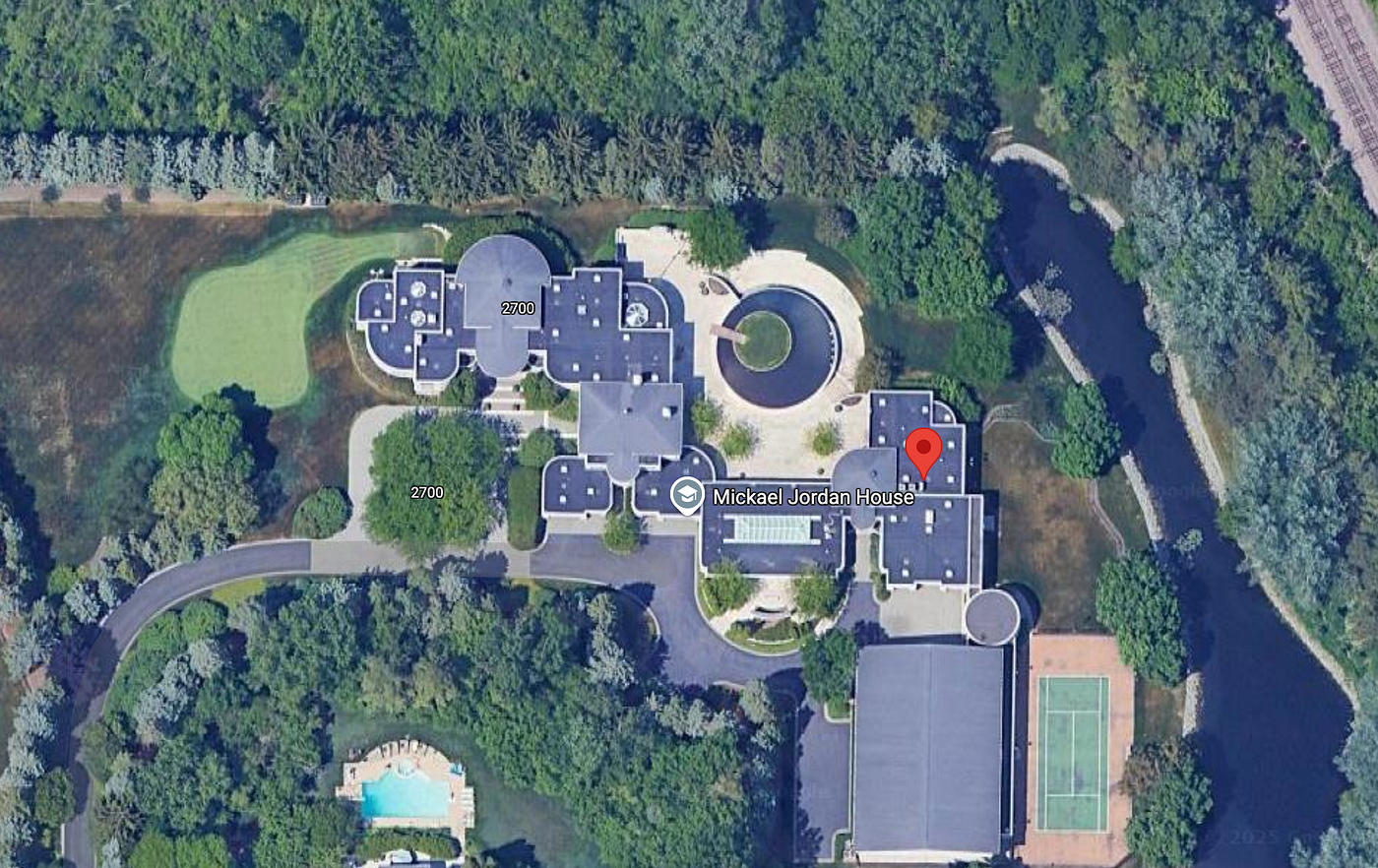
Michael Jordan’s estate was unlike any other home in the Chicago suburbs — or, frankly, anywhere. The property included:
- A full-sized indoor basketball court with the Jumpman logo
- A cigar lounge and wine cellar
- A swimming pool shaped like a basketball
- A par-3 golf hole
- A private lake stocked with fish
- A home gym with NBA-level training facilities
- A hair salon (designed for his then-wife)
- Detached Guest House
- Pool House
- Golf Training Facility
- A massive “23” gate, making the home unmistakably Jordan’s
While these features were perfect for Michael Jordan, they posed a huge challenge when trying to find a buyer. The mansion was built to fit the specific lifestyle of an NBA legend — meaning the buyer pool was already extremely limited. And even among NBA stars, there are exceedingly few who have the financial capacity that Michael Jordan does, meaning most lack the means to pay multiple tens of millions of dollars for a home. And if they did, would they not just build a completely bespoke home to suit?
Here’s why properties like this can often be a struggle to sell:
1. There Are No True Comparable Properties
Real estate pricing typically depends on comparable sales, or “comps,” which are similar homes in the same area that have recently sold. However, in Highland Park, the largest luxury homes were only about 10,000 square feet — just a fraction of the size of Michael Jordan’s 26,500-square-foot estate. With no truly comparable properties nearby, determining the right price became a challenge.
In cases like this, sellers must look beyond the local market and expand their search to find similar high-end homes, even if that means comparing properties in distant luxury markets such as Los Angeles, Miami, or Aspen, where ultra-wealthy buyers are more common.
Once identifying “comparable” properties in those markets, you would adjust the “subject” property valuation based on differences in what top-tier properties sell for in those markets, relative to sale prices in the subject property’s market — regardless of size.
2. Ultra-Custom Homes Appeal to a Tiny Market
A one-of-a-kind property is unique for a reason — very few buyers are actually looking for a home like it. While the custom features in Michael Jordan’s estate were designed to suit his lifestyle, most potential buyers saw them as costly burdens rather than desirable assets.
Owning a private basketball gym, a personal golf course, and a stocked pond comes with significant maintenance expenses, and beyond that, the next owner would have to pay property taxes ($148,000 per year in this case) and insurance on amenities they might never use. What made the home special to Jordan ultimately made it harder to sell.
And remember: the smaller the market, the smaller the price (relative to similar homes with larger markets).

3. Overpricing Prolongs the Sale
The mansion remained on the market for over a decade, largely because the asking price was too high for too long. Over the years, Michael Jordan and his agents experimented with different pricing strategies, even incorporating his iconic jersey number 23 by listing the home at $14,855,000 at one point. These price adjustments generated media attention, but in the end, it wasn’t creative marketing that sold the property.
One important lesson here is that the list price that you set for your property has very little to do with what it actually sells for. Rather, the list price really determines how long you are willing to wait for an acceptable offer. In this case, Michael Jordan’s successively lowered list prices show that at first, he was willing to wait quite some time (over a decade, it turns out).
The last list price of $14,855,000 was set in December of 2017; the property went under contract seven years later at $9,500,00–36% below list price.
The sale only happened when the list price was at the point that the market had appreciated somewhat, the seller was tired of owning and marketing the property, and a ready willing and able buyer stepped up with a price that made the deal happen.
All that outsize marketing effort and clever strategies, over a dozen years? Largely a complete waste of time and money.
4. The Law of Diminishing Returns
The law of diminishing returns in real estate is especially evident in ultra-luxury properties, where excessive size and over-customization can limit market appeal. Michael Jordan’s Highland Park mansion is a prime example of how a property can surpass the threshold of what buyers are willing to pay, regardless of its prestige or unique features. While high-end homes command premium prices, there comes a point where additional square footage, specialized amenities, and personal customizations do not translate into a proportional increase in value.
Instead, these features can become burdens, requiring costly maintenance, higher property taxes, and extensive upkeep that many buyers are unwilling to take on. The result is an extended time on the market and a series of price reductions, demonstrating that in real estate, more isn’t always better — what ultimately matters is alignment with buyer expectations and market demand.
In the end, these super-size over-the-top “improvements” can actually subtract value, meaning the property would be worth more without many of these additional features.

5. The Principle of Substitution
The principle of substitution played a major role in why Michael Jordan’s Highland Park mansion sat on the market for over a decade. No matter how iconic or custom-built a home may be, buyers will always compare it to other properties that offer similar space, location, and amenities at a lower price.
Jordan’s estate was one-of-a-kind, but for $29 million — or even half that price — buyers could find luxury homes in places like Los Angeles, Miami, or Aspen, where ultra-high-net-worth individuals actually want to live.
The reason the home ended up selling for less than $10 million is because $10 million is a huge sum of money for Highland Park, Illinois. For that money, the buyer could purchase almost any home within hundreds of miles — many of which would surely offer a competitive blend of location, luxury, amenities, and condition.
I am reminded of the time I visited the former house of Robin Williams in San Francisco, which sold this year for $18.1 Million. At the time I visited it in 2024, it was listed at $25 million. While it was a fabulous home, I remember thinking that for $25 million, a buyer could purchase virtually any home in the Bay Area, or California, for that matter — so why would anyone pay $25 million for it? I doubted they would, because no matter no how fabulous a home is, the principle of substitution will put an upward limit on price.
The Role of Marketing — And Its Limits
Marketing certainly plays an important role in selling real estate, particularly in the luxury market, and several creative strategies were used to generate interest in Michael Jordan’s home. The property was positioned as a “trophy home,” encouraging buyers to see it as a rare collector’s item, much like an exclusive pair of Air Jordans. To further entice potential buyers, one agent even offered a complete set of every Air Jordan sneaker ever released in the buyer’s size. The listing also generated widespread media coverage, with the sale framed as a unique opportunity to “own a piece of NBA history.”
Despite these efforts, the estate remained on the market for a dozen years. The reason was simple — no amount of marketing can compensate for an overpriced listing.

The Key Takeaway: Price is What Ultimately Sells a Home
In the end, Michael Jordan’s home sold not because of branding, storytelling, or incentives — but because Michael Jordan finally reached a point where he could let it go for what a buyer was willing to pay.
This is a lesson for any seller, whether you’re offloading a suburban family home or a world-famous athlete’s mansion. No matter how unique a property is, no matter how many marketing strategies are used, the right price is what gets a deal done.
When selling a unique property, it’s essential to expand the search for comparable properties beyond the local market. In cases where there are no true comps nearby, looking at similar high-end homes in other luxury markets across the country can provide a more accurate sense of value, and then make adjustments for local pricing dynamics from there.
It’s also important to be realistic about the potential buyer pool. Just because a home has expensive custom features doesn’t mean buyers will see them as valuable. What was once a luxury for the original owner could be viewed as an unnecessary expense or even a drawback for others.
Most importantly, pricing a home correctly from the start is key. Overpricing often results in a prolonged sale, multiple price reductions, and, in many cases, a lower final sale price than if the home had been competitively priced from the beginning.
Marketing plays a crucial role in selling ultra-luxury homes like Michael Jordan’s estate, but its primary purpose is to generate interest and get potential buyers through the door. High-end properties do deserve compelling storytelling, exclusivity, and strategic branding to attract attention, whether through media buzz, unique incentives, or positioning the home as a once-in-a-lifetime opportunity.
However, no matter how effective the marketing is, once buyers step onto the property, price speaks louder than words, photography, video, staging, and fame.
A well-marketed home can create excitement, but buyers ultimately compare it to other available options and assess whether the asking price aligns with their expectations and the market. In the end, marketing brings the right people to the table, but the price is what closes the deal.
Michael Jordan’s mansion was a cautionary tale for sellers: marketing alone won’t sell a home — but pricing it right will, every time.
—
Seb Frey is a top Silicon Valley REALTOR® helping people get rich in real estate. Check out his YouTube Channel, SebFreyTV.

메타데이터
- post_id
- a32abaee921e
- slug
- theres-no-marketing-strategy-like-the-right-price-lessons-learned-from-the-sale-of-michael-a32abaee921e
- url
- https://medium.com/@sebfrey/theres-no-marketing-strategy-like-the-right-price-lessons-learned-from-the-sale-of-michael-a32abaee921e
- canonical_url
- https://medium.com/@sebfrey/theres-no-marketing-strategy-like-the-right-price-lessons-learned-from-the-sale-of-michael-a32abaee921e
- author_url
- https://medium.com/@sebfrey
- status
- ok
- fetched_at
- 2026-06-15 20:49:13