Process Documentation vs Knowledge Bases: Why Operational Teams Keep Losing Critical Information
A new employee joins the company and needs help processing a customer exception. They open the company wiki, search through dozens of…
Process Documentation vs Knowledge Bases: Why Operational Teams Keep Losing Critical Information
A new employee joins the company and needs help processing a customer exception. They open the company wiki, search through dozens of articles, find three conflicting instructions, and eventually message the one person everyone says “knows how it really works.”
Meanwhile:
- Process updates take months to spread
- Teams follow inconsistent workflows
- New hires struggle to ramp up
- Audit requests trigger chaos
- Institutional knowledge lives inside employees instead of systems
Most organizations assume these are documentation problems.
In reality, they are architecture problems.
The root issue is that many companies are trying to manage operational process execution and organizational knowledge inside the same system — even though those are fundamentally different functions.
Why Most Organizations Confuse Process Documentation and Knowledge Management
The term “documentation” has become overly broad.
Teams use it to describe:
- SOPs
- Training guides
- Policy references
- Process instructions
- Institutional knowledge
- Compliance procedures
- Troubleshooting steps
- Team best practices
But these are not all the same type of information.
Some content exists to help employees understand context.
Other content exists to help employees execute work correctly.
That distinction matters far more than most organizations realize.
When both categories get mixed together inside a generic wiki or knowledge base, operational reliability begins to break down.
Knowledge Management and Process Documentation Solve Different Problems
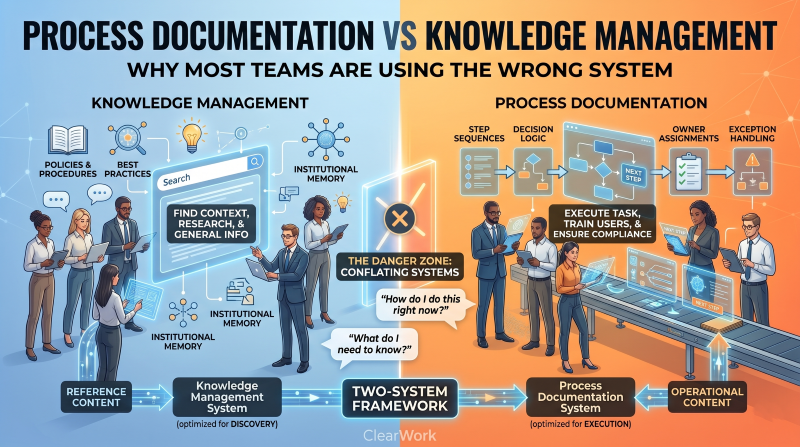
Knowledge Management Systems Are Built for Discovery
Knowledge management platforms such as:
- Wikis
- Confluence
- Notion
- Internal knowledge portals
are designed primarily for:
- Searchability
- Information sharing
- Context preservation
- Organizational learning
- Reference access
Employees visit these systems when they need to:
- Learn something
- Research something
- Understand background information
- Find guidance or best practices
These systems are optimized for exploration.
Process Documentation Systems Are Built for Execution
Process documentation serves a very different operational role.
Its purpose is to define:
- Step-by-step workflows
- Decision logic
- Ownership
- Handoffs
- Inputs and outputs
- Exception handling
- Compliance checkpoints
- Operational responsibilities
Process documentation answers:
“How do I perform this task correctly right now?”
That is not a search problem.
That is an execution problem.
And execution requires significantly more structure than a typical knowledge article provides.
Why Operational Content Breaks Inside Generic Wikis
When process instructions are stored alongside:
- Meeting notes
- Company updates
- Research articles
- Historical documentation
- Internal announcements
they lose operational clarity.
Employees can no longer easily distinguish:
- Current procedures
- Historical references
- Draft workflows
- Deprecated instructions
- Team-specific variations
Over time:
- Search quality degrades
- Documentation trust declines
- Employees rely on tribal knowledge instead
- Teams create shadow processes
The problem is not necessarily the volume of content.
The problem is that operational workflows require structured execution frameworks, not just searchable pages.
Why Findability Alone Doesn’t Solve Operational Problems
Many organizations attempt to solve documentation issues by improving search.
But operational execution is rarely a keyword-search problem.
A customer support rep handling an exception case does not want:
- Ten loosely related articles
- Broad policy explanations
- General recommendations
They need:
- Exact workflow guidance
- Context-specific decision logic
- Escalation rules
- Required approvals
- System-specific instructions
That requires process-oriented structure.
Operational documentation must be organized around:
- Roles
- Tasks
- Situations
- Workflow stages
- Exceptions
- Actions
not just searchable text.
Why Ownership Models Matter
Knowledge management systems often rely on broad ownership:
- Departments
- Shared contributors
- Subject matter experts
Content gets updated inconsistently and usually reactively.
That model may work reasonably well for:
- Company background
- Reference material
- Educational content
But operational workflows require much tighter governance.
Every critical process should have:
- A named owner
- Review accountability
- Update triggers
- Version history
- Maintenance expectations
Without clear ownership, operational documentation becomes stale extremely quickly.
The Cost of Stale Process Documentation
Outdated operational documentation creates far greater risk than outdated reference content.
If a historical company overview is inaccurate, the impact is minimal.
If a compliance workflow, escalation procedure, or customer-facing process is outdated, the consequences can include:
- Operational failures
- Audit findings
- Service inconsistency
- Regulatory exposure
- Customer dissatisfaction
- Employee confusion
This is why process documentation requires much stronger maintenance discipline than general knowledge management systems typically provide.
The Modern Two-System Model
High-performing organizations increasingly separate:
- Process execution systems
- Knowledge management systems
These systems work together — but they are not interchangeable.
What Process Documentation Should Contain
Strong process documentation includes:
- Step-by-step workflows
- Decision trees
- Owner assignments
- Inputs and outputs
- Required systems
- Escalation paths
- Compliance controls
- Exception handling
- Review timestamps
This transforms documentation into operational infrastructure rather than informational content.
What Knowledge Management Should Contain
Knowledge systems are better suited for:
- Policies
- Institutional context
- Research
- Best practices
- Training support
- Historical decisions
- Organizational learning
- Supporting reference materials
These systems help employees understand the environment they operate within.
Process systems help employees execute work correctly.
Both are necessary.
But they should not be treated as the same thing.
A Practical Framework for Separating the Two
Step 1: Audit Existing Documentation
Most organizations discover that a large portion of their wiki content is actually operational process material disguised as generic documentation.
Teams should classify content into two categories:
- Operational execution content
- Reference and contextual content
This immediately reveals governance gaps.
Step 2: Rebuild Operational Documentation Structurally
Operational workflows should include:
- Ownership
- Workflow stages
- Decision logic
- Exceptions
- Review cycles
- System interactions
Without those elements, documentation becomes descriptive instead of executable.
Step 3: Assign Named Process Owners
Every operational workflow requires accountability.
A specific individual — not a department — should own:
- Accuracy
- Reviews
- Updates
- Workflow alignment
This prevents documentation decay.
Step 4: Intentionally Link Both Systems
The strongest operational ecosystems connect process documentation and knowledge management together intentionally.
For example:
- A process document links to policy context
- A knowledge article links to the operational workflow implementing that policy
This creates operational clarity while preserving organizational learning.
What Implementation Typically Looks Like
Week 1: Documentation Assessment
- Export current wiki content
- Identify operational vs reference content
- Flag outdated materials
- Identify missing ownership
Week 2–3: Establish Structured Process Documentation
- Prioritize high-impact workflows
- Rebuild them with operational structure
- Add ownership and governance metadata
- Define exception handling
Week 4: Create Maintenance Triggers
Define what causes workflow reviews:
- Policy changes
- System updates
- Process exceptions
- Audit findings
- Operational incidents
This prevents documentation from becoming static and outdated.
Why Organizations See Better Results With This Model
Faster Employee Onboarding
New hires learn workflows faster when operational procedures are structured clearly and separated from broad informational content.
Lower Error Rates
Employees make fewer mistakes when documentation reflects current operational reality.
Improved Compliance Readiness
Structured process documentation creates cleaner audit trails and stronger governance visibility.
Reduced Information Searching
Employees spend less time searching through large knowledge repositories for operational answers.
Higher Documentation Trust
Teams actually use documentation when it consistently reflects how work happens in practice.
How Platforms Like ClearWork Support This Approach
Platforms such as ClearWork help organizations bridge the gap between operational discovery and structured process documentation.
By combining:
- AI-guided discovery
- Async operational interviews
- Process intelligence
- Structured workflow capture
- SOP generation
- Living documentation governance
organizations can build operational documentation systems grounded in how work actually happens rather than static wiki maintenance processes.
This creates a more sustainable operational knowledge foundation over time.
Common Mistakes Organizations Continue to Make
Moving Content Without Changing Structure
Migrating from one wiki platform to another does not solve governance or execution problems.
Treating Operational Workflows Like General Articles
Operational documentation requires ownership, structure, and maintenance discipline.
Documenting Idealized Processes Instead of Real Workflows
Employees lose trust quickly when documentation ignores operational reality and exceptions.
Confusing Training Content With Process Documentation
Training explains concepts.
Process documentation defines execution.
They are related but distinct.
Treating Documentation as a One-Time Initiative
Operational knowledge changes constantly. Documentation systems must evolve continuously alongside operations.
Frequently Asked Questions
What is the difference between process documentation and knowledge management?
Process documentation defines how work gets executed operationally. Knowledge management stores broader organizational information, context, and institutional knowledge.
Can Confluence or Notion manage both?
They can store both types of content, but without structured operational governance, process documentation often degrades into untrusted wiki content.
How do you know if something belongs in a process system?
If the content tells someone exactly how to perform a task, handle a workflow, or manage an operational exception, it belongs in structured process documentation.
Why do employees stop using internal knowledge bases?
Most organizations fail to maintain operational accuracy, ownership, and content structure over time, causing trust in documentation to decline.
How long does it take to separate process documentation from knowledge management?
Most organizations can establish an initial operational structure within 30 days, though long-term governance maturity typically takes several months to operationalize effectively.
The organizations building the strongest operational foundations are no longer treating all documentation as the same thing.
They are separating:
- operational execution systems from
- organizational knowledge systems
and designing each one intentionally for the role it is meant to serve.
Originally published: https://www.clearwork.io/blog-posts/process-documentation-vs-knowledge-management-why-most-teams-are-using-the-wrong-system
메타데이터
- post_id
- a32df0aa6a8a
- slug
- process-documentation-vs-knowledge-management-why-most-teams-are-using-the-wrong-system-a32df0aa6a8a
- url
- https://medium.com/@avery.brooks_59610/process-documentation-vs-knowledge-management-why-most-teams-are-using-the-wrong-system-a32df0aa6a8a
- canonical_url
- https://medium.com/@avery.brooks_59610/process-documentation-vs-knowledge-management-why-most-teams-are-using-the-wrong-system-a32df0aa6a8a
- author_url
- https://medium.com/@avery.brooks_59610
- status
- ok
- fetched_at
- 2026-06-23 17:05:31




