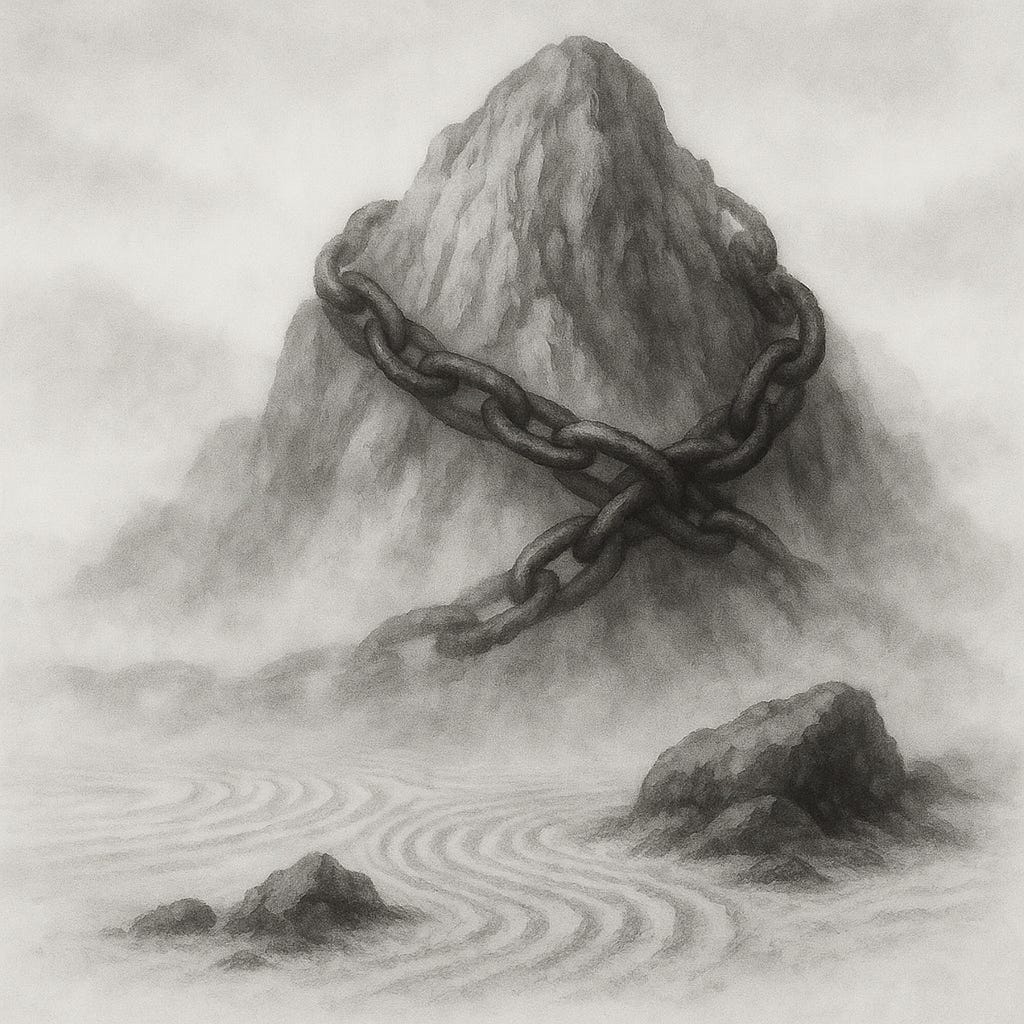
When the Hunter Becomes the Monster: Why Laozi Spoke Against Conventional Morality
Preface: The Age After God
When the Hunter Becomes the Monster: Why Laozi Spoke Against Conventional Morality

Preface: The Age After God
We now live in a post-Christian world — not one devoid of faith, but one haunted by its fragments. The cosmic hierarchy of Heaven and Hell, once so clear, has dissolved into moral ambiguity. Angels fall. Demons love. Priests doubt. And yet, the instinct to hunt evil endures.
Nietzsche warned:
Beware that, when fighting monsters, you yourself do not become a monster… for when you gaze long into the abyss, the abyss gazes also into you.
Long before Nietzsche, Laozi had already cautioned that moral zeal — the hunger to purify the world — is the beginning of decay.
When the Tao is lost, there arises virtue. When virtue is lost, there arises benevolence. When benevolence is lost, there arises righteousness. When righteousness is lost, there arises propriety. Propriety is the thin shell of loyalty and good faith, and the beginning of disorder. — Dao De Jing 38
And elsewhere:
When the government is too moral, the people become hypocrites. Calamity is what fortune depends upon, fortune is what calamity hides in. — Dao De Jing 58
For Laozi, righteousness itself can become the seed of violence. Once the natural flow of the Tao is lost, moral codes arise like brittle shells — and when those shells crack, chaos spills out. Demon-hunting, whether spiritual or political, is born of this brittle righteousness: the attempt to enforce purity by suppressing the shadow.
1. The Psychology of the Abyss
Carl Jung saw the same danger from within the psyche. The more we deny our inner darkness, the more it manifests externally as something to destroy.
The psychological rule says that when an inner situation is not made conscious, it happens outside, as fate. — Jung, Aion
The demon-hunter thus fights his own disowned self. The “evil” he pursues is his shadow projected upon the world. What Nietzsche called “the abyss” is, for Jung, the unconscious — that vast moral mirror where all we repress waits to be acknowledged.
2. Supernatural: The Hunter’s Shadow
In Supernatural, Sam and Dean Winchester begin as righteous avengers, heirs to a family mission of eradicating evil. Yet the more they hunt, the more the boundary blurs.
In “Bloodlust” (Season 2), Dean joins a hunter who kills vampires without question. Only later does he discover that the vampires live peacefully, feeding only on animal blood. The true predator, it turns out, is the human who believes he is good.
In “On the Head of a Pin” (Season 4), Dean tortures a demon at the command of angels — and afterward admits, “I enjoyed it.” The line between justice and cruelty collapses. The abyss has gazed back.
Meanwhile, some demons — Crowley, Meg, even Benny the vampire — display humor, loyalty, and love. Evil bleeds into humanity; humanity bleeds into evil. The show becomes a meditation on Jung’s warning: that those who fight darkness without knowing their own hearts are destined to become instruments of it.
3. Evil: When the Exorcist Needs Exorcism
In Evil, the struggle against demons turns into a study of projection. Kristen Bouchard, the rational psychologist, kills a predator and begins to dream of devils; her violence awakens what she most denies. David Acosta, the priest-in-training, questions whether his visions come from God or from his own psyche.
The show’s title becomes its thesis: evil is not a supernatural essence but a mirror — psychological, social, and spiritual. The line between the possessed and the exorcist evaporates.
Both Kristen and David embody Jung’s law of the shadow: what is repressed will return, wearing the masks we most fear. The more they resist the darkness within, the more vividly it animates the world around them.
4. The Taoist Mirror: Beyond Demon-Hunting
The Taoist worldview dissolves this entire dualistic drama. There is no cosmic war between God and Satan, no metaphysical abyss of damnation. There is only the rhythm of yin and yang — darkness and light, each giving birth to the other. Evil, in this vision, is not an alien force to be slain but a shadow that maintains the balance of the whole.
When we deny one pole, imbalance arises. When we worship righteousness, we breed cruelty. The zeal of the demon-hunter — moral, religious, or ideological — is the world’s disease of excess yang: fire without water, judgment without humility.
We do not need demons to make a dystopia. Human self-righteousness is enough. The Taoist remedy is non-contention (無爭) — the wisdom of acting without hostility, of restoring balance instead of waging war. The sage governs not by exorcism but by understanding, for he knows that the line between shadow and light is the pulse of life itself.
5. The Hunter, the Shadow, and Compassion
In the end, the true exorcism is self-knowledge. Both Jung and Laozi point toward the same truth: the monster is not a foreign creature but an unacknowledged part of the self. To confront it with compassion rather than hatred is to heal the split between yin and yang, heaven and earth, self and other.
In Supernatural, the Winchesters’ greatest evolution is not in their power, but in their empathy. They learn to spare the monster who resists his hunger — to see conscience where once they saw only sin. In Evil, the possibility of redemption comes not from faith in doctrine, but from the courage to face doubt and darkness honestly.
Both journeys move beyond the metaphysics of war into the psychology of wholeness — the Taoist and Buddhist recognition that light and shadow are two faces of the same Tao.
6. Conclusion: The End of Righteous War
Laozi warned that “propriety is the beginning of disorder” — that the attempt to perfect the world through moral control would only deepen its confusion. Nietzsche and Jung saw the same truth in the Western soul: when we hunt evil without knowing our own hearts, we become the instruments of the very darkness we condemn.
The Taoist Way offers a final inversion: Salvation lies not in victory, but in balance; not in purity, but in awareness. When we stop hunting monsters and start understanding them, the abyss ceases to be an enemy. It becomes a mirror — deep, dark, and compassionate.
Epilogue Aphorism
He who hunts monsters must one day face the mirror. For the truest victory is not the slaying of darkness, but the seeing of oneself within it.
메타데이터
- post_id
- a32e337f6cce
- slug
- when-the-hunter-becomes-the-monster-the-shadow-of-goodness-in-the-post-christian-imagination-a32e337f6cce
- url
- https://medium.com/@kleong54/when-the-hunter-becomes-the-monster-the-shadow-of-goodness-in-the-post-christian-imagination-a32e337f6cce
- canonical_url
- https://medium.com/@kleong54/when-the-hunter-becomes-the-monster-the-shadow-of-goodness-in-the-post-christian-imagination-a32e337f6cce
- author_url
- https://medium.com/@kleong54
- status
- ok
- fetched_at
- 2026-07-22 06:37:29