Thought leadership without a big budget: Lessons from the top for SMEs
Fifteen years ago, Debra D’Agostino launched the thought leadership division at the multinational research consultancy Oxford Economics — a…
Thought leadership without a big budget: Lessons from the top for SMEs
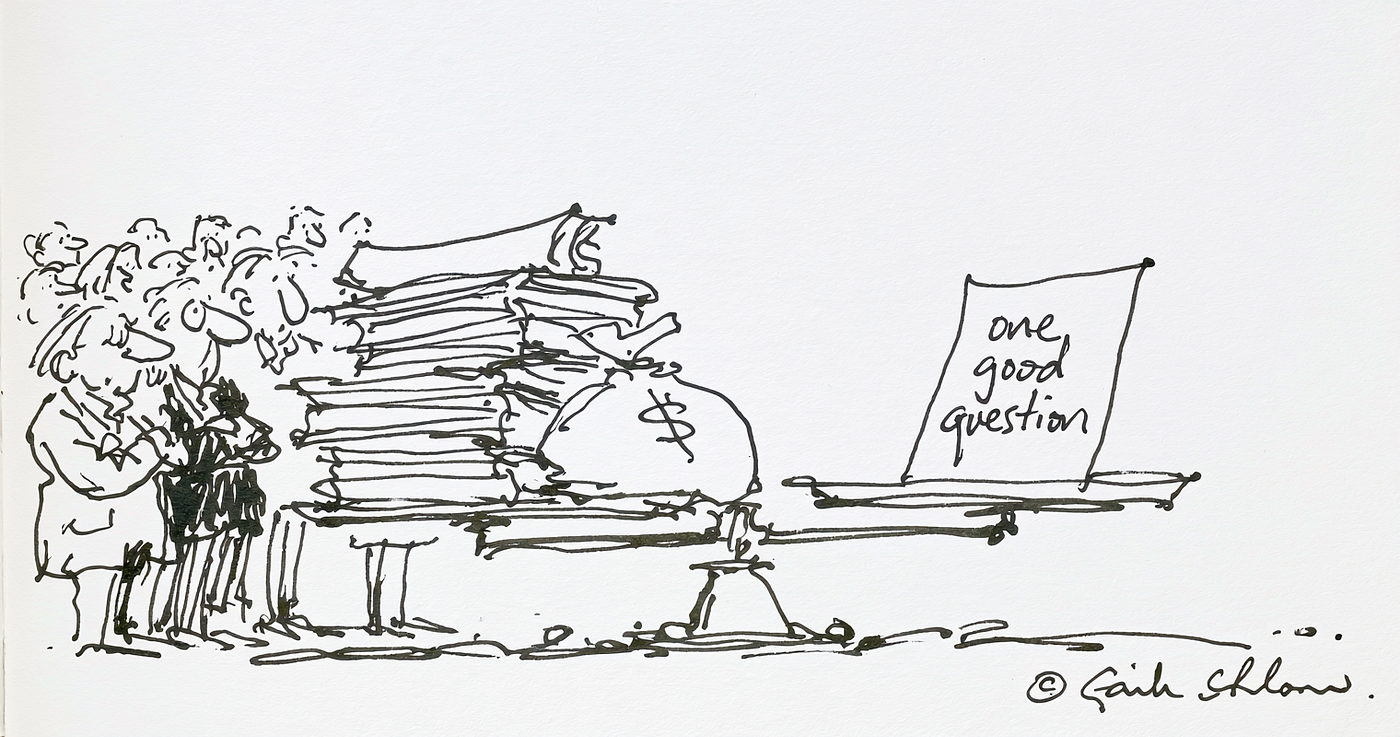
Budget doesn’t mattter
Fifteen years ago, Debra D’Agostino launched the thought leadership division at the multinational research consultancy Oxford Economics — a team tasked with helping large organisations establish themselves as authorities in their fields. Since then, she has watched from the inside as dozens of major multinationals turn their knowledge into public credibility. Her team of twenty researchers, former journalists and management consultants works with Fortune 500 companies to produce research that actually matters.
That sounds like a world far removed from the employment lawyer in Utrecht or the recruitment consultant in Rotterdam who simply wants to communicate that she is the best person for the job. Yet D’Agostino has said something that closes that gap: methodology matters. Budget is secondary.
This article is about that methodology. Not as a blueprint for multinationals, but as a compass for the SME professional who wants to make a start.
What thought leadership is not
D’Agostino is direct about something that still causes confusion in practice: thought leadership is not the same as content marketing. Anyone who thinks a well-argued opinion piece is enough is also mistaken. Thought leadership — or knowledge authority, as I prefer to call it — is something specific, and its criteria are stricter than most people expect.
Four pillars
She applies four standards. A publication must be grounded in evidence: data, interviews or rigorous desk research. It must be forward-looking; not examining the past but anticipating what is coming. It must say something new, taking the conversation somewhere it has not been before. And it must help the reader: after reading, someone should be able to do something they could not do before.
These are not soft criteria. They exclude a large proportion of what appears daily under the banner of thought leadership.
D’Agostino discussed this in May of this year during a webinar hosted by the GTLI, the Global Thought Leadership Institute, which forms part of the American Productivity and Quality Center (APQC). The GTLI is currently the only organisation working systematically at scale to gather and disseminate knowledge about this field.
Her interlocutor was Anthony Marshall, global leader of the IBM Institute for Business Value and co-author of The ROI of Thought Leadership, still the most authoritative book on the strategic value of the discipline.
Methodology over budget
When I interviewed her afterwards, she added something directly relevant to smaller organisations: “It is less about the size of the budget and more about the rigour of the approach. A solid, rigorous approach can have a stronger impact than a huge study with a weak methodology.”
The definition problem as the real cultural problem
When I asked whether she sees meaningful differences between the United States and Europe — particularly around self-promotion — she redirected me to what she considers the more fundamental issue.
“The hypothesis must be tested, not proved.”
“The real divide”, she said, “is not geographical but methodological. Too many organisations approach thought leadership with a conclusion already in hand, looking for research to confirm what they already believe. That is where most efforts go wrong. The hypothesis must be tested, not proved.”
That is a sharp observation. From her position working with global multinationals, the cultural dimension barely registers. For professionals in the Netherlands, however, there is an additional layer that cannot be ignored.
D’Agostino looks at the world from a multinational vantage point. Her audience is the global C-suite: executives accustomed to this kind of publication, who know the rules and judge a report on the quality of its research. At that level, her reasoning holds completely: good content is good content, everywhere.

The ‘maaiveld’ paradox
The SME professional stepping onto LinkedIn for the first time operates in a different context — not only in terms of budget or team, but also in terms of audience and expectation.
In the Netherlands, there is a deeply ingrained cultural norm that might be translated as the maaiveld (literally: ground level) paradox. The Dutch expression “doe maar gewoon, dan doe je al gek genoeg” — roughly: “just act normal, that’s already quite mad enough” — captures something real. Anyone who beats their own drum too loudly invites scepticism rather than admiration. The American norm of bold opinions and executive visibility frequently backfires here. Not because the Dutch dislike strong views, but because the packaging determines whether you are perceived as authoritative or merely arrogant.
“Those who combine professional expertise with a personal point of view, and who dare to be vulnerable, are the ones doing genuine thought leadership.”
Toyna Chin is a recognised authority in marketing for biotech companies and contract research organisations (CROs) — independent research organisations operating within the life sciences sector. She frames it sharply: those who combine professional expertise with a personal point of view, and who dare to be vulnerable, are the ones doing genuine thought leadership.
That is a useful formula, applicable at any scale. In the Dutch context, I would add a fourth element: modesty as strategy, not as weakness. Anyone who shares knowledge here as a contribution to their field, rather than as proof of their own greatness, builds authority faster than anyone who simply announces how good they are.
Content is universal. Tone is culturally determined. That distinction deserves an honest place in every conversation about thought leadership.
The one-person practice as editorial meeting
D’Agostino closed with an image that stays with you. From her time at Ziff Davis Media, where she helped launch the magazine CIO Insight, she recalls the editorial meetings: a room full of people from entirely different backgrounds, genuinely challenging one another. Not competing to be right but thinking sharply together. “That,” she said, “is how you build a thought leadership team. Not with like-minded people, but with people who force you to see things differently.”
For the SME professional or sole trader, that sounds like a world out of reach. Who builds a team of twenty researchers and former journalists when working alone?
The answer is: nobody. But the dynamic can be replicated, with different means.
Marshall notes a shift in how senior decision-makers engage with content. They no longer want to consume passively; they want to be in dialogue with it. That calls for an approach in which the professional disciplines themselves to engage in critical dialogue — not only with themselves, but with their sources, their assumptions and their audience.
The wrong use of AI
Artificial intelligence can play a role here, but a limited one. The authors of the book mentioned earlier warn explicitly against what they call ‘pseudo-thought leadership’: content generated entirely by AI that lacks the capacity to produce genuinely original ideas or insights. Anyone who uses AI as a writer loses precisely what distinguishes thought leadership from content marketing: an authentic voice and a personal point of view.
But AI as a challenger, as a support for the thinking process … that does work. Anyone who presents a line of reasoning to a capable digital assistant and asks for counterarguments, who stress-tests a hypothesis for weaknesses, who has a rough draft analysed for unproven assumptions, experiences something that resembles D’Agostino’s editorial meeting. Not identical, but functionally comparable.
A journalistic eye
D’Agostino built part of her team from former reporters for good reason. A journalistic eye asks the question the business owner does not ask themselves, identifies the flaw in the reasoning, and preserves an authentic voice when the text risks disappearing into jargon.
For the SME professional, a consultant with a journalistic background is not a luxury but a functional choice: the external sparring partner who makes the editorial meeting possible without requiring an entire team.
The result, even without a large team or a matching budget, is something that resembles the editorial meeting D’Agostino describes: a critical dialogue between different perspectives, with the business owner at the centre.
Where does the SME professional begin?
The threshold is lower than it appears. David Kochanek, a respected adviser in executive branding and knowledge leadership, points to a striking fact: fewer than two per cent of professionals on business platforms share anything at all. The vast majority just watch.
Anyone who begins by responding thoughtfully to others’ publications — adding a perspective, posing a sharp follow-up question, offering a considered and polite counterpoint — is already engaged. No article required. No research budget needed.
Anyone who shares one insight a week drawn from their own practice is laying a foundation.
Not volume, but consistency
The next step is publishing. The Flemish sales strategist Michael Humblet, author of Nobody Knows You and Why Now, built a large professional network with one post per week. He now has more than 31,000 followers. Not through volume, but through consistency. Anyone who shares one insight a week drawn from their own practice is laying a foundation.
And anyone who wants to add evidence without a large budget need not commission a costly research firm. D’Agostino said it herself: start with the data you already have. Every solicitor, estate agent or consultant possesses something large firms do not: direct, daily practical experience with real cases. Analysing twenty client conversations, identifying a pattern, testing a hypothesis — that is not large-scale research, but it is evidence-based.
Trust through vulnerability
Toyna Chin’s formula remains the compass throughout: expertise, a clear point of view, and something personal at stake. Anyone willing to allow that last element — who dares to show they have been wrong and what they learned from it — builds not only visibility. They build trust.
That is where thought leadership begins. Not with a large budget, but with the willingness to say something worth saying.
Pieter J. Bogaers is a communications consultant with a journalistic background. Through Close encounters and MeaVerba, he helps SME owners make their expertise systematically visible.
메타데이터
- post_id
- a3363f394e7b
- slug
- thought-leadership-without-a-big-budget-lessons-from-the-top-for-smes-a3363f394e7b
- url
- https://medium.com/@pieterbogaers-closeencounters/thought-leadership-without-a-big-budget-lessons-from-the-top-for-smes-a3363f394e7b
- canonical_url
- https://medium.com/@pieterbogaers-closeencounters/thought-leadership-without-a-big-budget-lessons-from-the-top-for-smes-a3363f394e7b
- author_url
- https://medium.com/@pieterbogaers-closeencounters
- status
- ok
- fetched_at
- 2026-08-09 16:13:27



