The Climate Brain — Why isn’t everyone a climate change activist?
This is the story behind the two pictures I drew. Climate Brain cartoons versions 1.0 and 2.0. These represent my attempts to make sense of…
The Climate Brain — Why isn’t everyone a climate change activist?

This is the story behind the two pictures I drew. Climate Brain cartoons versions 1.0 and 2.0. These represent my attempts to make sense of other people’s perspectives about global warming. This was written in April 2025.
There is likely some great academic literature on this — giving an in-depth scholarly perspective, but I haven’t read that much of it. If that’s what you are into — you can find this elsewhere.
This is more of a rant mostly based on conversations I can remember and discussions I’ve seen, quite a few on Twitter. Some of the arguments — especially later on — are a bit ‘half cooked’, but then they are quite difficult things to get your head around.
I’ll keep away from criticising climate change scientists, popular climate science books and controversial topics like religion. Actually — perhaps I won’t — that is where it gets interesting, and it might also mean that you keep reading a bit longer. And most people in the world are a bit religious, so these things can’t be ignored. It will also prompt discussion — which was sort of the point of the pictures. The stories here are based on real events, though I have merged some and changed some others a bit. In any case, I didn’t write anything down at the time, so I’ve made up the quotes, based on the gist of what I can remember.
Just in case you are a bit lazy, here are some of the main conclusions:
- Even educated people can have misconceptions about the basic science of global warming.
- Take people who say they are concerned about global warming with a pinch of salt, they might not be as concerned as you think.
- If you are a climate scientist or journalist — your priority is to help others develop a visual picture of what our planet will be like at 2 degrees C compared to what might happen at 3 degrees C or above.
The inspiration — is this something that concerns you?
Let’s start. There is a heatwave in some parts of India. On the news, I suspect on Channel 4, poor people are struggling to work with extreme heat. Some had collapsed in the street. “If it is this bad now, what will it be like in 100 years?”, I wonder. I do a quick search for easy-to-understand literature to help me with this question. This should be easy, but it isn’t, and it starts eating up some time. All I wanted was an idea of the maximum temperature, how often would this occur, and how long it would last in say 100-years’ time? Is a 3-week heatwave of 52 degrees C even possible? Of course, there is no single answer, as this all depends on climate action and unknowns in how the climate system responds. I didn’t find the answer I wanted, but found graphs from two journal articles that provided a little insight into how much hotter it might get in India with when/if the world’s average temperature increases from around 1.3 degrees C at the time to 1.5 or 2 degrees C.
I was facilitating a small group session the next week to help prepare students for writing an essay. The essay was unrated to climate, but these climate change graphs might be useful for a quick exercise in integrating different sources of info into a paragraph of a scientific essay. I added in a short extract from a news article about the suffering caused by the Indian heatwave, and an IPCC graph showing the various projections of global temperature up to 2100. It was just a 10-minute exercise, before going on to the main topic of the session. Something about malaria genetics, I suspect.
After the session when they were packing up and handing back the graph printouts, as a passing thought, I asked (something like), “What do you think of all this stuff — is this the sort of thing that concerns you?” The responses came as a surprise. OK, I can’t remember the exact words, but these were the themes, “Not really — it’s not like humans haven’t experienced climate change before”. Another said, “I mean, a bit, but people will adapt”. “It’s only another 2 degrees C, that really doesn’t sound like much”. One said, “It’s all based on models”. The final one said, “Yes — it concerns me”. But only 1 out of about 5.
What?? This can’t be right — can it? Don’t the climate experts now tell us that most people are now concerned — most of them just don’t know what they can do to make a difference.
Gone were the days when clever, educated people had doubts about the basic science. That was the early 2000s. Now (apparently) almost everyone ‘got’ the science, it was just that few are active in trying to implement change. Indeed, a LinkedIn post by a ‘carbon literacy’ coach just last week said something like, “I have trained 500 people, and only come across one climate change denier”. I was starting to have my doubts.
The phrases that these students were using are, of course, variations on those used by climate change deniers shared endlessly online, and even in mainstream national papers and broadcasters over the last 25 years. But the people telling me that they distrusted the science are not your mainstream right-wing climate American petro-geologist pro-gun-in-primary-schools climate change deniers. Neither had they the reasoning skills of the early Precambrian invertebracy. No — they — top grades in A-level science. Perhaps — one day — in the not-too-distant future — they may even be leading a team taking out one of your diseased organs and replacing it with someone else’s (hopefully healthy organ), or vice versa if you are less lucky.
This was interesting, and something I hadn’t seen discussed. Is poor understanding of the science a reason why there are not more activists? Back at my desk I sketched a flow diagram on PowerPoint — to think about how this might work. Given the same information in the media, how are some people driven to throw canned tomato soup at the protective glass of a famous work of art, while others regard such people as deluded extremists, whereas most just don’t do anything? One thing was now clear to me — scientific knowledge really does matter. More than this — a misconception in only one aspect of the science was sufficient to prevent reacting to news of future dangerous climate change with concern or alarm.
“Are you concerned?” — perhaps not a great question
Every now and again a survey on climate change attitudes appears. These show consistent results for the UK. About 80% of adults report that they are concerned about climate change. About half of these say they are very concerned. In the USA, this is also relatively high; about 65% worried or very worried — which perhaps is not what you might expect. Though strangely the same survey found 60% of Americans didn’t think that climate change is happening and caused by humans, which is a bit messed up and doesn’t quite add up.
So, I’m chatting about whether medical-related degrees in the UK should include something about the science of climate change. For example, is it important for a graduate medic to have a good knowledge of climate change? I have mixed feelings. If I was rushed into hospital with an asthma attack, this probably wouldn’t be at the forefront of my mind. I wouldn’t even care if the people treating me empathised with my suffering. Just diagnose me accurately, know what drugs to give me — and give them to me quickly. “Are you concerned about climate change?”; I ask. “Yes”. Do you reckon it’s a good idea for students on medical-related courses to learn about this at university?” “Not really. There are more important things: the cost-of-living crisis and the mental health crisis in young people”. They went on to say that it is hard to know what they can do, but they tried to recycle. I wasn’t really getting the impression that they were really that concerned.
I was starting to doubt that “How concerned are you?” and “How worried are you?” are great questions to figure out what people think. The answers you get might be just to avoid follow up questions. As a young teenager somewhere outside an evangelical church in the Bible Belt in the USA I get approached by a clean cut and highly confident older teen. Now when I think of it looking a bit like the current vice president of the USA. He, and asks me, “Patrick, it’s fantastic to meet you. Is Jesus in your life?” I was honest. A big mistake — I’m now stuck with him, and I can’t get away. “Letting Jesus into your life can be a struggle …. “, he starts. I decide that next time someone asks me I say, “Yes”. If I say ‘No’ the next 30 minutes won’t be fun.
Basically — people often won’t tell you what they really think in response to the direct question. The peer pressure is too strong. In fact, even having climate or sustainability in the conversation won’t help. And I suspect if they know your job relates to sustainability, you probably have no chance of hearing what lots of people really think. Almost everyone is pro-climate action, or pro-environment — or pretends to be. Just as if you asked a direct question, “How racist are you?”, you would have no idea if the answer was honest. And even racists might well tick, “I’m not racist”, in an anonymous poll. It’s a bit like that impossible to understand quantum stuff; the thing you are interested in changes by trying to measure it. You would need to read between the lines.
Climate-related topics are better conversation starters to figure out what people think. “Should private jets be banned?”, or “Should we have a new runway at Heathrow?” is much more revealing. These bring up issues responses like, “We need to get more visitors for the economy”, “If the extra capacity is needed, then yes”. In fact, the most common response is something like, “I haven’t really thought about it”, or “we would need to weigh up the positives and negatives”. Someone asked me, “What do you think [about private jets]?” I said, “I think they should be banned — for climate reasons”. This was met with a communal puzzled look like I wasn’t being serious. “If you do that then what about — like — cruise ships?” “Well yes” — I say. More puzzled looks followed.
The point is — the first thing on their mind isn’t, “Hang on — don’t we need to eliminate emissions to prevent collapse of ecosystems like coral reefs?”, or “This will make it impossible to meet our country’s commitments to emissions reduction, essential for ensuring intergenerational fairness”, or “rapid reduction in emissions is necessary for places that already have dangerous heat waves like Pakistan or to avoid the chances of 5 m sea level rise which will be devastating”. That is what you might expect them to say if they were, in fact, very concerned. I would suspect that people weighing up ‘both sides of the argument’ might tick ‘concerned’, or ‘very concerned’ in a poll on this topic.
So, despite the surveys saying people saying that they are concerned or worried about climate change in these polls, I don’t think that many of them are. Well, they are a bit. But in the same way as they are concerned about the increasing numbers of potholes. And not enough to stop the size of cars growing in the last 10 years, or to reduce foreign travel for environmental reasons, or even reduce beef for most people, or even voting for Trump.
Climate Brain Version 1.0 and the Science Centre
OK. What to do with this new insight? Start writing an academic review article? No. I didn’t want to read all the background literature. This, I guessed, is mostly Psychology, who would have their own in-group lingo that would take ages to decipher. I probably wouldn’t finish the paper, and if I did, Reviewer 2 would torture me in the peer review. While academics can sometimes look quite friendly — quite a few of them have an evil competitive streak; some just go out to destroy the opposition or any newcomers into their field of expertise. Especially in an anonymous review. And also — let’s face it — my own PowerPoint flow diagram was sending me to sleep, and was the sort of thing that would drive the audience to check their phones and look for emails to reply to in a talk.
First the idea came to me of drawing the processing of climate change information as a mechanism. Something like I’d seen in Richard Scarry books that I loved as a kid about how things worked (OK — I still think they are great). This was quickly followed by the idea of putting the mechanism inside a brain; why not — that’s where it happens? The picture would depict the flow of information as a liquid — no idea where this idea came from.
It was a fun holiday art project. I would add to it, or redraw bits of it, when thinking about conversations I heard or could remember, and the various opinions I saw on Twitter, rather than reading in-depth about the topic.
One thing was clear; the Science Centre was central to this (Figure 1). In the picture, the Science Centre is a cauldron. If all the ‘science knowledge’ taps on the escape pipes are shut, that represent the different sub-categories of knowledge– the Science Centre keeps filling up to the threshold of ‘I get the science’. If just one of these taps is open, the level might never rise to the ‘I accept the science’ threshold. I don’t think it is an all or nothing thing; these taps can be leaky — so people ‘sort of’ get some of the concepts but could have a niggling doubt — some bit of niggling misinformation that stops them getting to the threshold.
So, what is in the Science Centre? There are not many surprises here, it reads like a textbook, but here they are for the record. This list includes stuff added later to be expanded in version 2.0….
- Global temperatures have increased in the last 100 years.
- All global warming in the last 100 years is the result of human activities, mostly through burning fossil fuels that produce CO2 as a by-product.
- A small increase in the global average temperature has a big impact on extremes. Unlike the two above, I suspect many don’t get this. Indeed, a 2 degrees C increase might seem quite pleasant, like turning up the thermostat on a cold day from 17 degrees C to 19 degrees C. I’m chatting to someone from North Carolina, USA. Their region has been devastated by the extreme rain from Hurricane Harvey, and it still hasn’t recovered. I hear, “But I guess we must have to be philosophical and think of this as a 1 in 1000-year freak geological event. Just unlucky.” This person was eco-conscious but perhaps unaware that with another 2 degrees of warming, 1,000-year events can easily become 1 in 100-year events.
- Computer models are useful for figuring out what might happen in the future. In fact, we have no other way to do this. It’s not as if we have multiple earths to experiment with — or the time. This had to go in because of the ‘but it’s based on models’ comment I mentioned earlier.
- Past climate change occurred for several reasons, but only CO2 can explain this increase in temperature of the last 100 years or so. ‘The climate has always changed’ has been a consistent message from the professional climate mis-informers — but I guess quite a few real people think this too.
- Small concentrations can be impactful. Even if CO2 makes just 0.04% of the atmosphere, this has a big impact. This might well be difficult to get your head around
- All human societies have been established during a time of relatively stable global temperature. As I teach a tiny bit of human evolution in my course — I now know that few people have an idea of geological timescales and when the start of human societies depending on agriculture fit in. These times are just really difficult to learn, it’s really just abstract numbers. In fact, we can’t ignore that there are many people around the world who think that the world was created by God a few thousand years ago.
- Climate change is much more rapid than other climate events in human history.
- Agriculture and ecosystems depend on a predictable climate.
- As climate changes, some ecosystems shift, e.g. woodland will turn into grassland, some grassland will turn into desert, lakes might dry out, some places will get much wetter etc; some species will just die out. I’m pretty sure many people think that it will be slow with nature just adapting.
- Low probability events sometimes just happen. This went in Version 2.0 because I often hear, “We are no longer on the path to 4 degrees C warming thanks to the rapid growth of renewables. We are now heading for 2.7 degrees C above pre industrial temperatures by 2100 thanks to progress on renewables”. Great — but this doesn’t account for uncertainties. No one has ever pumped carbon dioxide onto earth to concentrations we might get to in 2300, just to see what will happen. OK, it will heat up for certain, but we don’t know exactly by how much. Hence all these graphs have error bars. So, “we are heading for 2.7 degrees C by 2100”, in fact, means something like a 90% chance of being between 2 and 4 degrees C. But even if it is ‘only’ a 1 in 20 chance that it will be hotter than 4 degrees C, this doesn’t mean it won’t happen. I certainly wouldn’t get into a boat with ‘only’ a 1 in 20 chance of sinking. Or let my kids do this — which is a better analogy. We could call this the bacon and sausages problem. There will, unfortunately, be people in hospital with colon cancer because their parents fed them lots of processed meat, like bacon, ham and sausages when they were kids. Some of these parents will have seen reports on the news or papers that eating lots of this stuff will put them at risk. OK, it is difficult not to like bacon and sausages, and the absolute risk may not be huge — your kids will probably be fine, but the risk wasn’t zero. They, despite the warnings, took a risk with their children’s future, and it didn’t pay off.
- Warming is irreversible — except over a geological timescale — irrelevant for us. This is important, as you are much more willing to take that 1 in 20 chance with something that is reversible. I don’t know how many people get this. I secretly suspect that there are some people out there who think that once we implement climate ‘solutions’, extreme weather etc. will go back to levels seen 20 years ago.
- Also linked to the above, tipping points exist. Once these tip over the edge, they may keep going and will not flip back to normal just because we then decide sometime in the future that emitting greenhouse gasses into the atmosphere wasn’t a great idea.

Figure 1. Climate Brain Version 1.0
Now, that is quite a long list, and likely not exhaustive of the essential knowledge. For example, future trends are shown in averages which mask local trends. A 3 degrees C global average increase, could well mean 6 degrees C average increase where you live. And there could be a big difference in extremes without the average temperature changing at all.
Do you need to know it all? — perhaps not. But what I came to realise is that it is the combination of knowledge that is key. It is all very well knowing that the world is heading for about 3 degrees C without some more serious action. But if you think this happened many times before in the last 10,000 years, or it is reversible, then this alone wouldn’t ring any alarm bells.
There may well be some scientists who will probably think this is easy, forgetting that most others in their science classes at school had their minds on other things. Now, when I first got interested in climate Twitter after responding to a misleading post underneath a BBC article on climate change, I got a reply like, with a ‘there is no climate emergency, the climate has always changed’ type of message. Then others joined in, posting one misleading graph, or pseudoscientific argument after the next. They seemed to reply immediately irrespective of the time of day and work in gangs– eventually turning to personal insults. I had to decide; give up avoiding the abuse — or keep going. I decided to try to stay and figure out what was going on and use the arguments to learn more about the science.
I later learned that some were professional mis-informers who were very good at this, with well-honed messages. Most were random (almost certainly paid) trolls and bots (automated computer accounts). Now the thing is that I couldn’t easily figure out why they were misleading. It took perhaps a few years of following up the origins of these graphs and learning from more informed accounts on Twitter who spent their time arguing with them to figure out how these people were working to mislead the public.
I have blocked most of these bots/trolls now, and the right-wing nonsense spreaders; it was necessary after Musk degenerated Twitter even more into X. But people must be exposed to snippets of misleading information that might plant a seed of doubt in one aspect of the science.
In my earliest sketch, I added a ‘trust the scientists’ switch. This bypasses all these complexities — just trust the mainstream scientists. To an extent, you have to do this. The problem is that there are lots of prominent rogue mis-informers — some former scientists who are highly confident. It only takes them to plant one misleading idea into your brain that makes you distrust one of these fundamental scientific ideas. Which scientists do you trust? But The Trust the Scientists tap made a return in Version 2.
A chat at a conference & where to put religion
So, I’m at a conference. I don’t go to too many of these. This was my first university education focused conference. It was surprisingly good. It is in 2022, and we had just had the hottest summer in the UK — ever, reaching over 40 degrees C somewhere for the first time. The country wasn’t working very well; trains were cancelled — a few fires were breaking out. Later we found out that this contributed to the deaths of around 3,000 people, although these were measured as excess deaths — so few people would have known that the heat was involved. Again, I’m wondering whether this will alert people to the seriousness of global heating.
I don’t know anyone at the buffet lunch, so I join a random person. We get talking. It turns out they are from Saudi Arabia and tells me that it’s a great place to go on holiday. I ask them about what the temperature is like there. The answer was something like, “this is nothing — where I’m from it gets much hotter in the summer”. I then ask if people in her country are in any way thinking about global warming given it gets so hot already. The response was something like…
“In my country, we are religious people. What happens is God’s will. I have an uncle who likes to go camping in the desert, and he has air conditioning in his tent.”
Hmm. Lots to unpack. We moved on to different topics. But religion had to go in the picture somewhere. But where? It wasn’t so much that they dismissed the science, or that they didn’t think that global warming wouldn’t be a problem. Indeed, for all I know, they could see the consequences as catastrophic. But in their mind, even if the consequences of climate change were horrific, this was God’s plan. In the picture, I added this as a Religious Fatalism tap. When closed, there is no point in acting even if you accept the science, and value people and the natural world. This would be the first-place religion could fit; but not the last. Faith can drive climate action for some other people.
I went on to wonder how they would have answered in one of those polls about ‘How much does climate change worry you?’ They may well have answered “not worried”, yet they may have accepted all the science. I don’t think these surveys are really capturing what goes on in the brains of many people.
The Values Centre
Later that day I’m at the conference dinner. I end up sitting on a table with lecturers having a good time. Teaching a range of topics from public health to international development. By chance (I think), most on this table were black and had an interest, and some had responsibility for equality, diversity, racial and social justice in their institutions. I ask them if climate is something their students are concerned about. They didn’t think so. They have much bigger problems to deal with — poverty, cost of living, discrimination etc. I got the impression from their tone, that these lecturers agreed with the students, ‘climate is not our thing’, — but I didn’t ask.
Conversation eventually turns to how everyone is getting home. One of them — with high-level responsibility for racial equality says they will fly back — despite a direct train link. “It’s cheaper than the train and can get back to take the kids to scouts.” No mention of carbon emissions, or what would be best to do (ethically). Again, these are not climate change deniers (I think), but I guess didn’t place climate change as an issue of the same importance as racial equality and social justice.
Nevertheless, it prompted me to add a ‘Values Centre’ to my Brain cartoon to capture the values that underlie concern about the impacts of climate change. In the picture, both this ‘Values Centre pot’ and the Science Centre need to be full to have any chance of becoming an activist. Weights add pressure to two valves that block the exit pipe. If any of these two valves are closed, the Values Centre can fill up to the ‘I care’ line.
The first valve represents empathy for people who might be impacted by climate change. Empathy is ‘feeling their pain’; the sort of thing where you might turn off the news because you can’t watch something horrific. This sometimes happens in the early days after people have had kids. These climate impacted people could be anybody, but most likely poor people living in a poor country living sometime in the future. Perhaps a Bangladeshi caring for young children pondering what to do after another crop failure and knowing that sea level rise will eventually destroy where they live. Everyone cares about poor black people in poor countries these days, right? Difficult to know; few people will tell you that they don’t care — even if they didn’t. I have never seen a survey on how racist people are.
But a conversation I had quite a long time ago raised some alarm bells. Talking to someone, who would later go into a successful career in industry, about using aid to prevent diseases that kill children in poor parts of sub-Saharan Africa. In their argument against countries like the UK funding this, they said something like, “these diseases are necessary to prevent overpopulation in Africa”. It was a throw-away comment in the middle of a bigger conversation. But I didn’t get the impression that they would have said something similar if a disease was killing large numbers of Americans or Australians. And, of course, she might have been unknowingly telling me that if my more distant African relatives died in childhood from a preventable disease, it was for the greater good. But I didn’t say anything — only thought of that a few days after the conversation.
But even then, everyone has preconceptions, and unconscious biases. While it shouldn’t matter, when you see a highly confident white male speak with a posh voice and suit, the first response about what you think, “this guy knows what he is talking about. I’d better listen”. It is sometimes only later that you can’t figure out what he was on about and that it was meaningless.
Closing the valve requires caring for people you will never meet and have never seen — living sometime in the future. But is a person alive today more valuable than the person born in 50 or 100 years? Sometimes we hear things like ‘this won’t result in near-term collapse of civilization’, as if medium-term collapse isn’t something to be overly concerned about. When I think of this, I think of a book I read about the Trans-Atlantic slave trade. Slavery was bringing in huge amounts of money to the United Kingdom. People didn’t like the idea of slavery, but it was just how things were done. But what struck me from reading the book was that most people had not seen a slave. Slaves were almost like an abstract concept, a bit like how we see future victims of climate change now. It took many years of gathering evidence, like diagrams of slave transport ships, and displays of objects like shackles for children to change minds to the point where people got to the tipping point, “this is actually really bad, and this isn’t justifiable. We must do something, and it is possible to change the system, even if it means some people losing a lot of money”.
On Twitter — I noticed there were some Christian ethics lecturers. Surely, they have thought about the ethical similarity between ending the trans-Atlantic slave trade and acting on climate? They didn’t make any connection. These issues are very different — you can’t compare them — was their type of response. I wasn’t convinced or too impressed with them.
The other value in the Values Centre represents caring for the natural world living in the future and the natural world — all the plants, animals, fungi and ecosystems. Is it important to you if half of the world’s frogs disappeared, the great coral reefs essentially vanished — leaving a sight resembling a demolition site, with a few weedy algae growing on it?
Surely most people value the natural world, don’t they? Not really. As a kid I came across boys attempting to catapult an owl in a tree, just for fun. A young Malaysian I met on the way to Malaysia talking about deforestation in their country — “Well it is simple — it’s just supply and demand”. Someone once argued that they didn’t see the need to conserve tigers, lions etc. This person was a doctor and a keen bird watcher but didn’t place any value in trying to prevent these wonderful creatures from going extinct.
So, when you see a massive fire in the Amazon destroying forest, this won’t lead to an emotional response in everyone. Trees are trees. It’s just a monkey etc. If you don’t know the different types of trees, butterflies or birds in the UK, you may not care too much about those in the Amazon. You need to have ‘eco-goggles’. When you walk around — recognise what is out there, what is rare/ unusual or indigenous or introduced, what has just emerged from hibernation or arrived back from spending the summer in Africa. If you don’t see any of this, you probably don’t care that much.
The springs of selfishness are the counterbalance to the empathy for other humans and nature. These work to prevent the ‘Values Centre’ filling up. But ‘selfishness’ isn’t quite a fair description of these. Exploiting fossil fuels has played a role in the economic growth in countries like India — so now there are fewer very poor people.
Indeed, I hear that they [India] is importing oil from Russia, refining it and selling it to the United Kingdom as jet fuel. India is also importing old British tyres and breaking them down in dangerous factories — severely impacting the health of local children. But why shouldn’t they develop their economies through polluting industries, when they are way behind European countries that got richer by doing the same? Why shouldn’t East Africa develop a pipeline bringing in fossil fuel from the coast? To date they haven’t contributed nearly as much to the climate problem as Europe or America. They certainly wouldn’t want some rich person telling them they shouldn’t do it. But then again, does anyone in Northern India want to condemn their grandchildren to a 55 degrees C heatwave, one of those enormous rivers drying up, or a global food shortage?
An ex-biomed researcher, born and brought up in India, once sent me a YouTube clip arguing that Indians should feel no obligation to reduce fossil fuels. Saying something like, “Now Westerners are telling poorer countries that we have to worry about the future. Two billion can’t eat now. And you are telling me that you have to reduce consumption!” The researcher didn’t have a strong view on climate, but it clearly struck enough of a chord to share it with me. Thinking back to the conference dinner — I could see this video appealing to people with relatives in the Global South. ‘Reducing emissions’ could be seen as an attack on those who fly back to see their relatives once a year. It must be annoying.
In fact, I suspect that some see going slow on climate action as good for equality. More of a, “They ‘privileged white people’ want to tell us what to do” — rather than “poor people in the Global South will suffer most”. It got me thinking, is it that some people see global warming as a thing for the privileged whose parents force them to watch Attenborough and take them for weekend walks in the country? OK, I had no idea what they were really thinking, these are just my guesses.
So even empathy for others is not that simple. Take, for example, a conversation with a leading Church of England minister. They were weighing in on the side of farmers in a conversation about if the UK should reduce beef consumption due to climate. “Our pastures soak up carbon dioxide from the atmosphere”, was their type of argument. I guess, from her perspective, when lots of your congregation are farmers, you want to be on their side. And pseudo-scientific arguments are rife and convincing, but my hunch was that she understood them or had the means to — but weighing it all up decided to go with compassion for people she knows, rather than the people she will never know, most living elsewhere in the future. But it must be tricky for them; avoiding having a strong opinion by seeing ‘both sides’ to keep everyone on side, avoid reputation damage, and be inclusive.
The springs of selfishness also encompass ideas of fairness. “It’s not fair”, is a huge driver of opinions. Just ask one child to wash up and tidy the kitchen, and the other to watch TV, and see what happens. Say you are a smoker working at a nursery with young children in the 1970s. Everyone smokes indoors in front of the toddlers. Evidence starts emerging that the children’s health is being damaged by second-hand smoke of the staff members, including yours. But smoking feels good, and perhaps you have some doubts about the science. Now someone suggests that you reduce your smoking from 5-a-day to 1-add-day to improve these children’s chances in life. All very well, but some who smoke 20 a day in the toddler room don’t seem to have any intention to give up. You are not going to take the message that seriously — you are going to feel hard-done-by.
The idea of fairness might include the, ‘And What about China?’ talking point. If the difference I (or my country) makes is small, is it worth doing? I suspect people who worked in the slave trade had similar thoughts. If the UK gives up slaves, then France will carry on and take up the slack. I only have a share in half a slave, while Lord Smith (I made that up) has 5,000 etc.
It’s not fair, links to an entitlement to a way of life. The norm is seen as what everyone else is doing who you see as equivalent. On the BBC news website there is an article about someone who takes extreme day trips. These involve flying to another European city in the morning and coming back just in time for bed. But she had thought about the climate impact. One justification was that everyone else is doing it and it’s not fair if you have a dog, because it is harder to go on holiday. And the planes are going anyway. So, if you feel unfairly treated and are able to think of yourself as a victim, then this lessens the guilt related to the consequences of your actions.
“It’s not fair”, of course, it is also a great excuse and justification to do nothing.
The Hopium Bypass
Then there is ‘hopium bypass’ which diverts from the ‘values centre’. This is an automatic reaction to warnings, a basic feeling that bad things won’t happen, or that even if bad things will happen it will be OK in the end. I’m listening to a conversation with an African doctor. In their country the forests are disappearing rapidly due to deforestation, mainly driven by corruption, lack of an effective government, and leaders who see trees as things to sell. Where they concerned? Yes — though they then added that the mass destruction of the environment might just be something that is going to happen before Jesus returns. Presumably, when He returned it would be all fine again. They had hope. Until then, I had not even the remotest suspicion that they were religious. How many people have similar beliefs? I don’t know, or even how you might find out. I had only ever knowingly met one other person with similar views, citing Revelations. No one, to my knowledge, has been brave enough to do the study properly.
Religious fatalism helps to shun responsibility. So, I’m driving through Nashville on a road trip. We try to get a motel for the evening. Everything is full. We drive out of town and try a few motels, taking turns. All full — it turns out that Bill Clinton is having an election rally, and the motels are full of press and everyone else. So, it gets to 2 am. We’ll sleep in the car — in a car park. Five am I wake up; we are on the road. It is just getting light. “Thought we’d make an early start while the roads are clear”. I go back to sleep on the passenger seat. Smash. We had veered off the road & the wing mirror had clipped a post and broken the passenger window, which had woken up the driver (and me). Some tiny bits of glass on my forehead. I am a little bit shiny — but otherwise fine. But it was very close. “Thank you, Jesus, for looking out for us”, says the driver, just woken up. Note, this was not, “That was irresponsible of me — driving with two hours sleep”. But then, in their mind, perhaps we would have both gone to heaven, not such a bad outcome.
So, how does religion alter the climate brain? Lots of interesting ways, some positive for climate action and others negative. But one might be with a major climate disaster, it won’t be, “we need to take some of the blame for that -we really should make a big effort to change so it doesn’t get worse”. It will be “we should thank God only 1,000 people died”. Is my road-trip story hopium, fatalism or something else? I haven’t figured this out quite yet.
Covid-pandemic hits. I see it early — perhaps early January 2020 on Channel 4 News and was gripped. Being fascinated about the origins of human diseases from even before my PhD on the topic, I thought it could be serious. Really serious, so get a bit obsessed with the science. Then it gets out of China. I ask in the lunchroom what they think. Two people say something like, “It’s overblown, just flu”. That was the initial reaction, at least. Then with one, we then start googling Flu and what infection fatality rate (IFR) means. Covid is quite a bit worse than they thought. The chances of dying if I got infected was about 1 in 5,000. Chances of hospitalisation are much higher. But many others have the same dismissive reaction: ‘overblown’, ‘won’t be a problem’ etc. The exception is Bharat, who had just moved to the office. Soon he was on TV all the time talking about it. But why were all these highly educated people dismissing the problem early in the pandemic, and quite confidently, even without fully looking into it? Natural hopium. The hopium bypass is often not properly reasoned out — just a positive gut feeling that things won’t be that bad. Perhaps the same sort of feeling people get when they start smoking as teenagers; the consequences won’t happen.
That’s enough on hopium and values. This is work in progress; but those were the ideas that I was trying to make sense of.
The Motor
The motor pumps climate change info into the brain. It has two on switches. Much of the information just doesn’t get in, as one of the switches is off. The first switch turns off the pump if there are any immediate distractions –something else more immediate or pressing; it isn’t as if people don’t have other things to worry about. Some people live in war zones, or don’t know if they will eat today. Or this could simply be because they are out clubbing or watching something good on Netflix.
The second switch turns on the motor if the ‘Values Centre’ is full, either because you care for other people, or for nature. I think this switch was influenced by a talk on ‘How to Talk about climate change’ from Prof Katherine Hayhoe. She recommends starting with things people are interested in, using shared values. Skiing, Floods. Are they farmers? Care about social justice and equity? Care about birds? Every major religion has a strand that cares for nature. Scary graphs just don’t cut the mustard with most people. All good stuff — this makes sense. I later re-interpreted, or more accurately added a different interpretation to this in Version 2.0 (below).
The Sieve and the Bungs of Prior Knowledge
If there happen to be any real climate scientists here, you might want to skip this bit. But it might be useful.
The sieve for incomprehensible graphs just had to go in. I kept on seeing graphs shared by climate change experts on Twitter from papers that were just really difficult to comprehend, unless you already knew lots about the topic. Some of these charts/graphs were even out of focus. Many had numbers or keys that were too small to be seen — unless seen on a big screen; and these were being shared to normal people’s mobile phones. Almost all of them had unexplained acronyms like LCM, AR6, RCP8.5 etc. Then I had a look at some climate change papers. Almost all the graphs I saw had the same problem. Acronyms, figure legends that didn’t explain the acronyms, or even unexplained error bars. The scientific literature was written in incompressible ‘ingroup’ code.
Even for undergraduate scientists, it is often only in the final year where students generally really start to decode scientific graphs with multiple scenarios and error bars etc. — even ones in their topic that have good figure legends. When I tried to make my essay writing task, looking for a few projections of heatwaves, most graphs had to be dismissed — too complex. But the climate scientists were sharing these anyway to the wider public. Heat maps are loved by climate change scientists, and they do look appealing — yet I suspect that these rarely are looked at. At first glance they all look the same, going from blue to some dark red colour. In any case you can only really understand a heatmap by carefully reading the figure legend/ key in detail. People rarely do. Most IPCC graphs are not good enough for the public.
Few climate science papers have a lay abstract, the discussions sections often start as an apology about the limitations of the study rather than the key findings in context. I once followed up on a Tweet by a respected climate scientist. It was about sea level rise due to the stability of massive glaciers in the Antarctic and Greenland. Apparently, it was one of the most important papers ever published in terms of humanity’s not-too distant future, as it showed that sea level rises of 15+ m can’t be ruled out in the next 250 years in a climate inaction scenario. This now appears as a scary dotted line in IPCC graphs. Reading the original paper myself — I wouldn’t know that this was an important paper. Hence, even climate journalists I suspect give up on reading most climate science literature. The climate science papers I have seen are just not well written.
So, in the brain picture, most climate research and graphs just get stuck in the sieve for most people. I began to feel sorry for the climate change journalists looking for a quick fact to beef up their articles. Now is it just because this is a specialist topic? No. Look at some of the more famous medical journals where a big effort is made to convey risks and have lay summaries — and many people would get a good handle on a paper even though the technical details are equally as complex. There is really no excuse; just get some feedback from non-experts and journalists. What do they get from it?
Now, in teaching, you always need to consider prior knowledge. It is one of the easiest things to get wrong. You assume people already know some stuff — perhaps because you think they must have covered it before. But they haven’t, never understood it, or just forgotten it. If you don’t have prior knowledge, then any more complex information doesn’t go in. This was depicted as a series of bungs. Much of the time, “Do you do anything about climate change?” The standard response is, “I try to recycle plastic bottles”. People get confused about climate with other environmental problems.
OK, everyone knows what fossil fuels are — don’t they? Well, I’m not sure. I found out from once teaching that a lot of 14-year-olds don’t know what the words ‘fossil fuel’ mean. Then there is the tricky concept that burning fossil fuel produces carbon dioxide. It may sound easy, but teaching anything that involves colourless substances is tricky. I hear you saying, well that’s children — they haven’t learnt it yet. The problem is that while they may get it in the lesson, weeks later, this is gone. But older educated people surely know this? Perhaps most, but I wouldn’t be sure. A top boss at a major environmental organisation is on the way to a botanical garden-like thing to meet the top people. They ask (to the scientist traveling with them), “Can you just clear this up with me? Plants take in carbon dioxide? Is that right?” Before making the sidestep to conservation, the boss had risen to CEO level in industry and done a good job. Just forgotten the basics.
Activist or a doomer? — the final step
Perhaps I should define activist. Because when the words ‘climate activist’ are mentioned, this fires up all sorts of images (often orange) and emotions in people. But in the brain picture this could be anything done in the belief it could make a difference, even a tiny difference. This could be anything from reducing your own carbon footprint — or through trying to influence the decision makers. Anything from going vegan, voting greener, buying a smaller car than you could have or making a deliberate choice to work on making solar panels/ electric planes etc. Or working within politics to change policy. Or blocking a major road.
So, in the brain picture you get the science, you care about the consequences, both these centres would be full & spilling over. Religion isn’t a barrier — either through a fuzzy but ill thought out ‘hopium’, or through ‘the coming disaster is all part of God’s plan’. In fact, it may be helping by increasing empathy for others, people who are poor and perhaps not even born yet, and other life. So here it spills out into the Action Centre. But the final barrier to being a climate change activist is having the knowledge of what you can do, and a belief that it might make a difference.
But what if you didn’t know what you could do? Well — in this version of the brain cartoon then the cauldron of doom fills up; you become a doomer — basically depressed about what the future holds. Flapping fish in a drying pond definition or doomer, my definition of doomer at the time I drew it.
And that was that. Climate Brain Version 1.0 was finished. I was quite pleased. It looked quite pleasing. I took a picture and stuck it on Twitter. Some people seemed interested — so it wasn’t a complete waste of time. Not so much the ‘big shots’, or the professional climate psychologists, — but I guess they are doing proper research on the topic, hence know more than me. For me, it became a useful framework for understanding climate change communication and how different people interpret things like news reports.
It appears there are lots of things that need to fall into place to ‘get’ the problem of climate change. I can see why most people seem apathetic.
Climate Brain Version 2.0: Doom revisited and an influential book
As soon as I had finished my brain picture, I knew I would update it one day. In the meantime, it was fun to map people’s attitudes to the brain. But it disturbed me that some arguments and views just didn’t fit. But I was a bit lazy, and there are other things to do — so I just left it. The final trigger to get me drawing again was driven by an attempt to make sense of the doomer debate and the arguments in an influential book.
The big doomer debate had kicked off on Twitter. Doom was featured in my original picture. I had put in the ‘Cauldron of Doom’ without a huge amount of thought. Once you accepted the science and cared about the consequences then the cauldron of doom could fill up; that feeling that you get when you get to the top of a roller coaster — this is going to be bad — there is no escape.
Doomers, as I understood at the time, were those people who go on endlessly about the terrible consequences that climate change might bring. The anti-doomers were arguing that this approach was counterproductive. Ranting on endlessly about the dangers of global warming was leading to inaction and depression in young people. Some went further saying things like, “Doomsayers are not interested in solutions. They have already given up. They often try to stand in the way of them.” Instead, the anti-doomers talked about the need for hope when talking publicly on climate, for example starting their talks, “Let me tell you why I’m hopeful about the climate….” Messages of climate hope and solutions would tip the balance into activism — so the argument goes. There was even the suggestion that doomers were being funded by the fossil fuel industry.
I even read an article with the title, “Don’t tell children they will die of climate change”. OK, I thought this might be a good point — you probably don’t want to tell children how they are going to die constantly. But it got me thinking. What do you tell them, if they ask a direct question? I tried to calculate the probability of babies born today in the UK dying of a heatwave. I didn’t get far. And anyway, I didn’t think that heat waves are the biggest climate threat for the UK.
I lost interest in the doom argument, as people were arguing without fully defining ‘doom’ and ‘doomer’. It could refer to misrepresentation of the science, or even making up the science, or those who argue that we should do nothing because it would make a difference. OK, the science should not be misrepresented, but I was a tad uncomfortable about not telling people the worst implications of global warming, provided the risks are accurately conveyed. In fact, I thought people should know this.
Then, adding fuel to the fire of the big doomer brawl, came the book, “Not the End of the World”, written by Dr Ritchie. Great title. The subtitle was also intriguing — and I suspected just a bit deliberately provocative, “How We Can Be the First Generation to Build a Sustainable Planet”. I had thought that the consequences of climate could be catastrophic for many people around the world and for many ecosystems and biodiversity. But — if the cover is correct — perhaps I am overly concerned. This book is for me; it might cheer me up. Of course, no one actually thinks the world will end due to climate change. And the “can” in the subtitle is very different to “will likely”, which would be much more reassuring, after all people can survive Ebola; many people don’t.
I was immediately sceptical — but then scientists (and ex-ones like me) are sometimes overly sceptical. Sustainable, in my mind, in terms of global warming meant no more global heating of our planet. Say the average age of the readership of the book is 35, this might mean getting to very near zero global emissions — including everything from planes to agriculture — everywhere in the world within 45 years. Any carbon dioxide produced by anyone, anywhere in the world would have to be sucked up by green life, or by man-made sucking machines.
But I didn’t read it at first — it looked too big. I did, however, listen to two interviews with the author. One interviewer, Michael Liebreich, was very enthusiastic. I didn’t really follow the logic, but somehow, I couldn’t quite figure out why. Each section of the book took a sensationalist, blown-out proportion clickbait headline that misrepresented the science in favour of the most horrendous impacts. The book then argued that, based on a hard rigorous mega-meta-data approach — these were wrong. In fact, it went further, saying that we are heading in the right direction for many things in the world. Things won’t be that bad; there is lots to be hopeful for. Great.
OK the first argument that I struggled with was the focus on global emissions per GDP (how rich countries are). Why divide emissions by GDP? I thought if we could apply this to anything else. In Europe we have had big declines in populations of some freshwater fish — like salmonids and eels since the 1980s. But we have also had economic growth. The decline in Atlantic eel populations looks bad, down about 90% since the 1990s, but it isn’t so bad if we divide the number of eels by GDP. Likewise, “the world has reached peak emissions per capita”. I’d never really thought about dividing the number of wild elephants by the human population. But if you did, the trend wouldn’t look as bad for the elephants. And back the poor eels trying to swim to the Sargasso Sea, while releasing the persistent organic pollutants that have accumulated in their fatty tissues onto their developing gametes destined to be their children don’t really care about the human population or GDP too much (I guess). Ultimately, in my simplistic view, the amount of CO2 pumped into the atmosphere is the thing that will heat up our planet.
But the responses to the book were also fascinating, and arguably more important than what the book said that I hadn’t read. For example, the review in the New Statesman said, “A personable and comforting book, which backs up its thesis with rigorous data analysis”. One review told us that there was a steady improvement in deforestation, and despair about climate change to the point that people are not having children is ‘mere foolishness’. This was intriguing. As I didn’t have the book at the time, I had a quick look at the Our World in Data website, linked to the author.
‘Our World in Data’ has beautiful graphs, often showing trends over time with some accompanying articles explaining what they mean. In the interview Dr Ritchie explained that it doesn’t try to build narratives around the data; they are presented in a neutral way. With 100 million users every year and loved by Business, Geography and Economics departments apparently, it will influence many people. Now, I had never thought of it as anything more than a useful website, but now I have some questions. It needed investigating.
Prompted by a reaction to the book saying that deforestation was heading in the right direction I thought that this would be a good topic to start with. It tells us that deforestation rates have fallen 26% since the 1990s. So, the website makes the argument that as countries get richer, they stop cutting down their forest — followed by a rebounding. A predictable U-shaped curve, so it said. This was nice. The default graph chosen to show the trend was for Scotland, France and England. But you could look at trends for other countries on the same graph, so I started to have a look. Strangely, it was missing data from before 1990 in Uganda, documented in a book called, ‘Deforestation in Uganda’, which had maps from the 1950s and 1970s of forest extent. I had been to Malaysia — a much wealthier country, and I thought that deforestation was still going ‘well’ there (from an economist’s perspective). The graph showed forest slowly but steadily disappearing there– though again over a limited time span. Let’s look up Australia, New Zealand and Canada, rich countries. Hmm. Since 1990, little change, perhaps not “rebounding” I had thought that some of those old forests in the West Coast of Canada are being hammered. I was starting to get the impression that there might be some cherry picking — highlighting data to tell a narrative. This website wasn’t looking so neutral, at least to me.
Also, there is the fact that when you are down to 10 trees, planting a few more would easily give a 500% increase in forestation. And, in Bristol, I once came across charcoal ‘produce of Madagascar’. I see lots of wood going into the Drax power station on the news and into building houses and those Amazon boxes. If these English forests are rebounding, could this simply be because we are hammering other countries’ forests? Graphs can be dangerous.
On Twitter the book was striking a chord with economists, some climate reporters and crypto bros alike. Some saying something like ‘I told you so — these environmentalists are just fear mongering alarmists; the world is getting better! That is the data view”. I (secretly) suspected that some of these people hadn’t read past the title & subtitle, and perhaps the back cover. Some reviews seemed to be using it as ammunition against people like me who are very concerned about what’s in store for the environment, “Recommend this to everyone who likes to think of themselves as rational and environmentally conscious.” But now they were reassured that we are on the path to sustainability with some ‘challenges’ that could be overcome.
Then I was watching an online talk about integrating sustainability in undergraduate education, a tricky task for lots of topics — full of lecturers from lots of universities. In the Zoom chat, I saw an academic ask something like, “What do we say to students who are getting depressed about the future of the planet?” Someone else responded, “I recommend “Not the End of the World”, by Dr Hannah Ritchie. It is excellent. Others were agreeing.
Clearly the book was having widespread appeal amongst my peer group. Promoted by Bill Gates, and authors from Oxford University, arguably within the top 20 universities in southern England, added extra weight to the book too. In fact — type ‘climate change’ into Amazon still, one year on, and it comes up as the best seller with a 4.6/5 rating and 100s of great reviews.
Anyone who just got interested in climate thinking of getting a book on climate change, the likelihood is that this would be the first book they would buy. If it wasn’t how people perceived the climate change problem, it is now. I would need to make sure the book is compatible with my brain to capture how they think. And would it cheer me up?
So, I bought the book. By now I was clear on the two things I wanted to know from reading it. Firstly, if climate change wouldn’t lead to the end of the world, and misleading reporting was leading to eco-doom, would a reader find out about how bad it could get? Secondly — to help with Climate Brain Version 2.0 — would it result in those who are not concerned becoming activists?
The Future Vision Centre — one side of the balance– ‘hope’ redefined.
OK rant over — back to the drawing. So, this was the motivation for the second version. But how to fit in the doom debate and arguments from the book in my picture? These didn’t fit into my old model.
The breakthrough was the realisation that visions of the future were central to your view on climate change. So, I squeezed in a ‘Future Vision Centre’ into the brain cartoon Figure 2. The rest is pretty much the same as the first drawing. Arguments in the book were not about the basic science I’d put in the ‘Science Centre’, which is assumed. Nor is it about core values in the ‘Values Centre’; there is an assumption that people care about other people and nature.
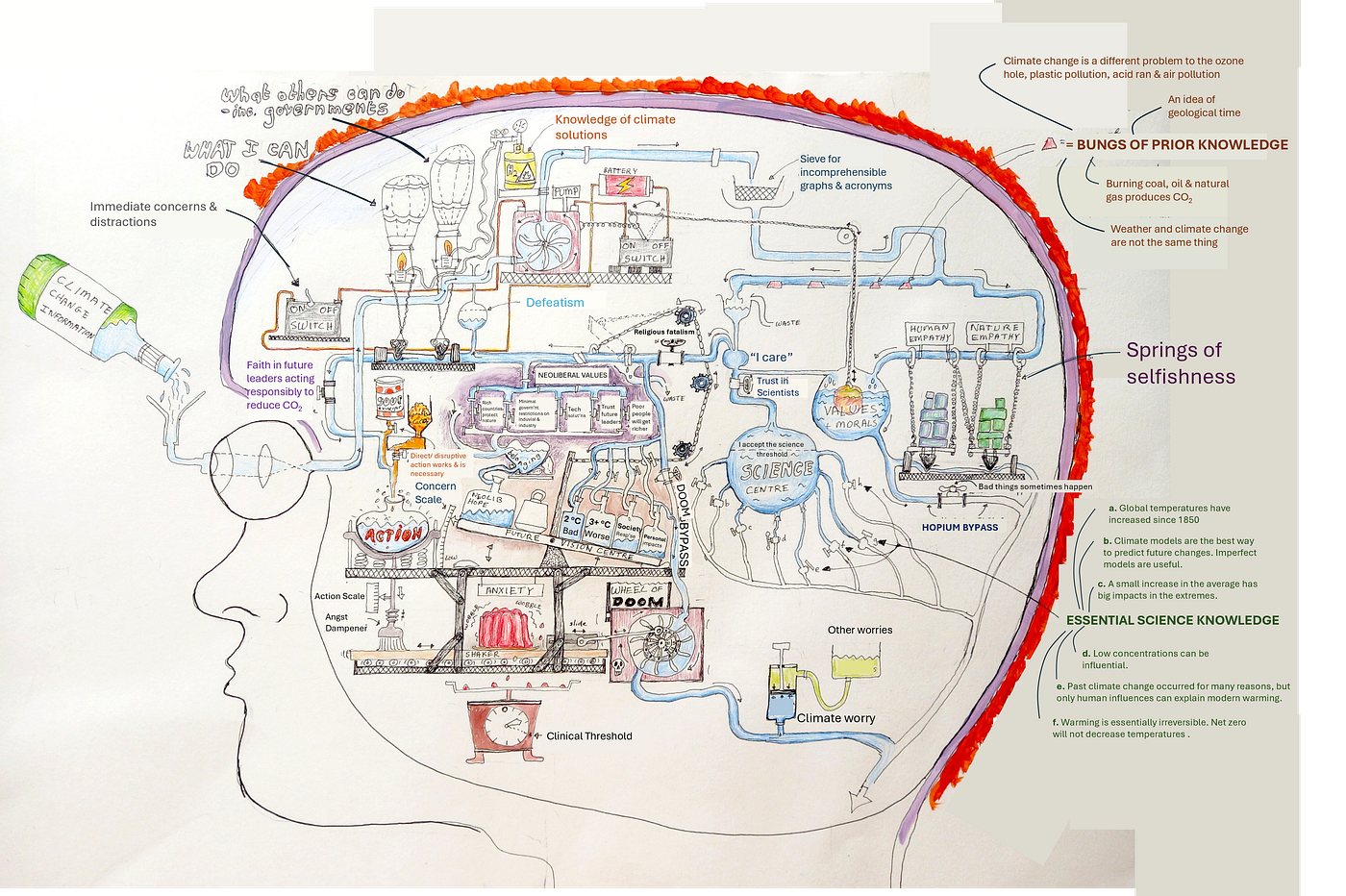
Figure 2. Climate Brain Version 2.0
The Future Vision Centre is depicted as a balance (see Figure 3 for detail). Is it worth doing something? Well, that will depend on what the visions for the future you have. But not just one future, you need two visions. It is essential to have a pretty grim vision of a potential future without climate action — to know it is something that you really want to avoid. You also need one with climate action. With both of these, you have a vision of what you are fighting for.
This, now I realise — is what some mean by ‘climate hope’. It is not that the future is particularly nice or ‘sustainable’. The future with climate action could be considerably worse than it is now, but without action it would be horrendous. A bit like having a choice of having a leg amputation with a half dose of anaesthetic, or none at all. Neither great, but one is definitely the better option.
All people I have met who are active in doing something about climate had a moment where they realised that this is serious, and that they should at least try to do something about it. Watching a documentary or a talk was often the initial trigger. Or just staring at a graph for others. It wasn’t hope that was the initial trigger, it was fear of losing things that you value.
Here, in the brain picture I depict the impact of action vs inaction as knowing what 2 oC warming looks like, compared to 3 oC warming. To tip the balance that enables the path to climate action, both of these ‘bottles’ of future vision need to be full. Of course, it wouldn’t harm to also know what 4 oC looks like, but a vision of these two is the minimum to tip the balance. The truth is, that I am yet to hear anyone outside of the internet talk about what 3 oC will look like. I’ve asked a few people too; they have no idea.
So, did the book give me a good picture of the difference between 2 and 3 oC warming? Not really, it was a bit vague. But it did paint a view of the future. This was based on past trends projected into the future. There was a lovely clear graph showing a trend with a big reduction in deaths from climate related disasters over the last 100 years. The ability to predict extreme weather is helping avert deaths from the increasing numbers of climate disasters. Improved agriculture and ability to move food around the world mean less famine too. And then in the future genetically modified crops will help make food production resistant to future droughts and pests. The great famines are a thing of the past!
I had seen variations of the graph quite a few times, often shared by the climate change denier crew. But it has faced criticism; the data behind it included great famines that had some climate influence but were largely caused by poor policy and wars. By averaging deaths over 10-year periods, these massive spikes — that contribute disproportionately to the pattern — were hidden.
OK, but, even if this graph wasn’t misleading, does this mean that trend will continue, so by the time we hit 3 oC, there are less climate deaths than 2 oC — just because it is further into the future & we’ll have more tech? For this, we need to find out what this difference really means. From what I have seen, a 3 oC world is something you really want to avoid, even for the heatwaves & associated fires alone. And given we know it is coming; we’ll prepare, right? Hmm — I’m not so sure. This is because of the extremes. For many years the climate won’t seem to make much difference to many people. Then something will happen, that people will say it is ‘unprecedented’ — how did that happen? Let’s face it, the UK trains should have worked when the temperature got above 35 degrees C. This had been coming for 40 years or so; but it still caught people by surprise.
In the podcast Michael Liebreich, brings up the discussion point that climate change could lead to societal breakdown citing Roger Hallam, the founder of Extinction Rebellion — and now in prison. The interviewer says, “It will take a millennium or more to get the extreme sea level rises?” Interestingly, Dr Ritchie did not address this directly. Neither “Near Term”, nor “Extreme” were defined for the listener. ‘Near term’ could be anything from 10 years, 80 years — when many children will be old — all going well, or 200 years — still relatively near-term in the scale of human civilisations and only a few generations away. So, a listener could easily think that a sea level rise of 3 m is impossible when, in fact, this is in the likely range by 2300 even with a lot of climate action. And a listener would never hear that by 2300, sea level rises of more than 10 m certainly can’t be ruled out.
Asked about her reaction to the scientific basis that climate change could lead to “Near term collapse of society and extreme violence”. “No”, replies Dr Ritchie, followed by a skilled swerve on to saying that tipping points are misunderstood; tipping points happen much more slowly than people think they do. So, though not addressing the question directly, a listener could be left thinking that we can rule out extreme violence or societal breakdown isn’t a threat from climate change.
So, I thought it was important to get a vision of how societies respond to climate change into the ‘future vision’ balance. What’s this all about? Well, the consequences of climate change are not just the odd hurricane, or the extreme heatwave, or even a fire that wipes out a city. The societal response could be like where climate impacts lead to a sudden decrease in global food production over a few years. Massive spike in food prices. Put another way, this is where everyone everywhere becomes poorer in the whole world — all at the same time. Would this lead to violence? — I hope not, but certainly wouldn’t bet against it.
What else could lead to societal breakdown? Rarely, in these discussions do people define society breakdown — so these arguments are mostly meaningless. But could a 3+ m sea level rise cause mass displacement — leading to wars? Yes, would be my instinct. This is quite a bit in the future, but I’m not sure we need to wait till then for societal disruption. What would happen if scientists finally got the data they need, perform some calculations and then announce to the world that the big glaciers in Greenland and Antarctic ice sheets are less stable than expected? We are heading for 10 m sea level rise within the next 250 years. Millions, possibly billions of people will be displaced eventually. While still in the distant future, everyone who lives or farms in a vulnerable area now knows that — in time — their property will be worthless. Long term investment in the area would seem futile. If not them, their descendants will need to move. Where too? Places higher up — those nice places where people already live who don’t really want any more people moving in next door. Or rich countries, with more accumulated resources, that can help to feed the few tens of million extra people. Could this lead to some sort of societal breakdown? Again, I wouldn’t bet against this.
How resilient are societies to disruptions? For me, a moment of revelation was when in 2000 lorry drivers in the UK blocked a few roads by protesting about the increase in fuel prices. In a few days the bread had disappeared from the shops. Was that all it took? A few blocked roads? Then I’m in the pub in 2008, and on the TV news banner there is something about a bank running out of money. One person in the pub was saying this is serious. I wasn’t too interested. But then it turned out it was serious. Very serious. Banks went under, people lost a lot of money, people got stuck in their houses — owing more than their houses were worth. If governments (OK taxpayers) didn’t bail some of the big banks out, then it would have been even worse.
It is not as if there was a sudden change on that date — this was a gradual process of poor decisions by a range of people. What happened in 2008 was that just that everyone suddenly became aware of what had been going on. Had all those journalists been warning the public about this for years? No. But why not? Perhaps those highly confident economics and business commentators you see on the news are just not as bright as they come across. Or perhaps the media were too busy reporting on celebrity scandals, royals and breaking news rather than looking in depth into important long-term things. There certainly were people who knew about the problem and ended up making a fortune. This shouldn’t have come as a surprise.
And what about the impacts of future warming on wildlife and ecosystems? Would readers of the book find out about what corals will be like at 3 degrees C warming? Or even the people whose livelihoods depend on these coral reef systems. Not really. I didn’t see much there.
The final thing on this slide of the future vision balance is how you see climate change affecting the things that mean something to you. This could be a vision of a flood running through your town leaving parts under water, or the landscape around you going up in flames. Or that a future vision about your children, or young people you know and care about being impacted. Even that your great grandchildren may have to migrate due to sea level rise. Or — a vision of boats full of migrants arriving and moving in next to your grandchildren, after they have been forced to migrate due to climate change.
It is only after writing this that I finally realised that this is what Prof. Katherine Hayhoe was talking about in her videos about ‘how to talk about climate change’. Scary graphs don’t work for many people. Indeed, I realised this myself in my teaching — although I should add that for me and several other people I have talked to, they work well. It is first making the connection with what people care about. In my first version of the brain, I assumed that this was just to get the information in, in the first place by the motor/pump. Only now I realise that it is also because you might want to terrify them into the feeling that — all you should not take all that lovely stuff for granted — this might be gone. But it might not be as bad with climate action. “You and I both care about our children. Did you know that they might lose everything they own?” “Will you join me and try to make sure this doesn’t happen?”. OK that might be bit of an exaggeration for effect — that is my interpretation.
The main thing is that you have a view of all these things with and without climate action.
The other side of the balance — A rosy future in a future climate
So, the other side of the Future Vision Balance were people have a rosy picture of the future — irrespective of the impacts of warming. There is a default weight that just sits there. This is because it is hard to visualise bad things in the future, or even things being different to what they are now. It is why cigarette packets are now covered with grim pictures of diseased lungs and hideous cancers.

Figure 3. Detail of the Future Vision Centre, the Wheel of Doom, and the Anxiety shaker.
The Flask of Neoliberal Hope makes up the remainder of this side of the balance. It is fed by several taps that represent different neoliberal ideas. There were ideas from the book that could have gone on either side of this balance.
The book argues that to survive climate change impacts, the most important thing that needs to happen is that poor people in poor countries need to get richer. The book is clear that the current system is working for human wellbeing; people are getting richer and living longer.
But is this idea likely to incentivise climate action? Perhaps neural for most people. But it could be harmful. For instance, how would this impact a leader? Take the decision of whether poor countries develop their fossil fuel infrastructure. Using this argument, you could argue, “Yes — it will help with dealing with the impacts of climate change”. Or a road into the Amazon or Congo forests. “Yes — it will help extract the minerals for batteries and be great for their economic development. They need to do this to mitigate against climate change”. Hence, I reckon these ideas could well be counterproductive, as they can be easily used as an argument to destroy the environment, with an environmental justification.
Related is the idea that as countries get richer, they will protect nature. This could be a conclusion from the ‘rebounding forests of rich countries’ I talked about earlier; richer countries no longer need to chop down forests for fuel, as they can afford to buy alternative fuel. Linked is they get richer, they will invest in women’s education, and this will reduce the birth rate.
A major theme in the book is that tech solutions will solve climate problems. While I partly agree, I thought that this idea could make people less likely to be activists. This took me back to another bit of the chat with the person from Saudi Arabia. Are you worried about the climate effects in your country? “No, I have an uncle who likes to go camping in the desert. He has a portable aircon in his tent” Hmm — so that’s it — in her mind excessive heat problem is solved through tech. I did think later that it wouldn’t do much good in a massive flash flood that we seem to see a lot of on the internet. The portable air-con and the tent would be rapidly rushing to the sea. Then a 50 degree C heatwave hits without his aircon. But her future vision is quite rosy, because of their faith in tech.
But one tech idea did get me wondering. The growing demand for meat around the world is fuelling deforestation. Deforestation is fuelling the heating planet. The book highlights that great areas could be reforested if only we stop eating vast quantities of meat; wildlife would thrive. But how do you do this? and who is the ‘you’ that is doing this? Meat substitutes would help. But then what? Do you just wait for them to slowly replace the meat? Or is this more of an active process? I had a vision of Oxford University data scientist academics turning up into the recently deforested semi-lawless part of the Amazon inhabited by illegal violent mining gangs. Announcing at the local drinking establishment that we don’t need to eat those tasty cows of yours, we can produce tasty protein in a factory. Time to move out of your farms and let the biodiversity flourish! Would it go down well? I don’t think so.
Surely this optimism based on tech hope will be a call to activism. On balance, I thought not, so in the picture I put the techno-hope on the other side leading to inaction. If the sea levels rise 5 m, we’ll just build higher barriers. Heat waves — portable aircon. Food shortages — well not a problem, in 50 years we will be eating different stuff grown in a climate-controlled factory and GM foods that are resistant to drought and flooding at the same time. Because all these things give a positive rosy picture of the future without the person reading it doing anything. They’ll be ‘challenges’ — but there are certainly not things that “we” can’t sort out with good tech. The capitalist system makes good tech, which will continuously get better — and given enough time, these problems will be solved. And if the vision of the future always looks rosy, then why would you get involved in climate action? There are other things to do; many more fun.
While the book is not political, according to the author, I don’t think you can really talk about this stuff without politics. Sticking to the meat substitutes — do governments restrict the freedom to eat meat, as you wish? I reckon that many people just hate the idea that governments should stopping people spending their hard-earned money as they like. This may explain the look I got when I suggested that private jets should be banned. In the Taylor Swift private jet debate very, sensible commentators (mostly Americans) were arguing that Taylor couldn’t possibly do without her private jets. It would be unfair for a government to take this away from her. Criticism of her is counterproductive. She has worked so hard for this, and she is nice and does good things. Rich people are rich because they work hard. And because of this, they deserve to consume (and pollute).
The next thing on the ‘rosy side of the balance’ is all about what you see future leaders doing. Now, just because the tech exists, it doesn’t mean it will be used. This is to capture the use of future technology. It was inspired by phrases like, “There will be problems, but we can overcome them”.
The big question is who the ‘we’ are in this sentence. In part, this refers to the leaders of the future. For instance, perhaps in 30 years’ time the lab grown meat tastes fantastic and is cheap. It could start to eat into animal agriculture. But all it takes is for a few world leaders to ban ‘fake meats’, and all this is undone. Also, these farmers now live in the recently deforested Amazon, on their family farms. It would take a government to actively expel them from their land. Perhaps some of these politicians have farmer friends who they want to protect. I just don’t have that much faith in future leaders. Even if they want to, they may have wars to fight, financial crashes to manage, a pandemic to manage, health services to run — or many or other big problems we haven’t thought of to sort out. I thought this was a bit of a crazy idea. But this was first written a month ago. Now the Tump, Musk, Vance and anti vaxer RFK Jn are in power, I don’t need to write much more to convince anyone that trusting leaders of the future to do the right thing is a good idea.
Likewise, if countries keep on investing on the ever-higher barriers to keep out the rising sea — all subsequent future leaders forever will need to keep the cash flowing to maintain them. The barriers are also an obvious target in any conflict.
Linked to this is another tap, before going into the action centre. This is about trusting leaders to turn on the carbon-sucking switch. Scientists are discussing things like spraying fine sulphur or building big carbon suckers to reduce the temperatures if it just gets too hot. But this requires the future leaders to turn on the big carbon suckers to sort out the “overshoot”.
Last, but certainly not least, the thing feeding into this side of the balance is Neoliberal Belonging. This is more of a fuzzy warm cherry pie with top quality ice cream feeling of being in a group of similar people. When people agree with you when you say neoliberal things. An extreme case is the MAGA cult in America. Turning up to a Trump rally, where everyone else is wearing the red cap and is pro-gun with gold Trump shoes in your Tesla cyber truck and a sympathy ear patch. It must just feel good. So, when you say stuff like, “I used to be a liberal, now I believe in energy freedom”, now your mates think you are great.
Any time there is a dangerous wildfire anywhere these days, people — instead of liking to this to climate — there is a group who say, “It’s arson” or “All these fires are NOT a coincidence, they are being set by leftists”, or “the environmentalists have stopped sweeping the forest floor”. This blaming of the other group reinforces this Neoliberal Belonging identity. That’s an extreme case, and American right wing are quite different to the Brits, who seem much more up for an argument (they click on Twitter links and argue back; American right wing doesn’t even click). But I reckon this ‘belonging’ feeling might be widespread. When anyone who mentions things like climate crisis or climate emergency, looks a bit hippy-ish, or like a trustafarian, they will automatically be dismissed. A message goes off in the brain, “you’re one of those alarmist liberals with no idea of the real world — we are against that”.
In the picture, there should probably be a link to the main ‘ON’ switch here. This Neoliberal centre perhaps should be moved to the values centre. Perhaps I’ll put it in Climate Brain Version 3.0.
A new place for the old doom, and the anxiety shaker
While clearly important, I wasn’t that too interested in the mental health/ emotion side of this topic. But why not put them in? It would be fun. And emotions make you do things or not, so can’t be separated from climate action.
In Version 2.0, one type of ‘doomisim’ is represented by the ‘Wheel of Doom’. This is driven by having a grim vision of the future and is perhaps a bit unavoidable. If you get the science, and care about the consequences, seeing news stories about climate will drive the wheel of doom. However, there are two paths to the wheel of doom. In the first route, the message first adds to knowledge of a future vision with and without climate action. This helps to tip the future vision balance. Messages that fail to do this go by the second route — straight to the ‘doom bypass’. This is wasted energy; it drives doom but avoids filling the future vision balance.
The wheel of doom drives the anxiety shaker, where the anxiety jelly sits. The more doom — the more anxiety. Is anxiety a bad thing? Yes and no. Anxiety can be a good motivator, so the jelly is allowed to wobble. But anxiety can be crippling too, hence there was a threshold where the jelly started wobbling too much, it started falling apart. Anxiety shaker in the picture is dampened down by being involved in climate action; knowledge that you are trying to be doing something.
The doom definitions, ‘there is no point in me doing anything — it won’t work’, and ‘I have no idea what I can do’ lives elsewhere. This is renamed ‘defeatism’.
The Action Centre
The Action Centre of the Brain cartoon has two components: knowledge of what needs to be done (e.g. by governments), and knowledge of what you can do. These are represented by hot air balloons. Fill these using the ‘hot air’ of your knowledge of what to do, and the valves lift up, then you can become some sort of activist through filling the Cauldron of Action. The decision to become a marching / protesting / disruptive activist is a separate tap which adds a bit of ‘spice’ to the activism, this releases orange calcium carbonate / cornflour mix, and tomato soup/vinegar mix that fall separately into the cauldron then react.
I thought that Not the End of the World would be helpful here, for those who are already worried. Plastics recycling — not really a climate issue. Massive consumption of beef — big climate problem. Replacing burning stuff with electricity and batteries — a good idea. But to get a better understanding of how the book might influence the reader; I would need to think a bit. In the podcast, the conversation was quite dismissive of doing something like join Extinction Rebellion or breaking the rules to highlight climate inaction. I needed to figure out a logic and see how the book influences each step.
- Do you think the risk of a future of 3 degrees C or above is acceptable? — No, staying under 2 degrees C is a much better idea. While the book makes it clear that even 2 degrees C would be bad, I don’t think it makes it clear how much worse 3 degrees C would be — in that the implications were not explicitly spelled out. And I think from reading the book that we will likely avoid warming over 3 degrees C anyway. Hence the book might not allow information to get to the action centre due to not enough weight on the right side of the future vision balance.
- Can staying under 2 degrees C be done mostly by a slow introduction of green policies — things like substitution of burning stuff with renewables — like many countries are doing already? No. Of course it will help, but the graphs I have seen indicate emissions need to fall very rapidly to ensure we don’t exceed 2 degrees C. I don’t think the book was explicitly clear on this. It has more of a ‘we are making good progress, but more should be done’ message. The extent of action required to be sure that the world doesn’t exceed 3 degrees C is not spelled out.
- Is large-scale societal change required to be quite confident the world is under 2 degrees C in 2100 — things like less flights, reduced cars (not just electric), radically reduced beef (and other meat) consumption, replacement of cities with cars with cities with bicycles and solar-powered electric trams? Well — Yes would be my guess. Global carbon emissions need to go down rapidly. They are still going up — despite good progress made in some areas. What did the book say? Not much. It did argue that ‘guilt shaming’ for people taking unnecessary flights wasn’t a good idea. For many readers this may give the idea that I thought it was perhaps unlikely that a reader would feel that this is something that needs to be acted on very rapidly. Banning private jets? Limiting size of cars to stop car bloat? Public transport? Cruise ships? There wasn’t much here.
- If we need large scale change, how does this happen? Is everyone just doing their bit sufficient? No, because not enough people get the extent of the problem, or care enough. Also, while doing something positive might be possible a few times, when everyone else is not doing it, then it takes huge willpower to reduce those flights to go on holidays. Basically, if it feels good, and it is easy, and everyone else is doing it — you probably will be tempted. So, do governments need to act decisively? What does the book say? Well, it does say that both individual and government action are necessary. It suggests that the answer is relatively simple — governments just need to put a price on carbon emissions.
- Will governments do this anyway, just because it is the right thing to do? No. Some have certainly done a bit and feel good about it, but not enough to ensure we stay under 2 degrees C. Left alone, some of them will work green technologies into the economy — while pursuing economic growth. A bit like they are doing now, and the world will end up between 2.5 degrees C and 4 degrees C by 2100. Political parties, and various other leaders are lobbied hard and funded by polluting industries. Even the top people in universities can’t be too outspoken. They need money from fossil fuel industries. Furthermore, I secretly suspect that many politicians don’t think global warming will be that bad — as few have talked informatively and passionately about this (since Margaret Thatcher). In fact, I don’t think I have ever seen politicians asked direct questions on this. But then if the journalists don’t understand this too, then they wouldn’t ask.
- Now, will governments be honest about what they are doing compared to the scale of what is necessary? No. They will say they are doing enough, even though they are not doing enough to meet their commitments they signed up to. Some simple low-hanging fruits have still not been implemented. Gas boilers are still going in, new petrol cars are still being sold, private jet use is going up, not down.
- Now there is the thorny question that if governments won’t just do what is necessary — then what? I mean, OK, it’s great to suggest ‘carbon tax’ is a great fix for many problems, but many governments won’t read the ‘carbon tax’ bit and think, “OK, let’s do that — it makes sense”. What would a reader of the book do? Kick off? March? Start throwing soup? Perhaps unlikely, though I didn’t see much guidance for readers. Can protesting/disruptive activism make a difference? My guess is that it does. Look how the big injustices in the past came to an end — things like apartheid in South Africa, civil rights in USA, ending Britain’s involvement in the trans-Atlantic slave trade, the right for women to vote? It was when a few charismatic leaders, with the support of lots of individuals put pressure on the leaders to change. While this started with individuals, it was the governments that implemented the new rules/laws. In the interview, the idea of doing something like join Extinction Rebellion was dismissed. Instead — come a climate aware MP, or engineer who works on solar panels and wind turbines.
- Can democratic governments do unpopular things? Yes, would be my guess, but you need charismatic leaders to drive the change. There was also the suggestion in the interview that governments in a democracy are powerless to do big things for the long term good. Such policies would be election losers. I hope not. In the interview Dr Ritchie suggests degrowth is not politically feasible within the next 5 to 10 years. I mean, what happens in 10 years’ time that could change anything? To me, therefore, this is an argument that degrowth is impossible. OK, I admit that I’m a bit out of my depth; I’m not 100% sure what degrowth is, but I guess it is sort of thing that’s required to have confidence that the world does not heat beyond 3 degrees C. There are, in fact, a lot of rules that people just accept for the greater good. Telling people that smoking is dangerous didn’t stop the pubs filling with smoke. Making it illegal did. Go to London, there are now places with very few cars. Likewise in Paris, so I’m told. These are big changes that at one time were unpopular and seemed impossible.
Ideas in the book — conducive to activism?
OK — so enough waffle. Since the original trigger for Version 2.0 of the Climate Cartoon was the book, “Not the End of the World”, what does the brain cartoon tell us about if it is leading to action or inaction?
This was tricky! In fact, the truth is I had forgotten until recently that this was the original inspiration for updating the picture, but I just had another look/listen to the podcast. The brain cartoon suggests that this depends on what is in the brain already. If you are already worried, but don’t know much, it could help to clarify which things would have a big impact, and which are less impactful. But if you are not already very worried, I couldn’t see how the book would make you more worried — probably less. It failed to paint a scary picture of the world without serious climate action.
What I thought could be harmful is that some readers/listeners may get the impression that anything said by disruptive activists, or climate reporters say is exaggerated — overhyping the bad situation we are in. Thinking, “these activists are alarmist doomers manipulated by coverage of climate change in the Guardian”, or “their doomsday messages can demotivate action they should focus on data-supported approaches and long-term trends instead (which look great).” Labelling disruptive activists as ‘doomers’ or ‘alarmists’ is a problem in my view; it hides the range of views of this group.
Take home messages — what should people do?
So, does the Climate Brain project have anything new, or even useful, to add? Have I just wasted my time? Perhaps, but I enjoyed it. Nevertheless, here are recommendations from Climate Brian Versions 1.0 and 2.0. I added some ideas when I first drew Version 1.0 (Figure 4), and most of these are OK still in my mind. I’ll just list new insights below– though I’m sure others will have said the same stuff elsewhere.
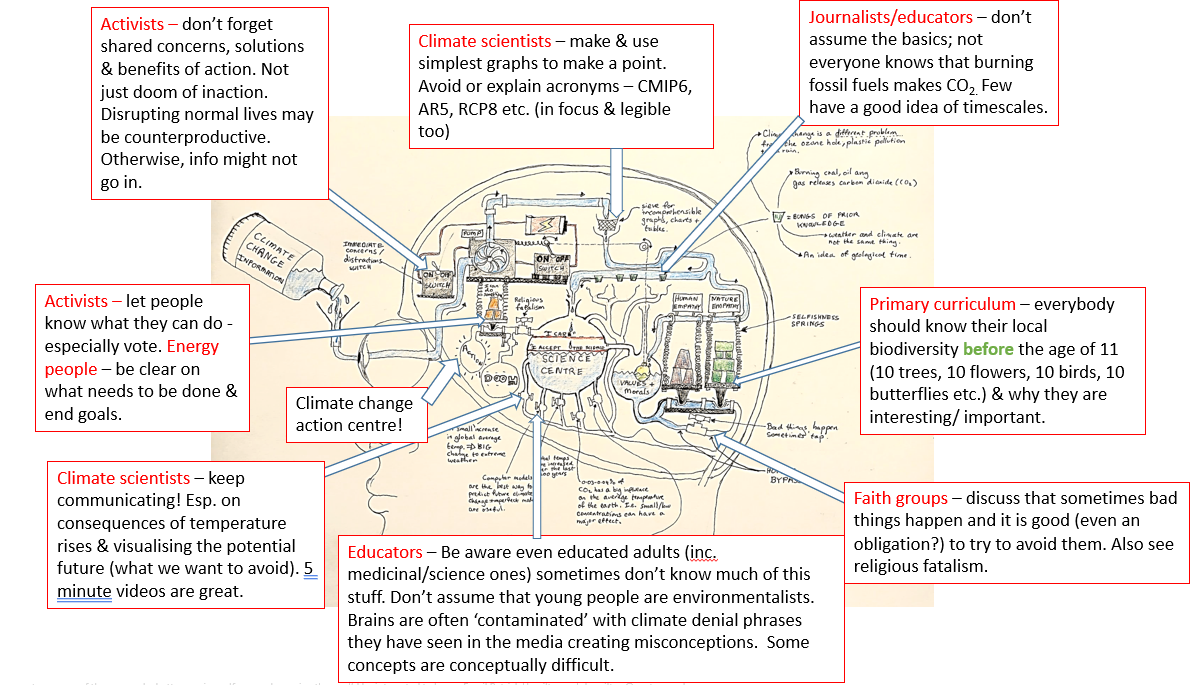
Figure 4. Ideas of what different people can do, from Climate Brain 1.0
Educators: Earlier on, in education such as primary school developing the Values Centre is vital. A first step into building empathy for the environment might be recognising what’s around you and knowing why it is interesting. Perhaps during primary school, 1 week a year at a field centre doing some interactive stuff like making charcoal with different types of wood. This could be combined with farming and cooking from scratch, developing an understanding of where it all comes from. Somehow, it would also be good to get the idea that people living in poor climate-prone regions are just people, like them. Long term relationships with others should be possible now, with the internet. You can’t love what you don’t know. Without this, climate information taught later might just not get into the brain or escape from the ‘values’ centre.
Science is quite complex, full of abstract concepts. With so many scientific misconceptions, there needs to be a series of active learning steps to address these. Given that teachers have no time — these need to be complete differentiated lessons and honed by lots of feedback. There should be videos of these lessons in practice ‘in the real world’ to save teachers even more time wondering how to convert these resources into a lesson. Perhaps these already exist. I haven’t looked.
In university education, surely, we don’t need to spell out the basics of climate science?; they already know this when they arrive? Well, we might. If you don’t, whatever you say will be dismissed by those already disengaged. I reckon every undergraduate class will have students with misconceptions in fundamental science. The current popular strategy of seamless integration of snippets of climate change into courses might just not work for people with fundamental misconceptions.
Reporting on Climate: Pretty much the only time that people will take notice of climate change is during extreme climate-related disasters. Therefore, scientists and journalists need to capitalise on the disasters, because it gets around the ‘immediate distractions switch’. In fact, they do a good job of this already. But what do you say, when a newspaper asks for a quote, or you get to talk for 30 seconds on the news? The standards are variations of “these things will get worse as the world will warm”. This is a ‘Doom Bypass’ statement. It is pointless. Of course it will; everyone knows that already. It becomes a ‘let’s have a worried academic on to bulk out a climate report to tell us what we already know’ moment.
Reporters seem to have cottoned on to the idea that just presenting depressing news might be counterproductive. Indeed, it may well be for some people. But they now sometimes add a hopeful message at the end of a depressing news story. For example, “There is a mass bleaching event going on in an enormous coral reef, and these events will only get more frequent. However, scientists have grown heat resistant corals in the lab”. But fail to mention that this is likely to fail. I think this is a misuse of hope. The problem is that people will add equal weight to both statements yet pouring buckets of heat-adapted coral larvae on a degraded reef the size of France just won’t do that much, a bit like homeopathy for reefs. Hence as many people will leave with the feeling that ‘the coral reefs are fine’ as with ‘there is a serious problem’. This is giving someone an Alzheimer’s disease diagnosis but then adding that scientists have just identified another protein involved in the disease process.
Others best avoided are, “This is why I’m confident we can stay below 2 oC. It just opens the Hopium Channel. There is a similar problem with the word ‘solutions’. These are not really solutions to the climate crisis — they are the things that will make impacts of climate less horrendous.
So, for both scientists and reporters, your job — given your 30 second sound bite opportunity is to build a vision of the future, based on what’s just happened. “If the world reaches 2 degrees C, something similar might occur once every [e.g. 20 years]. But if the world reaches 3 degrees C, it will be like this.” Even better to link this vision to imagery, rather than just numbers and statistics, e.g. “the landscape here will look more like that you see in [insert country]”. This covers both hope and doom, so there shouldn’t be any complaints. Stick to two temperatures — don’t add any more. I was in two minds about whether one of these temperatures should be 4 degrees C rather than 3 degrees C. Perhaps add the speed of action required to make the difference. The point is they will see the necessity to act but don’t leave them with false hope.
I would also avoid the standard responses: “This type of event will become more common with warming, and “every fraction of a degree matters” and “we can avoid this if we act”. These sound good but convey no new information to most listeners. The other one that is used, is ‘this was made 30% more likely due to climate change”. I really don’t think this is useful. People know this anyway, and, of course, risks being wrong for tricky to model things like wildfires.
I know that many climate change scientists already think they are doing what they can. I once observed a conversation between quite famous professional climate scientists on Twitter congratulating each other on their outreach work. “We have done our bit” sentiment. I think they are wrong. Not completely — there are some great communicators, but I once bumped into a climate scientist at a science festival — aimed at the public. I asked him what he did (his display wasn’t about climate). Worked on models of future rainfall in Africa. Now, amazingly despite spending lots of time on Twitter reading about climate from various links, I don’t think I have heard anything about future rainfall in Africa. I would remember if I had. I’d really like to know what my (now young) relatives will experience in 2100 if the world hits 3+ degrees C warming. So, I ask him, “Do you put your insights on Twitter — it could be interesting to lots of people?” “No. we don’t have time — too busy writing grants, papers and doing the research. That’s difficult enough. I know some who have tried, but they get attacked relentlessly by internet trolls, so gave up.”
It struck me that there is a whole continent that needs to know what he knows, but he was not engaged in the easiest means of communication. Quite frankly I thought he and his mates should toughen up a bit; just block or ignore the annoying accounts and keep going. Or set up some anonymous accounts. Just 2 hours a week — that’s all it takes. Now BlueSky and LinkedIn are taking up the slack, the troll problem isn’t a real barrier (although you may just end up talking to like-minded people). But I still know nearly nothing about rainfall in Africa, societal tipping points, future food shortages, Australian, Californian and Mediterranean fires, or even what a heatwave in England looks like if we hit 3+ degrees C, despite regularly reading the media reports on climate. There must be many scientists with huge knowledge of these out there close to a keyboard.
Journalists Interviewing Politicians: This is always tricky. They are very honed and smooth. But the one thing that is always missing is what politicians think the world will be like without climate action. Simply ask them what the implications of climate inaction are and listen. What do they bring up? Do they answer the question? Say something vague, like ‘it will be serious, but fail to quantify anything. Or do they convey an accurate vision of a world they really want to avoid? We really need to know this. It is easy to argue for the need to go slow, if you don’t have a clear idea of what you are trying to avoid.
Surprisingly, these are two questions I have never heard. I somehow suspect that the journalists don’t know enough to judge if the answers are correct. Indeed, it wasn’t long ago that they used to invite fully paid-up climate change deniers onto mainstream TV to add a bit of balance.
The lack of aftermath about Climate Brain Version 2.0
So, I put the new version, Climate Brain Version 2.0 on Twitter. Unlike the first version, there was not a huge amount of interest. But then the drawing wasn’t great. Too busy, inconsistent style, and it had wonky out of focus writing (I should have taken my own advice). On BlueSky — the same — except Marc invited me to write a blog about the picture. I got a bit carried away. So here it is.
Perhaps in the summer I’ll make Climate Brain 3.0.
I hope it is of some use to somebody somewhere, and has a (positive) influence! If this has influenced your teaching or communication in any way, I would be interested to know.
Written and drawn by Patrick Hamilton — @patbhamilton, p.b.hamilton@exeter.ac.uk
메타데이터
- post_id
- a337d88b3ade
- slug
- the-climate-brain-why-isnt-everyone-a-climate-change-activist-a337d88b3ade
- url
- https://medium.com/@patrickhamilton103/the-climate-brain-why-isnt-everyone-a-climate-change-activist-a337d88b3ade
- canonical_url
- https://medium.com/@patrickhamilton103/the-climate-brain-why-isnt-everyone-a-climate-change-activist-a337d88b3ade
- author_url
- https://medium.com/@patrickhamilton103
- status
- ok
- fetched_at
- 2026-06-23 03:48:11