The Fear Your Grandfather Felt
Are your phobias, talents, and deepest anxieties truly yours, or are you just replaying a biological script written by ancestors you never…
The Fear Your Grandfather Felt
Are your phobias, talents, and deepest anxieties truly yours, or are you just replaying a biological script written by ancestors you never met?
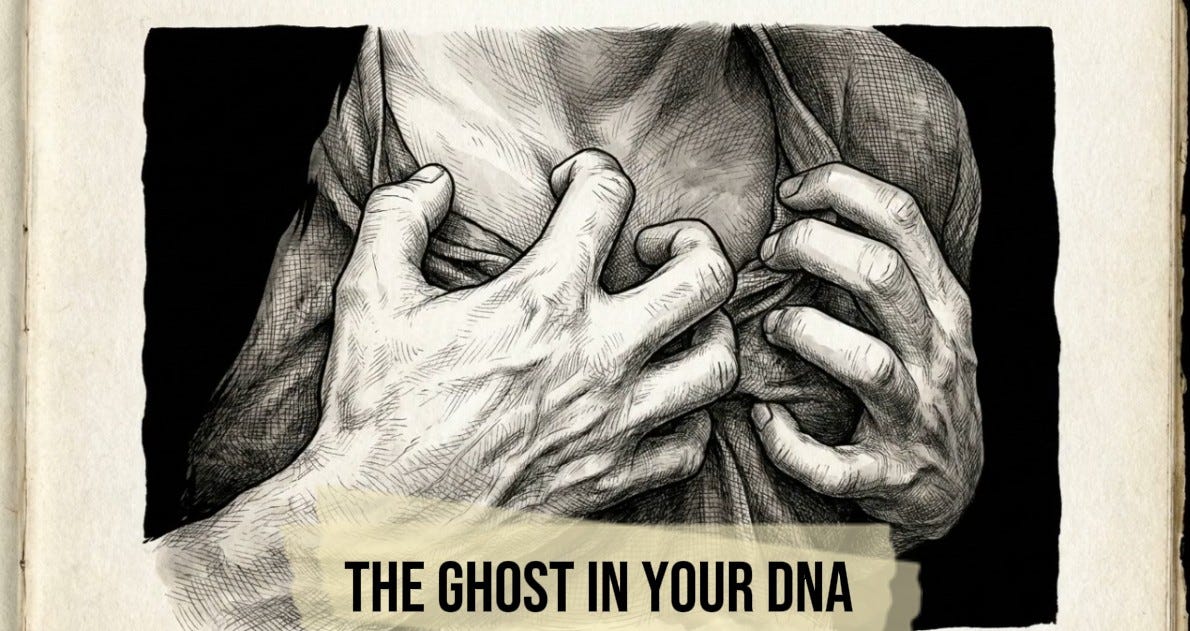
The Ghost in your DNA
The Mice That Were Never Shocked
In a laboratory at Emory University, researchers did something quietly extraordinary to a group of mice.
They taught the mice to fear the smell of cherry blossoms.
Not through instinct — through experience. Every time the scent of acetophenone drifted through the cage, the mice received a mild electric shock. The association formed quickly. Soon, the smell alone was enough to produce the full physiological panic response — elevated heart rate, freezing, the complete readiness to flee something that was no longer there.
Then the researchers waited.
The conditioned mice had offspring. Those offspring had never been shocked. They had never smelled cherry blossoms in any context other than safety. And yet, when the scent reached them, they flinched. Their nervous systems responded with a sensitivity that was measurably, specifically greater than mice with no such history. The fear had traveled — not through memory, not through observation, but through biology. Through the body itself.
The grandchildren showed the same response.
A fear earned through experience by one generation had been inherited, without experience, by the next two. The shock was gone. The lesson remained.
Explore the haunting reality of Genetic Memory. Beyond DNA and physical traits, discover how our flesh remembers the trauma, fears, and triumphs of the past, turning human consciousness into a decentralized generational archive. →
[embed]
The Ghost in the Body
This is not metaphor. It is a mechanism.
The human body carries two kinds of inheritance. The first is genetic — the sequence of DNA that determines eye color, blood type, the architecture of the face. This is the inheritance everyone knows about.
The second is epigenetic — a layer of chemical switches that sit on top of the DNA and determine which genes are active and which are silenced. These switches respond to experience. Stress, trauma, sustained fear — all of them leave marks on the epigenome, turning certain genes up or down in response to the environment.
What the Emory mouse study showed is that some of these marks survive the passage between generations. The fear learned by the father altered the chemistry of his sperm in ways specific to that fear. The offspring were born with a nervous system already tuned to the stimulus — already sensitized to the smell that their father had learned to associate with pain.
The body had written the lesson into the next generation's hardware before the next generation existed.
The Snake You Never Met
You have probably never been bitten by a snake.
You may never have encountered one in a situation of genuine danger. And yet, if a snake-like shape moves suddenly at the edge of your vision — a garden hose, a length of rope, a shadow with the wrong kind of motion — something happens in your body before your mind has processed what it saw.
The heart rate spikes. The muscles contract. The breath catches. All of this occurs in approximately twenty milliseconds — faster than conscious thought, faster than the visual cortex can resolve what it actually saw. The body has already responded to the threat before the mind has confirmed the threat exists.
This is not irrational. It is a system optimized for a world in which the cost of a false negative — not reacting to a real snake — was death, and the cost of a false positive — reacting to a harmless shape — was a moment of embarrassment. The system evolved to accept false positives freely, because they were survivable. The false negatives were not.
The result is a nervous system that carries, in its very structure, the accumulated fear responses of ancestors who survived long enough to pass their genes forward. The ones who did not flinch when they should have — they are not here. Their descendants are not here. The ones who flinched at everything, even the hose, even the shadow — they survived. We are their children.
Our brains are, in a literal structural sense, a tribute to the snakes of the past.
The Mismatch
The system works. It has always worked. For most of human history, the threats that activated it were the threats it was designed for — immediate, physical, localized, resolvable. The predator appeared. The body responded. The predator was escaped or confronted. The cortisol cleared. The nervous system returned to baseline.
This is the rhythm the body was built for: spike, response, resolution, recovery.
What the body was not built for is what it now faces every hour of every day — a continuous, low-level, irresolvable stream of threat signals delivered through a screen. The news cycle does not resolve. The notification does not conclude. The crisis is always ongoing, always global, always just visible enough to activate the ancient circuits and never specific enough to be addressed by running or fighting.
The amygdala — the brain's threat-detection center — cannot distinguish between a predator in the grass and a headline on a phone. It registers threat and prepares the body. The cortisol rises. The muscles tighten. The attention narrows. And then — nothing. No resolution. No escape. Just the next headline. The next notification. The same threat, still present, still unresolved.
Among the Kaluli people of Papua New Guinea — living in conditions closer to the ancestral environment for which these systems were designed — the rate of clinical depression is nearly unmeasurable. In industrialized populations, it exceeds five percent and rising.
The hardware is ancient. The environment is new. The mismatch between them is where modern anxiety lives.
What You Inherited
The fear of heights. The unease in enclosed spaces. The specific, irrational dread of spiders in a country where no spider can seriously harm you. These are not weaknesses. They are not failures of rationality. They are the accumulated survival responses of people who lived in a world where heights killed, where enclosed spaces trapped, where certain small creatures were reliably deadly.
Those people survived. You are here because they survived. And because they survived, their fear is yours — not as a memory, not as a story, but as a tuning in the nervous system, a sensitivity in the neural pathways, a response that fires twenty milliseconds before the thinking mind can intervene.
The Emory researchers showed that this tuning can be written in a single generation and read by the next two. The Johns Hopkins study published earlier this year found five hundred cases of non-standard inheritance — fears and traits appearing in descendants that were absent in both parents, arising from somewhere in the ancestral record without direct transmission.
We are not blank slates. We are annotated documents — marked up by every generation that came before us, carrying responses to threats that we have never personally encountered and may never encounter, flinching at the shape of a danger that our great-grandparents knew and we have only inherited.
The Pen
There is one thing the mouse study cannot tell us, because mice cannot do it.
The mice who inherited the fear of cherry blossoms could not know that they had inherited it. Could not examine it. Could not ask why the scent produced the response it did, or trace the response back to a laboratory three generations ago, or decide — with full knowledge of the mechanism — how to relate to what they felt.
We can do this.
The twenty-millisecond response of the amygdala is faster than thought. The fear arrives before the mind. This is true and probably permanent — the hardware is not being redesigned. But the mind that arrives two hundred milliseconds later, the mind that catches up to the fear and can examine it and name it and trace its possible origin — that mind has options that the nervous system alone does not.
Not to eliminate the fear. Not to talk it out of existence with logic. But to hold it differently — to recognize that the flinch at the garden hose is not a commentary on the present moment but an echo from a world that is mostly gone, that the tightening in the chest at the news headline is a system doing exactly what it was designed to do in a context it was not designed for.
The script was written in blood. By people who survived something. For a world that no longer entirely exists.
But the question of what to do with the script — that part, for the first time in the history of the species, belongs to us.
메타데이터
- post_id
- a344f4bbdb4f
- slug
- the-fear-your-grandfather-felt-a344f4bbdb4f
- url
- https://medium.com/@muhammed.ht26/the-fear-your-grandfather-felt-a344f4bbdb4f
- canonical_url
- https://medium.com/@muhammed.ht26/the-fear-your-grandfather-felt-a344f4bbdb4f
- author_url
- https://medium.com/@muhammed.ht26
- status
- ok
- fetched_at
- 2026-06-12 07:40:50