Architecting the Agentic Enterprise: Key Takeaways from Snowflake Summit 2026
Let’s be honest: most organisations are still figuring out AI.
Architecting the Agentic Enterprise: Key Takeaways from Snowflake Summit 2026
Let’s be honest: most organisations are still figuring out AI.
While there has been plenty of experimentation with chatbots, copilots, document summarisation, and code generation, many businesses are only now starting to understand what AI means for their architecture, operating models, governance frameworks, and development practices. New terminology seems to appear every month, from Retrieval-Augmented Generation (RAG) and Model Context Protocols (MCPs) to agents, agentic workflows, skills, and AI-powered automation.
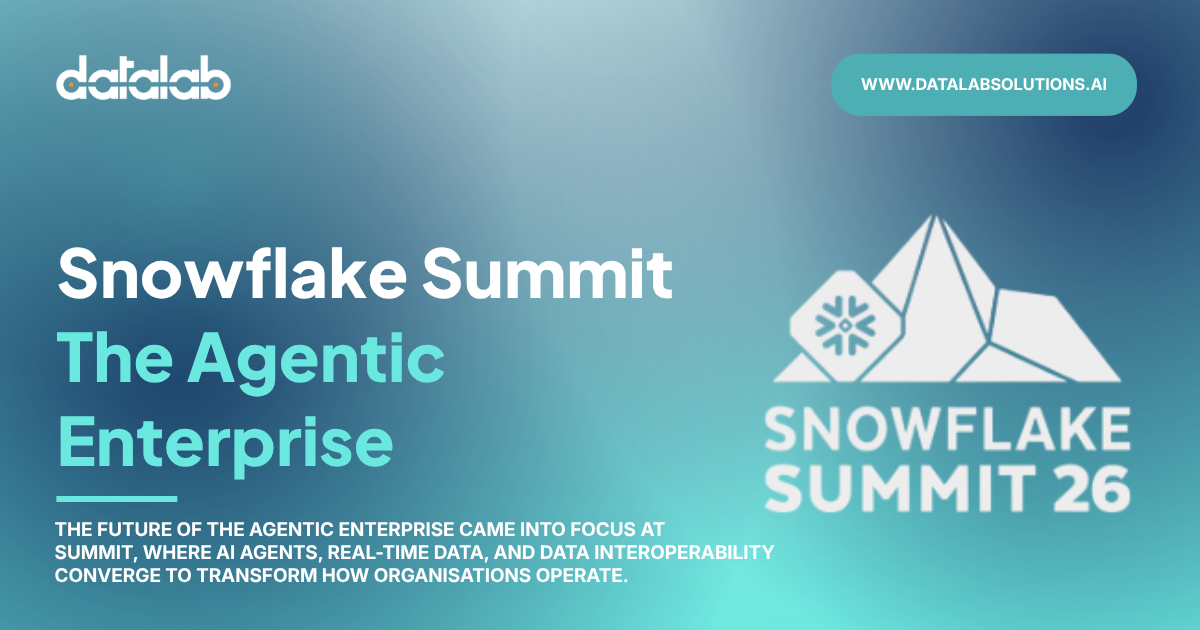
What Snowflake Summit 2026 demonstrated is that the conversation is rapidly moving beyond AI assistants towards the concept of the Agentic Enterprise, a world where AI doesn’t simply answer questions but actively participates in business processes, collaborates with employees, interacts with enterprise systems, and helps drive decisions.
However, for this vision to become reality, organisations need more than just AI models. Agents require access to trusted, governed, and real-time data. They need to work seamlessly across applications and platforms without complex integration projects. They need the ability to understand business context, operate within governance boundaries, and make decisions using current information rather than yesterday’s batch loads.
Several key themes emerged throughout Summit 2026. Data velocity is becoming increasingly important as organisations look to support real-time decision-making through streaming architectures. Interoperability is replacing traditional integration approaches, with open standards such as Apache Iceberg removing friction between platforms and enabling data to be shared and accessed across different technologies. Agentic development practices are beginning to emerge, bringing together local development environments, cloud execution, enterprise data, AI agents, skills, and MCP-connected tools into a single development experience. At the same time, governance is evolving beyond data protection to encompass agent identity, accountability, security, and control.
The question for organisations is no longer whether AI is coming, but whether their data platforms, governance models, architectures, and teams are ready for what’s next.
Snowflake Summit 2026 provided a glimpse into how Snowflake intends to address these challenges and build the foundation for the Agentic Enterprise.
1. The Rise of the Agentic Enterprise
Perhaps the most significant shift at Summit was the evolution of AI from assistant to worker.
Over the past two years, most organisations have focused on AI assistants. Employees ask questions, generate content, summarise information, and receive recommendations. While valuable, these use cases still require humans to interpret the results and take action.
The next phase is fundamentally different.
Agentic systems are designed to execute tasks, orchestrate workflows, collaborate with employees, and interact directly with enterprise systems. Rather than simply supporting work, agents become participants in getting work done.
This shift introduces new opportunities and new challenges. Organisations will need to think about how business processes are designed, how human and AI workers collaborate, how institutional knowledge is captured as reusable skills, and how governance extends beyond data access to autonomous decision making.
Many organisations are still learning the terminology and experimenting with the technology. However, the direction of travel is becoming increasingly clear. The future workforce is likely to consist of both humans and AI agents working together.
Key announcements
- Snowflake CoWork (formerly Intelligence)
- Multi-agent orchestration
- User Skills for reusable business capabilities
- Agent Automations
- Cortex Sense enterprise memory
- Natoma acquisition
- Personal enterprise agents for knowledge workers
2. Data Velocity: The Fuel for Agentic Decision Making
One of the strongest messages from Summit was the growing importance of data velocity.
Traditional analytics platforms were designed around historical reporting. Daily refreshes, overnight processing, and scheduled reporting cycles were often sufficient for business decision making.
Agentic systems operate differently.
An AI agent managing inventory, monitoring fraud, responding to customer interactions, optimising logistics, or coordinating operational workflows requires current information. Waiting hours or days for refreshed data introduces delays that reduce effectiveness and limit autonomy.
As organisations deploy more intelligent systems, streaming data becomes increasingly important. The ability to process events as they happen enables agents to make more informed decisions and respond to changing business conditions faster.
This represents a significant architectural shift. Many organisations have invested heavily in data warehouses and analytics platforms but have not yet fully embraced streaming architectures. Summit 2026 suggests that streaming is becoming a foundational capability for supporting agentic workloads.
Data velocity is no longer simply a technical concern. It is becoming a business capability.
Key announcements
- Snowflake Data Stream, fully managed Kafka-compatible streaming
- Postgres Data Mirroring
- Adaptive Compute
- Interactive Compiler
- Unistore enhancements
- Hybrid Tables General Availability

3. Interoperability is Replacing Integration
For decades, enterprise data architecture has largely been built around integration.
Data is extracted, transformed, copied, replicated, and moved between systems. While this approach has enabled analytics and reporting, it has also introduced significant complexity, cost, and governance challenges.
Every copy creates friction.
It increases storage costs, creates reconciliation challenges, introduces latency, and complicates security and governance.
One of the most important strategic themes at Summit was the move towards interoperability.
Instead of moving data between platforms, Snowflake is increasingly focused on allowing different technologies to operate against the same governed datasets. This approach reduces duplication while providing organisations with greater flexibility in selecting technologies and tools.
Apache Iceberg has become a central component of this vision.
Open table formats allow organisations to avoid locking data into a single processing engine while still maintaining governance, performance, and consistency. As AI, analytics, operational systems, and external engines increasingly need access to the same information, interoperability becomes critical.
In many ways, interoperability may prove to be just as important as AI itself. Organisations cannot create intelligent systems if information remains trapped within silos.
Key announcements
- Snowflake Managed Iceberg Storage GA
- Apache Iceberg v3 support
- Bi-directional external engine writes
- Open Sharing enhancements
- Cross-platform data access
- Zero-copy sharing capabilities
4. MCPs and the Connected Enterprise
AI agents create the most value when they can take action.
Answering questions is useful.
Executing tasks is transformational.
One of the most interesting themes from Summit was Snowflake’s commitment to the Model Context Protocol (MCP) ecosystem. MCPs are rapidly emerging as a standard mechanism for connecting agents to enterprise applications, services, APIs, and tools.
Historically, every integration required custom development. APIs simplified this challenge by standardising how applications communicate. MCPs have the potential to do the same thing for AI agents.
This matters because organisations operate across hundreds of systems. CRM platforms, ticketing systems, collaboration tools, development environments, finance applications, and operational platforms all contain information and business processes.
For agents to become truly useful, they need to interact with these systems.
MCPs allow agents to move beyond simply retrieving information and into executing business actions. Creating tickets, updating customer records, triggering workflows, sending communications, and coordinating activities all become possible through a common integration framework.
Many organisations are still exploring how MCPs fit into their architecture, but it is increasingly clear that they will play an important role in enabling enterprise AI adoption.
Key announcements
- MCP support within CoWork
- MCP support within CoCo
- 100+ enterprise MCP integrations
- Salesforce, Jira, Slack, ServiceNow, Gmail connectivity
5. Agentic Development Practices are Emerging
Software development is changing rapidly.
Developers are increasingly working alongside AI systems that can generate code, analyse repositories, execute commands, investigate issues, and automate repetitive tasks.
This shift is beginning to influence how development environments themselves are designed.
Historically, developers worked within local environments that were largely disconnected from enterprise data platforms and governance frameworks. The emergence of cloud-hosted agents and AI-native development tools is changing this model.
Development workflows are becoming increasingly integrated with enterprise data, cloud infrastructure, documentation repositories, and operational systems.
This creates opportunities to accelerate delivery while improving consistency and governance.
More importantly, it introduces entirely new design patterns.
Organisations are beginning to think about designing systems for agents, creating reusable skills, orchestrating specialised agents, and combining human expertise with autonomous execution.
The software development lifecycle itself is becoming increasingly agentic.
Key announcements
- CoCo Desktop
- Cloud Agents
6. Governance: The Foundation of the Agentic Enterprise
If there was one theme that appeared across almost every announcement, it was governance.
As organisations move towards agentic systems, governance must evolve beyond simply controlling access to data.
Businesses now need to govern what agents can see, understand, decide, and do.
This introduces new requirements around accountability, transparency, auditability, security, and semantic consistency.
Without governance, organisations will struggle to move AI beyond experimentation.
Trust becomes the critical factor.
Business leaders need confidence that agents are operating against trusted information. Security teams need visibility into actions performed by autonomous systems. Data teams need assurance that business definitions remain consistent regardless of which application, dashboard, model, or agent is accessing information.
Governance is increasingly becoming the foundation that enables AI adoption rather than a constraint that slows it down.
The organisations that establish strong governance frameworks today will be significantly better positioned to scale agentic systems in the future.
Key announcements
- Horizon Context
- Semantic governance layer
- Agent Identity
- Prompt Injection Protection
- Intent-Based Governance
- Agent auditing and lineage
- Context-aware security controls
- Enterprise-wide semantic consistency
Final Thoughts
Snowflake Summit 2026 was not simply about introducing new AI features.
It showcased the building blocks required for organisations to transition from experimenting with AI to operating as an Agentic Enterprise.
Across all six themes, a common pattern emerged.
Data needs to move faster. Systems need to work together more easily. Agents need access to business processes and enterprise applications. Development practices need to evolve. Governance needs to extend beyond data and into autonomous decision making.
Perhaps most importantly, interoperability is becoming a strategic priority. Open technologies such as Apache Iceberg, MCPs, and open sharing frameworks are reducing friction between platforms and creating a more connected technology ecosystem.
The organisations that gain the greatest advantage from AI over the next decade will not necessarily be those with the largest models or the most sophisticated prompts.
They will be the organisations that build the data platforms, governance frameworks, operating models, and development practices required to support a workforce that increasingly includes both humans and AI agents.
That, more than anything else, was the message from Snowflake Summit 2026.
Next Steps
- Learn more about Snowflake Summit
- Sign up for a Snowflake Trial
If you found this useful, follow me on LinkedIn for more on the Snowflake AI Data Cloud.
AIDataCloud #Snowflake #AgenticEnterprise
메타데이터
- post_id
- a34f12a4a523
- slug
- architecting-the-agentic-enterprise-key-takeaways-from-snowflake-summit-2026-a34f12a4a523
- url
- https://medium.com/datalabsolutions/architecting-the-agentic-enterprise-key-takeaways-from-snowflake-summit-2026-a34f12a4a523
- canonical_url
- https://medium.com/datalabsolutions/architecting-the-agentic-enterprise-key-takeaways-from-snowflake-summit-2026-a34f12a4a523
- author_url
- https://medium.com/@douglas_day
- status
- ok
- fetched_at
- 2026-07-18 08:50:28