Simplifying Clustering: A Comprehensive Introduction to Euclidean and Mahalanobis Distances
Are you curious about how clustering algorithms can group similar data points together? Understanding the distance between these points is…
Simplifying Clustering: A Comprehensive Introduction to Euclidean and Mahalanobis Distances
Are you curious about how clustering algorithms can group similar data points together? Understanding the distance between these points is crucial for successful clustering. In this blog post, we’ll simplify two powerful distance metrics, Euclidean and Mahalanobis, and explain how they are used in clustering, making it easy to visualize and understand the process. Let’s get started!!
“You can read the complete blog using “Friend Link” if you are not a member of the medium yet!!”

Euclidean and Mahalanobis distance
1. Euclidean Distance
Euclidean distance is a way to measure the difference between two points in a multi-dimensional space. It is commonly used in clustering, which is a technique used in data analysis to group similar data points together.
Imagine you have a dataset of fruits, with the features of weight, height, and width. To cluster these fruits into groups, you need a way to compare the similarity between each pair of fruits. Euclidean distance can help you with that.
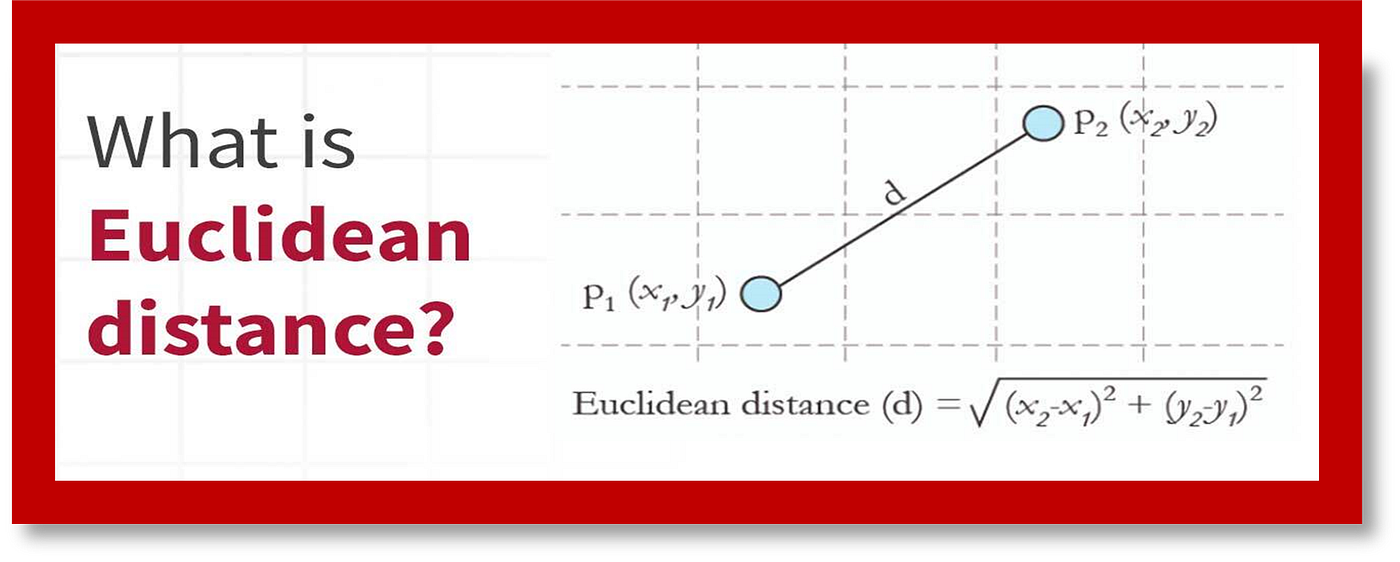
Euclidean distance
To calculate the Euclidean distance between two fruits, you would first convert each feature into a numerical value. For example, if an apple weighs 200 grams, has a height of 10 centimeters, and a width of 8 centimeters, you would convert it into a three-dimensional point: (200, 10, 8).
To calculate the distance between this apple and another fruit, say a pear with weight 300 grams, height 12 centimeters, and width 10 centimeters, you would subtract the corresponding values of each feature. Then, you square each result and sum them up. In this case, the Euclidean distance would be:
√((300–200)² + (12–10)² + (10–8)²) = √104 ≈ 10.2

Euclidean distance
This means that the pear is 10.2 units away from the apple in the three-dimensional space defined by weight, height, and width. This distance can be used to group similar fruits together based on their similarities in size and weight.
In summary, Euclidean distance is a simple and widely used method for calculating the similarity between two points in a multi-dimensional space. It is commonly used in clustering to group similar data points together, making it a useful tool for understanding patterns in large datasets.

classification vs clustering
2. Mahalanobis distance
Mahalanobis distance is a way to measure the distance between two points in a multi-dimensional space, taking into account the covariance between the dimensions. It’s used in clustering to determine how similar two data points are by considering not only their individual values but also how they relate to each other.
Imagine you have a dataset of people’s heights and weights, and you want to group them into clusters based on their body size. If you only consider the Euclidean distance between two data points, you might end up with clusters that are not meaningful. For example, a tall and heavy person might be grouped with a short and light person because they are close in terms of Euclidean distance.

Mahalanobis distance
However, if you use Mahalanobis distance, it takes into account the correlation between height and weight. This means that tall and heavy people will be considered more similar to each other than to short and light people. As a result, the clusters you obtain will be more meaningful, as they will group people who are similar not only in terms of their individual characteristics but also in how they relate to each other.
In summary, Mahalanobis distance is an advanced way to measure similarity between data points that takes into account the covariance between the different dimensions of the data. It’s particularly useful in clustering applications, where you want to group data points based on how similar they are in a multi-dimensional space. By considering the relationships between different variables, Mahalanobis distance helps to create more meaningful clusters that reflect the underlying patterns in the data.

Thanks for reading!!
Cheers!! Happy reading!! Keep learning!!
Please upvote, share & subscribe if you liked this!! Thanks!!
You can connect with me on LinkedIn, **YouTube, **Kaggle, and GitHub for more related content. Thanks!!
메타데이터
- post_id
- a35d9c005a70
- slug
- simplifying-clustering-a-comprehensive-introduction-to-euclidean-and-mahalanobis-distances-a35d9c005a70
- url
- https://blog.gopenai.com/simplifying-clustering-a-comprehensive-introduction-to-euclidean-and-mahalanobis-distances-a35d9c005a70
- canonical_url
- https://blog.gopenai.com/simplifying-clustering-a-comprehensive-introduction-to-euclidean-and-mahalanobis-distances-a35d9c005a70
- author_url
- https://medium.com/@jyotidabass
- status
- ok
- fetched_at
- 2026-08-02 12:58:45