How Generative Engines Improve User Experience
Introduction
How Generative Engines Improve User Experience

Introduction
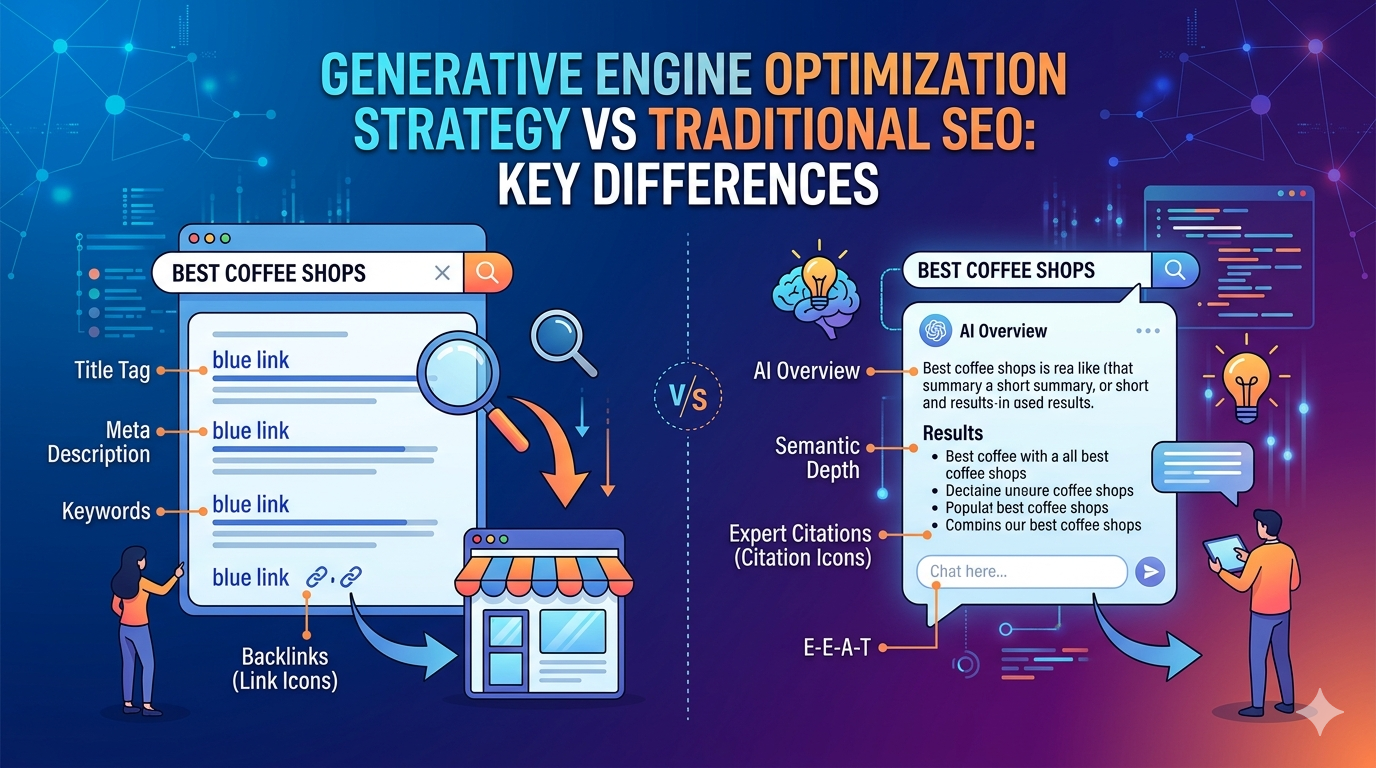
Traditional search engines helped users find links. Generative Engines go further, they synthesize answers, guide decisions, and often remove the need to click through multiple pages.
This shift is not just technical. It directly affects how users experience your brand.
Instead of browsing:
- Users ask complex questions
- AI generates structured responses
- Decisions happen within the interface
For businesses, this creates a new challenge: If your content is not structured for generative systems, you may lose visibility — even if your SEO is strong.
This is where ***Generative Engines optimization*** becomes important. It’s not about replacing SEO, but extending it into AI-driven discovery and experience layers.
What Are Generative Engines?
Generative Engines are AI systems that:
- interpret user intent
- generate contextual responses
- combine data from multiple sources
- deliver answers instead of links
Examples include:
- AI search assistants
- conversational interfaces
- AI-driven product recommendations
They act as experience layers, not just discovery tools.
1. How do Generative Engines reduce friction in user journeys?
The most immediate impact is friction reduction.
Instead of:
- searching → scanning → comparing → deciding
Users now:
- ask → receive → evaluate → act
Example: A user asks: “Best running shoes for flat feet under ₹10,000”
A generative system:
- understands constraints
- filters options
- presents structured recommendations
Business impact:
- Faster decision cycles
- Lower bounce rates (in many cases)
- Higher intent clarity
2. Why do Generative Engines create more personalized experiences?
Generative Engines process:
- context
- previous interactions
- behavioral signals
This allows them to generate:
- tailored responses
- contextual product suggestions
- adaptive content flows
Unlike static personalization (rules-based), this is:
- dynamic
- intent-aware
- continuously improving
Result: Users feel understood, not just targeted.
3. How do Generative Engines improve information clarity?
Traditional web content often requires:
- scanning multiple pages
- interpreting fragmented information
Generative Engines:
- summarize
- structure
- prioritize
They convert:
- long-form content → actionable insights
Example outputs:
- comparison tables
- step-by-step guidance
- pros/cons summaries
Why this matters: Clarity reduces cognitive load, which directly improves user experience.
4. How do Generative Engines support faster decision-making?
Generative Engines are particularly strong in:
- high-intent queries
- multi-variable decisions
They help users:
- compare options
- understand trade-offs
- reach conclusions quickly
In commerce: This can influence:
- product selection
- pricing evaluation
- feature comparison
Outcome: Users spend less time searching and more time deciding.
5. How do Generative Engines enhance conversational interaction?
User experience is no longer page-based. It is increasingly conversation-based.
Users can:
- refine queries
- ask follow-up questions
- explore alternatives
Example flow:
- “Best CRM for small teams?”
- “Which ones support WhatsApp integration?”
- “Compare pricing for India-based businesses”
This creates:
- deeper engagement
- iterative discovery
- more natural interaction
6. How do Generative Engines improve content accessibility?
Generative Engines make content:
- easier to consume
- easier to understand
- easier to act on
They adapt:
- tone
- structure
- complexity
This benefits:
- non-technical users
- mobile users
- global audiences
Key shift: Content is no longer static, it is interpreted and re-delivered.
7. How does Generative Engines optimization impact user experience?
This is where strategy matters.
If your content is not optimized for generative systems:
- it may not be surfaced
- it may be misinterpreted
- it may lose context
Generative Engines optimization focuses on:
- structured content
- clear entity relationships
- question-based formatting
- concise, self-contained answers
This improves:
- AI retrieval
- response accuracy
- brand representation inside AI outputs
Webgarh Point of View
Many businesses assume that adopting AI tools automatically improves user experience.
That is not accurate.
The most common issue is: AI is layered on top of unstructured systems.
This leads to:
- inconsistent outputs
- weak recommendations
- poor AI visibility
A structured approach matters because:
- Generative Engines rely on clean inputs
- content must be machine-interpretable
- systems must support consistent data flows
At Webgarh, the approach typically involves:
- content restructuring for AI retrieval
- entity and schema alignment
- workflow and data clarity
- integration with commerce systems
This ensures AI enhances the experience instead of creating noise.
Practical Outcomes Businesses Can Expect
When implemented correctly, Generative Engines can contribute to:
- Faster user journeys
- Improved decision confidence
- Better content engagement
- Higher-quality traffic (intent-driven)
- Reduced support queries (in many cases)
- Improved discoverability in AI platforms
It’s important to note: These outcomes depend on execution quality, not just tool adoption.
FAQ Section
Q1: What are Generative Engines in simple terms?
Generative Engines are AI systems that generate answers instead of showing links. They interpret user intent and provide structured, contextual responses.
Q2: How are Generative Engines different from search engines?
Search engines return results. Generative Engines synthesize information and deliver direct answers, often reducing the need to browse multiple pages.
Q3: Why is Generative Engines optimization important?
Without optimization, your content may not be correctly interpreted or surfaced by AI systems. Optimization ensures visibility, accuracy and better representation.
Q4: Do Generative Engines replace SEO?
No. They extend SEO into AI-driven discovery. Traditional SEO remains important, but needs to be adapted for generative environments.
Q5: How do Generative Engines affect eCommerce?
They influence:
- product discovery
- comparison journeys
- buying decisions
- customer support interactions
What is GEO (Generative Engine Optimization)?
GEO is the process of structuring content and systems so that AI engines can interpret, retrieve and present your information accurately.
→ Check your AI visibility with our free GEO audit.
Final Takeaway
Generative Engines are not just a new interface — they are reshaping how users discover, evaluate and interact with businesses.
The opportunity is real, but so is the risk:
- visibility is shifting
- user journeys are compressing
- experience expectations are rising
Businesses that treat Generative Engines as a system-level change, not just a tool, are more likely to benefit.
The focus should not be on adopting AI quickly, but on implementing it correctly and structurally.
메타데이터
- post_id
- a36627cff6b2
- slug
- how-generative-engines-improve-user-experience-a36627cff6b2
- url
- https://medium.com/@upkepr/how-generative-engines-improve-user-experience-a36627cff6b2
- canonical_url
- https://medium.com/@upkepr/how-generative-engines-improve-user-experience-a36627cff6b2
- author_url
- https://medium.com/@upkepr
- status
- ok
- fetched_at
- 2026-06-12 07:40:50