Best Prompts & Styles for Suno AI Music (2026)
How to engineer high-fidelity tracks using advanced prompt structures.
Best Prompts & Styles for Suno AI Music (2026)
https://prompts4.gumroad.com/l/AIMusicPrompts
How to engineer high-fidelity tracks using advanced prompt structures.
I have spent the last year listening to an enormous amount of artificial intelligence music. A significant portion of it sounds like a robot panicking inside a tin can. The vocals are distorted, the rhythms wander aimlessly, and the overall mix lacks any human feeling. When creators first discover tools like Suno or Udio, they often type vague requests like upbeat pop song or sad guitar track into the text box. This usually results in bland, generic audio that fails to capture any real emotion.
During my research, I noticed a separate group of creators quietly producing incredible audio. They were building lush cinematic soundscapes, tight electronic grooves, and hyper-realistic vocal performances. The determining factor for this high-quality output is precision.
AI music creation represents a fundamental paradigm shift in how we produce and consume sound. By utilizing deep learning models, creators can now bypass technical hurdles and directly translate their imaginative concepts into high-fidelity audio. These models require meticulous guidance to produce professional, genre-accurate results. Engineering the exact parameters of your prompt is an essential step in the production process.
Here is the framework for **structuring prompts** that actually work.
The Problem With Vague Prompts
To a human, asking for a sad acoustic song makes perfect sense. We fill in the gaps with our own cultural context. To an AI model, that request is nearly meaningless.
When you leave gaps in your instructions, the system defaults to the most average patterns in its training data. If you want high-fidelity musical generation or genre experimentation, you need to provide concrete constraints. Whether you are using Suno AI for full song generation with vocals or Udio for high-fidelity experimentation, the best tracks consistently rely on a few specific ingredients.
Define the Emotional Arc
Emotions in music are rarely static. A song that stays at the exact same emotional intensity for three minutes feels unnatural.
Instead of labeling a single mood, you need to describe how the track evolves over time. You should be highly specific about the emotional arc of the piece. For example, you might instruct the model to shift from a somber adagio to a frantic presto. This gives the AI a roadmap for tension and release, which is the absolute foundation of good composition.
Use Technical Constraints
Artificial intelligence responds exceptionally well to numerical and technical parameters.
Including technical musical terms like BPM, Time Signature, Reverb, or Mode will give you much better precision. If you want a complex jazz fusion arrangement, explicitly ask for a 7/8 time signature and extended chords like 13ths and sharp 11ths. When you provide the mathematical boundaries of the track, the model starts executing exactly what you envisioned.
Specify Instruments and Techniques
A guitar can sound a hundred different ways depending on the player. You have to tell the model exactly how the instrument is being played.
Mention specific instruments alongside their precise playing techniques. There is a massive sonic difference between requesting a generic violin and asking for staccato bowing. If you want a Delta blues track, ask for a resonating slide guitar in an open D tuning. For an ethereal pop song, request dream pop vocals that sit deep in the mix with multiple layers of whispering harmonies.
You can even layer different elements in the prompt, such as foley sounds combined with traditional instruments to build a unique texture. These micro-decisions create a sense of realism that vague instructions can never achieve.
Establish the Spatial Environment
Music does not happen in a vacuum. The physical space where the sound occurs drastically changes how we perceive it.
You need to describe the spatial environment or the intended feel of the room. Words like cavernous, smoky, or clinical give the audio engine instructions on how to handle reverb, delay, and mixing. A vocal recorded in a smoky jazz club requires entirely different processing than an ASMR whisper designed to create a 3D binaural effect in the listener’s ear.
The Prompt Structure in Action
Let us look at how these elements come together in practice to create a highly specific instruction.
An engineered prompt looks like this: “Compose a neoclassical string quartet piece in G minor that emphasizes polyphonic textures and intricate counterpoint between the first violin and cello. The composition should shift from a somber adagio to a frantic presto, utilizing staccato bowing to create a sense of urgency.”
This leaves nothing to chance. It specifies the genre, the key, the exact instruments, the musical theory techniques, the emotional arc, and the playing style.
https://prompts4.gumroad.com/l/AIMusicPrompts
Building Your Production System
Learning to generate high-quality audio is quickly becoming a valuable skill for filmmakers, game developers, and bedroom producers. The tools are already incredibly powerful, but your output relies heavily on the quality of your input.
You can spend weeks testing variations and trying to figure out the exact phrasing that triggers the best results. Building a library of successful prompts allows you to iterate faster and stack small wins into a reliable production system.
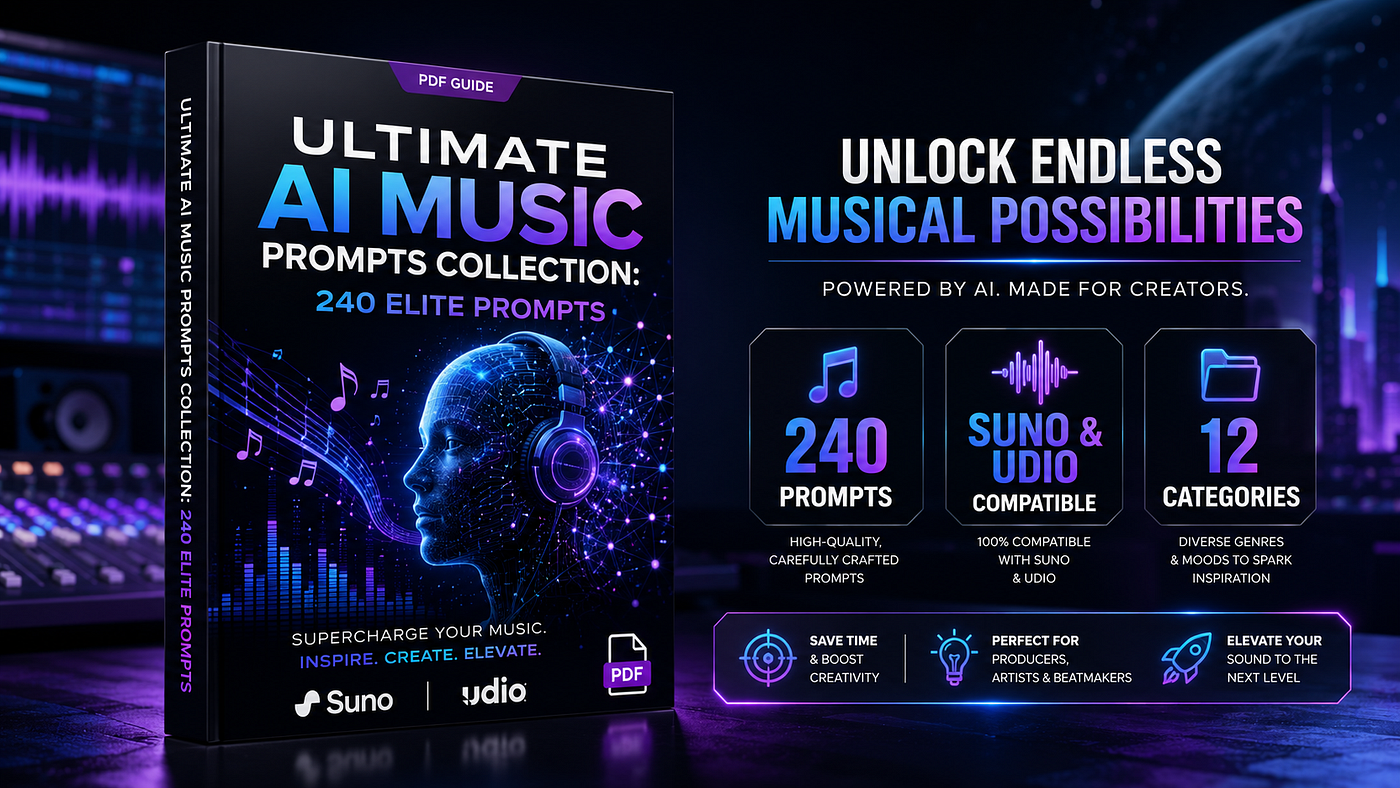
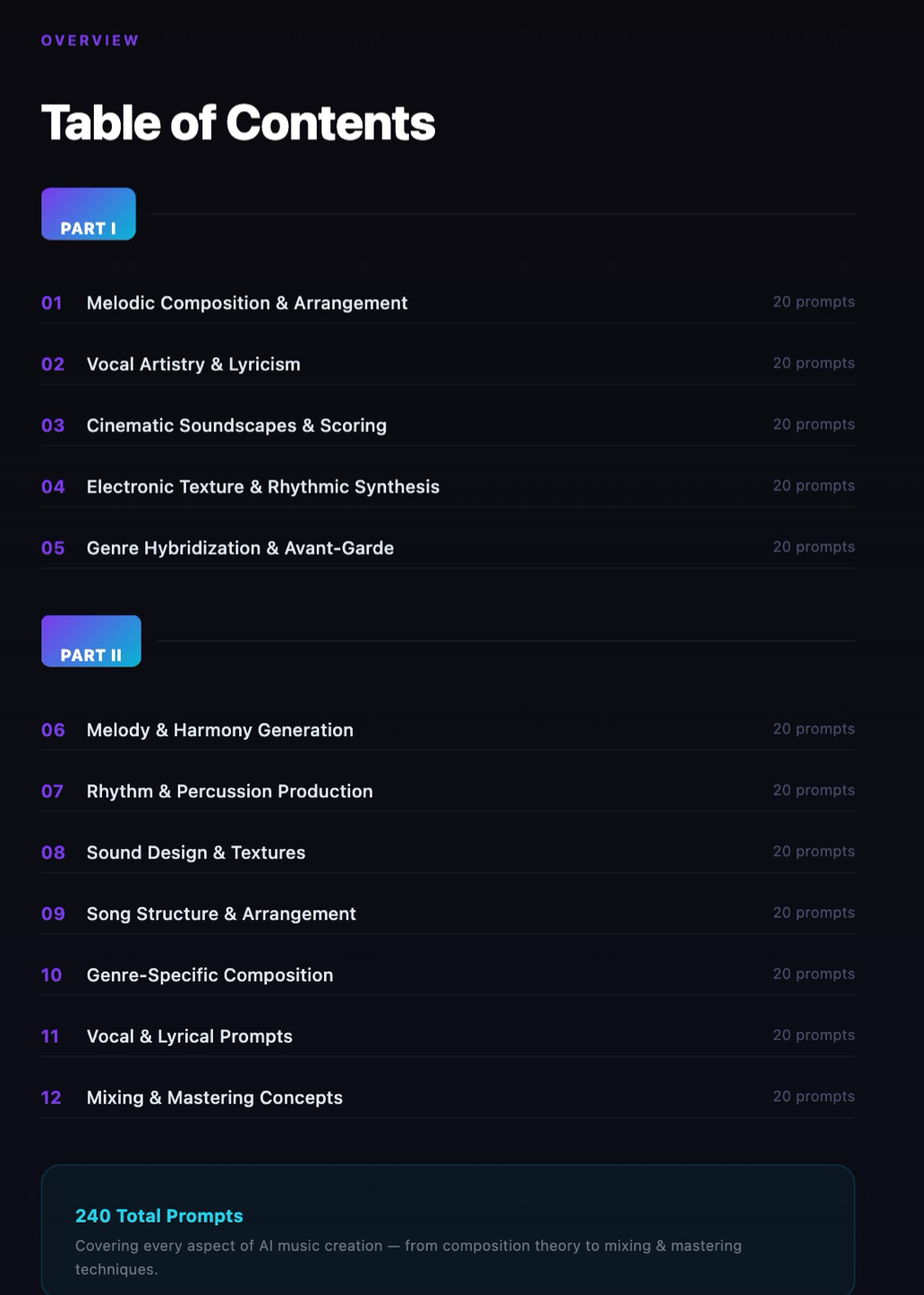
**I have compiled a comprehensive, research-backed collection of 240 elite prompts for AI music creation**. It covers everything from classical composition and vocal artistry to cinematic soundscapes and electronic texture. The bundle is organized into 12 distinct categories, offering an incredible range of possibilities for your next project.
If you are ready to move past the blank screen and start creating unforgettable sounds, you can download the full guide right here:
메타데이터
- post_id
- a369b1502f18
- slug
- best-prompts-styles-for-suno-ai-music-2026-a369b1502f18
- url
- https://medium.com/@qumyjufoteg/best-prompts-styles-for-suno-ai-music-2026-a369b1502f18
- canonical_url
- https://medium.com/@qumyjufoteg/best-prompts-styles-for-suno-ai-music-2026-a369b1502f18
- author_url
- https://medium.com/@qumyjufoteg
- status
- ok
- fetched_at
- 2026-06-21 20:33:08