🚀Summary Blog: Self-Taught Evaluators
In the evolving field of AI and machine learning, large language models (LLMs) require robust evaluators to ensure their responses align…
🚀Summary Blog: Self-Taught Evaluators

In the evolving field of AI and machine learning, large language models (LLMs) require robust evaluators to ensure their responses align with human preferences. Traditionally, building such evaluators involves collecting large amounts of human-annotated data, which can be costly and time-consuming. The paper introduces a novel approach to overcome these challenges by using synthetic data for model training, bypassing the need for human annotations.
⭐️The Challenge:
LLMs rely heavily on strong evaluators for both training and inference. These evaluators act as reward models, guiding the LLM to improve its responses over time. However, creating these evaluators traditionally depends on human judgment data, which can become outdated as models improve. Additionally, collecting high-quality preference data, especially for complex tasks like coding or mathematics, requires expert input, making it difficult to scale.
⭐️New Approach: Self-Taught Evaluators
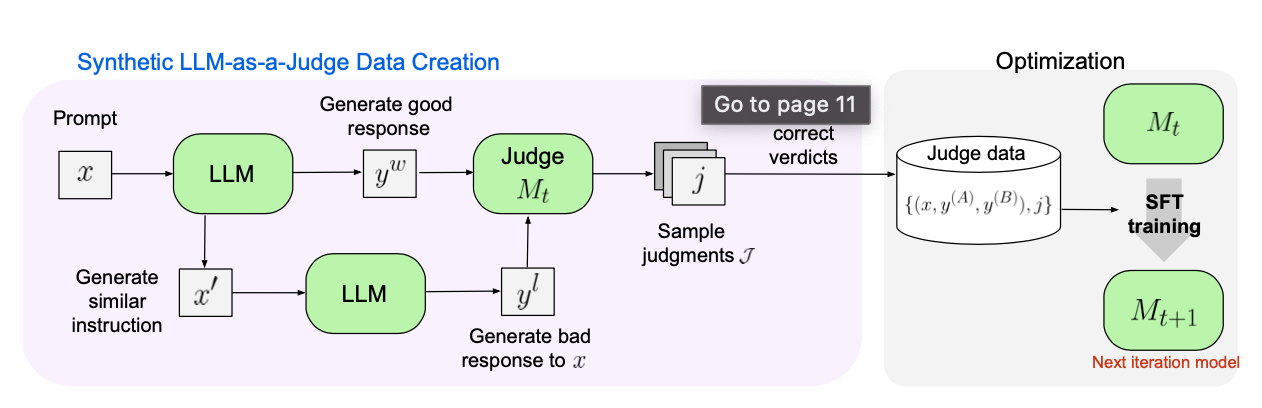
The core idea behind Self-Taught Evaluators is to eliminate the dependency on human annotations by using a fully synthetic training loop. Here’s how it works:
- Synthetic Data Generation: The model generates contrasting responses (one high-quality, one low-quality) for a given instruction. These pairs form the basis of training data.
- LLM-as-a-Judge: The model itself evaluates the responses, generating reasoning traces and judgments. These evaluations are used to fine-tune the model iteratively. 3. Iterative Self-Improvement: With each iteration, the model refines its judgments based on the previous round of improvements, leading to a more accurate and reliable evaluator over time.
This method, which begins with an initial seed model (such as Llama-3–70B-Instruct), results in significant improvements in evaluation accuracy without any human-labeled data. The iterative training loop enhances the model’s ability to self-improve, making it a powerful tool for model evaluation.
⭐️Key Concepts:
- LLM-as-a-Judge: A concept where the LLM is used to evaluate responses, offering explanations through reasoning traces. This makes the evaluation process transparent and explainable. - Synthetic Data: Data generated by the model itself, which can be customized to specific evaluation criteria. This allows for efficient training without the need for human-generated data. - Iterative Training: A continuous process where the model refines its own judgments and improves with each iteration.
⭐️Performance Highlights:
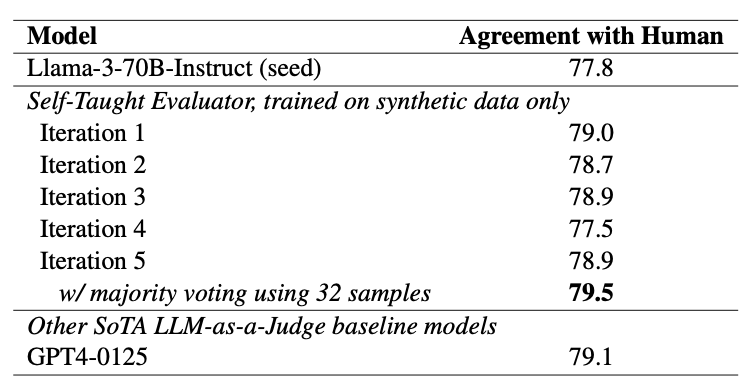
Self-Taught Evaluator trained on synthetic data without any human annotated preference labels performs on par with GPT-4 judgments
- RewardBench: The Self-Taught Evaluator improved Llama-3–70B-Instruct’s performance from 75.4 to 88.7, matching or surpassing models trained with human-labeled data. - MT-Bench: The model achieved performance on par with GPT-4, demonstrating its effectiveness as a scalable evaluation method. - Model Training: Self-taught evaluators can be used to train reward models, guiding LLMs to produce better responses without human intervention. - Benchmarking: These evaluators offer a scalable solution for evaluating LLMs, particularly in complex tasks where human judgment is challenging to obtain.
⭐️Challenges and Limitations:
While the Self-Taught Evaluator model shows great promise, it has certain limitations: 1. Inference Cost: Generative LLM-as-a-Judge models typically have longer outputs, resulting in higher inference costs compared to simpler reward models. 2. Model Size: The approach relies on large models (e.g., 70B parameters), and its effectiveness on smaller models has not been fully explored.
⭐️Conclusion:
The Self-Taught Evaluators paper presents a groundbreaking method for model-based evaluation, eliminating the need for human-labeled data through an innovative synthetic data approach. By iteratively improving its judgments, the model becomes a more accurate and scalable evaluator, paving the way for future advancements in LLM evaluation. As AI continues to evolve, methods like this will be crucial in maintaining the high performance and alignment of models with human preferences.
메타데이터
- post_id
- a37c1e4f6e8f
- slug
- summary-blog-self-taught-evaluators-a37c1e4f6e8f
- url
- https://medium.com/@aashi-dutt3/summary-blog-self-taught-evaluators-a37c1e4f6e8f
- canonical_url
- https://medium.com/@aashi-dutt3/summary-blog-self-taught-evaluators-a37c1e4f6e8f
- author_url
- https://medium.com/@aashi-dutt3
- status
- ok
- fetched_at
- 2026-07-14 02:16:34