Where Chocolate Really Begins: Cacao Agriculture
Before cacao becomes chocolate, it is soil, climate, care, and time.

Where Chocolate Really Begins: Cacao Agriculture
Before cacao becomes chocolate, it is soil, climate, care, and time.
By Robert Cabeca • Chef, Chocolatier
I remember the first time I held a real, live cacao pod in my hands.
It was 2012, at my then chocolate shop, Cocova, in Washington, DC. That year, the Fancy Food Show had come to the city, and the International Fine Cocoa Institute Association was hosting its gala. There was a quiet excitement in the air — the kind that only happens when passionate people gather around something they truly love.
That evening, Santiago Peralta, cofounder of Paccari Chocolate, came into the shop carrying something I had only ever seen in pictures.
A fresh cacao pod direct from Ecuador!
It was about the size of a football, a beautiful golden yellow, with deep ridges running from end to end. It didn’t even look like something that could become chocolate.
And yet, there it was — the beginning of everything anciently delicious.
I remember feeling almost giddy, like a five-year-old boy seeing something magical for the first time.
He began telling us stories — about the trees, the farms, the families, the land. Customers had gathered, and the room became quiet in that way it does when something meaningful is about to happen.
Then he cut the pod open revealing the heart of chocolate.
A cluster of seeds — cacao beans — surrounded by this soft, white, almost fluffy fruit. This fruit is called mucilage, and I had never seen it before in person.
It looked delicate.
It looked sweet.
And it was.
We all leaned in. We tasted it.
And I remember thinking, this… this is cacao fruit!
What we tasted was bright, tropical, almost lychee-like. It was juicy, vibrant, alive.
That moment stayed with me.
Because it changed something fundamental in how I understood chocolate.
Flavor does not begin in the chocolate factory. It begins on the farm.
Chocolate Does Not Begin as Chocolate

Sketch of cacao and chocolate.
Cacao and chocolate illustration
When most people think about chocolate, they think about bars, truffles, desserts, or maybe cacao powder.
But chocolate, of course, does not begin as any of those things.
It begins as a fruit.
Before cacao becomes chocolate, it is soil, climate, care, and time.
The cacao tree — Theobroma cacao, often translated as “Food of the Gods” — grows in a very specific part of the world. A narrow band around the equator known as the cacao belt.
Within roughly 20 degrees north and south of the equator, in regions of Central and South America, West Africa, and parts of Southeast Asia, cacao trees grow in warm, humid environments under the canopy of taller trees protecting them from direct sunlight.
They do not grow easily.
They do not grow quickly.
And they do not grow healthfully without care.
The Life of a Cacao Tree

Tiny cocoa flower.
Blossoming cacao flower
A cacao tree is not a machine that just produces cacao pods prolifically.
It is a delicate organism.
It can take three to five years before a tree produces its first meaningful harvest! It requires consistent rainfall, stable temperatures, protection from wind, shade from the sun, and surrounding vegetation for nourishment.
Even then, it is very vulnerable.
Disease, pests, and climate fluctuations can affect yield and quality unexpectedly and significantly. For farmers, this is not just agriculture — it is long-term commitment fraught with risk tempered by patience and expertise.
And when the tree finally produces fruit, the cacao pods do not grow neatly on branches like apples.
They grow directly from the trunk and main limbs of the tree, requiring manual harvesting.
It is one of the most striking things you will ever see.
Inside the Pod

Cacao pods on a tree ready for harvest
Each cacao tree produces anywhere from 100 to 250 pods per harvest, and each cacao pod contains roughly 30 to 50 beans. It takes roughly 200 beans to make one bar of chocolate! These amazing beans are surrounded by that white pulp — the mucilage I tasted for the first time that night in the summer of 2012.
This pulp is not a byproduct.

Tasting the inside of the cacao fruit.
Opened cacao pod revealing delicious fruit
It is the essential beginning of fine flavor.
Because what happens next — what most people never see — is one of the most important transformations in the making of chocolate.
Cacao Farming Is Not Mechanical — It Is Personal
Cacao farming is almost entirely done by hand.

Plantation farmers collecting cocoa pods for harvest.
Plantation farmers sorting the days cacao harvest
Harvesting requires skill. Each pod must be cut carefully to avoid damaging the tree. Timing matters — too early or too late affects the quality of the beans.
In many parts of the world, cacao is grown by smallholder farmers, often on family farms that have been passed down through generations.
Cacao farming is not industrial agriculture.
It is hands-on tedious human work.
It is knowledge carried through experience — knowing when to harvest, how to ferment, how to dry, how to protect the crop.
And every one of those decisions affects the quality of what you eventually taste.
Agriculture Is Flavor
This is one of the most important things I can share with you as a chocolatier:
Flavor does not begin in the chocolate factory.
It begins on the farm.
Soil composition, climate, rainfall, altitude, genetics — all of these influence the beans long before they are ever fermented, roasted or refined.
If you’ve ever tasted pieces of two different chocolate bars side by side and noticed how different they are — fruitier, nuttier, brighter, deeper — what you are experiencing is not just processing.
You are tasting agriculture.
You are tasting place.
You are tasting decisions made months, even years, before the chocolate was ever made.
A Shift in Perspective
That moment in my shop — holding that cacao pod, tasting that mucilage — shifted something in me permanently.
Because I realized that chocolate is not just a finished product.
It has been and always will be an evolutionary journey.
And the more you understand that journey, the more deeply meaningful the experience becomes.
What used to be just “a piece of chocolate” becomes something else entirely.
It becomes:
a tree a farm a family a climate a season a set of human decisions
And suddenly, tasting becomes deeper.

Delectible taste of fine chocolate.
Lady mindfully tasting chocolate
More connected.
More intentional.
More heartfully appreciated.
Why This Matters in Tasting
When I guide people through chocolate tastings, this is always part of the discussion
We talk about it directly.
Because when you understand where chocolate begins, you taste differently.
You slow down.
You become more curious.
You start to ask better questions:
Why does this taste bright? Why does this feel smooth? Why is this more intense? Where is this flavor really coming from?
And often, the answers lead back to the farm.
Luxury Begins at the Source

Chocolate truffle display at The Chocolate House, D.C.
Luxury truffle display at old Cocova shop
In many ways, luxury in chocolate is misunderstood.
People often think it is about packaging, branding, or price.
But true luxury — the kind that lasts — begins at the source.
It begins with:
careful farming respect for the land attention to detail and time
Time that cannot be rushed.
Time that cannot be replicated.
Time that must be honored.
The Beginning of the Journey
That cacao pod I held in my hands that night was, obviously, not chocolate.
But it contained the entire potential of chocolate.
Everything that followed — fermentation, drying, roasting, refining — all of it depended on what began right there.
On the tree.
In the soil.
In the care of the farmer.
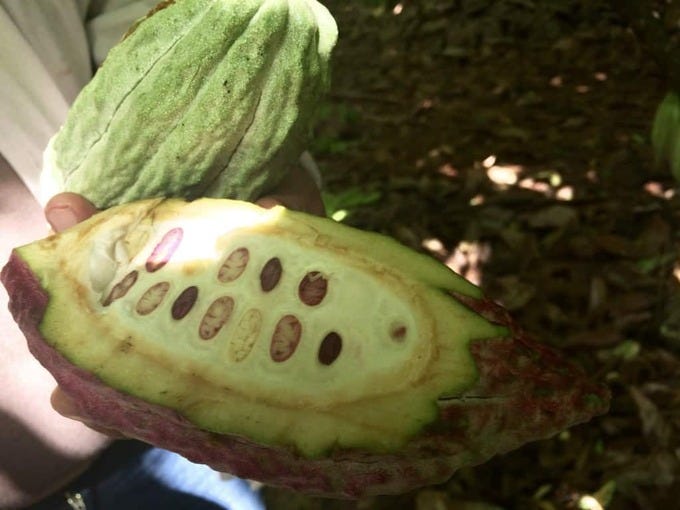
Cocoa pod cut in half revealing fine quality.
Opened cacao pod revealing fruit and beans
What Comes Next
If agriculture is where chocolate begins, then fermentation is where cacao begins to transform into chocolate.
In the next article in this series, we will explore what happens after the pod is opened — how those beans, surrounded by sweet pulp, begin the process of becoming chocolate as we know it.
Because what happens in fermentation is where flavor truly starts to emerge.
And it is one of the most fascinating steps in the entire journey.
A Final Thought

The Bean to Bar Journey of Fine Chocolate
Bean to bar journey
The next time you hold a piece of chocolate, I invite you to think back — not to the bar, not to the wrapper, but to the beginning.
To the tree.
To the pod.
To that moment when what looks nothing like chocolate holds everything chocolate will become.
Because once you see that…
you never taste chocolate the same way again.
Stay tuned for more deep-dive articles exploring chocolate makers, cacao varieties, tasting techniques, and the remarkable journey from bean to bar. I’ll also be sharing new resources and experiences here on the website in the weeks ahead.
Yours in chocolate,
Robert Cabeca
Chef, Chocolatier
메타데이터
- post_id
- a39752b79b1e
- slug
- cacao-agriculture-a39752b79b1e
- url
- https://medium.com/@robert_42008/cacao-agriculture-a39752b79b1e
- canonical_url
- https://medium.com/@robert_42008/cacao-agriculture-a39752b79b1e
- author_url
- https://medium.com/@robert_42008
- status
- ok
- fetched_at
- 2026-07-15 21:17:01




