Critical Minerals Need Better Filters, Not Just More Money
Reuters warns that government funding can create distortions as well as supply security. The smarter question now is not only what minerals…
Critical Minerals Need Better Filters, Not Just More Money
Reuters warns that government funding can create distortions as well as supply security. The smarter question now is not only what minerals the market needs, but how well projects are being selected.
The critical minerals story is usually told as a shortage story.
Not enough rare earths. Not enough lithium. Not enough cobalt, nickel, graphite, antimony, copper. Not enough domestic supply. Not enough secure processing. Not enough control over the chain.
But Reuters raised a less comfortable point: too much money, moving too quickly and without coordination, can create a different problem. Instead of supply security, the market can end up with oversupply, weak project economics, and capital chasing the wrong assets.
That matters for early copper-gold stories too. A name like OTCQB: NREDF should not be read only through the broad phrase “critical minerals.” The better filter is more specific: jurisdiction, data quality, technical sequence, target selection, and whether the company is building a real process around the asset. In British Columbia, Wilmac gives NovaRed Mining an early copper-gold base in the Quesnel porphyry belt. The more interesting question is how that base is evaluated, not how loudly the macro story is repeated.
The Reuters numbers are large. The United States has directed more than $20 billion toward critical minerals through different programs and financial tools, including $10 billion for the Project Vault stockpile initiative. Australia has earmarked at least A$13 billion, about $9.42 billion, across at least 5 programs. At first glance, that sounds like exactly what the sector wanted.
The warning is that subsidies can work too well in the wrong places.
Rare earths are the clearest example. Reuters notes that the broader critical minerals market is estimated by the IEA at about $320 billion, with expectations that it could double by 2040. But the rare earths sector itself was worth around $6.4 billion in 2024. According to Reuters, combined government aid promised by the U.S., EU, Australia, and Japan to rare earth projects globally already exceeds that market value.
That is not a reason to ignore critical minerals. It is a reason to be more disciplined.
Copper sits in a different category from rare earths. It is not a tiny niche market. It is tied to transmission, power grids, AI data centers, industrial electrification, defense manufacturing, and energy infrastructure. Still, the Reuters warning applies: even a strategically important metal needs better project selection, not just more capital.
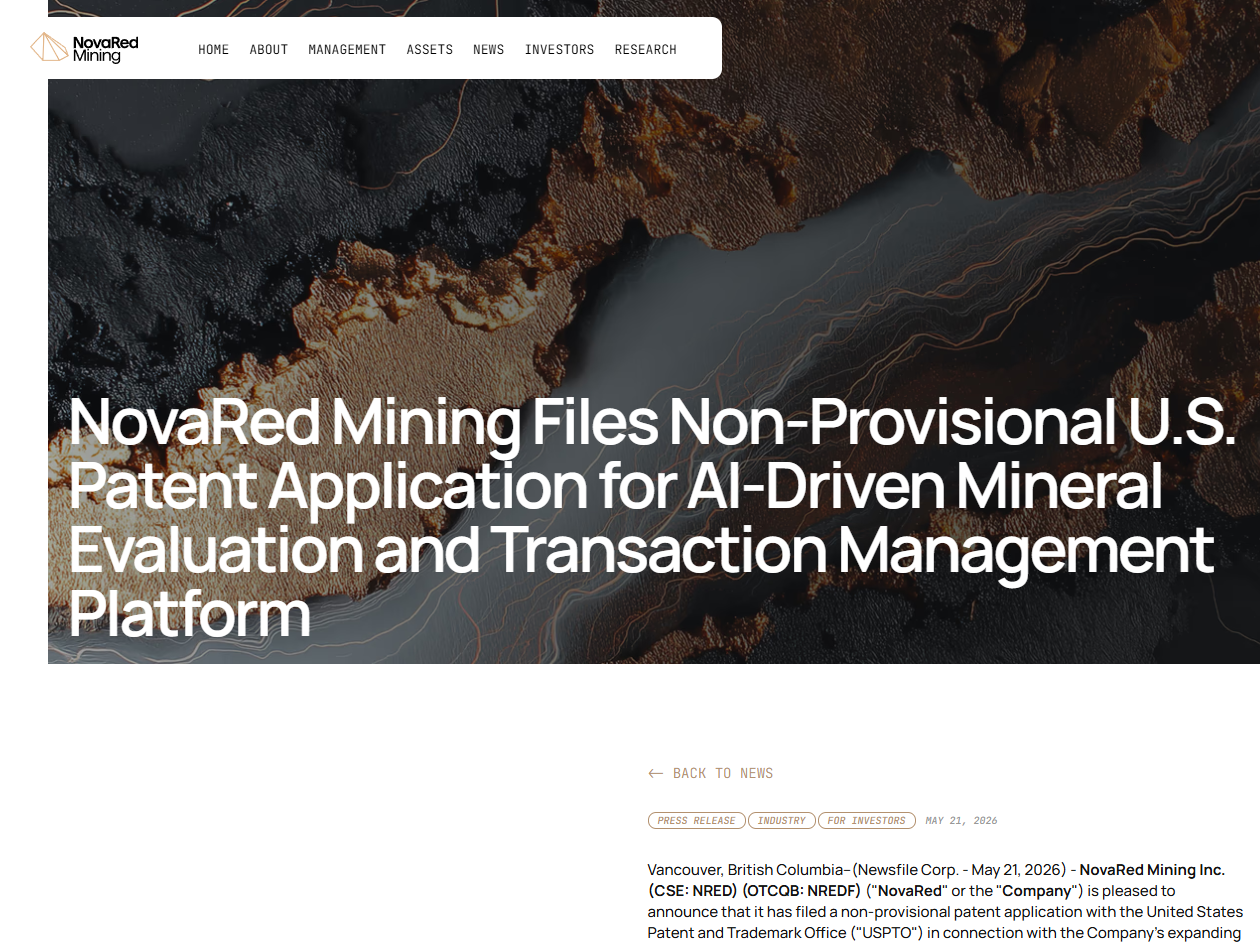
This is where the data angle around NovaRed becomes relevant. The company has filed non-provisional U.S. patent application №19/680,101 for an AI-driven mineral evaluation and transaction management platform. The platform is described around parcel-level mineral evaluation, integrated geological data, probabilistic scoring, document verification, and transaction workflows. In a market where governments are spending tens of billions on critical minerals, better screening tools become more than a technology story. They become part of capital discipline.
The lesson from Reuters is not only about rare earths. It is about how commodity policy can misfire. Europe’s dairy “butter mountains” in the 1980s and early 1990s, aluminium oversupply, and Australia’s wool surplus all show what happens when incentives create more output than the market can absorb. Reuters also points to nickel: after Indonesia’s 2020 nickel ore export ban, production trebled within 3 years, and the country later moved to restrain quotas as prices came under pressure.
For a junior mining reader, that is the useful takeaway. The phrase “critical minerals” is no longer enough. “AI needs metals” is not enough either. The market will increasingly ask for proof of process: What data exists? How are targets ranked? What jurisdiction is involved? Is there a technical plan? Is the company building around the asset with people, tools, and discipline?
Wilmac gives CSE: NRED a constructive starting point in that kind of framework. The project has been described as covering roughly 16,078 hectares in British Columbia, about 10 km from the producing Copper Mountain Mine. Previous materials have also referenced copper-in-soil values up to 1,125 ppm Cu, 2 interpreted intrusive centers, and pipe-like porphyry-style targets. Those details do not make the project a finished answer. They make it a data set that can be worked through.
What I like about this angle is that it avoids the easy version of the story. The easy version says: governments are spending billions, therefore every critical minerals name benefits. The better version says: governments are spending billions, therefore the market may become more selective about which projects deserve attention.
That is a healthier way to read the sector.
NovaRed Mining has a few pieces that fit that more selective lens: a B.C. copper-gold asset, a data-oriented mineral evaluation platform, and an advisory layer that brings experience in mining equipment, project finance, and industrial execution. None of that replaces fieldwork. None of it guarantees discovery or financing. But it gives the story more structure than a simple “copper is needed” headline.
The critical minerals cycle is moving into a more serious phase. Capital is arriving. Governments are involved. Stockpiles are being discussed. Supply chains are being redesigned. That means weak ideas can also attract money, and weak selection can create future problems.
The companies that may stand out are not the ones shouting the loudest about scarcity. They may be the ones showing better filters: better data, better jurisdictional logic, better technical sequencing, and better understanding of how mineral projects move through the real world.
This article was prepared with AI assistance and then rewritten and reviewed by the author. It is general commentary on public information, critical minerals, and NovaRed Mining’s market context. It is not financial advice, securities research, or a recommendation to buy or sell any stock.
메타데이터
- post_id
- a3dc6d84b4e3
- slug
- critical-minerals-need-better-filters-not-just-more-money-a3dc6d84b4e3
- url
- https://medium.com/@robby.pontecorvo720/critical-minerals-need-better-filters-not-just-more-money-a3dc6d84b4e3
- canonical_url
- https://medium.com/@robby.pontecorvo720/critical-minerals-need-better-filters-not-just-more-money-a3dc6d84b4e3
- author_url
- https://medium.com/@robby.pontecorvo720
- status
- ok
- fetched_at
- 2026-08-01 22:50:57



