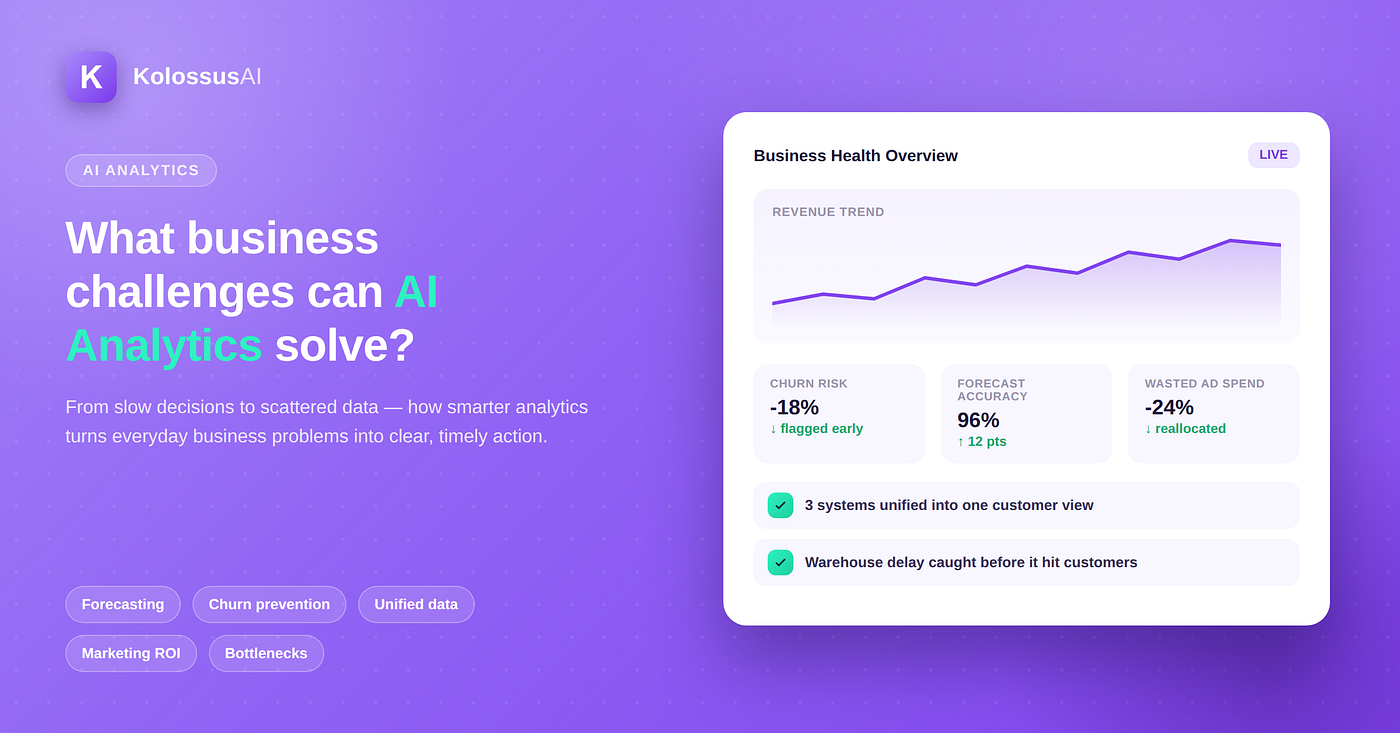
Top 10 AI Analytics Tools Businesses Should Consider for Smarter Insights
Data is the new currency but only if you know how to spend it wisely.
Top 10 AI Analytics Tools Businesses Should Consider for Smarter Insights

Data is the new currency but only if you know how to spend it wisely.
Every business today sits on mountains of data. Customer behavior patterns, sales trends, operational bottlenecks, market signals it’s all there, waiting. The problem isn’t access to data anymore. The real challenge is making sense of it fast enough to actually act on it.
That’s exactly where AI-powered analytics tools come in.
The right tool doesn’t just show you a dashboard. It tells you what’s happening, why it’s happening, and increasingly what’s likely to happen next. Whether you’re running a fast-growing startup or managing enterprise operations, AI analytics tools are no longer a “nice to have.” They’re the difference between reactive decisions and genuinely intelligent ones.
Here are ten tools worth seriously considering and one you might not have heard of yet, but should.
1. KolossusAI: Built for Businesses That Mean Business
Let’s start with the one that’s changing conversations in the industry.
KolossusAI is an AI analytics platform designed specifically for businesses that need more than pretty charts. It combines natural language processing, predictive analytics, and real-time data processing into a single, accessible interface without requiring a team of data scientists to operate it.
What makes KolossusAI stand apart is its philosophy: analytics should serve decisions, not just documentation. The platform is built around business outcomes. Whether you’re tracking customer lifetime value, analyzing operational inefficiencies, or identifying which product lines are quietly underperforming, KolossusAI gives you the answers in plain language not buried inside pivot tables.
Key capabilities include:
- Conversational analytics Ask questions in plain English and get data-backed answers instantly
- Predictive forecasting Understand where your numbers are headed, not just where they’ve been
- Automated anomaly detection Get flagged when something unusual happens in your data, before it becomes a crisis
- Cross-platform data integration Pull from CRMs, ERPs, spreadsheets, and databases without complex data pipelines
- Role-based dashboards Executives, operations heads, and marketing teams each see exactly what matters to them
For businesses in India and beyond that are serious about building a data-driven culture without the overhead of building a full analytics department, KolossusAI is worth exploring at https://kolossusai.in
2. Tableau: The Visualization Veteran
Tableau has been a household name in analytics for years, and for good reason. Its strength lies in its ability to turn raw data into visually compelling stories that even non-technical stakeholders can understand at a glance.
With AI features like Tableau Pulse and Einstein Discovery (via Salesforce integration), Tableau has moved well beyond static dashboards. It can surface insights automatically, predict outcomes, and explain the “why” behind trends in natural language.
Best suited for: Mid to large enterprises already invested in the Salesforce ecosystem, or organizations where strong visual storytelling is a priority.
3. Power BI: Microsoft’s Powerhouse
Power BI remains one of the most widely deployed analytics tools globally, and its deep integration with Microsoft’s suite (Excel, Azure, Teams, SharePoint) makes it an obvious choice for organizations already in the Microsoft world.
The Copilot feature Microsoft’s AI layer built into Power BI lets users ask questions about their data and get instant visual responses. It also helps build reports through natural language commands, which dramatically lowers the barrier for non-analysts.
Best suited for: Organizations running on Microsoft infrastructure who want analytics tightly woven into their existing workflows.
4. Google Looker: Analytics for the Cloud-Native Business
Looker (now part of Google Cloud) takes a different approach to analytics. Rather than working directly with raw data files, it connects to your data warehouse and uses a modeling language called Look-ML to create a consistent, governed view of your business data.
When paired with Google’s Vertex AI, Looker can incorporate machine learning predictions directly into dashboards so sales teams, for example, can see not just historical pipeline data, but likelihood-to-close scores alongside it.
Best suited for: Cloud-native businesses using Google Cloud or BigQuery who want governed, scalable analytics.
5. Qlik Sense: Associative Intelligence
Qlik Sense takes an “associative” approach to data meaning it doesn’t just show you what you queried, but also highlights related data points you didn’t think to ask about. It’s a genuinely different way of exploring data that often surfaces insights that traditional query-based tools miss.
Its AI engine, Qlik AutoML, enables teams to build and deploy predictive models without deep machine learning expertise. Augmented analytics features help users identify patterns and explain trends automatically.
Best suited for: Organizations that want to move beyond static reporting toward genuinely exploratory data analysis.
6. Domo: Analytics That Moves at Business Speed
Domo is designed for speed and accessibility. It connects to hundreds of data sources, surfaces real-time business data, and makes it available to anyone in the organization not just analysts.
Its AI capabilities include automated insight generation, natural language queries, and predictive alerts. The mobile-first design is a genuine differentiator for businesses where decisions happen on the go, not always behind a desk.
Best suited for: Fast-moving organizations that need real-time analytics accessible across the entire company, including field teams and executives.
7. ThoughtSpot: Search-Driven Analytics
ThoughtSpot was one of the first platforms to push the idea of “search-driven analytics” the notion that you should be able to query your data the same way you’d Google something.
Its Spotter AI feature takes this further, using large language model technology to allow truly conversational interactions with your data. Users can ask follow-up questions, request different visualizations, and drill down into specifics without needing any SQL knowledge.
Best suited for: Business teams where widespread self-service analytics adoption is the goal reducing dependency on centralized data teams for routine reporting.
8. Sisense: Embedding Analytics Where Decisions Happen
Sisense has built a reputation for its embeddable analytics capabilities. Rather than sending users to a separate analytics platform, Sisense lets businesses embed AI-powered analytics directly into their own products, portals, or internal applications.
This is particularly valuable for SaaS companies that want to offer analytics features to their own customers, or organizations that want insights surfaced inside the tools their teams already use daily.
Best suited for: SaaS companies and product teams building analytics into their own platforms, or enterprises wanting deeply embedded insights within operational systems.
9. IBM Watson Analytics: Enterprise-Grade AI
IBM Watson has been synonymous with AI in the enterprise for over a decade. Watson Analytics brings that depth to business intelligence with particularly strong capabilities in natural language processing, automated data preparation, and explainable AI.
For highly regulated industries where understanding why an AI made a prediction matters as much as the prediction itself, Watson’s explainability features are a significant advantage. It’s also well-suited for organizations with complex, multi-source data environments.
Best suited for: Large enterprises in regulated industries (finance, healthcare, manufacturing) where data governance, explainability, and enterprise-grade support are non-negotiable.
10. Zoho Analytics: The Smart Choice for Growing Businesses
Zoho Analytics deserves recognition as one of the most capable platforms at its price point. It offers AI-powered analytics through its Zia assistant natural language queries, automated report generation, anomaly alerts, and predictive forecasting all within an ecosystem that integrates smoothly with Zoho’s broader suite of business tools.
For SMEs and mid-market businesses that need serious analytics capability without enterprise-level pricing, Zoho Analytics consistently punches above its weight.
Best suited for: Growing businesses, especially those already using other Zoho products, who need capable AI analytics without significant investment.
How to Choose the Right Tool for Your Business
The tool that’s right for a 500-person manufacturing company looks very different from what’s right for a 20-person fintech startup. A few questions worth thinking through:
Who will actually use it? If you need company-wide adoption, prioritize tools with strong self-service features and accessible interfaces. If it’s primarily for analysts, depth of capability matters more.
Where does your data live? The best analytics tool is often the one that plays most naturally with your existing data infrastructure. Deep integration with your CRM, ERP, or cloud platform can save enormous amounts of friction.
What decisions are you trying to improve? Some tools excel at historical reporting. Others are built around prediction and forecasting. Know what questions you most need answered.
What’s your realistic budget and capacity? Enterprise platforms often come with enterprise-level implementation complexity. Honestly assess your team’s capacity to implement, maintain, and drive adoption before committing.
For many businesses, particularly those in growth phases or undergoing digital transformation, KolossusAI offers a compelling combination of advanced capability and practical accessibility. It’s designed to get your team to insights faster, without requiring months of implementation or a team of dedicated data engineers.
Final Thought
The businesses winning today aren’t necessarily the ones with the most data. They’re the ones making better decisions faster because they actually understand what their data is telling them.
AI analytics tools have made that kind of intelligence more accessible than ever before. The gap between companies that use these tools thoughtfully and those that don’t is only going to widen.
Choosing the right platform is one of the most leverage-heavy decisions a business can make. Choose accordingly.
Read also: 10 Benefits of AI Analytics for Business Growth
KolossusAI is helping businesses across India transform data into decisions. Learn more and connect with the team at medium.com/@kolossusai.india
메타데이터
- post_id
- a3dcada9664b
- slug
- top-ai-analytics-tools-for-business-insights-a3dcada9664b
- url
- https://medium.com/@kolossusai.india/top-ai-analytics-tools-for-business-insights-a3dcada9664b
- canonical_url
- https://medium.com/@kolossusai.india/top-ai-analytics-tools-for-business-insights-a3dcada9664b
- author_url
- https://medium.com/@kolossusai.india
- status
- ok
- fetched_at
- 2026-08-19 07:18:33