Most Developers Learn CQRS as a Definition. Few Know When It Actually Solves a Problem
You’ve probably seen the acronym. CQRS — Command Query Responsibility Segregation. Sounds fancy. Looks impressive on architecture diagrams…
Most Developers Learn CQRS as a Definition. Few Know When It Actually Solves a Problem
You’ve probably seen the acronym. CQRS — Command Query Responsibility Segregation. Sounds fancy. Looks impressive on architecture diagrams. And most of us learn it the same way: a definition, a diagram, maybe a blog post.
But here’s the truth: most developers who know the definition have never felt the actual pain that CQRS solves. And that’s exactly why so many teams apply it too early — or skip it when they genuinely need it.
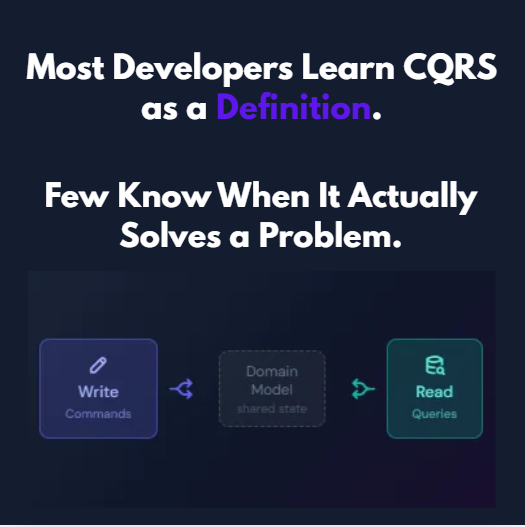
CQRS is not about splitting code for the sake of architecture. It’s about separating write complexity from read optimization — when both start evolving in completely different directions.
Think of a real system. Writes are where your business rules live — consistency checks, transactions, validations. Reads are about speed — and giving users dashboards and reports fast.
In a simple CRUD app, these two things grow together, and they’re fine sharing a model. But in a system at scale? They start pulling in opposite directions. That’s when CQRS becomes less of a pattern and more of a relief valve.
Writes focus on :
- Consistency
- Business rules
- Transactions
- Data integrity
Reads focus on:
- Performance
- Projections
- Reporting
- Scalability
When a system grows and your read and write workloads stop behaving the same way, forcing them to share a single model becomes technical debt in disguise. A query optimized for speed shouldn’t care about your domain validation logic. And your write model shouldn’t be bloated with twenty JOIN tables and serve a dashboard.
// One model trying to serve both concerns
class OrderService {
  getOrderDashboard(userId) {
    // 5 JOINs, aggregations, slow as heck
  }
  placeOrder(order) {
    // validations, transactions, business rules
  }
}

// After CQRS — each concern gets its own model
class OrderCommandHandler { // Writes }
class OrderQueryHandler   { // Reads }
But CQRS also adds real complexity.
Before you split your models, ask honestly: Does your app actually feel this pain? If it doesn’t, you might be importing problems that don’t exist yet.
Skip CQRS if your app
- Simple CRUD app with predictable load
- Doesn’t have separate read/write scaling needs
- Has no tolerance for eventual consistency trade-offs
- Has a team unfamiliar with async/sync flows
Consider CQRS when
- Read and write workloads are scaling at different rates
- Complex domain logic is colliding with query performance
- You need independent scaling of reads and writes
- Reporting and projections have unique data shape needs
The architecture world has a bad habit: we solve tomorrow’s problems with today’s complexity. And we call it “being prepared.” But systems don’t grow in theory — they grow under real pressure, and patterns become valuable only when that pressure actually shows up.
Architecture should solve pressure — not create it
Humanity keeps inventing distributed complexity just to display a customer dashboard 12ms faster.
Start simple. Introduce CQRS only when the system demands it. The pattern exists to serve your software — not the other way around. Know the definition, yes. But more importantly, know the pain it was invented to fix.
When you feel that pain — when reads and writes start pulling in opposite directions and sharing a model becomes a liability — that’s when CQRS stops being a definition and starts being a solution.
Thanks for reading.
Give the 👏 if you found this helpful, and don’t forget to follow me for more awesome content!
메타데이터
- post_id
- a3e748d66ff2
- slug
- most-developers-learn-cqrs-as-a-definition-few-know-when-it-actually-solves-a-problem-a3e748d66ff2
- url
- https://medium.com/@kamlesh90/most-developers-learn-cqrs-as-a-definition-few-know-when-it-actually-solves-a-problem-a3e748d66ff2
- canonical_url
- https://medium.com/@kamlesh90/most-developers-learn-cqrs-as-a-definition-few-know-when-it-actually-solves-a-problem-a3e748d66ff2
- author_url
- https://medium.com/@kamlesh90
- status
- ok
- fetched_at
- 2026-06-15 20:49:13