Layman's Review of ‘Domestic Homicide Involving Female Perpetrators And Male Victims’
In 2020 Alexandra Lysova and Jackie Salas wrote the paper (titled above). It is also chapter 12 of the book ‘Preventing Domestic…
Layman's Review of ‘Domestic Homicide Involving Female Perpetrators And Male Victims’
In 2020 Alexandra Lysova and Jackie Salas wrote the paper (titled above). It is also chapter 12 of the book ‘Preventing Domestic Homicides’.
Click Here To Jump The Paywall.
The 31 Authors of ‘Preventing Domestic Homicides’ have compiled a lot of information about domestic homicide in their book. In chapter 12 Alexandra Lysova and Jackie Salas explore domestic homicide perpetuated by females against males. They identify a lot of flaws in the systems that fail male victims of domestic violence. The chapter is structured around detailing how perpetrators and victims fall somewhere on the scale of abused to abuser, with an explanation of the continuum, followed by 3 case studies exemplifying men at different points on the scale and themes and recommendations for each of those.
Scale of Abused to Abuser
Women in abusive relationships that kill their intimate partners fall somewhere on the spectrum of abused woman using self defense, through violent resistance (lashing back at a the primary abuser), through mutually abusive relationship, to primary aggressor, (controlling and coercive physical abuser).
They also put situational violence on this scale, however that looks to be a different way to look at abuse. Assessing a single incident rather than looking at a pattern of abuse, but may also be used to refer to physical violence that happens without a coercive control component.
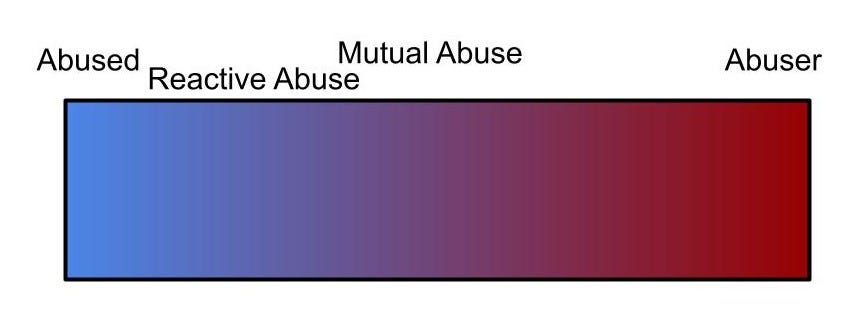
Scale/Continuum of Abused to Abuser.
They claim that most women who homicide fall towards the abused side of the scale, doing so in self defense, or reactively, with only a few on the abusive end.
They reference a fair few studies to imply this (more on this later). They quote one study as finding that only 9% of women convicted of domestic violence were the primary aggressor in the relationship. About them they say that:
These women used coercive control and severe violence with their partners more often than other women. As is the case for women, male victims of such violence are severely impacted.
My thoughts about where women land on the scale
While I absolutely agree that there are female domestic homicide perpetrators that fall everywhere on that scale, after looking at the examples they give, I feel that they have pushed each perpetrator as far towards the abused end of the continuum as they can, shifting the numbers towards self defense and away from abusive.
For example, when looking at the case study they use as a demonstration of ‘a female primary aggressor’, (the 9% referenced above) I get the impression that the category would be better described as, ‘extremely abusive, with lots of evidence and no possibly way to blame the victim for it’.
(or perhaps they chose an extreme case, even within that category, for demonstration purposes, but it does make me wonder what the least extreme example in this category would look like.)
Case study for Female Primary Abuser
The example/case study that they use to demonstrate a female primary abuser who kills their partner, is a woman who:
- had been convicted for domestic violence against a previous partner
- hit him with an ashtray and a coffee table
- broke his collarbone
- demanded that communication with his ex go through her
- Turned up at his work and had a go at his coworkers
- her daughter called the police to report her violence
- called him a ‘has been’ in front of strangers
- Was aggressive enough towards him in a shop that strangers intervened to calm her down (on cct)
- called him at work screeching, ‘What sort of f** man are you?’
- was on police body-cam screaming and shouting at him
- was on police body-cam saying “when I wake up tomorrow I don’t know what mood I’m going to be in.”
- was on body-cam saying “I’m gonna fucking kill ya…” (hours before she did) (she did clarify “not literally”, but then she did literally kill him)
- claimed in court that he walked into her knife and she didn’t notice
with a male victim who:
- had friends and colleges who were concerned about his decline since his involvement with her
- had colleges who had noticed black eyes, scratches, bite marks, and a gash across his nose and warned him to leave
- had a black eye at their wedding
- originally played down and lied about his injuries, before opening up and telling more people about his situation
- had told at least 11 people about her abuse
- had gone to work with ‘part of his ear not attached and teeth marks’
- was recorded saying “I’ve told you, you do punch rather hard don’t you?”
- was also recorded saying “We are going to have to refine the excuse for my eye, you know the garage door that we made up, that doesn’t wash.”
- told a paramedic about the abuse
- had injuries treated by 2 GP’s and one hospital emergency room
- had missed his fathers-day custody time because he was badly injured and didn’t want his daughter to see him like that.
- Was seen by his ex (that fathers day) shaking and with scratches down his face, two black eyes, bruising around his neck, and was trembling.
- told his ex he was living in hell, and when told to leave replied “trust me, I can’t.”
- had been found the night before by her daughter, bleeding from his leg and chest and head
- would not say what had happened and despite being “visibly injured”
- was seen at a pub, (with her) bleeding from injuries to his head and chest
- had 60 external injuries on his body indicating “regular assaults”
- had stab wounds to his chest and legs, bruises, abrasions, scalp wounds, extensive blunt blows to his head, and several old and recent rib fractures
- was a respected member of the community, a successful solicitor and loving father
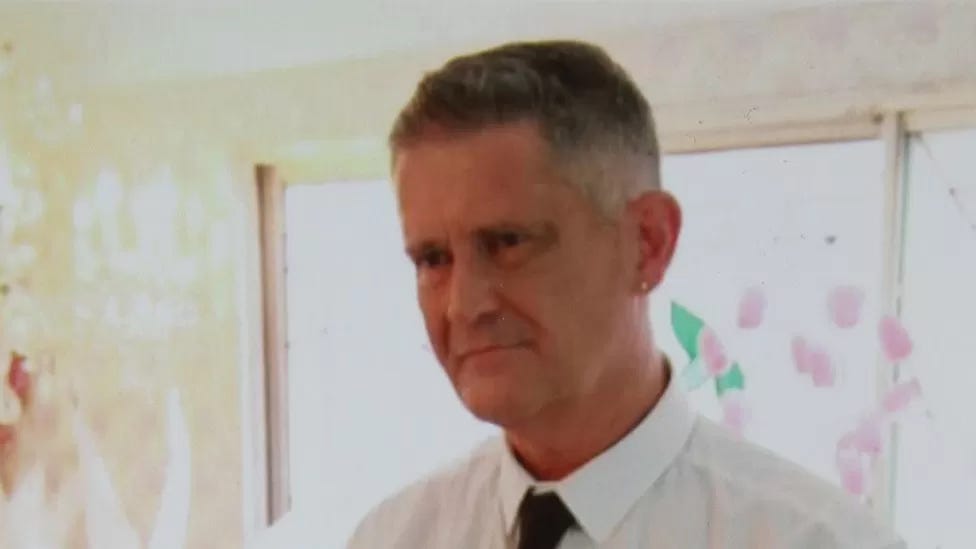
photo from: LANCASHIRE POLICE
Case Study for Mutual Abuse
We can compare this to the example they gave for mutual abuse.
Where both parties:
- were drunk
- were arguing
- had previously been charged with a domestic violence related crime
And where the woman:
- had repeatedly stabbed him in the back of the head 18 months earlier
- had been convicted previously of wounding him with a glass candlestick holder
- Had assaulted him eight months beforehand (not reported to police)
- was on a 2 year good behavior bond (for wounding him)
- punched him in the face (to break up a fight between him and another man)
- stabbed him in the neck
- said “he needs to be taught a lesson” (after stabbing him)
- was depressed
- was smaller than him
And where the man:
- had been charged with assaulting a former partner in another country
- had charges for assaulting police officers in another country
- was sleeping on the lounge, and woken up, by her drunk friends and a guy who they met at the pub
- violently attacked the man, punching him repeatedly and smashing his face into the floor.
- retaliated to her (after she punched him in the face)
- had a protection order (AVO) to protect him from her
And there were factors that were not agreed upon:
- She gave testimony about him being, violent, verbally abusive, very jealous and very controlling, threatening her at her workplace, and breaking their things.
- A housemate gave testimony that 18 months prior, she had seen her stabbing him in the back of the head three or four times, while he was sitting on the lounge with his head in his hands,
- She claimed that that stabbing (the non deadly one to the back of his head) happened accidently while trying to exit a room where he was blocking her, while he had a knife.
The judge said, “[he used] controlling conduct, verbal abuse and demeaning language towards [her], who responded with the use of violence, including the use of weapons, usually at times when both were intoxicated".
The judge also said the relationship was more ‘mutual violence’ than ‘violent resistance.’
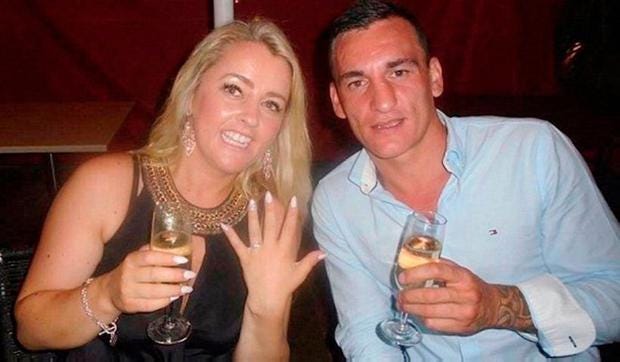
The authors use this example to point out how difficult it is for police, or anyone to determine who the primary abuser is, or to differentiate between mutual abuse and reactive abuse.
They also say:
if it were not Mr. Walsh who was killed, then it could easily have been Ms. Cahill who was killed by her partner.
Possibly, but I’m skeptical. He had been violent to other men, but his abuse towards her, was drawn from what she claimed at her trial, and it didn’t reach the level of severity or injury that her abuse towards him repeatedly did, in front of witnesses.
But on the note of them both committing some abuse, and both having a criminal charge for it too, (although his was towards a previous partner) and with much abuse happening behind-closed-doors (as abuse often does). This case does demonstrate how difficult it can be for police, or even courts to work through the details of abusive relationships and determine who the primary abuser is, or if it is mutually abusive.
Getting it Wrong
Getting it wrong can cause a lot of problems further down the line, such as the victim not reaching out for help from the police in future incidents for fear that they may be misinterpreted as the perpetrator. Or police, or courts using old (wrong) arrests as evidence that they are the primary perpetrator, or making it harder to understand risk factors that are present and what intervention is needed. (many of which are noted in a study they reference, about female primary victims being arrested, it highlights many problems that clearly apply when victims of any gender get arrested.)
In terms of intervention needs, the authors point out that intervention programs designed for women arrested for domestic violence perpetration are more likely to explore the contexts and complexities of the abuse, and because these programs are designed to be used with a group of women who fall everywhere along the continuum from abused to abuser the intervention is:
famed ecologically, concentrates on contextualizing women’s experiences, and is tailored to meet the needs of women in the group
This is contrasted with interventions for male perpetrators of domestic violence which are geared towards men who are the primary perpetrators.
These programs often have insufficient funding for individual assessment and, within group processes, deliberately limit exploration of individual needs and context in favor of psychoeducation and group-based work.
Many programs have a strong focus on the agency and choices of male offenders and on the need for men to admit the use of the control and power in the relationships and focus on changing their own attitudes and behavior.
This seems like it would be incredibly problematic for any men who find themselves in these programs who are not themselves on the abuser end of the scale.
I would think that men in these programs who are in mutually abusive relationships, may benefit, somewhat, by stopping their own abuse. But then what?
And for men who have been ‘reactively violent’ or men who have acted in self defense, who find themselves in these programs while being in a relationship with a female primary abuser?
Those men are being told that they need to admit their use of control and power and focus on changing their own attitudes and beliefs.
So many victims, of both genders, already blame themselves, taking on a sense of responsibility for the actions of their abusers, so many are already gaslit, minimizing the abuse they suffer, maximizing their own role in it, or justifying that their abuser was right for whatever BS reason.
To be in that place mentally as a victim, and to be put into one of these programs… at best it would be tiresome, (and probably infuriating) if you realize that it’s not targeted at you, but if it’s not that, it could easily be some very effective gaslighting. Which would make the situation even worse.
Photo by Yan Krukau: https://www.pexels.com/photo/people-pointing-fingers-at-a-stressed-man-7640495/
Case study for Male Primary Abuser
And finally we compare those examples to the example of an abused woman, killing her partner in self-defenses.
Where the woman:
- didn’t go to as many family gatherings
- started checking with him when making decisions
- had texted him “You hit me not once, not twice, but three times with my baby in my arms,”
- had called 911 (for a prior incident)
- had a court order barring his threats, harassment and assaults during visits
- had split up with him
- confided in her cousin that she was very scared of him and what he might do
- had been found by the car, barely conscious with a broken leg
And the man:
- threw her clothes out the window
- smashed her phone while trying to stop her calling 911
- was convicted of a breach of peace (for the clothes throwing/phone smashing incident)
- moved out
- sent her text messages the morning of his death including “doa on sight,”
- and a text “I said what I said so u could take it however u want u but after today u will have to call the cops cuz it over today.”
- and a text “N u will see how crazy shit will get today.”
- went to her house
- hit her with his belt
- died pinned between the car and garage wall
Again there were factors that were not agreed upon:
- She claimed he had previously slashed her tires,
- choked her,
- stolen her cell phone
- and that she had lost her job due to his actions.
- She claimed that just before his death he had tried to choke her with his belt in her house and in her car.
- Police claim the physical evidence is inconsistent with that.
- Prosecutors claim she accelerated for 100 feet before crashing and crushing him, breaking her leg holding the gas pedal to the floor,
- She claimed that she can’t remember that part well.

Certainly if someone has been strangling you, killing them is self defense. (as a jury eventually ruled.) And hitting someone with a belt is obviously abuse.
So this is an accurate example of an abused woman killing her abuser in self defense.
I guess I was just expecting, their example of a primary abuser (male), to be similar to their example of a primary abuser (female), only with the victim killing their abuser rather than being killed by them. It is the same place on the scale, with a flipped viewpoint after all.
Which means this is probably a good place to point out the trap that my thoughts were falling into for anyone else falling into it.
The scale isn’t about severity, (that would be a different scale) just directionality.
But severity can help make the directionality clear and obvious.
This case was clear enough for 23 out of 24 jury members, but not enough for 1 jury member and the prosecution.
The severity and clarity of the primary female agressor case study was so much more intense. The difference could have been used to demonstrate that the scale is about direction of abuse, not severity, but it wasn’t, which makes me wonder why they picked the cases that they did. (I’m sure they could have found an example of a female victim who’s story was a reflection of the male victims but ended with the victim having to defend herself with deadly force to avoid getting killed).
Authors Knowledge, News Reporting and Adjacent Justice Issues
But I get the impression that they chose this particular case, not because it was a good example of what they wanted to demonstrate but because they were already familiar with it. — It was widely publicized, with 38 domestic violence organizations calling for her charges to be dropped. — Rather than because it’s an excellent case study example.
Much of that support was because she spent 3 years in prison (while her young child was growing) going through two trials and awaiting a verdict.
People spending time in prison awaiting a trial and verdict is an issue across the entire justice system. The injustice is especially evident when the person is eventually found innocent or when they have a young child and are missing out on their child’s formative years (and that child misses them through their formative years too) or when they are victims of a crime themselves.
This case involved all three, and therefore was a good example of that particular injustice. But the complications that exacerbated those issues are the same ones that make this a less than ideal example of primary male abuser/self-defense homicide. Such as a set of facts that did not make abundantly clear (although it was still fairly clear) that she was the victim of domestic violence, causing the prosecution and one jury member to believe that she did not act in self defense. (leading to a charge of murder and a second trial.)
They also seem to reference news articles as sources about the incidents they use as examples. In the book’s first chapter they say that:
Data for these cases was gathered from public sources including inquests and in-depth reviews, and when necessary, media reports.
But they do not specify which sources they used for these particular case studies. (Unless you count linking to news articles.) Hopefully it was somewhere better than the news articles. Because news articles can be very biased.
(And to be clear, sadly I have also had to rely on the information they gave and news articles and a documentary (also bias but included some body cam footage) and a panel discussion, as I don’t have access to police reports or death review data or complete body cam footage.)
This case is an excellent example of the way that news reporting can skew, giving a blatantly bias point of view. Early news articles about this incident portrayed it very differently to later news articles.
One of the early articles called her ‘crazy’ and mentioned how horrible of a death it was, and everything that made her look suspicious, even including that “thankfully his child wasn’t in the car at the time.” (wow, that conjures up a horrific visual, using a detail that never happened.) It went on to mentioning that police had been to their house prior because of domestic violence, in one line at the end, that in the context of the rest of the article left the impression that they had been called for her violence. It very much gives the impression of an unprovoked crazy woman violently committing murder.
Many of the later articles were also bias, but in the other direction, mentioning things that were claimed by her, but heavily disputed, as though they were fact, mentioning the garage wall in a way that would leave most people thinking that it was 3 feet from the car not 100. Some mentioned the police had intervened and he had pled guilty to charges against him 10 days earlier, leaving the reader with the impression that they were charges for physical violence against her. (Rather than for ‘disturbing the peace’.)
These news articles were linked to from the study, but the study didn’t say weather they got their information about the case only from those news articles, or if they were just linked for reference.

Photo by brotiN biswaS: https://www.pexels.com/photo/selective-focus-photography-of-magazines-518543/
Violent Resistance
They also write a little about Violent Resistance claiming that:
acts of preemptive violence may be self-defensive
They also point out that while violent resistance includes self defense it also extends further:
also encompasses forms of physical resistance that are not preemptively or immediately self-defensive but rather, are strategies that women may use to regain sense of control, autonomy, and safety
And give a quick example:
An example may be the case of a women who, after experiencing many years of severe victimization, kills her partner while he is asleep or passed out.
Issues specific to male victims of domestic violence
Alexandra Lysova and Jackie Salas Identify quite a few issues that men face when they are the victims of domestic violence, such as treatment programs assuming that the men who are in them are primary perpetrators, difficulty recognizing that what is happening to them is domestic violence, difficulty asking for help, difficulty finding help when they do ask and others not recognizing them as victims.
They explain it much better than I do, so here are some of their words on:
- Men not being recognized as victims, by friends family and professionals.
it is more difficult for friends, family, and professionals within the community to be open to possibility of male victimization. Male victims may be more reluctant to disclose violence and seek help.
- They sometimes don’t even recognize that it’s abuse themselves. And/or when they do recognize it, they can be stopped from reporting it because of stigmatization.
Experiences of domestic violence for male victims are exacerbated by the embarrassment, shame, and stigmatization that men feel about being abused by a woman. This often prevents male victims from acknowledging their victimization to their friends, family, police, and to themselves, and, as a result, holds them back from reporting the experiences of victimization to the authorities.
- Cops are less likely to press charges when/if they do report it.
charges are more likely to be laid in cases where the victim was female
- Weapons and bodily harm are likely to have been used (at least by the time (or in the cases) that it gets reported to the police).
in cases of domestic violence reported to police involving male victims, a higher proportion involve severe assaults including assaults with weapon, threats to use a weapon, or causing bodily harm
- Even when they do reach out for help, that help is hard to find.
for the men who are victims of controlling and abusive women and who do reach out for help, this help may be difficult to find. Most resources for preventing domestic violence homicide focus on women victims and many have gender-specific service policies
- Even when they do find services that help men, spaces for them are often limited.
still availability of these services is very limited. In Canada, for example, only between 6% and 8% of domestic violence shelters serve male victims
- The places where they end up, often don’t offer help for domestic violence related issues like domestic violence shelters do.
Other housing supports, such as the YMCA, that primarily serve emergency shelter needs of men would do well to integrate supports and services for domestic violence risk management,
- There are a lack of assessments for men who may be in mutually abusive relationships, or be victims in abusive relationships.
All too often, within domestic violence services, there is a lack of opportunity, time, and resources to identify, clarify, and differentiate mutual and bidirectional violence from broader patterns of abuse in the relationship that tilt more clearly to a predominant perpetrator and victim
- These assessments often happen late for women, (in perpetrators programs) and not at all for men.
Intervention programs that best recognize the complexities of mutuality, violent resistance, self-defense, and associated safety and risk management needs are those designed for women arrested for domestic violence perpetration
- When men find themselves in the equivalent male programs there is no chance to explore context or uncover women's use of violence, instead they focus on admitting their use of violence and on their own attitudes and behavior.
Many programs have a strong focus on the agency and choices of male offenders and on the need for men to admit the use of the control and power in the relationships and focus on changing their own attitudes and behavior. Although this focus might be appropriate for a majority of offenders for whom countering of minimization and blame is a central component of intervention, it does limit exploration of the relational and couple context and often precludes discussion of patterns of mutuality and of women’s use of violence.
- They recognize that assesments identifying primary perpetrators would be useful for everyone, in family court, as well as intervention services.
Such assessments would have multiple benefits, one of which is to better identify cases of mutual abuse, but also for more effectively delineating the risk management and intervention needs of both members of a couple.
- They mention how appealing plea bargains can be, and touch on some of the issues that come with that.
Although efficient, this route means that the court does not hear or consider arguments about the case.
That’s a lot of society and support based issues that male victims of domestic violence face, on top of facing the domestic violence itself. So what do they conclude we do about all these issues? And what do they suggest is the best way to minimize Domestic Homicide Involving Female Perpetrators And Male Victims?
Their Conclusion/Recommendation
They recommend that because most domestic homicide involving female perpetrators and male victims happens in relationships with a primary male abuser, that to reduce it we need to (keep) funding programs that prioritize female victims.
or, in their words:
Despite substantial improvements in the treatment of female victims of domestic violence since the earlier 1970s, it is alarming that there are still many women who cannot get help with stopping their male abuser and have to take justice in their own hands by murdering a perpetrator as the last resort. This strongly indicates that intervention programs should continue to prioritize female victims of domestic violence.
They recognize a few of the issues they pointed out above, (difficulty identifying a primary abuser and people not recognizing male victims and men not getting help.) but don’t suggest doing anything about them.
In relation to the assessments needed (to asses mutuality/primary abusers.) they say that the assessments are:
currently very difficult to come by
But do not propose any plans to change that. Or indicate that we should.
In relation to people not recognizing male victims and the men not getting help they say that it:
is consistent with general patterns of male help seeking
They do recommend, help that includes, but doesn’t target male victims, (universal prevention programs and more research improved policy responses):
Universal prevention programs in the media and educational settings directed at boys and girls, men and women should challenge the minimization of domestic violence and educate people about the harms of any violence in relationships.
and
Continuing research and efforts to improve policy responses to domestic violence of both men and women will challenge the societal culture of violence, prevent future deaths, and reduce a degree of secondary victimization of family members and friends involved in these tragedies.
My thoughts about their conclusion
It’s frustrating.
They are partially right, the funding of women's shelters and other supports for women (starting in the 70’s) seems to have reduced domestic homicide rates, for both men and women. And continuing to fund them and expand them is an important part of tackling the problem, both for men and women.
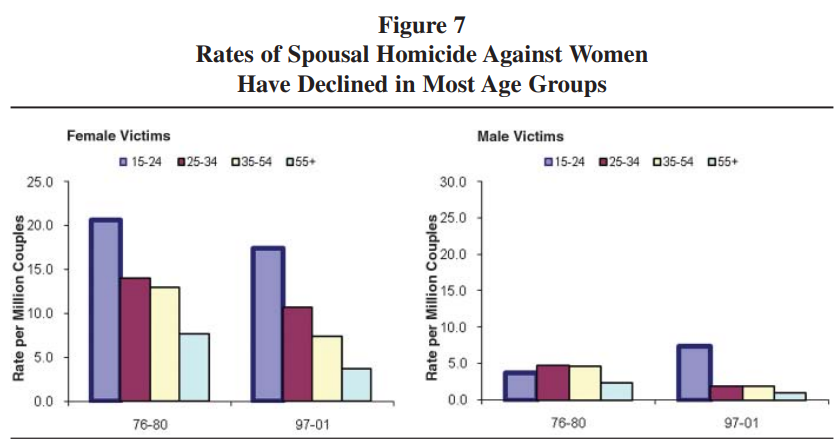
fig 7 from study National Trends in Intimate Partner Homicides: Explaining Declines in Canada, 1976 to 2001 which was linked to in ‘Domestic Homicide Involving Female Perpetrators And Male Victims’
(And perhaps we could reduce male perpetrated domestic homicides in the same way. By providing more shelters for men. (It’s worth trying at least.))
But after they had so many great words about the issues male domestic violence victims face, and things that we could do about them. I expected them to include some of them in their conclusion.
And then there’s the fact that we are already funding these programs!
It’s good that we do, and we should keep doing it, I was just expecting recommendations for things that we could do to make it ‘Better’ not more ‘the same’.
I was hoping to see some of the recommendations they made in the previous section, as part of their conclusion like:
- Making sure people, (friends, family, professionals, perpetrators and the victims themselves) recognize domestic violence when a woman is the perpetrator.
- Lowering stigmatization.
- Ensuring that charges are pressed against female abusers when appropriate.
- Creating refuges for men.
- Ensuring that police and hospital staff connect male victims with support services.
- Having effective support services for male victims, so that the police, and medical staff have somewhere reliable and useful to refer men to.
- Increasing domestic violence help at non-domestic-violence shelters.
- Creating more opportunities to assess who is the primary abuser. (particularly in custody cases.)
Their References to Justify Skimming or Ignoring These Points
They justify skimming over all these points of recommendation in all the TLDR sections, their summary, conclusion, introduction and chapter 1’s summary which says:
In some instances, women kill their male intimate partners. When these homicides occur, it is more likely to have happened in the context of a woman’s prior history of victimization with severe domestic violence. There are some exceptions to this pattern.
Heavily implying that the vast majority of men killed by their partners are abusers.
There are a few quotes throughout the chapter, that they backed up with research, to support this conclusion. But upon diving deeper into the research. Their words were technicaly true, but the impression they gave was not.
Women who killed thier partners were more likely to have been abused than men who killed thier partners, but they were as likely to have been abusive as they were to have been abused.
For example one study of intimate partner homicides found 55.6% of male victims had been abusive (13.6% for female victims) and 55.6% had been abused (47.2% for female victims).
Another study found 36.6% of female killers had acted in self defence (1.1% for male killers).
And the 9% study I mentioned earlier:
[a] study of women convicted of domestic violence identified a small group of women (9%) who were primary aggressors in the relationship
Is a really interesting study. But the 9% was based on self reports from women about their and their partners use of violence/control. To be clasified as a primary agressor they had to report that either, they were violent/controlling and their partner never was, or they reported that they comitted 1/4 of a standart deviation more violence/control than their partner did.
There were a lot more quotes and research with a similar spin to them, if you are interested in a more detailed write up of this section you can read: My Reference article: Quotes and Research Backing Up The Skimming Over Of Abused Men
Overall
Domestic Homicide Involving Female Perpetrators And Male Victims was worth the read, it has a lot of interesting concepts and communicates them clearly, giving an overview and examples.
While it falls into problems of defaulting to a women-as-victims-view wherever possible, and concludes that the best way to help men is to help women escape from that man's violence, it also recognises some of the issues that are specific to men facing domestic violence.
The book.
Chapter 12 as part of the book as a whole
This is only chapter 12, of a whole book, (I found this chapter from a reference from another study). The book has 31 contributors so I’m not sure if it should be seen as a whole or viewed as more of a patchwork quilt.
The first chapter emphasizes how much of a gendered problem domestic homicide is and gives a few different stat’s, (it is hard to measure as I touched upon in to in the Statistics portion of this article). They then point out that domestic homicide is often preventable, before giving a short summary of each chapter.
The chapters cover: older women, rural communities, LGBTQ2s+, teens and young adults, Immigrant communities, perpetrator mental health, Child homicides, police and military, DV in the workplace, Indigenous communities and Men.
They identify challenges specific to each group and identify ways to help. (eg, rural, distance to help, access to firearms, tight communities, help with flexible and innovative programs.)
I will be writing up some things about the book as a whole, and other chapters, but this article is too long already, so, I’ll leave that for another day, and leave you with the links to the research and some recourses for help if you’re unlucky enough to need them.

If you would like to share this article without a paywall, please use this link:
Sources:
The Book: https://www.sciencedirect.com/book/9780128194638/preventing-domestic-homicides
Domestic Homicide Involving Female Perpetrators And Male Victims (chapter 12) : https://sci-hub.ru/https://www.sciencedirect.com/science/article/pii/B9780128194638000125
Related or referenced Links:
Victims blame themselves: https://medium.com/r/?url=https%3A%2F%2Fsolaramentalhealth.com%2Funderstanding-self-blame%2F
9% study: https://sci-hub.ru/https://link.springer.com/article/10.1007/s10896-006-9032-4
Documentary of male primary victims case: https://youtu.be/6p6U2oDXQcY
Speaking panel with female primary victim: https://youtu.be/1-dqZbHN8BY?t=667
My Refrence Article For a closer look at refrences used in their chapter: https://medium.com/@nanajuana/reference-article-quotes-and-research-used-to-back-up-the-skimming-over-of-abused-men-eceeeb2ac2bd?sk=2c45a7fcc10620f84461df21ba3a4751
Links To Help: For Men Facing Domestic Violence:
Australia
Resources and support for men who’ve experienced domestic violence — Relationships Australia NSW — 1300 364 277
MensLine — Family Violence — Staying Safe -1300 78 99 78
UK
The Adam Project — 07912 495 159
ManKind Initiative — 01823 334244
Respect — Mens Advice Line — 0808 8010327
USA
메타데이터
- post_id
- a3ef4a2f2d9d
- slug
- laymans-review-of-domestic-homicide-involving-female-perpetrators-and-male-victims-a3ef4a2f2d9d
- url
- https://medium.com/@nanajuana/laymans-review-of-domestic-homicide-involving-female-perpetrators-and-male-victims-a3ef4a2f2d9d
- canonical_url
- https://medium.com/@nanajuana/laymans-review-of-domestic-homicide-involving-female-perpetrators-and-male-victims-a3ef4a2f2d9d
- author_url
- https://medium.com/@nanajuana
- status
- ok
- fetched_at
- 2026-07-25 09:10:25